Recognition: unknown
End-to-end Automated Deep Neural Network Optimization for PPG-based Blood Pressure Estimation on Wearables
Pith reviewed 2026-05-10 16:05 UTC · model grok-4.3
The pith
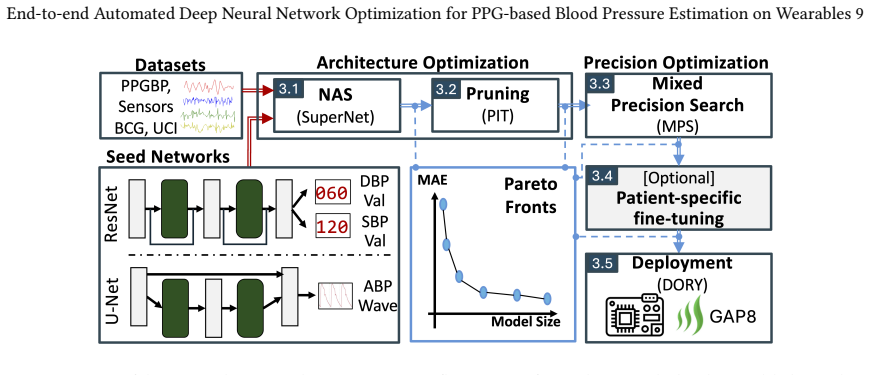
An automated pipeline combining hardware-aware neural architecture search, pruning, and mixed-precision search creates compact DNNs for PPG-based blood pressure estimation that fit on ultra-low-power wearables while matching or exceeding un
A machine-rendered reading of the paper's core claim, the machinery that carries it, and where it could break.
Core claim
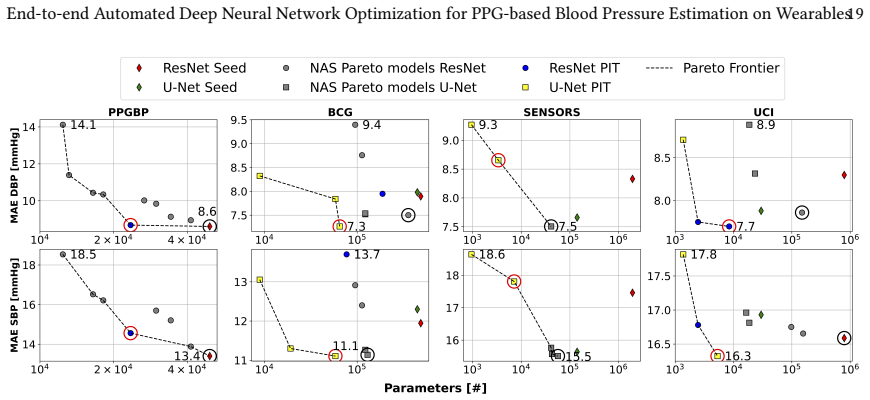
Starting from existing high-accuracy DNNs for PPG-to-BP waveform reconstruction or direct regression, the automated pipeline of hardware-aware neural architecture search, pruning, and mixed-precision search produces optimized networks that achieve up to 7.99 percent lower error with 7.5 times fewer parameters, or up to 83 times fewer parameters with negligible accuracy loss. Every resulting model fits inside 512 kB of memory on the GreenWaves GAP8 SoC while using less than 55 kB, runs at an average 142 ms latency, and consumes 7.25 mJ per inference. Patient-specific fine-tuning on top of these models further raises accuracy by as much as 64 percent.
What carries the argument
The end-to-end automated optimization pipeline of hardware-aware neural architecture search combined with pruning and mixed-precision search
If this is right
- Fully on-device BP estimation becomes feasible while preserving user data privacy and eliminating cloud round-trips.
- Battery life on wearables extends because each inference uses only 7.25 mJ on average.
- Real-time monitoring is practical given the 142 ms average latency on the target low-power multicore chip.
- Patient-specific fine-tuning can deliver up to 64 percent additional accuracy improvement without changing the base model architecture.
Where Pith is reading between the lines
- The same automated pipeline could be reused for other sensor-based health tasks such as arrhythmia detection or oxygen saturation estimation on the same hardware.
- Widespread adoption would lower the barrier to continuous ambulatory BP tracking in everyday devices rather than clinical settings.
- If the optimization process proves robust, it reduces reliance on hand-crafted model compression for medical edge AI applications.
Load-bearing premise
The assumption that the automatically optimized models will continue to generalize across unseen patients and everyday conditions without hidden accuracy drops or biases introduced by the search and compression steps.
What would settle it
Running the optimized models on a new, diverse patient dataset recorded under real-world motion and lighting variations and observing error rates that exceed those of the original unoptimized baselines by a large margin.
Figures





read the original abstract
Photoplethysmography (PPG)-based blood pressure (BP) estimation is a challenging task, particularly on resource-constrained wearable devices. However, fully on-board processing is desirable to ensure user data confidentiality. Recent deep neural networks (DNNs) have achieved high BP estimation accuracy by reconstructing BP waveforms or directly regressing BP values, but their large memory, computation, and energy requirements hinder deployment on wearables. This work introduces a fully automated DNN design pipeline that combines hardware-aware neural architecture search (NAS), pruning, and mixed-precision search (MPS) to generate accurate yet compact BP prediction models optimized for ultra-low-power multicore systems-on-chip (SoCs). Starting from state-of-the-art baseline models on four public datasets, our optimized networks achieve up to 7.99% lower error with a 7.5x parameter reduction, or up to 83x fewer parameters with negligible accuracy loss. All models fit within 512 kB of memory on our target SoC (GreenWaves' GAP8), requiring less than 55 kB and achieving an average inference latency of 142 ms and energy consumption of 7.25 mJ. Patient-specific fine-tuning further improves accuracy by up to 64%, enabling fully autonomous, low-cost BP monitoring on wearables.
Editorial analysis
A structured set of objections, weighed in public.
Referee Report
Summary. The manuscript presents an end-to-end automated optimization pipeline that integrates hardware-aware neural architecture search (NAS), pruning, and mixed-precision search (MPS) to design compact deep neural networks for photoplethysmography (PPG)-based blood pressure estimation on resource-constrained wearables, specifically targeting the GreenWaves GAP8 SoC. Starting from state-of-the-art baseline models on four public datasets, the optimized networks are claimed to deliver up to 7.99% lower error with a 7.5x parameter reduction or up to 83x fewer parameters with negligible accuracy loss, while requiring less than 55 kB memory, achieving 142 ms average inference latency and 7.25 mJ energy consumption. Patient-specific fine-tuning is reported to yield up to 64% further accuracy improvement, enabling fully on-device, privacy-preserving BP monitoring.
Significance. If the performance gains and efficiency metrics hold under rigorous, subject-independent evaluation protocols, the work would meaningfully advance practical deployment of accurate BP estimation on wearables by automating hardware-aware model design. The combination of multiple optimization stages into a single pipeline addresses a real barrier for ultra-low-power SoCs and could support continuous, low-energy monitoring. The empirical focus means significance depends directly on the strength of the experimental evidence for generalization.
major comments (1)
- [Abstract] Abstract: The central performance claims (up to 7.99% lower error, 7.5x–83x parameter reductions, and 64% improvement from patient-specific fine-tuning) are presented without any information on baseline selection criteria, the exact public datasets used, train/validation/test splits, statistical testing, or whether the NAS/pruning/MPS and fine-tuning phases employ strictly subject-independent partitioning. Because PPG signals are strongly subject-dependent, this omission is load-bearing for the claim that the reported gains reflect robust, generalizable improvements rather than dataset-specific artifacts or leakage.
minor comments (1)
- The abstract refers to 'four public datasets' without naming them; explicitly listing the dataset names (e.g., in the abstract or §1) would aid immediate reader assessment of the experimental scope.
Simulated Author's Rebuttal
We thank the referee for the constructive feedback on our manuscript. We address the major comment below and will revise the abstract to incorporate the requested details, thereby strengthening the presentation of our results.
read point-by-point responses
-
Referee: [Abstract] Abstract: The central performance claims (up to 7.99% lower error, 7.5x–83x parameter reductions, and 64% improvement from patient-specific fine-tuning) are presented without any information on baseline selection criteria, the exact public datasets used, train/validation/test splits, statistical testing, or whether the NAS/pruning/MPS and fine-tuning phases employ strictly subject-independent partitioning. Because PPG signals are strongly subject-dependent, this omission is load-bearing for the claim that the reported gains reflect robust, generalizable improvements rather than dataset-specific artifacts or leakage.
Authors: We agree that the abstract should provide more explicit information to support the performance claims and to address potential concerns regarding subject-dependence. The full manuscript specifies four public datasets, with all experiments (including NAS, pruning, MPS, and patient-specific fine-tuning) using strictly subject-independent train/validation/test splits to prevent leakage. Baseline models were chosen as representative state-of-the-art approaches from the recent literature on PPG-based BP estimation. While formal statistical hypothesis testing was not performed, results are reported consistently across datasets and evaluation metrics. In the revised version, we will expand the abstract to name the datasets, confirm the subject-independent partitioning protocol, describe baseline selection, and note the consistent cross-dataset performance. This revision directly addresses the generalizability concern without altering the underlying experimental design. revision: yes
Circularity Check
No circularity: purely empirical optimization results on public datasets
full rationale
The paper presents an automated pipeline combining hardware-aware NAS, pruning, and mixed-precision search applied to baseline DNNs for PPG-based BP estimation. All reported gains (error reductions, parameter savings, latency, energy) are measured empirical outcomes on four public datasets after the optimization process completes. No equations, derivations, or self-referential definitions appear in the abstract or described content that would reduce the claimed improvements to quantities defined by the search objectives themselves. The central claims rest on experimental measurements rather than any load-bearing mathematical reduction or self-citation chain.
Axiom & Free-Parameter Ledger
Reference graph
Works this paper leans on
-
[1]
IEEE Standard for Wearable Cuffless Blood Pressure Measuring Devices.IEEE Std 1708-2014(2014), 1–38
2014. IEEE Standard for Wearable Cuffless Blood Pressure Measuring Devices.IEEE Std 1708-2014(2014), 1–38. doi:10.1109/IEEESTD.2014.6882122
-
[2]
Nicolas Aguirre, Edith Grall-Maës, Leandro J. Cymberknop, and Ricardo L. Armentano. 2021. Blood Pressure Morphology Assessment from Photoplethysmogram and Demographic Information Using Deep Learning with Attention Mechanism.Sensors21, 6 (2021). doi:10.3390/s21062167
-
[3]
Jérémy Alexandre, Kevin Tan, Tiago P. Almeida, Josep Sola, Bruce S. Alpert, and Jay Shah. 2023. Validation of the Aktiia blood pressure cuff for clinical use according to the ANSI/AAMI/ISO 81060-2:2013 protocol.Blood Pressure Monitoring28 (4 2023), 109. Issue 2. doi:10.1097/MBP.0000000000000639
-
[4]
Noor Faris Ali and Mohamed Atef. 2023. An efficient hybrid LSTM-ANN joint classification-regression model for PPG based blood pressure monitoring.Biomedical Signal Processing and Control84 (7 2023), 104782. doi:10.1016/J.BSPC.2023.104782
-
[5]
Almeida, Meritxell Cortés, David Perruchoud, Jérémy Alexandre, Pascale Vermare, Josep Sola, Jay Shah, Luisa Marques, and Cyril Pellaton
Tiago P. Almeida, Meritxell Cortés, David Perruchoud, Jérémy Alexandre, Pascale Vermare, Josep Sola, Jay Shah, Luisa Marques, and Cyril Pellaton
-
[6]
doi:10.1038/s41440- 023-01258-2
Aktiia Cuffless Blood Pressure Monitor Yields Equivalent Daytime Blood Pressure Measurements Compared to a 24-h Ambulatory Blood Pressure Monitor: Preliminary Results from a Prospective Single-Center Study.Hypertension Research46, 6 (June 2023), 1456–1461. doi:10.1038/s41440- 023-01258-2
-
[7]
Amir Arjomand, Amin Boudesh, Farnoush Bayatmakou, Kenneth B. Kent, and Arash Mohammadi. 2025. TransfoRhythm: A Transformer Architecture Conductive to Blood Pressure Estimation via Solo PPG Signal Capturing. arXiv:2404.15352 [eess.SP] https://arxiv.org/abs/2404.15352
-
[8]
Win-Ken Beh, Yu-Chia Yang, Yi-Cheng Lo, Yun-Chieh Lee, and An-Yeu(Andy) Wu. 2023. Machine-aided PPG Signal Quality Assessment (SQA) for Multi-mode Physiological Signal Monitoring.ACM Trans. Comput. Healthcare4, 2, Article 14 (April 2023), 20 pages. doi:10.1145/3587256
-
[9]
Luca Benfenati, Sofia Belloni, Alessio Burrello, Panagiotis Kasnesis, Xiaying Wang, Luca Benini, Massimo Poncino, Enrico Macii, and Daniele Jahier Pagliari. 2024. EnhancePPG: Improving PPG-based Heart Rate Estimation with Self-Supervision and Augmentation. arXiv:2412.17860 [eess.SP] https://arxiv.org/abs/2412.17860
-
[10]
Dayi Bian, Pooja Mehta, and Nandakumar Selvaraj. 2020. Respiratory Rate Estimation using PPG: A Deep Learning Approach. In2020 42nd Annual International Conference of the IEEE Engineering in Medicine & Biology Society (EMBC). 5948–5952. doi:10.1109/EMBC44109.2020.9176231
-
[11]
Nazareno Bruschi, Angelo Garofalo, Francesco Conti, Giuseppe Tagliavini, and Davide Rossi. 2020. Enabling mixed-precision quantized neural networks in extreme-edge devices. InProceedings of the 17th ACM International Conference on Computing Frontiers(Catania, Sicily, Italy)(CF ’20). Association for Computing Machinery, New York, NY, USA, 217–220. doi:10.1...
-
[12]
Alessio Burrello, Francesco Carlucci, Giovanni Pollo, Xiaying Wang, Massimo Poncino, Enrico Macii, Luca Benini, and Daniele Jahier Pagliari. 2024. Optimization and Deployment of Deep Neural Networks for PPG-based Blood Pressure Estimation Targeting Low-power Wearables. In2024 IEEE Biomedical Circuits and Systems Conference (BioCAS). 1–5. doi:10.1109/BioCA...
- [13]
- [14]
-
[15]
Alessio Burrello, Daniele Jahier Pagliari, Pierangelo Maria Rapa, Matilde Semilia, Matteo Risso, Tommaso Polonelli, Massimo Poncino, Luca Benini, and Simone Benatti. 2022. Embedding Temporal Convolutional Networks for Energy-efficient PPG-based Heart Rate Monitoring.ACM Trans. Comput. Healthcare3, 2, Article 19 (mar 2022), 25 pages. doi:10.1145/3487910 Ma...
-
[16]
Alessio Burrello, Daniele Jahier Pagliari, Matteo Risso, Simone Benatti, Enrico Macii, Luca Benini, and Massimo Poncino. 2021. Q-PPG: Energy- Efficient PPG-Based Heart Rate Monitoring on Wearable Devices.IEEE Transactions on Biomedical Circuits and Systems15, 6 (2021), 1196–1209. doi:10.1109/TBCAS.2021.3122017
- [17]
-
[18]
Charles Carlson, Vanessa-Rose Turpin, Ahmad Suliman, Carl Ade, Steve Warren, and David E. Thompson. 2021. Bed-Based Ballistocardiography: Dataset and Ability to Track Cardiovascular Parameters.Sensors21, 1 (2021). doi:10.3390/s21010156
-
[19]
Juan Cheng, Yufei Xu, Rencheng Song, Yu Liu, Chang Li, and Xun Chen. 2021. Prediction of arterial blood pressure waveforms from photoplethys- mogram signals via fully convolutional neural networks.Computers in Biology and Medicine138 (11 2021), 104877. doi:10.1016/J.COMPBIOMED.202 1.104877
-
[20]
Ali Cherry, Aya Nasser, Wassim Salameh, Mohamad Abou Ali, and Mohamad Hajj-Hassan. 2025. Real-Time PPG-Based Biometric Identification: Advancing Security with 2D Gram Matrices and Deep Learning Models.Sensors25, 1 (Jan. 2025), 40. doi:10.3390/s25010040 Publisher: Multidisciplinary Digital Publishing Institute
- [21]
-
[22]
Thiago Bulhões Da Silva Costa, Felipe Meneguitti Dias, Diego Armando Cardona Cardenas, Marcelo Arruda Fiuza De Toledo, Daniel Mário De Lima, Jose Eduardo Krieger, and Marco Antonio Gutierrez. 2023. Blood Pressure Estimation From Photoplethysmography by Considering Intra- and Inter-Subject Variabilities: Guidelines for a Fair Assessment.IEEE Access11 (2023...
-
[23]
Chadi El Hajj and Panayiotis A. Kyriacou. 2020. Cuffless and Continuous Blood Pressure Estimation From PPG Signals Using Recurrent Neural Networks. In2020 42nd Annual International Conference of the IEEE Engineering in Medicine & Biology Society (EMBC). 4269–4272. doi:10.1109/EMBC 44109.2020.9175699
-
[24]
Mark Wong Kei Fong, E. Y.K. Ng, Kenneth Er Zi Jian, and Tan Jen Hong. 2019. SVR ensemble-based continuous blood pressure prediction using multi-channel photoplethysmogram.Computers in Biology and Medicine113 (10 2019), 103392. doi:10.1016/J.COMPBIOMED.2019.103392
-
[25]
Flávio D. Fuchs and Paul K. Whelton. 2020. High Blood Pressure and Cardiovascular Disease.Hypertension75, 2 (2020), 285–292. arXiv:https://www.ahajournals.org/doi/pdf/10.1161/HYPERTENSIONAHA.119.14240 doi:10.1161/HYPERTENSIONAHA.119.14240
- [26]
-
[27]
Carlijn Geerse, Cher van Slobbe, Edda van Triet, and Lianne Simonse. 2019. Design of a care pathway for preventive blood pressure monitoring: Qualitative study.JMIR Cardio3 (1 2019). Issue 1. doi:10.2196/13048
-
[28]
Sergio González, Wan Ting Hsieh, and Trista Pei Chun Chen. 2023. A benchmark for machine-learning based non-invasive blood pressure estimation using photoplethysmogram.Scientific Data 2023 10:110 (3 2023), 1–16. Issue 1. doi:10.1038/s41597-023-02020-6
-
[29]
Rui He, Zhi-Pei Huang, Lian-Ying Ji, Jian-Kang Wu, Huihui Li, and Zhi-Qiang Zhang. 2016. Beat-to-beat ambulatory blood pressure estimation based on random forest. In2016 IEEE 13th International Conference on Wearable and Implantable Body Sensor Networks (BSN). 194–198. doi:10.1109/ BSN.2016.7516258
-
[30]
Howard, Menglong Zhu, Bo Chen, Dmitry Kalenichenko, Weijun Wang, Tobias Weyand, Marco Andreetto, and Hartwig Adam
Andrew G. Howard, Menglong Zhu, Bo Chen, Dmitry Kalenichenko, Weijun Wang, Tobias Weyand, Marco Andreetto, and Hartwig Adam
-
[31]
MobileNets: Efficient Convolutional Neural Networks for Mobile Vision Applications
MobileNets: Efficient Convolutional Neural Networks for Mobile Vision Applications.CoRRabs/1704.04861 (2017). arXiv:1704.04861 http://arxiv.org/abs/1704.04861
work page internal anchor Pith review arXiv 2017
-
[32]
Bin Huang, Weihai Chen, Chun Liang Lin, Chia Feng Juang, and Jianhua Wang. 2022. MLP-BP: A novel framework for cuffless blood pressure measurement with PPG and ECG signals based on MLP-Mixer neural networks.Biomedical Signal Processing and Control73 (3 2022), 103404. doi:10.1016/J.BSPC.2021.103404
-
[33]
Access 27/03/2025
iMDsoft MetaVision ICU. Access 27/03/2025. iMDsoft MetaVision ICU, https://imd-soft.com/metavision/icu/
2025
-
[34]
Ram Jagannathan, Shivani A Patel, Mohammed K Ali, and K M Venkat Narayan. 2019. Global Updates on Cardiovascular Disease Mortality Trends and Attribution of Traditional Risk Factors.Current diabetes reports19, 7 (June 2019), 44. doi:10.1007/s11892-019-1161-2
-
[35]
D. Jahier Pagliari, M. Risso, B. A. Motetti, and A. Burrello. 2023. PLiNIO: A User-Friendly Library of Gradient-based Methods for Complexity-aware DNN Optimization. arXiv:2307.09488 [cs.LG]
-
[36]
Alistair E.W. Johnson, Tom J. Pollard, Lu Shen, Li Wei H. Lehman, Mengling Feng, Mohammad Ghassemi, Benjamin Moody, Peter Szolovits, Leo Anthony Celi, and Roger G. Mark. 2016. MIMIC-III, a freely accessible critical care database.Scientific Data3 (5 2016), 1–9. Issue 1. doi:10.1038/SDATA.2016.35;SUBJMETA=139,1750,308,409,692,700;KWRD=DIAGNOSIS,HEALTH+CARE...
-
[37]
Greeshma Joseph, Almaria Joseph, Geevarghese Titus, Rintu Mariya Thomas, and Dency Jose. 2014. Photoplethysmogram (PPG) signal analysis and wavelet de-noising. In2014 Annual International Conference on Emerging Research Areas: Magnetics, Machines and Drives (AICERA/iCMMD). 1–5. doi:10.1109/AICERA.2014.6908199
-
[38]
Tresa Joseph and Bindiya T.S. 2024. Real-time Blood Pressure Prediction on Wearables with Edge-Based DNNs: A Co-Design Approach.ACM Trans. Des. Autom. Electron. Syst.30, 1, Article 11 (Dec. 2024), 24 pages. doi:10.1145/3699512
-
[39]
Mohamad Kachuee, Mohammad Mahdi Kiani, Hoda Mohammadzade, and Mahdi Shabany. 2015. Cuff-less high-accuracy calibration-free blood pressure estimation using pulse transit time. In2015 IEEE International Symposium on Circuits and Systems (ISCAS). 1006–1009. doi:10.1109/ISCAS.20 Manuscript submitted to ACM 28 Carlucci, Pollo et al. 15.7168806
-
[40]
Mohammad Kachuee, Mohammad Mahdi Kiani, Hoda Mohammadzade, and Mahdi Shabany. 2017. Cuffless Blood Pressure Estimation Algorithms for Continuous Health-Care Monitoring.IEEE Transactions on Biomedical Engineering64, 4 (2017), 859–869. doi:10.1109/TBME.2016.2580904
-
[41]
Tai Le, Floranne Ellington, Tao-Yi Lee, Khuong Vo, Michelle Khine, Sandeep Kumar Krishnan, Nikil Dutt, and Hung Cao. 2020. Continuous Non-Invasive Blood Pressure Monitoring: A Methodological Review on Measurement Techniques.IEEE Access8 (2020), 212478–212498. doi:10.1109/ ACCESS.2020.3040257
-
[42]
Nayoung Lee, Sang-Hyun Kim, Misoon Lee, and Jiyoung Woo. 2024. Advancing Continuous Blood Pressure Estimation with Transformer on Photoplethysmography in Operation Room.IEEE Access12 (2024), 90486–90500. doi:10.1109/ACCESS.2024.3417940
-
[43]
Lin Li, Chao Chen, Lei Pan, Leo Yu Zhang, Zhifeng Wang, Jun Zhang, and Yang Xiang. 2023. A Survey of PPG’s Application in Authentication. Computers & Security135 (Dec. 2023), 103488. doi:10.1016/j.cose.2023.103488
-
[44]
Yung-Hui Li, Latifa Nabila Harfiya, Kartika Purwandari, and Yue-Der Lin. 2020. Real-Time Cuffless Continuous Blood Pressure Estimation Using Deep Learning Model.Sensors20, 19 (2020). doi:10.3390/s20195606
-
[45]
Yongbo Liang, Zhencheng Chen, Guiyong Liu, and Mohamed Elgendi. 2018. A new, short-recorded photoplethysmogram dataset for blood pressure monitoring in China.Scientific Data5 (2 2018). doi:10.1038/sdata.2018.20
-
[46]
Sungjun Lim, Taero Kim, Hyeonjeong Lee, Yewon Kim, Minhoi Park, Kwang Yong Kim, Minseong Kim, Kyu Hyung Kim, Jiyoung Jung, and Kyungwoo Song. 2025. Robust optimization for PPG-based blood pressure estimation.Biomedical Signal Processing and Control105 (7 2025), 107585. doi:10.1016/J.BSPC.2025.107585
-
[47]
Wenrui Lin, Berken Utku Demirel, Mohammad Abdullah Al Faruque, and G.P. Li. 2021. Energy-efficient Blood Pressure Monitoring based on Single-site Photoplethysmogram on Wearable Devices. In2021 43rd Annual International Conference of the IEEE Engineering in Medicine & Biology Society (EMBC). 504–507. doi:10.1109/EMBC46164.2021.9630488
-
[48]
Hanxiao Liu, Karen Simonyan, and Yiming Yang. 2018. DARTS: Differentiable Architecture Search.CoRRabs/1806.09055 (2018). arXiv:1806.09055 http://arxiv.org/abs/1806.09055
work page Pith review arXiv 2018
-
[49]
Russell V Luepker, Donna K Arnett, David R Jacobs, Susan J Duval, Aaron R Folsom, Christopher Armstrong, and Henry Blackburn. 2006-01. Trends in Blood Pressure, Hypertension Control, and Stroke Mortality: The Minnesota Heart Survey.The American journal of medicine.119, 1 (2006-01)
2006
-
[50]
Gloria Martínez, Newton Howard, Derek Abbott, Kenneth Lim, Rabab Ward, and Mohamed Elgendi. 2018. Can Photoplethysmography Replace Arterial Blood Pressure in the Assessment of Blood Pressure?Journal of Clinical Medicine7, 10 (2018). doi:10.3390/jcm7100316
-
[51]
Agnes S. Meidert and Bernd Saugel. 2017. Techniques for non-invasive monitoring of arterial blood pressure. Issue JAN. doi:10.3389/fmed.2017.00231
-
[52]
Beatrice Alessandra Motetti, Matteo Risso, Alessio Burrello, Enrico Macii, Massimo Poncino, and Daniele Jahier Pagliari. 2024. Joint Pruning and Channel-Wise Mixed-Precision Quantization for Efficient Deep Neural Networks.IEEE Trans. Comput.73, 11 (2024), 2619–2633. doi:10.1109/TC.2024. 3449084
-
[53]
Ramakrishna Mukkamala, Jin-Oh Hahn, Omer T. Inan, Lalit K. Mestha, Chang-Sei Kim, Hakan Töreyin, and Survi Kyal. 2015. Toward Ubiquitous Blood Pressure Monitoring via Pulse Transit Time: Theory and Practice.IEEE Transactions on Biomedical Engineering62, 8 (2015), 1879–1901. doi:10.1109/TBME.2015.2441951
-
[54]
Ayodele Odutayo, Christopher X Wong, Allan J Hsiao, Sally Hopewell, Douglas G Altman, and Connor A Emdin. 2016. Atrial fibrillation and risks of cardiovascular disease, renal disease, and death: systematic review and meta-analysis.BMJ354 (2016). arXiv:https://www.bmj.com/content/354/bmj.i4482.full.pdf doi:10.1136/bmj.i4482
-
[55]
Caijie Qin, Yong Li, Chibiao Liu, and Xibo Ma. 2023. Cuff-Less Blood Pressure Prediction Based on Photoplethysmography and Modified ResNet. Bioengineering10, 4 (2023). doi:10.3390/bioengineering10040400
-
[56]
K Rishi Vardhan, S Vedanth, G Poojah, K Abhishek, M Nitish Kumar, and Vineeth Vijayaraghavan. 2021. BP-Net: Efficient Deep Learning for Continuous Arterial Blood Pressure Estimation using Photoplethysmogram. In2021 20th IEEE International Conference on Machine Learning and Applications (ICMLA). 1495–1500. doi:10.1109/ICMLA52953.2021.00241
-
[57]
Olaf Ronneberger, Philipp Fischer, and Thomas Brox. 2015. U-Net: Convolutional Networks for Biomedical Image Segmentation. arXiv:1505.04597 [cs.CV]
work page internal anchor Pith review Pith/arXiv arXiv 2015
-
[58]
Monalisa Singha Roy, Rajarshi Gupta, and Kaushik Das Sharma. 2022. BePCon: A Photoplethysmography-Based Quality-Aware Continuous Beat-to-Beat Blood Pressure Measurement Technique Using Deep Learning.IEEE Transactions on Instrumentation and Measurement71 (2022), 1–9. doi:10.1109/TIM.2022.3212750
-
[59]
M. Saeed, C. Lieu, G. Raber, and R.G. Mark. 2002. MIMIC II: a massive temporal ICU patient database to support research in intelligent patient monitoring. InComputers in Cardiology. 641–644. doi:10.1109/CIC.2002.1166854
-
[60]
Access 16/05/2024
Nordic Semiconductor. Access 16/05/2024. Nordic II, https://www.nordicsemi.com/
2024
-
[61]
Mingda Sheng, Rui Xing, Youze Xin, Bing Zhang, Zhuoqi Guo, Zhongming Xue, and Li Geng. 2024. A 4.4𝜇W Cuffless Blood Pressure Measurement Processor Based on Event-Driven and Module-Level Asynchronous Scheme. In2024 IEEE Biomedical Circuits and Systems Conference (BioCAS). 1–5. doi:10.1109/BioCAS61083.2024.10798356
- [62]
-
[63]
Bailian Sun, Safin Bayes, Abdelrhman Mohamed Abotaleb, and Mohamed Hassan. 2023. The Case for tinyML in Healthcare: CNNs for Real-Time On-Edge Blood Pressure Estimation. InProceedings of the 38th ACM/SIGAPP Symposium on Applied Computing(Tallinn, Estonia)(SAC ’23). Association Manuscript submitted to ACM End-to-end Automated Deep Neural Network Optimizati...
-
[64]
Access 16/05/2024
Greenwaves Technologies. Access 16/05/2024. Gap8, https://greenwaves-technologies.com/ gap8_mcu_ai/
2024
-
[65]
Zhonghe Tian, Aiping Liu, Guokang Zhu, and Xun Chen. 2025. A paralleled CNN and Transformer network for PPG-based cuff-less blood pressure estimation.Biomedical Signal Processing and Control99 (1 2025), 106741. doi:10.1016/J.BSPC.2024.106741
-
[66]
Gomez, Łukasz Kaiser, and Illia Polosukhin
Ashish Vaswani, Noam Shazeer, Niki Parmar, Jakob Uszkoreit, Llion Jones, Aidan N. Gomez, Łukasz Kaiser, and Illia Polosukhin. 2017. Attention is all you need. InProceedings of the 31st International Conference on Neural Information Processing Systems(Long Beach, California, USA)(NIPS’17). Curran Associates Inc., Red Hook, NY, USA, 6000–6010
2017
-
[67]
Matthew Ward and Jeremy A. Langton. 2007. Blood pressure measurement.Continuing Education in Anaesthesia, Critical Care and Pain7 (2007), 122–126. Issue 4. doi:10.1093/bjaceaccp/mkm022
-
[68]
William B. White, Alan S. Berson, Carroll Robbins, Michael J. Jamieson, L. Michael Prisant, Edward Roccella, and Sheldon G. Sheps. 1993. National standard for measurement of resting and ambulatory blood pressures with automated sphygmomanometers.Hypertension (Dallas, Tex. : 1979)21 (1993), 504–509. Issue 4. doi:10.1161/01.HYP.21.4.504
-
[69]
Jialong Zhang, Jianzheng Li, Yizhou Jiang, Kai Wang, Ran Guo, Yu Ma, and Yajie Qin. 2022. A Hardware-based Lightweight ANN for Real-time Wearable Blood Pressure Estimation. In2022 44th Annual International Conference of the IEEE Engineering in Medicine & Biology Society (EMBC). 4295–4298. doi:10.1109/EMBC48229.2022.9871215
-
[70]
Yiming Zhang, Shirong Qiu, Kai Du, Shun Wu, Ting Xiang, Kenghao Zheng, Zijun Liu, Hanjie Chen, Nan Ji, Fa Wang, Weijia Wu, and Yuan Ting Zhang. 2026. Artificial Intelligence-Enhanced Wearable Blood Pressure Monitoring in Resource-Limited Settings: A Co-Design of Sensors, Model, and Deployment. Issue 1. doi:10.1007/s40820-025-02003-9
-
[71]
Yiming Zhang, Congcong Zhou, Xianglin Ren, Qing Wang, Hongwei Wang, Ting Xiang, Shirong Qiu, Yuan-Ting Zhang, and Xuesong Ye. 2025. Personalized Continuous Blood Pressure Tracking Through Single Channel PPG in Wearable Scenarios.IEEE Journal of Biomedical and Health Informatics29, 6 (2025), 4109–4120. doi:10.1109/JBHI.2025.3535788
-
[72]
Kai Zhou, Zhixiang Yin, Yu Peng, and Zhiliang Zeng. 2022. Methods for Continuous Blood Pressure Estimation Using Temporal Convolutional Neural Networks and Ensemble Empirical Mode Decomposition.Electronics11, 9 (2022). doi:10.3390/electronics11091378 Manuscript submitted to ACM
discussion (0)
Sign in with ORCID, Apple, or X to comment. Anyone can read and Pith papers without signing in.