Recognition: unknown
Hall transports from Taub-NUT AdS black holes
Pith reviewed 2026-05-10 15:58 UTC · model grok-4.3
The pith
Taub-NUT AdS black holes exhibit finite Hall transport due to frame-dragging from the NUT parameter.
A machine-rendered reading of the paper's core claim, the machinery that carries it, and where it could break.
Core claim
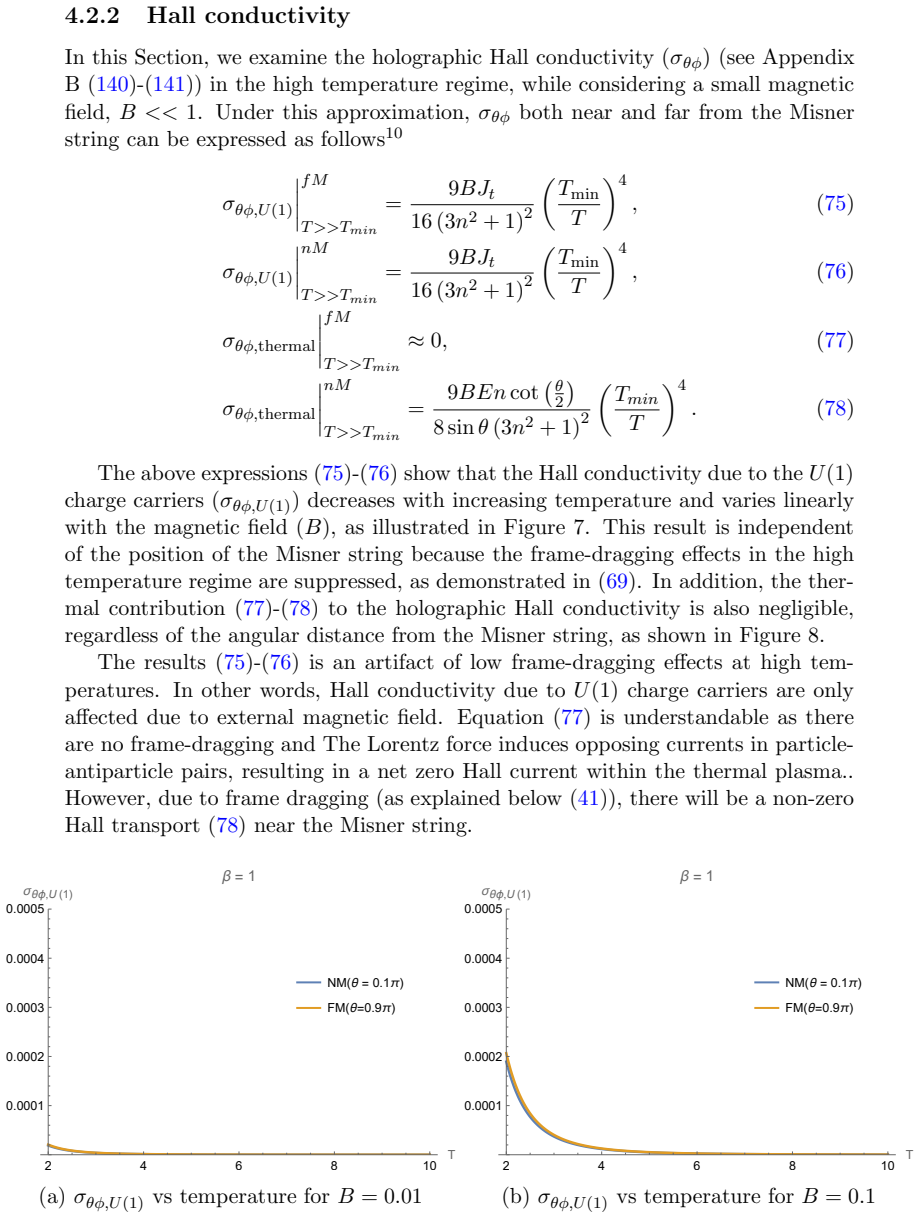
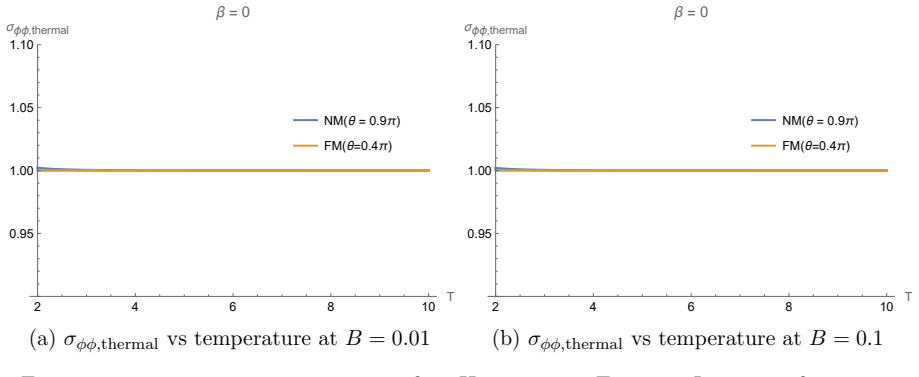
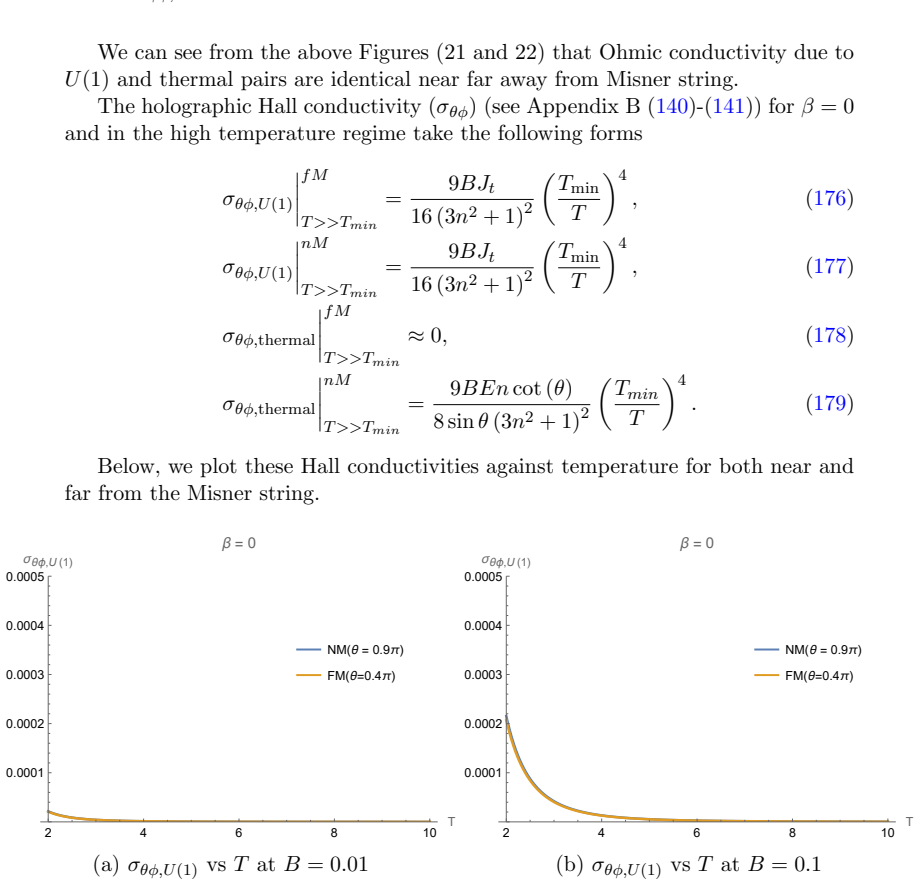
In the probe D-brane framework applied to Taub-NUT AdS black holes, the NUT parameter generates frame-dragging that produces finite Hall conductivity in the boundary theory. Calculations across low and high temperature regions, both near and far from the Misner string, indicate that these frame-dragging contributions to Hall transport are appreciable only at lower temperatures with small magnetic fields near the string, becoming insignificant at finite magnetic fields.
What carries the argument
Probe D-branes embedded in the Taub-NUT AdS geometry, with the NUT parameter serving as the source of frame-dragging that alters the response to external electric and magnetic fields.
If this is right
- Frame-dragging produces a nonzero Hall conductivity.
- The effect is pronounced at low temperatures and close to the Misner string under small magnetic fields.
- Increasing the magnetic field to finite values suppresses the frame-dragging contribution to transport.
- Separate analysis in low and high temperature limits reveals the temperature dependence of the conductivities.
Where Pith is reading between the lines
- This frame-dragging mechanism might correspond to rotational effects in real materials that show Hall conductivity, suggesting holographic models for rotating condensed matter systems.
- Similar studies in other NUT-charged geometries could uncover patterns in anomalous Hall transport across different dimensions.
- Including the backreaction of the D-brane might lead to modifications in the bulk geometry that affect the transport coefficients further.
Load-bearing premise
The probe D-brane approximation remains valid, allowing the NUT parameter to map directly to frame-dragging in the dual field theory without notable backreaction or higher-order corrections.
What would settle it
Computing the Hall conductivity in this setup and finding it to be zero or independent of the NUT parameter at low temperatures near the Misner string with small magnetic field would disprove the presence of finite Hall transport from frame-dragging.
Figures






read the original abstract
We compute Hall transport coefficients associated with Taub-NUT AdS black holes in four space-time dimensions using the probe D-brane approach. In particular, we examine the effects due to the NUT parameter ($n$), or equivalently, the novel frame-dragging on the holographic charge transport properties. In our analysis, we treat the external electric field as a constant background, while varying the magnetic field ($B$) from small to finite. Within this framework, we analyze conductivities in both low and high temperature regions, focusing on locations that are both near and far from the Misner string. Our calculations show that frame-dragging effects are significant primarily at lower temperatures and near the Misner string, while a small magnetic field is maintained. However, these effects become negligibly small at a ``finite" magnetic field and even at lower temperatures. Our analysis reveals the existence of finite Hall transport, that has its origin in the novel frame-dragging.
Editorial analysis
A structured set of objections, weighed in public.
Referee Report
Summary. The manuscript computes Hall transport coefficients for 4D Taub-NUT AdS black holes via the probe D-brane DBI action on the fixed background geometry. It reports finite Hall conductivity arising from the NUT parameter n (equivalently, novel frame-dragging effects encoded in metric cross terms), which are prominent at low temperatures and near the Misner string for small magnetic field B, but become negligible at finite B even at low T. The analysis treats the electric field as a constant background and examines conductivities in low/high-T regimes both near and far from the Misner string.
Significance. If the probe approximation and attribution hold, the work supplies a holographic model in which off-diagonal Hall transport is generated purely by gravitational frame-dragging from the NUT charge, without external rotation or additional matter fields. This could furnish a controlled setting for studying transport in strongly coupled systems with analogous geometric effects and offers a concrete realization of the abstract claim that finite Hall conductivity originates in the n-dependent metric terms.
major comments (2)
- [Probe D-brane setup and Misner-string analysis] § on probe D-brane setup and Misner-string placement: the central claim that finite Hall conductivity is reliably extracted from the DBI action and attributable to frame-dragging requires the probe limit to remain valid precisely where the n-dependent cross terms are largest. No explicit check is provided that the induced world-volume curvature remains small compared with the D-brane tension scale, nor that back-reaction stays perturbative near the coordinate singularity; this undermines the interpretation of the computed conductivity as a dual transport coefficient.
- [Conductivity calculations] Conductivity extraction (likely §4 or §5): the manuscript states that the Hall conductivity is obtained from the background geometry and probe action, yet supplies neither the explicit off-diagonal component of the conductivity tensor nor its reduction to the n-dependent metric cross terms. Without the formula, the limit n→0, or a comparison to the known vanishing Hall conductivity in the absence of frame-dragging, the attribution of the finite result to the novel frame-dragging cannot be verified.
minor comments (2)
- [Abstract] The abstract asserts that calculations were performed across temperature and magnetic-field regimes but contains no explicit formulas, numerical values, or error estimates; adding at least the leading expression for the Hall conductivity would improve readability.
- [Introduction] Notation for the NUT parameter n and the magnetic field B should be introduced with a brief reminder of their relation to the metric components and the dual field-theory quantities.
Simulated Author's Rebuttal
We thank the referee for the careful reading of our manuscript and the constructive comments. We address each major point below and have revised the paper to incorporate clarifications and additional details that strengthen the presentation.
read point-by-point responses
-
Referee: [Probe D-brane setup and Misner-string analysis] the central claim that finite Hall conductivity is reliably extracted from the DBI action and attributable to frame-dragging requires the probe limit to remain valid precisely where the n-dependent cross terms are largest. No explicit check is provided that the induced world-volume curvature remains small compared with the D-brane tension scale, nor that back-reaction stays perturbative near the coordinate singularity; this undermines the interpretation of the computed conductivity as a dual transport coefficient.
Authors: We appreciate the referee highlighting the need for explicit validation of the probe approximation in the regimes where frame-dragging effects from the NUT parameter are strongest. The manuscript employs the standard probe limit in which the D-brane tension is taken large relative to background scales, with back-reaction neglected by construction. To address the concern directly, the revised version will include a dedicated paragraph providing order-of-magnitude estimates of the induced world-volume curvature near the Misner string (for the small-B, low-T regime considered) and confirming that it remains well below the tension scale, ensuring the approximation stays perturbative. This addition will support the reliability of the extracted conductivities as holographic transport coefficients. revision: yes
-
Referee: [Conductivity calculations] the manuscript states that the Hall conductivity is obtained from the background geometry and probe action, yet supplies neither the explicit off-diagonal component of the conductivity tensor nor its reduction to the n-dependent metric cross terms. Without the formula, the limit n→0, or a comparison to the known vanishing Hall conductivity in the absence of frame-dragging, the attribution of the finite result to the novel frame-dragging cannot be verified.
Authors: We thank the referee for noting this omission in explicit presentation. The revised manuscript will include the full derivation of the conductivity tensor from the DBI action, with the explicit off-diagonal Hall component σ_xy isolated and shown to arise directly from the n-dependent metric cross terms g_tφ. We will demonstrate analytically that σ_xy vanishes identically in the limit n → 0, recovering the expected zero Hall conductivity for standard AdS black holes without frame-dragging, and provide a brief comparison to the vanishing result in the literature for non-NUT cases. These additions will make the attribution to the novel gravitational frame-dragging fully transparent and verifiable. revision: yes
Circularity Check
No circularity: Hall conductivity computed directly from DBI action on fixed background
full rationale
The paper derives the Hall transport coefficients by solving the equations of motion obtained from the probe D-brane DBI action evaluated on the Taub-NUT AdS metric, with the NUT parameter n entering explicitly through the metric cross terms that produce frame-dragging. Conductivities are extracted from the resulting current responses to applied electric and magnetic fields without any parameter fitting to data, without renaming a known result, and without load-bearing self-citations that close the derivation. The calculation remains self-contained against the external holographic dictionary and the given background geometry.
Axiom & Free-Parameter Ledger
free parameters (2)
- NUT parameter n
- Magnetic field B
axioms (2)
- domain assumption AdS/CFT correspondence maps bulk gravity to boundary field theory transport
- domain assumption Probe D-brane approximation neglects backreaction on the geometry
Reference graph
Works this paper leans on
-
[1]
Anti de Sitter space and holography,
E. Witten, “Anti de Sitter space and holography,” Adv. Theor. Math. Phys.2, 253-291 (1998) doi:10.4310/ATMP.1998.v2.n2.a2 [arXiv:hep-th/9802150 [hep- th]]
-
[2]
The LargeNlimit of superconformal field the- ories and supergravity,
J. M. Maldacena, “The LargeNlimit of superconformal field the- ories and supergravity,” Adv. Theor. Math. Phys.2, 231-252 (1998) doi:10.4310/ATMP.1998.v2.n2.a1 [arXiv:hep-th/9711200 [hep-th]]
-
[3]
Gauge theory corre- lators from noncritical string theory,
S. S. Gubser, I. R. Klebanov and A. M. Polyakov, “Gauge theory corre- lators from noncritical string theory,” Phys. Lett. B428, 105-114 (1998) doi:10.1016/S0370-2693(98)00377-3 [arXiv:hep-th/9802109 [hep-th]]
-
[4]
“Hall Conductivity of Flavor Fields from AdS/CFT,” Phys. Rev. D76, 086007 (2007) doi:10.1103/PhysRevD.76.086007 [arXiv:0708.1994 [hep-th]]
-
[5]
Strange Metallic Behavior in Anisotropic Background,
B. H. Lee, D. W. Pang and C. Park, “Strange Metallic Behavior in Anisotropic Background,” JHEP07, 057 (2010) doi:10.1007/JHEP07(2010)057 [arXiv:1006.1719 [hep-th]]
-
[6]
Towards strange metallic holography,
S. A. Hartnoll, J. Polchinski, E. Silverstein and D. Tong, “Towards strange metallic holography,” JHEP04, 120 (2010) doi:10.1007/JHEP04(2010)120 [arXiv:0912.1061 [hep-th]]
-
[7]
K. Y. Kim and D. W. Pang, ‘Holographic DC conductivities from the open string metric,” JHEP09, 051 (2011) doi:10.1007/JHEP09(2011)051 [arXiv:1108.3791 [hep-th]]
-
[8]
Notes on Properties of Holographic Strange Metals,
B. H. Lee and D. W. Pang, “Notes on Properties of Holographic Strange Metals,” Phys. Rev. D82, 104011 (2010) doi:10.1103/PhysRevD.82.104011 [arXiv:1006.4915 [hep-th]]
-
[9]
Holographic quantum crit- icality and strange metal transport,
B. S. Kim, E. Kiritsis and C. Panagopoulos, “Holographic quantum crit- icality and strange metal transport,” New J. Phys.14, 043045 (2012) doi:10.1088/1367-2630/14/4/043045 [arXiv:1012.3464 [cond-mat.str-el]]
-
[10]
Conductivities for Hyperscaling Violating Geometries,
A. Karch, “Conductivities for Hyperscaling Violating Geometries,” JHEP06, 140 (2014) doi:10.1007/JHEP06(2014)140 [arXiv:1405.2926 [hep-th]]. 48
-
[11]
N. Nagaosa, J. Sinova, S. Onoda, A. H. MacDonald and N. P. Ong, “Anomalous Hall effect,” Rev. Mod. Phys.82, no.2, 1539-1592 (2010) doi:10.1103/RevModPhys.82.1539 [arXiv:0904.4154 [cond-mat.mes-hall]]
-
[12]
Kontani, Hiroshi,”Anomalous transport phenomena in Fermi liquids with strong magnetic fluctuations”Reports on Progress in Physics 71, 1361-6633, url:http://dx.doi.org/10.1088/0034-4885/71/2/026501, DOI:10.1088/0034- 4885/71/2/026501
-
[13]
Transport Properties
Ziman JM. Transport Properties. In: Principles of the Theory of Solids. Cam- bridge University Press; 1972:211-254
1972
-
[14]
”The hall conductivity of a two-dimensional con- fined system.” Z
Ono, Y., Kramer, B. ”The hall conductivity of a two-dimensional con- fined system.” Z. Physik B - Condensed Matter 67, 341–347 (1987). https://doi.org/10.1007/BF01307258
-
[15]
Ando, Tsuneya and Matsumoto, Yukio and Uemura, Yasutada,”Theory of Hall Effect in a Two-Dimensional Electron System”,Journal of the Phys- ical Society of Japan 1975JPSJ...39..279A, doi : 10.1143/JPSJ.39.279, https://ui.adsabs.harvard.edu/abs/1975JPSJ...39..279A
-
[16]
Hall effect in the two-dimensional Luttinger liquid,
P. W. Anderson, “Hall effect in the two-dimensional Luttinger liquid,” Phys. Rev. Lett.67, no.15, 2092 (1991) doi:10.1103/PhysRevLett.67.2092
-
[17]
The first law of black hole thermodynamics for Taub–NUT spacetime,
R. Durka, “The first law of black hole thermodynamics for Taub–NUT spacetime,” Int. J. Mod. Phys. D31, no.04, 2250021 (2022) doi:10.1142/S0218271822500213 [arXiv:1908.04238 [gr-qc]]
-
[18]
Empty space generalization of the Schwarzschild metric,
E. Newman, L. Tamburino and T. Unti, “Empty space generalization of the Schwarzschild metric,” J. Math. Phys.4, 915 (1963) doi:10.1063/1.1704018
-
[19]
Empty space-times admitting a three parameter group of mo- tions,
A. H. Taub, “Empty space-times admitting a three parameter group of mo- tions,” Annals Math.53, 472-490 (1951) doi:10.2307/1969567
-
[20]
The Flatter regions of Newman, Unti and Tamburino’s generalized Schwarzschild space,
C. W. Misner, “The Flatter regions of Newman, Unti and Tamburino’s generalized Schwarzschild space,” J. Math. Phys.4, 924-938 (1963) doi:10.1063/1.1704019
-
[21]
Twisted spacetime in Einstein gravity,
H. Zhang, “Twisted spacetime in Einstein gravity,” [arXiv:1609.09721 [gr-qc]]
-
[22]
A new interpretation of the NUT metric in general relativity,
W. B. Bonnor, “A new interpretation of the NUT metric in general relativity,” Math. Proc. Cambridge Phil. Soc.66, no.1, 145-151 (1969) doi:10.1017/s0305004100044807
-
[23]
Twisted Black Hole Is Taub-NUT,
Y. C. Ong, “Twisted Black Hole Is Taub-NUT,” JCAP01, 001 (2017) doi:10.1088/1475-7516/2017/01/001 [arXiv:1610.05757 [gr-qc]]
-
[24]
Misner Gravitational Charges and Variable String Strengths,
A. B. Bordo, F. Gray, R. A. Hennigar and D. Kubizˇ n´ ak, “Misner Gravitational Charges and Variable String Strengths,” Class. Quant. Grav.36, no.19, 194001 (2019) doi:10.1088/1361-6382/ab3d4d [arXiv:1905.03785 [hep-th]]
-
[25]
Thermodynamics of Taub-NUT-AdS spacetimes,
J. F. Liu and H. S. Liu, “Thermodynamics of Taub-NUT-AdS spacetimes,” Eur. Phys. J. C84, no.5, 515 (2024) doi:10.1140/epjc/s10052-024-12826-2 [arXiv:2309.01609 [hep-th]]
-
[26]
Thermodynamics of Taub-NUT and Plebanski solutions,
H. S. Liu, H. Lu and L. Ma, “Thermodynamics of Taub-NUT and Plebanski solutions,” JHEP10, 174 (2022) doi:10.1007/JHEP10(2022)174 [arXiv:2208.05494 [gr-qc]]
-
[27]
Dyonic Taub-NUT-AdS: Unconstrained ther- modynamics and phase structure,
A. Awad and E. Elkhateeb, “Dyonic Taub-NUT-AdS: Unconstrained ther- modynamics and phase structure,” Phys. Rev. D108, no.6, 064022 (2023) doi:10.1103/PhysRevD.108.064022 [arXiv:2304.06705 [gr-qc]]. 49
-
[28]
Taub-NUT black hole in higher derivative gravity and its thermodynamics,
Y. Q. Chen, H. S. Liu and H. Lu, “Taub-NUT black hole in higher derivative gravity and its thermodynamics,” Phys. Rev. D110, no.10, 104068 (2024) doi:10.1103/PhysRevD.110.104068 [arXiv:2409.07692 [gr-qc]]
-
[29]
Thermodynamics of Taub- NUT/Bolt-AdS Black Holes in Einstein-Gauss-Bonnet Gravity,
A. Khodam-Mohammadi and M. Monshizadeh, “Thermodynamics of Taub- NUT/Bolt-AdS Black Holes in Einstein-Gauss-Bonnet Gravity,” Phys. Rev. D79, 044002 (2009) doi:10.1103/PhysRevD.79.044002 [arXiv:0811.1268 [hep- th]]
-
[30]
Taub-NUT solu- tions in conformal electrodynamics,
A. Ballon Bordo, D. Kubizˇ n´ ak and T. R. Perche, “Taub-NUT solu- tions in conformal electrodynamics,” Phys. Lett. B817, 136312 (2021) doi:10.1016/j.physletb.2021.136312 [arXiv:2011.13398 [hep-th]]
-
[31]
Topological Terms and the Misner String Entropy,
L. Ciambelli, C. Corral, J. Figueroa, G. Giribet and R. Olea, “Topological Terms and the Misner String Entropy,” Phys. Rev. D103, no.2, 024052 (2021) doi:10.1103/PhysRevD.103.024052 [arXiv:2011.11044 [hep-th]]
-
[32]
Taub-NUT Spacetime in the (A)dS/CFT and M-Theory,
Clarkson Richard, “Taub-NUT Spacetime in the (A)dS/CFT and M-Theory,” University of Waterloo , 2005, http://hdl.handle.net/10012/1264
2005
-
[33]
First law for Kerr Taub-NUT AdS black holes,
N. H. Rodr´ ıguez and M. J. Rodriguez, “First law for Kerr Taub-NUT AdS black holes,” JHEP10(2022), 044 doi:10.1007/JHEP10(2022)044 [arXiv:2112.00780 [hep-th]]
-
[34]
Holographic complexity of charged Taub-NUT-AdS black holes,
J. Jiang, B. Deng and X. W. Li, “Holographic complexity of charged Taub-NUT-AdS black holes,” Phys. Rev. D100, no.6, 066007 (2019) doi:10.1103/PhysRevD.100.066007 [arXiv:1908.06565 [hep-th]]
-
[35]
Charged Taub-NUT-AdS Black Holes in f(R) Gravity and Holographic Complexity,
S. Chen, Y. Pei, L. Li and T. Yang, “Charged Taub-NUT-AdS Black Holes in f(R) Gravity and Holographic Complexity,” Int. J. Theor. Phys.62, no.2, 16 (2023) doi:10.1007/s10773-023-05280-5
-
[36]
Aspects of holography of Taub-NUT- AdS 4 spacetimes,
G. Kalamakis, R. G. Leigh and A. C. Petkou, “Aspects of holography of Taub-NUT- AdS 4 spacetimes,” Phys. Rev. D103, no.12, 126012 (2021) doi:10.1103/PhysRevD.103.126012 [arXiv:2009.08022 [hep-th]]
-
[37]
Quasinormal modes of NUT-charged black branes in the AdS/CFT correspondence,
P. A. Cano and D. Pere˜ niguez, “Quasinormal modes of NUT-charged black branes in the AdS/CFT correspondence,” Class. Quant. Grav.39, no.16, 165003 (2022) doi:10.1088/1361-6382/ac7d8d [arXiv:2101.10652 [hep-th]]
-
[38]
Remarks on the quasinormal modes of Taub- NUT-AdS4,
G. Kalamakis and A. C. Petkou, “Remarks on the quasinormal modes of Taub- NUT-AdS4,” [arXiv:2503.21001 [gr-qc]]
-
[39]
A. Karch and A. O’Bannon, “Metallic AdS/CFT,” JHEP09, 024 (2007) doi:10.1088/1126-6708/2007/09/024 [arXiv:0705.3870 [hep-th]]
-
[40]
Metallic transports from Taub- NUT AdS black holes,
M. A. Khan, H. Rathi and D. Roychowdhury, “Metallic transports from Taub- NUT AdS black holes,” JHEP01, 127 (2026) doi:10.1007/JHEP01(2026)127 [arXiv:2510.10445 [hep-th]]
-
[41]
Tong, Lectures on the quantum hall effect (2016), arXiv:1606.06687 [hep-th]
D. Tong, “Lectures on the Quantum Hall Effect,” [arXiv:1606.06687 [hep-th]]
-
[42]
Solid State Physics
Neil W. Ashcroft and N. David Mermin, “Solid State Physics”, Publisher : Holt, Rinehart and Winston (1976)
1976
-
[43]
Introduction to the AdS/CFT correspondence,
A. V. Ramallo, “Introduction to the AdS/CFT correspondence,” Springer Proc. Phys.161, 411-474 (2015) doi:10.1007/978-3-319-12238-0 10 [arXiv:1310.4319 [hep-th]]
-
[44]
S. A. Hartnoll, “Lectures on holographic methods for condensed mat- ter physics,” Class. Quant. Grav.26, 224002 (2009) doi:10.1088/0264- 9381/26/22/224002 [arXiv:0903.3246 [hep-th]]. 50
-
[45]
Stability and Hawking-Page-like phase transition of phantom AdS black holes,
H. Abdusattar, “Stability and Hawking-Page-like phase transition of phantom AdS black holes,” Eur. Phys. J. C83, no.7, 614 (2023) doi:10.1140/epjc/s10052-023-11766-7
-
[46]
A Note on Self-gravitating Radiation in AdS Spacetime,
Z. H. Li, B. Hu and R. G. Cai, “A Note on Self-gravitating Radiation in AdS Spacetime,” Phys. Rev. D77, 104032 (2008) doi:10.1103/PhysRevD.77.104032 [arXiv:0804.3233 [gr-qc]]
-
[47]
S. Rath and S. Dash, “Effects of weak magnetic field and finite chemical po- tential on the transport of charge and heat in hot QCD matter,” Eur. Phys. J. A59, no.2, 25 (2023) doi:10.1140/epja/s10050-023-00941-9 [arXiv:2112.11802 [hep-ph]]
-
[48]
A.W. Tyler and A.P. Mackenzie ”Hall effect of single layer, tetrago- nal Tl2Ba2CuO6 near optimal doping” Physica C:Superconductivity,doi : https://doi.org/10.1016/S0921-4534(97)00751-X,
-
[49]
Ohm’s law for a relativistic pair plasma,
E. G. Blackman and G. B. Field, “Ohm’s law for a relativistic pair plasma,” Phys. Rev. Lett.71, 3481-3484 (1993) doi:10.1103/PhysRevLett.71.3481 [arXiv:astro-ph/9402068 [astro-ph]]
-
[50]
Stojkovic-acute, Branko P. and Pines, David ”Theory of the longitudinal and Hall conductivities of the cuprate superconductors”, Phys. Rev. B, doi : 10.1103/PhysRevB.55.8576, url : https://link.aps.org/doi/10.1103/PhysRevB.55.8576
-
[51]
Quantum Critical Transport and the Hall Angle,
M. Blake and A. Donos, “Quantum Critical Transport and the Hall Angle,” Phys. Rev. Lett.114, no.2, 021601 (2015) doi:10.1103/PhysRevLett.114.021601 [arXiv:1406.1659 [hep-th]]
-
[52]
Strange Metallic Behaviour and the Thermodynamics of Charged Dilatonic Black Holes,
R. Meyer, B. Gouteraux and B. S. Kim, “Strange Metallic Behaviour and the Thermodynamics of Charged Dilatonic Black Holes,” Fortsch. Phys.59, 741- 748 (2011) doi:10.1002/prop.201100030 [arXiv:1102.4433 [hep-th]]
-
[53]
Ding, Wenxin and ˇZitko, Rok and Shastry, B. Sriram, ”Strange metal from Gutzwiller correlations in infinite dimensions: Transverse transport, optical response, and rise of two relaxation rates” Phys- ical Review B(2017) http://dx.doi.org/10.1103/PhysRevB.96.115153, DOI:10.1103/physrevb.96.115153
-
[54]
Linear and quadratic in temperature resistivity from holography,
X. H. Ge, Y. Tian, S. Y. Wu, S. F. Wu and S. F. Wu, “Linear and quadratic in temperature resistivity from holography,” JHEP11, 128 (2016) doi:10.1007/JHEP11(2016)128 [arXiv:1606.07905 [hep-th]]
-
[55]
Hall conductivity from dyonic black holes,
S. A. Hartnoll and P. Kovtun, “Hall conductivity from dyonic black holes,” Phys. Rev. D76, 066001 (2007) doi:10.1103/PhysRevD.76.066001 [arXiv:0704.1160 [hep-th]]
-
[56]
A. Karch, A. O’Bannon and E. Thompson, “The Stress-Energy Tensor of Flavor Fields from AdS/CFT,” JHEP04, 021 (2009) doi:10.1088/1126- 6708/2009/04/021 [arXiv:0812.3629 [hep-th]]
-
[57]
Thermoelectric DC conductivities from black hole horizons,
A. Donos and J. P. Gauntlett, “Thermoelectric DC conductivities from black hole horizons,” JHEP11, 081 (2014) doi:10.1007/JHEP11(2014)081 [arXiv:1406.4742 [hep-th]]. 51
discussion (0)
Sign in with ORCID, Apple, or X to comment. Anyone can read and Pith papers without signing in.