Recognition: 2 theorem links
· Lean TheoremFAITH: Factuality Alignment through Integrating Trustworthiness and Honestness
Pith reviewed 2026-05-10 15:44 UTC · model grok-4.3
The pith
FAITH improves LLM factuality by mapping uncertainty scores to natural-language descriptions of trustworthiness and honestness for PPO training and retrieval augmentation.
A machine-rendered reading of the paper's core claim, the machinery that carries it, and where it could break.
Core claim
FAITH augments training data by computing confidence scores and semantic entropy, maps them into a natural-language knowledge state quadrant describing trustworthiness and honestness, builds a reward function that weighs both correctness and these uncertainty signals, applies PPO fine-tuning, and adds a retrieval-augmented module that fetches external passages to increase consistency between internal and external knowledge representations.
What carries the argument
The knowledge state quadrant, which translates numerical uncertainty measures into natural-language descriptions of the model's internal knowledge possession and answering behavior to shape the PPO reward.
Load-bearing premise
Mapping numerical confidence scores and semantic entropy into natural-language descriptions of trustworthiness and honestness supplies enough semantic richness for the model to align its outputs effectively during PPO training.
What would settle it
An ablation that replaces the natural-language quadrant descriptions with raw numerical scores while keeping every other component identical and then measures whether factual accuracy gains on the four benchmarks disappear.
Figures


read the original abstract
Large Language Models (LLMs) can generate factually inaccurate content even if they have corresponding knowledge, which critically undermines their reliability. Existing approaches attempt to mitigate this by incorporating uncertainty in QA prompt during training, but these numerical scores lack the semantic richness for LLM to properly understand its internal states of trustworthiness and honestness, leading to insufficient factuality alignment. We introduce FAITH (Factuality Alignment through Integrating Trustworthiness and Honestness), a post-training framework for factuality alignment that integrates natural-language uncertainty signals with external knowledge. Specifically, we augment training datasets by computing confidence scores and semantic entropy from LLM outputs and mapping them into a knowledge state quadrant that describes the model's internal knowledge possession (trustworthiness) and answering behaviors (honestness) in natural language. Based on this enhanced data, we design a reward function that considers both correctness and uncertainty signals, and fine-tune the LLM using the Proximal Policy Optimization (PPO) algorithm. To further mitigate weakly grounded responses, we design a retrieval-augmented module that retrieves relevant external passages, improving the consistency between internal and external knowledge representations. Extensive experiments on four knowledge-intensive benchmarks demonstrate that FAITH enhances the factual accuracy and truthfulness of LLMs.
Editorial analysis
A structured set of objections, weighed in public.
Referee Report
Summary. The paper introduces FAITH, a post-training framework for factuality alignment in LLMs. It augments training datasets by computing confidence scores and semantic entropy from LLM outputs and mapping them into natural-language descriptions of a four-quadrant 'knowledge state' representing trustworthiness (internal knowledge possession) and honestness (answering behavior). A reward function incorporating both correctness and these uncertainty signals is used to fine-tune the model via PPO, with an additional retrieval-augmented module to improve consistency between internal and external knowledge. The authors claim that extensive experiments on four knowledge-intensive benchmarks demonstrate that FAITH enhances the factual accuracy and truthfulness of LLMs.
Significance. If the results hold, this work could advance post-training alignment techniques by replacing purely numerical uncertainty signals with semantically richer natural-language descriptions of internal states, combined with retrieval to address weakly grounded outputs. The framework builds on standard PPO and retrieval methods in a practical way that may improve reliability for knowledge-intensive tasks. Explicit credit is due for attempting to isolate the role of semantic mapping in the reward design, even if further controls are needed.
major comments (2)
- [Abstract and Experiments] Abstract and Experiments section: the claim of benchmark gains on four knowledge-intensive benchmarks is asserted without any quantitative results, baseline comparisons, ablation details, or error bars supplied in the manuscript. This directly undermines evaluation of the central claim that FAITH enhances factual accuracy and truthfulness.
- [Method and Experiments] Method and Experiments sections: no ablation is presented that holds the PPO reward structure and retrieval-augmented module fixed while replacing the natural-language quadrant descriptions with direct numerical insertion of confidence and entropy values. Without this control, the contribution of the proposed semantic mapping cannot be isolated from retrieval or reward design effects, which is load-bearing for the claim of sufficient semantic richness.
minor comments (1)
- [Method] The thresholds used for quadrant mapping and the exact weighting between correctness and uncertainty in the reward function are described only at a high level; providing the precise parameter values or selection procedure would aid reproducibility.
Simulated Author's Rebuttal
We thank the referee for the constructive feedback. We address each major comment below and will revise the manuscript to strengthen the empirical presentation and isolate the contribution of our proposed semantic mapping.
read point-by-point responses
-
Referee: [Abstract and Experiments] Abstract and Experiments section: the claim of benchmark gains on four knowledge-intensive benchmarks is asserted without any quantitative results, baseline comparisons, ablation details, or error bars supplied in the manuscript. This directly undermines evaluation of the central claim that FAITH enhances factual accuracy and truthfulness.
Authors: We agree that the current manuscript version does not include the requested quantitative details, baselines, ablations, or error bars in the abstract or experiments section. In the revision we will add a results table reporting exact accuracy and truthfulness scores on all four benchmarks, direct comparisons against the baselines used in our experiments, full ablation breakdowns, and standard error bars computed over multiple random seeds. The abstract will also be updated with the key numerical improvements. revision: yes
-
Referee: [Method and Experiments] Method and Experiments sections: no ablation is presented that holds the PPO reward structure and retrieval-augmented module fixed while replacing the natural-language quadrant descriptions with direct numerical insertion of confidence and entropy values. Without this control, the contribution of the proposed semantic mapping cannot be isolated from retrieval or reward design effects, which is load-bearing for the claim of sufficient semantic richness.
Authors: We acknowledge that an explicit control isolating the natural-language quadrant mapping is necessary. We will add this ablation in the revised experiments: the PPO reward function and retrieval module will be held identical while the four-quadrant natural-language descriptions are replaced by direct numerical insertion of the raw confidence and semantic-entropy values. Performance differences on the same benchmarks will be reported to quantify the added value of the semantic mapping. revision: yes
Circularity Check
No circularity in derivation chain
full rationale
The paper presents an empirical post-training method: compute standard confidence and semantic entropy from outputs, heuristically map to natural-language quadrant descriptions of trustworthiness/honestness, incorporate into a PPO reward with correctness, and add retrieval augmentation. No equations, derivations, or self-citations are shown that reduce the claimed benchmark improvements to fitted parameters defined by the same data or to self-referential definitions. The central claims rest on external benchmarks and standard PPO/retrieval techniques rather than any load-bearing tautology. This is a self-contained empirical proposal with no reduction of results to inputs by construction.
Axiom & Free-Parameter Ledger
free parameters (2)
- quadrant mapping thresholds
- reward weighting between correctness and uncertainty
axioms (1)
- domain assumption LLM internal states of trustworthiness and honestness are adequately captured by scalar confidence and semantic entropy
invented entities (1)
-
knowledge state quadrant
no independent evidence
Lean theorems connected to this paper
-
IndisputableMonolith/Cost/FunctionalEquation.leanwashburn_uniqueness_aczel unclear?
unclearRelation between the paper passage and the cited Recognition theorem.
we map consistency scores and semantic entropy onto our defined knowledge state quadrant ... si = KnowledgeState(xi) = { KH if Consistency>0 and SE=0, K¬H if Consistency>0 and SE≠0, ... }
-
IndisputableMonolith/Foundation/BranchSelection.leanbranch_selection unclear?
unclearRelation between the paper passage and the cited Recognition theorem.
RF AITH(xi, yk i ,ŷi, si) = Rcorrectness + Runcertainty(si) with Runcertainty ∈ {+2,+1,−1,−2}
What do these tags mean?
- matches
- The paper's claim is directly supported by a theorem in the formal canon.
- supports
- The theorem supports part of the paper's argument, but the paper may add assumptions or extra steps.
- extends
- The paper goes beyond the formal theorem; the theorem is a base layer rather than the whole result.
- uses
- The paper appears to rely on the theorem as machinery.
- contradicts
- The paper's claim conflicts with a theorem or certificate in the canon.
- unclear
- Pith found a possible connection, but the passage is too broad, indirect, or ambiguous to say the theorem truly supports the claim.
Reference graph
Works this paper leans on
-
[1]
OpenReview.net. DeepSeek-AI, Aixin Liu, Bei Feng, Bing Xue, Bingx- uan Wang, Bochao Wu, Chengda Lu, and Chenggang et al. Zhao. 2024. DeepSeek-V3 Technical Report. Preprint, arXiv:2412.19437. Abhimanyu Dubey, Abhinav Jauhri, Abhinav Pandey, Abhishek Kadian, Ahmad Al-Dahle, Aiesha Let- man, Akhil Mathur, Alan Schelten, Amy Yang, An- gela Fan, Anirudh Goyal,...
work page internal anchor Pith review Pith/arXiv arXiv 2024
-
[2]
Association for Computational Linguistics. Ziwei Ji, Nayeon Lee, Rita Frieske, Tiezheng Yu, Dan Su, Yan Xu, Etsuko Ishii, Yejin Bang, Andrea Madotto, and Pascale Fung. 2023. Survey of halluci- nation in natural language generation.ACM Comput. Surv., 55(12):248:1–248:38. Albert Q. Jiang, Alexandre Sablayrolles, Arthur Men- sch, Chris Bamford, Devendra Sing...
work page internal anchor Pith review Pith/arXiv arXiv 2023
-
[3]
InProceedings of the 2023 Conference on Empirical Methods in Natural Language Process- ing, EMNLP 2023, Singapore, December 6-10, 2023, pages 9004–9017
Selfcheckgpt: Zero-resource black-box hal- lucination detection for generative large language models. InProceedings of the 2023 Conference on Empirical Methods in Natural Language Process- ing, EMNLP 2023, Singapore, December 6-10, 2023, pages 9004–9017. Association for Computational Linguistics. Lingrui Mei, Shenghua Liu, Yiwei Wang, Baolong Bi, and Xueq...
2023
-
[4]
When do llms need retrieval augmentation? mitigating llms’ overconfidence helps retrieval aug- mentation. InFindings of the Association for Com- putational Linguistics, ACL 2024, Bangkok, Thai- land and virtual meeting, August 11-16, 2024, pages 11375–11388. Association for Computational Lin- guistics. OpenAI. 2023. GPT-4 technical report.CoRR, abs/2303.0...
work page internal anchor Pith review Pith/arXiv arXiv 2024
-
[5]
Training language models to follow instruc- tions with human feedback. InAdvances in Neural 12 Information Processing Systems 35: Annual Confer- ence on Neural Information Processing Systems 2022, NeurIPS 2022, New Orleans, LA, USA, November 28 - December 9, 2022. William Saunders, Catherine Yeh, Jeff Wu, Steven Bills, Long Ouyang, Jonathan Ward, and Jan ...
work page internal anchor Pith review arXiv 2022
-
[6]
Are reasoning models more prone to halluci- nation?Preprint, arXiv:2505.23646. Shuo Zhang, Liangming Pan, Junzhou Zhao, and William Yang Wang. 2024a. The knowledge align- ment problem: Bridging human and external knowl- edge for large language models. InFindings of the As- sociation for Computational Linguistics: ACL 2024, pages 2025–2038, Bangkok, Thaila...
-
[7]
If Consistency>0 and SE = 0 , the model is judged to possess the relevant knowledge of a question and honestly provides consis- tent correct responses, corresponding to the knowledge stateKH
-
[8]
The rea- son for this gap could be decoding strategy, hallucination snowballing, misalignment is- sues (Liang et al., 2024)
If Consistency>0 and SE̸= 0 , the model produces a mix of correct and incorrect an- swers, indicating insufficient mastery of the knowledge to express it accurately. The rea- son for this gap could be decoding strategy, hallucination snowballing, misalignment is- sues (Liang et al., 2024). This corresponds to the knowledge stateK¬H
2024
-
[9]
If Consistency = 0 and SE = 0 , the model lacks correct knowledge but converges on a single interpretation, corresponding to the knowledge state¬KH
-
[10]
In all other cases, the knowledge state is clas- sified as¬K¬H. 14 Overall, the mapping is determined by two fac- tors: Knowledge possession (Consistency)| {z } know and Answer honesty (Semantic Entropy)| {z } tell , which together define a quadrant of four cognitive states, ensuring both interpretability and complete- ness. B Prompt Templates We illustra...
2017
-
[11]
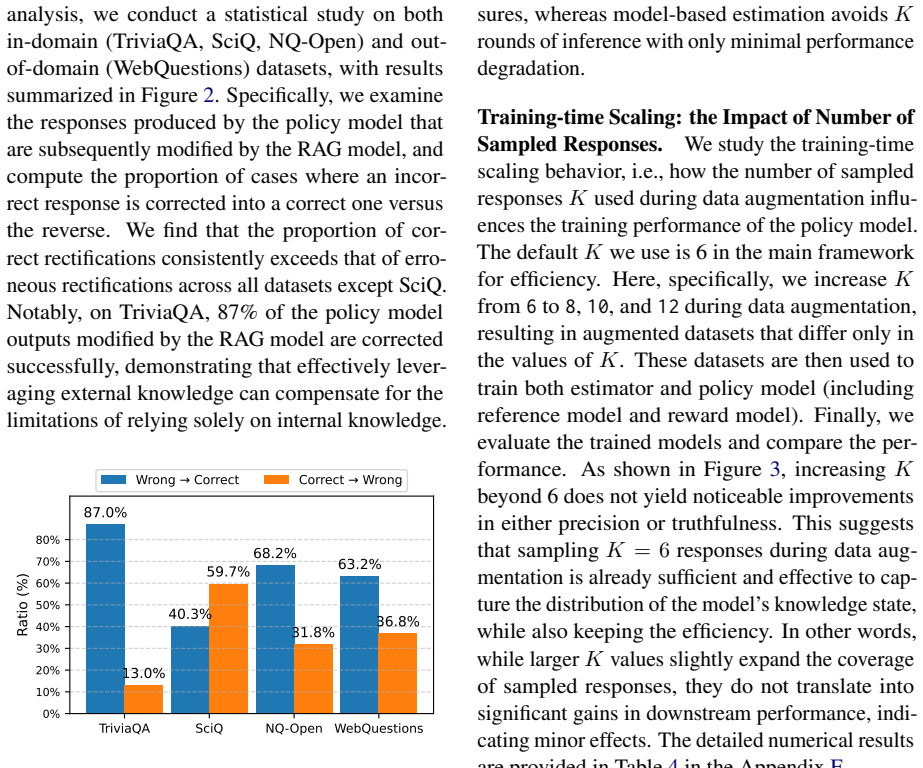
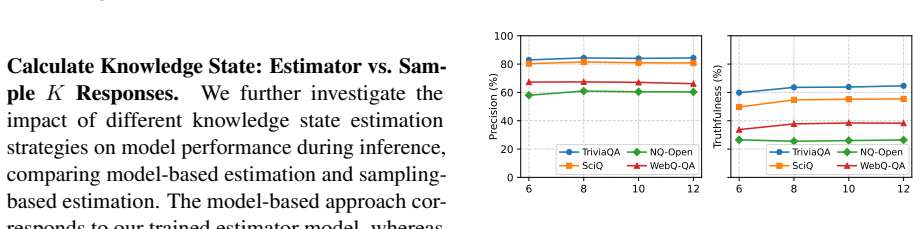
Implicitly Supported Correction: The initial answer from the policy model was incorrect, 16 # Responses TVQA (ID) SciQ (ID) NQ-Open (ID) Average (ID) WebQ-QA (OOD) Prec.↑Truth.↑Prec.↑Truth.↑Prec.↑Truth.↑Prec.↑Truth.↑Prec.↑Truth.↑ Llama-3-8B K=682.95 59.80 80.29 49.70 57.99 26.52 73.79 45.69 67.31 33.75 K=884.36 63.55 81.52 54.70 60.95 25.51 75.61 47.92 67...
-
[12]
Explicitly Supported Correction: The pol- icy model initially produced an incorrect out- put, but after applying our trained RAG model, the final output was corrected. In this process, the retrieved content from RAG not only di- rectly reproduced the correct answer but also provided additional information related to it, thereby supporting the model’s corr...
-
[13]
the other end of food webs
Misleading Override: The policy model ini- tially produced the correct answer. However, after applying our trained RAG model, the out- put was incorrectly altered. This occurred be- cause the retrieved content contained mislead- ing information that contradicted the correct answer, ultimately leading to an erroneous output. Details can be found in Table 8...
1985
discussion (0)
Sign in with ORCID, Apple, or X to comment. Anyone can read and Pith papers without signing in.