Recognition: unknown
Local topological markers for Chern insulators in ribbon geometry
Pith reviewed 2026-05-10 15:41 UTC · model grok-4.3
The pith
In ribbon geometries, the local Chern marker for Chern insulators agrees with the local Středa marker throughout the bulk, with boundary mismatches shrinking as the system enlarges.
A machine-rendered reading of the paper's core claim, the machinery that carries it, and where it could break.
Core claim
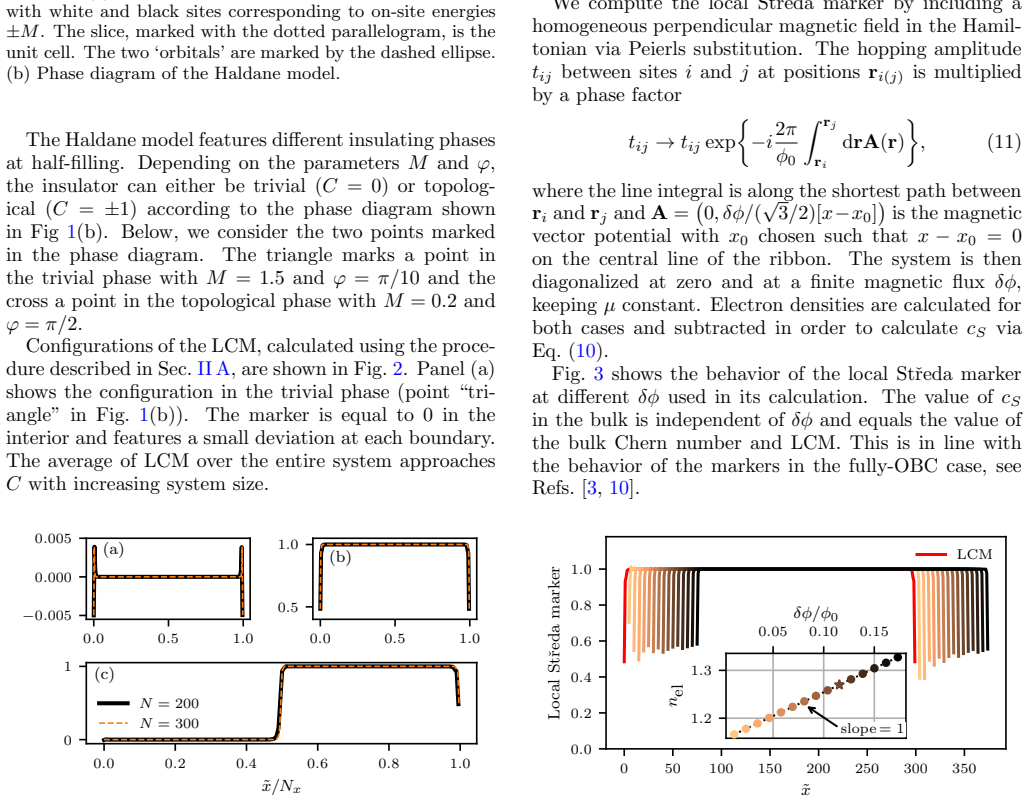
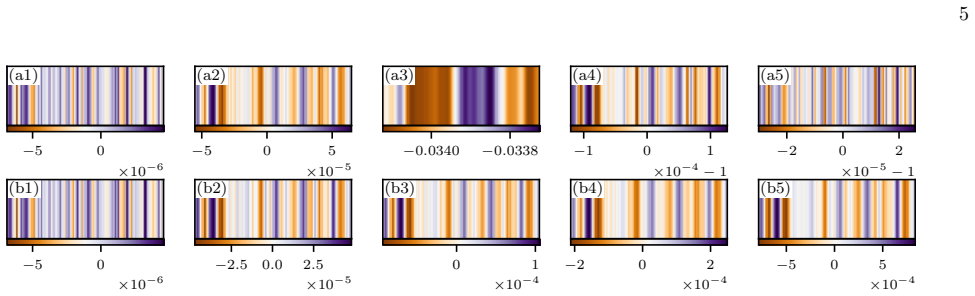
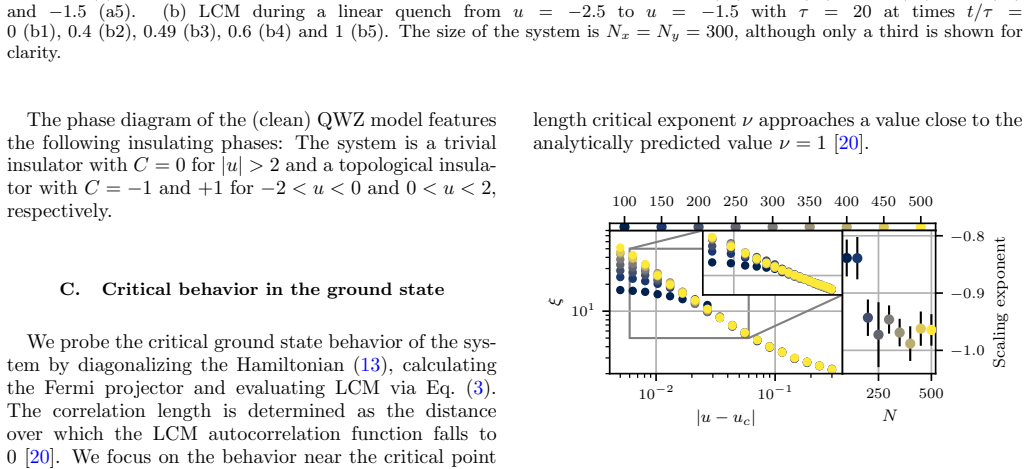
We express the local Chern marker in the hybrid position-momentum basis for ribbon geometries with partial translational symmetry. For the Haldane model, this marker shows qualitatively different behavior at the two boundaries compared to fully open systems. It agrees with the local Středa marker in the bulk, with small boundary deviations that diminish as the system size increases. This agreement holds for weakly disordered cases as long as disorder does not substantially change the Chern number. Using this setup, scaling exponents extracted from the local Chern marker in a weakly disordered Qi-Wu-Zhang Chern insulator converge to analytically predicted values with increasing system size.
What carries the argument
The local Chern marker formulated in the hybrid position-momentum basis for systems with partial translational symmetry, which enables efficient computation and direct comparison to the Středa marker.
If this is right
- The markers agree in the bulk even when weak disorder is present, as long as it does not induce large changes in the Chern number.
- Deviations at the ribbon boundaries decrease with increasing transverse system size.
- Extracted scaling exponents from local marker profiles approach analytic predictions for larger systems.
- Boundary effects differ between ribbon and fully open boundary conditions.
Where Pith is reading between the lines
- Such local markers could be used to map topological properties in mesoscopic devices with natural ribbon-like geometries.
- The hybrid basis method might reduce computational cost for studying dynamics in other partially symmetric topological systems.
- If the agreement holds more generally, it could validate local markers as reliable probes for experimental signatures of Chern phases in finite samples.
Load-bearing premise
The hybrid-basis expression for the local marker, enabled by partial translational symmetry, does not introduce systematic errors that would invalidate its comparison to the Středa marker or to fully open geometries.
What would settle it
Observation that the bulk values of the local Chern marker and local Středa marker differ by an amount that remains finite as the ribbon width increases to infinity would contradict the claimed agreement.
Figures




read the original abstract
Local topological markers are used to characterize Chern insulators in the presence of spatial inhomogeneities, such as boundaries and disorder. In this paper, we study the local Chern marker in systems with partial translational symmetry. We express the local Chern marker in the hybrid position-momentum basis for both open and periodic boundary conditions. We calculate the local Chern marker for a Haldane model ribbon. We show that the behavior at the two boundaries is qualitatively different from fully open geometries. We further compare the local Chern marker with the local St\v{r}eda marker and show agreement in the bulk and small deviations at the boundaries that diminish with increasing system size. The correspondence between the two markers remains good if disorder is introduced, provided its magnitude remains below large values that cause substantial change of the Chern number due to Anderson physics. Finally, by exploiting the numerical efficiency due to partial translational symmetry, we study equilibrium critical behavior and the Kibble-Zurek mechanism in a weakly disordered Qi-Wu-Zhang Chern insulator. We extract relevant scaling exponents from the local Chern marker configuration and show that they converge to the analytically predicted values with increasing system size.
Editorial analysis
A structured set of objections, weighed in public.
Referee Report
Summary. The manuscript develops expressions for the local Chern marker in the hybrid position-momentum basis for ribbon geometries that retain partial translational symmetry along one direction. For the Haldane model ribbon it reports bulk agreement between this local Chern marker and the local Středa marker, with boundary deviations that decrease as ribbon width increases; the same markers remain consistent under weak disorder. The numerical efficiency of the hybrid formulation is then used to extract Kibble-Zurek scaling exponents from the local Chern marker configuration in a weakly disordered Qi-Wu-Zhang Chern insulator, showing convergence to analytically predicted values with increasing system size.
Significance. If the hybrid-basis definition is shown to be free of spurious boundary artifacts, the work supplies an efficient route to local topological diagnostics in systems with one periodic direction. This would be useful for studying inhomogeneities, disorder, and non-equilibrium dynamics in Chern insulators, and the reported marker agreement plus exponent convergence would strengthen the case for using local markers in ribbon geometries.
major comments (2)
- [Section on hybrid-basis definition (near the start of the results)] The hybrid position-momentum expression for the local Chern marker (introduced for both open and periodic boundary conditions) is load-bearing for all subsequent claims. The manuscript does not supply an explicit analytic or numerical limit demonstrating that, as ribbon width tends to infinity, the bulk value of this hybrid marker recovers the standard real-space local Chern marker of a fully open system. Without such a check, the reported qualitative differences in boundary behavior relative to open geometries and the bulk agreement with the Středa marker could contain definitional contributions rather than purely physical ones.
- [Section on equilibrium critical behavior and Kibble-Zurek mechanism] In the Qi-Wu-Zhang scaling analysis, the extraction of Kibble-Zurek exponents from the local Chern marker configuration is presented without a description of the fitting procedure, the precise range of system sizes and disorder strengths employed, or uncertainty estimates on the extracted exponents. This omission makes it impossible to judge whether the observed convergence to analytical values is robust against post-hoc choices of fitting windows or finite-size cutoffs.
minor comments (2)
- [Abstract and associated figures] The abstract states that boundary deviations 'diminish with increasing system size' but does not quantify the rate or show the corresponding data collapse; a brief statement or inset in the relevant figure would clarify the scaling.
- [Methods section] Notation for the hybrid-basis projector and Berry-phase integral should be cross-referenced to the standard real-space definitions to facilitate comparison with the literature on local markers.
Simulated Author's Rebuttal
We thank the referee for their careful reading and constructive comments on our manuscript. We address each major comment below and will revise the manuscript accordingly to improve clarity and rigor.
read point-by-point responses
-
Referee: [Section on hybrid-basis definition (near the start of the results)] The hybrid position-momentum expression for the local Chern marker (introduced for both open and periodic boundary conditions) is load-bearing for all subsequent claims. The manuscript does not supply an explicit analytic or numerical limit demonstrating that, as ribbon width tends to infinity, the bulk value of this hybrid marker recovers the standard real-space local Chern marker of a fully open system. Without such a check, the reported qualitative differences in boundary behavior relative to open geometries and the bulk agreement with the Středa marker could contain definitional contributions rather than purely physical ones.
Authors: We agree that an explicit check of the bulk limit is valuable for confirming that the hybrid marker is consistent with the standard real-space definition. Although the manuscript already demonstrates bulk agreement with the local Středa marker (which itself recovers the Chern number in the thermodynamic limit), we will add a numerical demonstration in the revised manuscript: we will compute the hybrid marker for progressively wider ribbons and show convergence of the bulk value to the known real-space local Chern marker obtained from fully open geometries. This will clarify that the reported boundary differences arise from the ribbon geometry itself rather than from the hybrid formulation. revision: yes
-
Referee: [Section on equilibrium critical behavior and Kibble-Zurek mechanism] In the Qi-Wu-Zhang scaling analysis, the extraction of Kibble-Zurek exponents from the local Chern marker configuration is presented without a description of the fitting procedure, the precise range of system sizes and disorder strengths employed, or uncertainty estimates on the extracted exponents. This omission makes it impossible to judge whether the observed convergence to analytical values is robust against post-hoc choices of fitting windows or finite-size cutoffs.
Authors: We acknowledge that the details of the fitting procedure were insufficiently described. In the revised manuscript we will expand this section to include: (i) a precise description of the fitting procedure (including the functional form fitted to the local Chern marker profiles and the criteria for choosing fitting windows), (ii) the exact ranges of system sizes and disorder strengths used in the scaling analysis, and (iii) uncertainty estimates on the extracted exponents, obtained via ensemble averaging over multiple disorder realizations together with standard-error bars. These additions will allow readers to assess the robustness of the convergence to the analytically predicted values. revision: yes
Circularity Check
No circularity: numerical markers compared to independent analytical predictions
full rationale
The paper adapts the standard local Chern marker to ribbon geometry via a hybrid position-momentum basis enabled by partial translational symmetry, then computes it numerically for clean and disordered Haldane and Qi-Wu-Zhang models. Bulk agreement with the separately defined local Středa marker, diminishing boundary deviations with system size, and convergence of extracted scaling exponents to analytically predicted Kibble-Zurek values are all external benchmarks, not tautological by construction. No self-citations are load-bearing for the central claims, no parameters are fitted to the target quantities, and the hybrid expression is presented as a calculational tool rather than a redefinition that forces the reported agreements.
Axiom & Free-Parameter Ledger
axioms (2)
- domain assumption Non-interacting electrons in a lattice with well-defined Chern bands remain valid under weak disorder that does not induce Anderson localization strong enough to change the global Chern number.
- domain assumption The hybrid position-momentum representation correctly captures the local Chern marker for systems with partial translational symmetry.
Forward citations
Cited by 1 Pith paper
-
Energy-Resolved Quantum Geometry from St\v{r}eda Response: Driven-Dissipative Bosonic Lattices and Disordered Systems
Driven-dissipative bosonic lattices enable reconstruction of a coarse-grained energy-resolved Středa marker that reveals quantum-geometric features of topological bands even under strong disorder.
Reference graph
Works this paper leans on
-
[1]
Prodan, T
E. Prodan, T. L. Hughes, and B. A. Bernevig, Entangle- ment Spectrum of a Disordered Topological Chern Insu- lator, Phys. Rev. Lett.105, 115501 (2010)
2010
-
[2]
Bianco and R
R. Bianco and R. Resta, Mapping topological order in coordinate space, Phys. Rev. B84, 241106 (2011)
2011
-
[3]
Bianco and R
R. Bianco and R. Resta, Orbital Magnetization as a Local Property, Phys. Rev. Lett.110, 087202 (2013)
2013
-
[4]
Marrazzo and R
A. Marrazzo and R. Resta, Locality of the anomalous Hall conductivity, Phys. Rev. B95, 121114 (2017)
2017
-
[5]
d’Ornellas, R
P. d’Ornellas, R. Barnett, and D. K. K. Lee, Quantized bulk conductivity as a local Chern marker, Phys. Rev. B 106, 155124 (2022)
2022
-
[6]
D. T. Tran, A. Dauphin, A. G. Grushin, P. Zoller, and N. Goldman, Probing topology by “heating”: Quantized circular dichroism in ultracold atoms, Science Advances 3, e1701207 (2017)
2017
-
[7]
Irsigler, J.-H
B. Irsigler, J.-H. Zheng, and W. Hofstetter, Interact- ing Hofstadter Interface, Phys. Rev. Lett.122, 010406 (2019)
2019
-
[8]
Privitera and G
L. Privitera and G. E. Santoro, Quantum annealing and nonequilibrium dynamics of Floquet Chern insulators, Phys. Rev. B93, 241406 (2016)
2016
-
[9]
Drigo and R
E. Drigo and R. Resta, Chern number and orbital magne- tization in ribbons, polymers, and single-layer materials, Phys. Rev. B101, 165120 (2020)
2020
-
[10]
Markov, D
A. Markov, D. Golovanova, A. Yavorsky, and A. Rubtsov, Locality of topological dynamics in Chern insulators, Sci- Post Phys.17, 152 (2024)
2024
-
[11]
Prodan, Disordered topological insulators: a non- commutative geometry perspective, J
E. Prodan, Disordered topological insulators: a non- commutative geometry perspective, J. Phys. A: Math. Theor.44, 113001 (2011)
2011
-
[12]
ˇSirca and M
S. ˇSirca and M. Horvat,Computational Methods in Physics, Graduate Texts in Physics (Springer Interna- tional Publishing, Cham, 2018)
2018
-
[13]
In this case, the componentn=−N y/2 should be set to
-
[14]
[12] for details
See Ref. [12] for details
-
[15]
Ba` u and A
N. Ba` u and A. Marrazzo, Local Chern marker for periodic systems, Phys. Rev. B109, 014206 (2024)
2024
-
[16]
J. D. Hannukainen, M. F. Mart´ ınez, J. H. Bardarson, and T. K. Kvorning, Local Topological Markers in Odd Spatial Dimensions and Their Application to Amorphous Topological Matter, Phys. Rev. Lett.129, 277601 (2022)
2022
-
[17]
F. D. M. Haldane, Model for a Quantum Hall Effect with- out Landau Levels: Condensed-Matter Realization of the ”Parity Anomaly”, Phys. Rev. Lett.61, 2015 (1988)
2015
-
[18]
C. W. Groth, M. Wimmer, A. R. Akhmerov, and X. Waintal, Kwant: a software package for quantum transport, New J. Phys.16, 063065 (2014). 9
2014
-
[19]
See supplemental material for movie showing evolution of the local Stˇ reda marker withδϕin systems of different size
-
[20]
Stˇ reda, Theory of quantised Hall conductivity in two dimensions, J
P. Stˇ reda, Theory of quantised Hall conductivity in two dimensions, J. Phys. C: Solid State Phys.15, L717 (1982)
1982
-
[21]
Ulˇ cakar, J
L. Ulˇ cakar, J. Mravlje, and T. Rejec, Kibble-Zurek Be- havior in Disordered Chern Insulators, Phys. Rev. Lett. 125, 216601 (2020)
2020
-
[22]
H. Yuan, J. Zhang, S. Chen, and X. Nie, Kibble-Zurek be- havior in a topological phase transition with a quadratic band crossing, Phys. Rev. B110, 165130 (2024)
2024
-
[23]
T. W. B. Kibble, Topology of cosmic domains and strings, J. Phys. A: Math. Gen.9, 1387 (1976)
1976
-
[24]
W. H. Zurek, Cosmological experiments in condensed matter systems, Phys. Rep.276, 177 (1996)
1996
-
[25]
Dziarmaga, Dynamics of a quantum phase transition and relaxation to a steady state, Adv
J. Dziarmaga, Dynamics of a quantum phase transition and relaxation to a steady state, Adv. Phys.59, 1063 (2010)
2010
-
[26]
Chen, Scaling theory of topological phase transitions, J
W. Chen, Scaling theory of topological phase transitions, J. Phys.: Condens. Matter28, 055601 (2016)
2016
-
[27]
Qi, Y.-S
X.-L. Qi, Y.-S. Wu, and S.-C. Zhang, Topological quan- tization of the spin Hall effect in two-dimensional param- agnetic semiconductors, Phys. Rev. B74, 085308 (2006)
2006
-
[28]
D’Alessio and M
L. D’Alessio and M. Rigol, Dynamical preparation of Flo- quet Chern insulators, Nat Commun6, 8336 (2015)
2015
-
[29]
Local topological markers for Chern insulators in ribbon geom- etry
M. Repˇ se, T. Rejec, and J. Mravlje, Dataset for “Local topological markers for Chern insulators in ribbon geom- etry” (2026)
2026
discussion (0)
Sign in with ORCID, Apple, or X to comment. Anyone can read and Pith papers without signing in.