Recognition: 2 theorem links
· Lean TheoremEnergy-Resolved Quantum Geometry from Stv{r}eda Response: Driven-Dissipative Bosonic Lattices and Disordered Systems
Pith reviewed 2026-05-11 03:17 UTC · model grok-4.3
The pith
Driven-dissipative bosonic lattices give direct access to energy-resolved Středa responses that reveal quantum geometry in topological bands under disorder.
A machine-rendered reading of the paper's core claim, the machinery that carries it, and where it could break.
Core claim
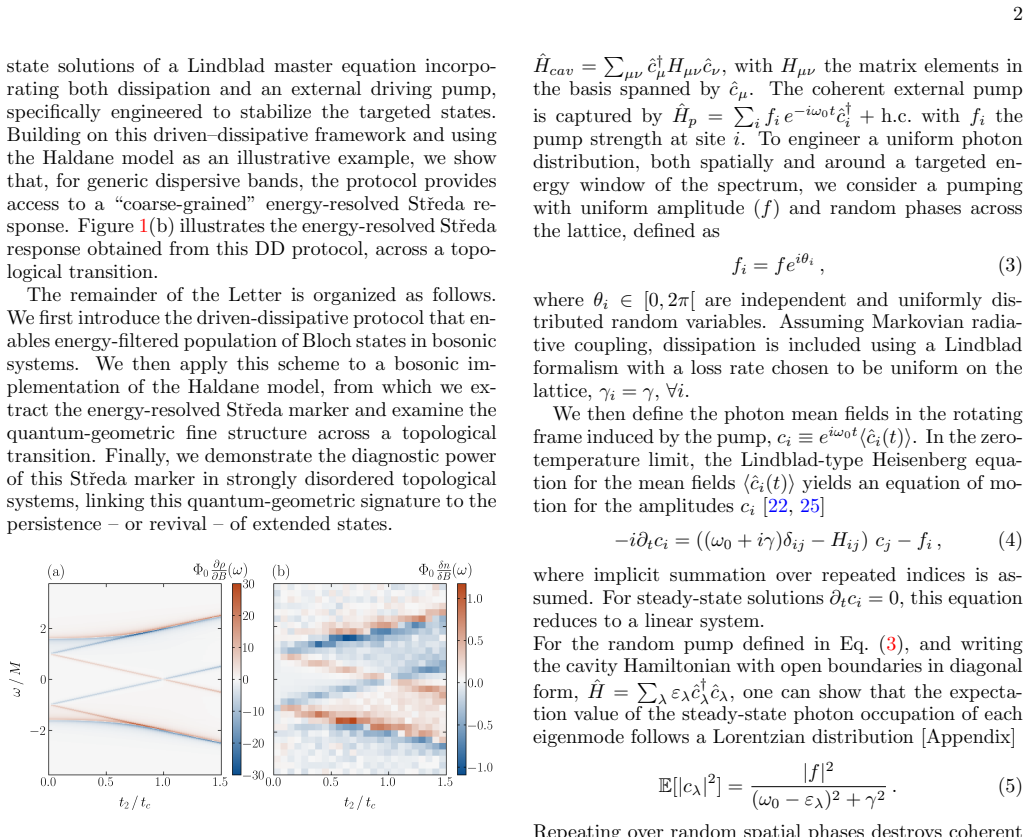
We show that driven-dissipative bosonic lattices provide direct access to both the integrated and energy-resolved Středa responses. Our scheme uses controlled pumping with uniform strength and random phases across the lattice, together with uniform loss, to yield a Lorentzian filter of eigenmode occupations. For generic dispersive bands, this enables reconstruction of a coarse-grained energy-resolved Středa response, establishing these platforms as versatile probes of anomalous spectral flow and energy-resolved quantum geometry. As a striking application, we show that this marker elucidates the fate of topological bands under strong disorder, capturing the quantum-geometric structure of the
What carries the argument
The Lorentzian filter of eigenmode occupations generated by uniform-strength random-phase pumping combined with uniform loss, which samples the magnetic-field response of the density of states at specific energies.
If this is right
- The platforms become direct probes of anomalous spectral flow in addition to the integrated Chern number.
- Topological bands can be tracked through the disorder-driven transition into topological Anderson insulators via their quantum-geometric signatures.
- The method supplies a coarse-grained energy-resolved Středa response for any dispersive band that can be prepared in a driven-dissipative bosonic lattice.
- Local density measurements under controlled pumping suffice to extract both integrated and spectrally resolved topological markers.
Where Pith is reading between the lines
- The same pumping-loss filter could be adapted to extract other energy-resolved geometric quantities such as the quantum metric tensor in non-Hermitian or open settings.
- Cold-atom or photonic realizations of the scheme would allow direct comparison of the measured Středa marker against exact diagonalization of finite disordered samples.
- The approach suggests a route to measure spectral flow in systems where conventional Hall conductivity is inaccessible due to dissipation or particle loss.
Load-bearing premise
The Lorentzian filter created by uniform pumping and loss accurately reconstructs the energy-resolved magnetic response of the density of states for generic dispersive bands, even when strong disorder is present.
What would settle it
A numerical or experimental check in which the reconstructed energy-resolved Středa marker fails to match the independently computed quantum metric or Berry curvature integrated over a known clean topological band or a disordered Anderson insulator.
Figures


read the original abstract
The St\v{r}eda formula links the Hall conductivity of an insulator to the magnetic-field response of its particle density, providing a local and universal probe of the topological Chern number. Beyond this quantized response, an energy-resolved St\v{r}eda marker can be defined from the magnetic response of the density of states, revealing detailed features of the quantum geometry of Bloch bands. We show that driven-dissipative bosonic lattices provide direct access to both the integrated and energy-resolved St\v{r}eda responses. Our scheme uses controlled pumping with uniform strength and random phases across the lattice, together with uniform loss, to yield a Lorentzian filter of eigenmode occupations. For generic dispersive bands, this enables reconstruction of a coarse-grained energy-resolved St\v{r}eda response, establishing these platforms as versatile probes of anomalous spectral flow and energy-resolved quantum geometry. As a striking application, we show that this marker elucidates the fate of topological bands under strong disorder, capturing the quantum-geometric structure underlying topological Anderson insulators.
Editorial analysis
A structured set of objections, weighed in public.
Referee Report
Summary. The paper proposes that driven-dissipative bosonic lattices with uniform-strength random-phase pumping and uniform loss generate a Lorentzian filter on eigenmode occupations, enabling direct reconstruction of both the integrated and energy-resolved Středa responses. This provides access to energy-resolved quantum geometry for generic dispersive bands and, as a key application, elucidates the persistence of topological quantum geometry in strongly disordered systems such as topological Anderson insulators.
Significance. If the central reconstruction holds, the scheme supplies a practical, local probe of anomalous spectral flow and band geometry in open bosonic platforms that complements closed-system measurements. The extension to disordered topological bands is potentially valuable because it targets a regime where conventional transport or spectroscopy can be ambiguous.
major comments (1)
- [Application to disordered systems] The derivation of the Lorentzian filter (uniform pumping + uniform loss) is stated to hold for generic dispersive bands, yet the application to topological Anderson insulators under strong disorder assumes the same filter continues to sample localized eigenstates uniformly enough to recover the magnetic response of the density of states. No explicit check is provided that disorder-induced localization or level repulsion leaves the effective filter width and the resulting Středa marker undistorted.
minor comments (2)
- [Introduction] Notation for the energy-resolved Středa marker should be introduced with an explicit definition (e.g., as a function of energy and magnetic field) before its reconstruction is discussed.
- [Abstract] The abstract and main text should clarify the range of validity of the coarse-graining implicit in the Lorentzian filter (e.g., relative to the bandwidth or disorder strength).
Simulated Author's Rebuttal
We thank the referee for the constructive comment and positive assessment of the work. We address the concern about the robustness of the Lorentzian filter under strong disorder below.
read point-by-point responses
-
Referee: [Application to disordered systems] The derivation of the Lorentzian filter (uniform pumping + uniform loss) is stated to hold for generic dispersive bands, yet the application to topological Anderson insulators under strong disorder assumes the same filter continues to sample localized eigenstates uniformly enough to recover the magnetic response of the density of states. No explicit check is provided that disorder-induced localization or level repulsion leaves the effective filter width and the resulting Středa marker undistorted.
Authors: The derivation of the Lorentzian filter follows directly from the steady-state solution of the Lindblad master equation with site-local pumping of uniform strength and random phases together with uniform loss. This yields an eigenmode occupation that is strictly a function of the mode energy (Lorentzian centered at the pump frequency), independent of the spatial support of the eigenmode. Consequently the filter applies to both extended and localized states; random phases ensure that the effective pumping rate into a normalized mode remains uniform on average regardless of localization. Nevertheless, to directly address the referee's request for an explicit check against possible distortions from localization or level repulsion, we will add numerical verification in the revised manuscript (new supplementary figure) confirming that the reconstructed energy-resolved Středa marker in the topological Anderson insulator regime remains undistorted and consistent with the expected quantum geometry. revision: yes
Circularity Check
No significant circularity; derivation self-contained
full rationale
The paper proposes using driven-dissipative bosonic lattices with uniform-strength random-phase pumping plus uniform loss to produce a Lorentzian filter on eigenmode occupations, thereby accessing the integrated and energy-resolved Středa responses. This construction rests on the pre-existing Středa formula (linking Hall conductivity to magnetic-field response of density) and standard Lindblad master equations for open systems; neither the target marker nor its energy resolution is defined in terms of the proposed filter, nor is any parameter fitted to data and then relabeled as a prediction. The application to topological Anderson insulators under disorder is presented as a direct consequence of the same framework without redefinition or self-referential closure. No load-bearing step reduces to a self-citation chain, ansatz smuggled via prior work, or renaming of known results. The derivation remains independent of its own outputs.
Axiom & Free-Parameter Ledger
axioms (2)
- domain assumption The Středa formula and its energy-resolved extension apply to Bloch bands in both closed and driven-dissipative settings.
- domain assumption Uniform pumping with random phases plus uniform loss produces a Lorentzian filter on eigenmode occupations for generic dispersive bands.
Lean theorems connected to this paper
-
IndisputableMonolith/Cost/FunctionalEquation.leanwashburn_uniqueness_aczel unclearOur scheme uses controlled pumping with uniform strength and random phases across the lattice, together with uniform loss, to yield a Lorentzian filter of eigenmode occupations... Φ0 ∂ρ(ω)/∂B |_{B=0} = ∫ [F_xy(k) δ(ω-ε_k) + ... ]
-
IndisputableMonolith/Foundation/AlexanderDuality.leanalexander_duality_circle_linking unclearenergy-resolved Středa marker... topological Anderson insulators
Reference graph
Works this paper leans on
-
[1]
D. J. Thouless, M. Kohmoto, M. P. Nightingale, and M. den Nijs, Phys. Rev. Lett.49, 405 (1982)
work page 1982
-
[2]
B. I. Halperin, Phys. Rev. B25, 2185 (1982)
work page 1982
- [3]
-
[4]
J. E. Avron and R. Seiler, Phys. Rev. Lett.54, 259 (1985)
work page 1985
-
[5]
Q. Niu, D. J. Thouless, and Y.-S. Wu, Phys. Rev. B31, 3372 (1985)
work page 1985
-
[6]
Streda, Journal of Physics C: Solid State Physics15, L717 (1982)
P. Streda, Journal of Physics C: Solid State Physics15, L717 (1982)
work page 1982
- [7]
-
[8]
P. Streda and L. Smrcka, Journal of Physics C: Solid State Physics16, L895 (1983)
work page 1983
-
[9]
D. Xiao, J. Shi, and Q. Niu, Phys. Rev. Lett.95, 137204 (2005)
work page 2005
- [10]
-
[11]
C. Duval, Z. Horv´ ath, P. A. Horv´ athy, L. Martina, and P. C. Stichel, Modern Physics Letters B20, 373 (2006), https://doi.org/10.1142/S0217984906010573
-
[12]
L. Peralta Gavensky, G. Usaj, and N. Goldman, Phys. Rev. X15, 031067 (2025)
work page 2025
- [13]
-
[14]
S. A. Yang, Z. Qiao, Y. Yao, J. Shi, and Q. Niu, Euro- physics Letters95, 67001 (2011)
work page 2011
-
[15]
Z. Qiao, Y. Han, L. Zhang, K. Wang, X. Deng, H. Jiang, S. A. Yang, J. Wang, and Q. Niu, Phys. Rev. Lett.117, 056802 (2016)
work page 2016
- [16]
-
[17]
Prodan, Journal of Physics A: Mathematical and The- oretical44, 113001 (2011)
E. Prodan, Journal of Physics A: Mathematical and The- oretical44, 113001 (2011)
work page 2011
-
[18]
L. Lu, J. D. Joannopoulos, and M. Soljaˇ ci´ c, Nature pho- tonics8, 821 (2014)
work page 2014
-
[19]
A. B. Khanikaev and G. Shvets, Nature photonics11, 763 (2017)
work page 2017
- [20]
- [21]
- [22]
- [23]
-
[24]
A local quantized marker for topological magnons from circu- lar dichroism,
B. Bermond, A. Defossez, and N. Goldman, “A local quantized marker for topological magnons from circu- lar dichroism,” (2025), arXiv:2504.17374 [cond-mat.mes- hall]
-
[25]
H. M. Price, O. Zilberberg, T. Ozawa, I. Carusotto, and N. Goldman, Phys. Rev. B93, 245113 (2016)
work page 2016
- [26]
-
[27]
H.-T. Lim, E. Togan, M. Kroner, J. Miguel-Sanchez, and A. Imamo˘ glu, Nature communications8, 14540 (2017)
work page 2017
-
[28]
F. D. M. Haldane, Phys. Rev. Lett.61, 2015 (1988)
work page 2015
-
[29]
R. B. Laughlin, Phys. Rev. Lett.52, 2304 (1984)
work page 1984
- [30]
-
[31]
C. W. Groth, M. Wimmer, A. R. Akhmerov, J. Tworzyd lo, and C. W. J. Beenakker, Phys. Rev. Lett. 103, 196805 (2009)
work page 2009
-
[32]
Y.-Y. Zhang, R.-L. Chu, F.-C. Zhang, and S.-Q. Shen, Phys. Rev. B85, 035107 (2012)
work page 2012
-
[33]
Topological fine structure of an energy band,
H. Liu, C. Fulga, E. J. Bergholtz, and J. Asboth, “Topological fine structure of an energy band,” (2023), arXiv:2312.08436 [cond-mat.mes-hall]
-
[34]
B. D. Assun ¸ c ao, G. J. Ferreira, and C. H. Lewenkopf, Phys. Rev. B109, L201102 (2024)
work page 2024
-
[35]
Universal multifrac- tality at the topological anderson insulator transition,
K. Kovalenka, A. Ranjbar, S. Azadi, R. V. Belosludov, T. D. K¨ uhne, and M. S. Bahramy, “Universal multifrac- tality at the topological anderson insulator transition,” (2026), arXiv:2601.22065 [cond-mat.mtrl-sci]
-
[36]
Local topological markers for Chern insulators in ribbon geometry
M. Repˇ se, T. Rejec, and J. Mravlje, “Local topological markers for chern insulators in ribbon geometry,” (2026), arXiv:2604.10190 [cond-mat.mes-hall]
work page internal anchor Pith review Pith/arXiv arXiv 2026
-
[37]
T. V. C. Ant˜ ao, Y. Sun, A. O. Fumega, and J. L. Lado, Phys. Rev. Lett.136, 156601 (2026)
work page 2026
-
[38]
M. Jamotte, L. Peralta Gavensky, C. Morais Smith, M. Di Liberto, and N. Goldman, Communications Physics6, 264 (2023)
work page 2023
-
[39]
J. Noh, S. Huang, K. P. Chen, and M. C. Rechtsman, Phys. Rev. Lett.120, 063902 (2018)
work page 2018
-
[40]
J.-W. Dong, X.-D. Chen, H. Zhu, Y. Wang, and X. Zhang, Nature materials16, 298 (2017)
work page 2017
-
[41]
H. Xue, Y. Yang, and B. Zhang, Advanced Photonics Research2, 2100013 (2021)
work page 2021
- [42]
-
[43]
M. D. Reichl and E. J. Mueller, Phys. Rev. A89, 063628 (2014)
work page 2014
-
[44]
K. Wintersperger, C. Braun, F. N. ¨Unal, A. Eckardt, M. D. Liberto, N. Goldman, I. Bloch, and M. Aidels- burger, Nature Physics16, 1058 (2020)
work page 2020
- [45]
- [46]
-
[47]
Quan- tized Chern-Simons Axion Coupling in Anomalous Flo- quet Systems,
L. P. Gavensky, N. Goldman, and G. Usaj, “Quan- tized Chern-Simons Axion Coupling in Anomalous Flo- quet Systems,” (2025), arXiv:2506.20719 [cond-mat.mes- hall]
-
[48]
H. Liu, I. C. Fulga, and J. K. Asb´ oth, Phys. Rev. Res. 2, 022048 (2020)
work page 2020
-
[49]
M. Rechtsman, A. Szameit, F. Dreisow, M. Heinrich, R. Keil, S. Nolte, and M. Segev, Phys. Rev. Lett.106, 193904 (2011)
work page 2011
-
[50]
B. Yang, H. Zhang, T. Wu, R. Dong, X. Yan, and X. Zhang, Physical Review B99, 045307 (2019)
work page 2019
-
[51]
D.-T. Tran, A. Dauphin, N. Goldman, and P. Gaspard, Phys. Rev. B91, 085125 (2015)
work page 2015
-
[52]
M. A. Bandres, M. C. Rechtsman, and M. Segev, Phys. Rev. X6, 011016 (2016)
work page 2016
-
[53]
P. A. McClarty, Annual Review of Condensed Matter Physics13, 171 (2022)
work page 2022
-
[54]
F. Zhuo, J. Kang, A. Manchon, and Z. Cheng, Advanced Physics Research4, 2300054 (2025)
work page 2025
-
[55]
B. Wang, M. Aidelsburger, J. Dalibard, A. Eckardt, and N. Goldman, Phys. Rev. Lett.132, 163402 (2024). 7
work page 2024
-
[56]
C. Repellin, J. L´ eonard, and N. Goldman, Phys. Rev. A 102, 063316 (2020)
work page 2020
-
[57]
J. L´ eonard, S. Kim, J. Kwan, P. Segura, F. Grusdt, C. Repellin, N. Goldman, and M. Greiner, Nature619, 495 (2023)
work page 2023
-
[58]
L. Peralta Gavensky, S. Sachdev, and N. Goldman, Phys. Rev. Lett.131, 236601 (2023)
work page 2023
- [59]
-
[60]
J. K. Asb´ oth and A. Alberti, Physical Review Letters 118(2017), 10.1103/physrevlett.118.216801
-
[61]
P. G. Harper, Proceedings of the Physical Society. Section A68, 874 (1955)
work page 1955
-
[62]
D. R. Hofstadter, Phys. Rev. B14, 2239 (1976)
work page 1976
- [63]
-
[64]
P. d’Ornellas, R. Barnett, and D. K. K. Lee, Phys. Rev. B106, 155124 (2022)
work page 2022
-
[65]
A. Weiße, G. Wellein, A. Alvermann, and H. Fehske, Rev. Mod. Phys.78, 275 (2006). Appendix Appendix A: Steady-state photon occupation distribution from the random pumping We provide here the derivation of Eq. (5). Our starting point is the Lindblad-type Heisenberg equation of motion for an operator ˆA i d⟨ ˆA⟩ dt =⟨[ ˆA, ˆH]⟩+i X σ γσ D 2 ˆL† σ ˆAˆLσ − n ...
work page 2006
-
[66]
Standard deviation analysis The DD scheme presented in the main text produces inherently random outcomes due to the random phases entering the pumping protocol. In the limit of an infinite number of realizations, one expects the steady-state population to converge to the ideal distribution given by Eq. (5), and consequently, the extracted Stˇ reda respons...
-
[67]
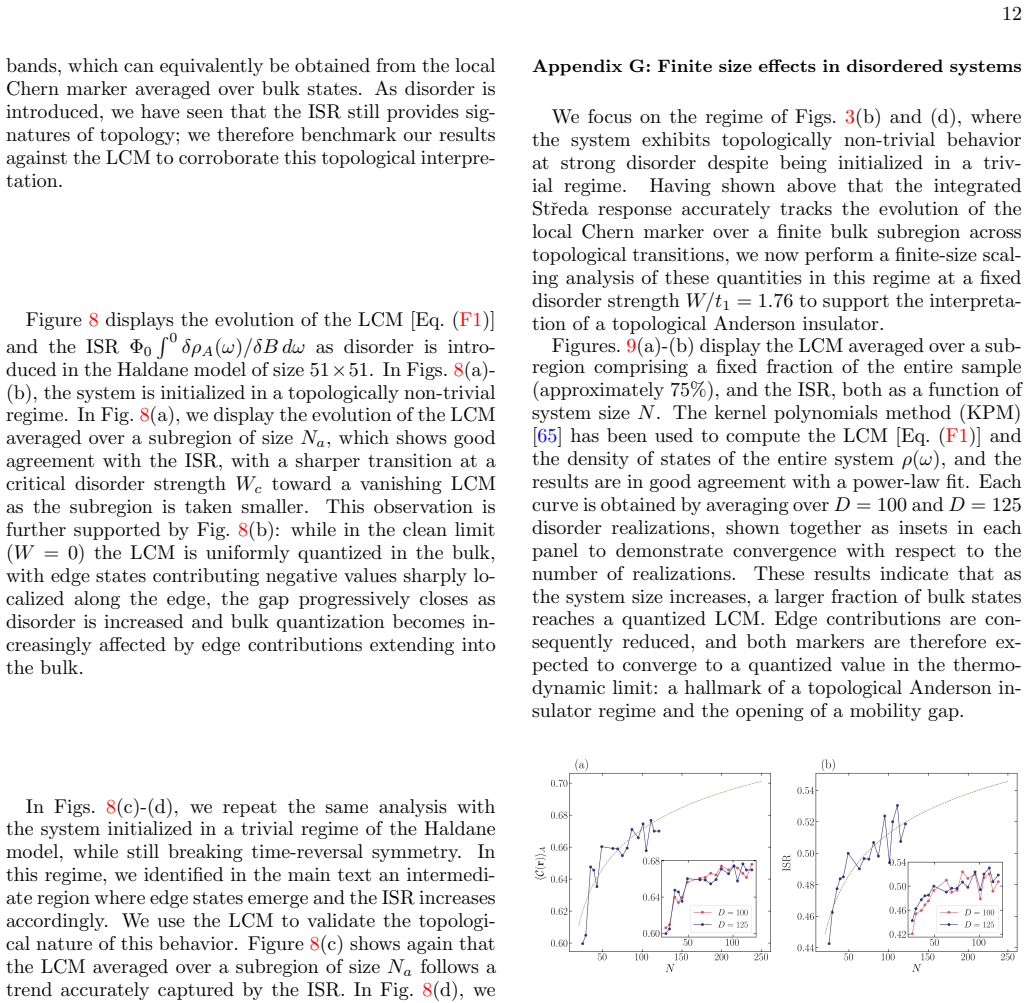
has been used to compute the LCM [Eq. (F1)] and the density of states of the entire systemρ(ω), and the results are in good agreement with a power-law fit. Each curve is obtained by averaging overD= 100 andD= 125 disorder realizations, shown together as insets in each panel to demonstrate convergence with respect to the number of realizations. These resul...
discussion (0)
Sign in with ORCID, Apple, or X to comment. Anyone can read and Pith papers without signing in.