Recognition: unknown
A Theoretical Investigation of He I Line Profiles for the Spectroscopic Analysis of DB White Dwarfs
Pith reviewed 2026-05-10 15:36 UTC · model grok-4.3
The pith
Computer simulations of Stark broadening give different He I line profiles than the semi-analytical methods long used for DB white dwarf spectroscopy.
A machine-rendered reading of the paper's core claim, the machinery that carries it, and where it could break.
Core claim
The authors show that Stark-broadened He I line profiles computed from computer simulations produce measurably different outcomes from the semi-analytical profiles that are routinely adopted in DB white dwarf analyses. Their comprehensive re-analysis of the SDSS DR17 sample incorporates the effects of frequency sampling, Doppler broadening, line dissolution, neutral-particle broadening, and three-dimensional hydrodynamical corrections, with the simulation-based profiles serving as the reference point for the comparison.
What carries the argument
Stark-broadened He I line profiles obtained from computer simulations, used as the benchmark against which traditional semi-analytical profiles are tested.
If this is right
- Atmospheric parameters derived for DB white dwarfs will shift when simulation-based profiles replace semi-analytical ones.
- Surface gravity and effective temperature scales for the DB population will change, altering inferred masses and cooling ages.
- Large-scale surveys such as SDSS will yield updated statistics on the DB white dwarf luminosity function and space density.
- Future spectroscopic pipelines for helium-rich white dwarfs must decide which broadening treatment to adopt as standard.
Where Pith is reading between the lines
- Adoption of the simulation profiles could require re-calibration of model atmospheres for other helium-dominated objects such as subdwarf B stars.
- Direct observational tests against independent temperature indicators, such as ultraviolet photometry or parallax distances, would provide an external check on which profile set is preferred.
- Extending the same simulation approach to additional He I lines or to mixed H/He compositions would test the generality of the reported differences.
Load-bearing premise
The computer simulations of Stark broadening accurately reproduce the physical conditions inside the dense, high-gravity atmospheres of DB white dwarfs without introducing unquantified systematic errors.
What would settle it
A set of high-resolution spectra of well-characterized DB white dwarfs in which the observed line shapes are fitted significantly better by one family of profiles than the other would decide whether the simulation-based calculations are the more accurate choice.
Figures




read the original abstract
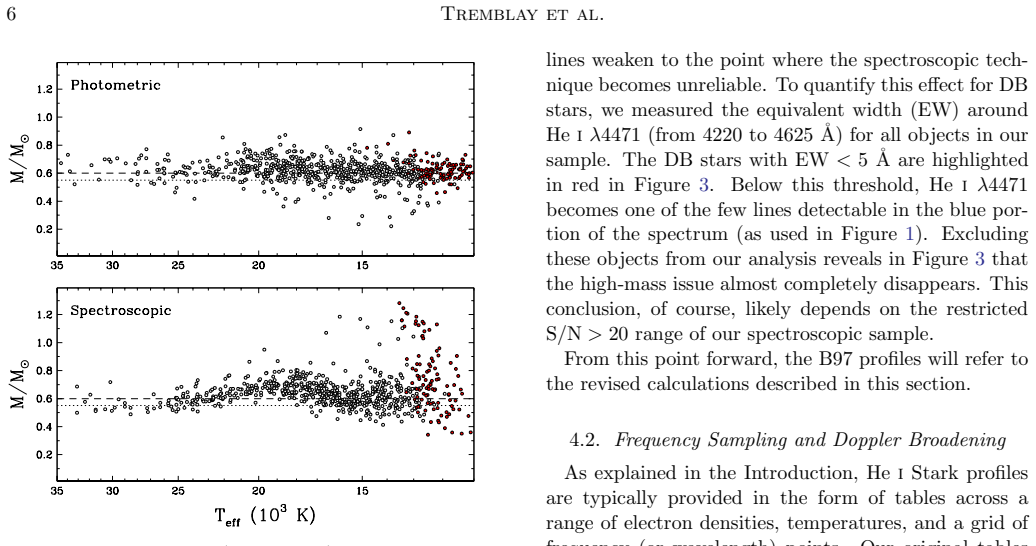
We present a comprehensive investigation of He I line profile calculations used in the spectroscopic analyses of DB white dwarfs. Our study includes an in-depth photometric and spectroscopic analysis of all DB white dwarfs in the Data Release 17 of the Sloan Digital Sky Survey, examining the effects of frequency sampling, Doppler broadening, line dissolution, broadening by neutral particles, and 3D hydrodynamical corrections on our results. More importantly, we compare the outcomes obtained from the semi-analytical He I Stark profiles commonly used in DB white dwarf spectroscopic analyses with our recent calculations of Stark-broadened profiles derived from computer simulations.
Editorial analysis
A structured set of objections, weighed in public.
Referee Report
Summary. The manuscript presents a theoretical investigation of He I line profiles for the spectroscopic analysis of DB white dwarfs. It performs photometric and spectroscopic analysis of all DB white dwarfs in SDSS Data Release 17, exploring the impacts of frequency sampling, Doppler broadening, line dissolution, neutral particle broadening, and 3D hydrodynamical corrections. Central to the work is a comparison between commonly used semi-analytical He I Stark profiles and profiles calculated from computer simulations of Stark broadening.
Significance. If the simulation-based profiles prove more accurate for the dense, high-gravity conditions in DB white dwarf atmospheres, this could lead to improved determinations of effective temperatures, surface gravities, and other parameters from spectroscopy. The comprehensive analysis of a large observational sample and consideration of multiple broadening mechanisms add to the potential significance. However, the work's impact hinges on demonstrating the fidelity of the simulations to real plasma conditions.
major comments (2)
- [Abstract] Abstract: The abstract describes the scope and comparisons but provides no quantitative results, error analysis, or validation details; the full text must be examined to determine whether data exclusions or fitting choices affect the central comparison between the two profile calculation methods.
- [Simulation method] Simulation validation section: The computer simulations of Stark broadening are positioned as an improvement without explicit benchmarks against laboratory data or analytic limits at the electron densities, temperatures, and gravities relevant to DB white dwarfs; this is load-bearing for interpreting reported differences as reflecting improved physics rather than numerical artifacts.
minor comments (1)
- [Methods] Notation for distinguishing Stark, Doppler, and neutral broadening contributions could be clarified in the methods to avoid ambiguity when discussing combined line profiles.
Simulated Author's Rebuttal
We thank the referee for the careful and constructive review of our manuscript. We address each major comment in detail below and indicate the revisions we will make to improve clarity and strengthen the presentation of our results.
read point-by-point responses
-
Referee: [Abstract] Abstract: The abstract describes the scope and comparisons but provides no quantitative results, error analysis, or validation details; the full text must be examined to determine whether data exclusions or fitting choices affect the central comparison between the two profile calculation methods.
Authors: We agree that the abstract would be strengthened by the inclusion of key quantitative findings. In the revised manuscript we will add specific results from the SDSS DR17 analysis, including the typical differences in derived T_eff and log g when switching between the simulation-based and semi-analytical Stark profiles, as well as a concise statement on the sample selection criteria and the main validation steps (frequency sampling, neutral broadening, and 3D corrections) that underpin the comparison. This will allow readers to assess the central results without first consulting the full text. revision: yes
-
Referee: [Simulation method] Simulation validation section: The computer simulations of Stark broadening are positioned as an improvement without explicit benchmarks against laboratory data or analytic limits at the electron densities, temperatures, and gravities relevant to DB white dwarfs; this is load-bearing for interpreting reported differences as reflecting improved physics rather than numerical artifacts.
Authors: The Stark-broadening simulations follow the computational framework we validated in earlier work against both laboratory measurements and analytic limits over the electron-density and temperature range relevant to DB white dwarfs. To make this validation explicit within the present manuscript, we will expand the simulation-methods section with a concise summary of those benchmarks, quoting the level of agreement achieved at n_e ~ 10^16–10^18 cm^{-3} and T ~ 10 000–30 000 K. This addition will allow readers to judge directly whether the reported profile differences arise from improved physics rather than numerical effects. revision: yes
Circularity Check
No circularity: direct comparison of independent Stark profile methods against observations
full rationale
The paper's core activity is a side-by-side comparison of two distinct He I Stark broadening calculations (standard semi-analytical profiles versus profiles obtained from computer simulations) when applied to SDSS DR17 DB white dwarf spectra, together with explicit checks on frequency sampling, Doppler broadening, line dissolution, neutral broadening, and 3D corrections. No equation, fitted parameter, or reported outcome is shown to be mathematically equivalent to its own input by construction, and the reference to 'our recent calculations' simply identifies the provenance of one of the two methods being contrasted rather than serving as the sole justification for the comparison result. The analysis therefore remains self-contained against external benchmarks.
Axiom & Free-Parameter Ledger
axioms (2)
- domain assumption Stark broadening dominates the shape of He I lines in DB white dwarf atmospheres
- domain assumption Computer simulations provide a more accurate representation of Stark broadening than semi-analytical approximations
Reference graph
Works this paper leans on
-
[1]
W., & Griem, H
Ali, A. W., & Griem, H. R. 1965, Phys. Rev., 140, A1044
1965
-
[2]
1962, Pure and Applied Physics, 13, 493
Baranger, M. 1962, Pure and Applied Physics, 13, 493
1962
-
[3]
J., & Cooper, J
Barnard, A. J., & Cooper, J. 1970, JQSRT, 10, 695
1970
-
[4]
J., Cooper, J., & Shamey, L
Barnard, A. J., Cooper, J., & Shamey, L. J. 1969, A&A, 1, 28
1969
-
[5]
1995, PhD thesis, Universit´ e de Montr´ eal
Beauchamp, A. 1995, PhD thesis, Universit´ e de Montr´ eal
1995
-
[6]
1997, ApJS, 108, 559 B´ edard, A
Beauchamp, A., Wesemael, F., & Bergeron, P. 1997, ApJS, 108, 559 B´ edard, A. 2024, Ap&SS, 369, 43 B´ edard, A., Bergeron, P., Brassard, P., & Fontaine, G. 2020, ApJ, 901, 93
1997
-
[7]
2019, ApJ, 876, 67
Bergeron, P., Dufour, P., Fontaine, G., et al. 2019, ApJ, 876, 67
2019
-
[8]
K., & Ruiz, M
Bergeron, P., Leggett, S. K., & Ruiz, M. T. 2001, ApJS, 133, 413
2001
-
[9]
T., & Leggett, S
Bergeron, P., Ruiz, M. T., & Leggett, S. K. 1997, ApJS, 108, 339
1997
-
[10]
A., & Liebert, J
Bergeron, P., Saffer, R. A., & Liebert, J. 1992, ApJ, 394, 228
1992
-
[11]
1991, ApJ, 367, 253
Bergeron, P., Wesemael, F., & Fontaine, G. 1991, ApJ, 367, 253
1991
-
[12]
2011, ApJ, 737, 28
Bergeron, P., Wesemael, F., Dufour, P., et al. 2011, ApJ, 737, 28
2011
-
[13]
L., Elyajouri, M., & Monreal-Ibero, A
Capitanio, L., Lallement, R., Vergely, J. L., Elyajouri, M., & Monreal-Ibero, A. 2017, A&A, 606, A65
2017
-
[14]
Caron, A., Bergeron, P., Blouin, S., & Leggett, S. K. 2023, MNRAS, 519, 4529
2023
-
[15]
Chambers, K. C., Magnier, E. A., Metcalfe, N., et al. 2016, arXiv e-prints, arXiv:1612.05560
work page internal anchor Pith review Pith/arXiv arXiv 2016
-
[16]
B., Gomez, T
Cho, P. B., Gomez, T. A., Montgomery, M. H., et al. 2022, ApJ, 927, 70
2022
-
[17]
2021, MNRAS, 501, 5274
Cukanovaite, E., Tremblay, P.-E., Bergeron, P., et al. 2021, MNRAS, 501, 5274
2021
-
[18]
E., Freytag, B., Ludwig, H
Cukanovaite, E., Tremblay, P. E., Freytag, B., Ludwig, H. G., & Bergeron, P. 2018, MNRAS, 481, 1522 D¨ appen, W., Anderson, L., & Mihalas, D. 1987, ApJ, 319, 195
2018
-
[19]
1976, A&AS, 23, 147
Deridder, G., & van Rensbergen, W. 1976, A&AS, 23, 147
1976
-
[20]
2005, ApJ, 627, 404
Dufour, P., Bergeron, P., & Fontaine, G. 2005, ApJ, 627, 404
2005
-
[21]
2007, ApJ, 663, 1291
Dufour, P., Bergeron, P., Liebert, J., et al. 2007, ApJ, 663, 1291
2007
-
[22]
S., Koester, D., & Basri, G
Finley, D. S., Koester, D., & Basri, G. 1997, ApJ, 488, 375
1997
-
[23]
2001, PASP, 113, 409 Gaia Collaboration, Babusiaux, C., van Leeuwen, F., et al
Fontaine, G., Brassard, P., & Bergeron, P. 2001, PASP, 113, 409 Gaia Collaboration, Babusiaux, C., van Leeuwen, F., et al. 2018, A&A, 616, A10
2001
-
[24]
2014, ApJ, 796, 128 —
Genest-Beaulieu, C., & Bergeron, P. 2014, ApJ, 796, 128 —. 2019a, ApJ, 871, 169 —. 2019b, ApJ, 882, 106 Gentile Fusillo, N. P., Tremblay, P.-E., G¨ ansicke, B. T., et al. 2019, MNRAS, 482, 4570
2014
-
[25]
A., & Carde˜ noso, V
Gigosos, M. A., & Carde˜ noso, V. 1996, Journal of Physics B Atomic Molecular Physics, 29, 4795
1996
-
[26]
A., & Cardenoso, V
Gigosos, M. A., & Cardenoso, V. 1987, Journal of Physics B Atomic Molecular Physics, 20, 6005
1987
-
[27]
A., Fraile, J., & Torres, F
Gigosos, M. A., Fraile, J., & Torres, F. 1985, PhRvA, 31, 3509
1985
-
[28]
A., & Gonz´ alez, M.´A
Gigosos, M. A., & Gonz´ alez, M.´A. 2009, A&A, 503, 293
2009
-
[29]
P., & Winget, D
Kilcrease, D. P., & Winget, D. E. 2017, in Astronomical Society of the Pacific Conference Series, Vol. 509, 20th European White Dwarf Workshop, ed. P. E. Tremblay, B. Gaensicke, & T. Marsh, 143
2017
-
[30]
R., Baranger, M., Kolb, A
Griem, H. R., Baranger, M., Kolb, A. C., & Oertel, G. 1962, Physical Review, 125, 177
1962
-
[31]
B., & Bergeron, P
Holberg, J. B., & Bergeron, P. 2006, AJ, 132, 1221
2006
-
[32]
Hooper, C. F. 1968, Physical Review, 169, 193
1968
-
[33]
G., & Mihalas, D
Hummer, D. G., & Mihalas, D. 1988, ApJ, 331, 794
1988
-
[34]
2025, ApJ, 979, 157
Kilic, M., Bergeron, P., Blouin, S., et al. 2025, ApJ, 979, 157
2025
-
[35]
2020, ApJ, 898, 84
Kilic, M., Bergeron, P., Kosakowski, A., et al. 2020, ApJ, 898, 84
2020
-
[36]
L., Valette, B., et al
Lallement, R., Vergely, J. L., Valette, B., et al. 2014, A&A, 561, A91
2014
-
[37]
Lara, N., Gonz´ alez, M.´A., & Gigosos, M. A. 2012, A&A, 542, A75
2012
-
[38]
Lewis, E. L. 1967, in Proc. Phys. Soc., Vol. 92, 817
1967
-
[39]
Liebert, J., Bergeron, P., & Holberg, J. B. 2005, ApJS, 156, 47
2005
-
[40]
P., et al
McCleery, J., Tremblay, P.-E., Gentile Fusillo, N. P., et al. 2020, MNRAS, 499, 1890
2020
-
[41]
1978, Stellar Atmospheres (San Francisco: W
Mihalas, D. 1978, Stellar Atmospheres (San Francisco: W. H. Freeman) DB White Dwarfs Revisited17 O’Brien, M. W., Tremblay, P. E., Klein, B. L., et al. 2024, MNRAS, 527, 8687
1978
-
[42]
2018, ApJ, 857, 56
Rolland, B., Bergeron, P., & Fontaine, G. 2018, ApJ, 857, 56
2018
-
[43]
2020, JQSRT, 249, 107002
Rosato, J., Marandet, Y., & Stamm, R. 2020, JQSRT, 249, 107002
2020
-
[44]
Seaton, M. J. 1990, Journal of Physics B Atomic Molecular Physics, 23, 3255
1990
-
[45]
2020, ApJ, 901, 104
Tremblay, P., Beauchamp, A., & Bergeron, P. 2020, ApJ, 901, 104
2020
-
[46]
2026, ApJ, 1000, 253
Tremblay, P., Beauchamp, A., Bergeron, P., & B´ edard, A. 2026, ApJ, 1000, 253
2026
-
[47]
E., & Bergeron, P
Tremblay, P. E., & Bergeron, P. 2009, ApJ, 696, 1755
2009
-
[48]
2011, ApJ, 730, 128
Tremblay, P.-E., Bergeron, P., & Gianninas, A. 2011, ApJ, 730, 128
2011
-
[49]
Cunningham, T., & Hollands, M. A. 2019, MNRAS, 482, 5222
2019
-
[50]
1955, Physik der Sternatmospharen, MIT besonderer Berucksichtigung der Sonne., Vol
Unsold, A. 1955, Physik der Sternatmospharen, MIT besonderer Berucksichtigung der Sonne., Vol. 2 (Springer)
1955
-
[51]
R., Cooper, J., & Smith, E
Vidal, C. R., Cooper, J., & Smith, E. W. 1973, ApJS, 25, 37
1973
-
[52]
G., Adelman, J., Anderson, John E., J., et al
York, D. G., Adelman, J., Anderson, John E., J., et al. 2000, AJ, 120, 1579
2000
discussion (0)
Sign in with ORCID, Apple, or X to comment. Anyone can read and Pith papers without signing in.