Recognition: unknown
Second-order Kuramoto model with adaptive simplicial complex
Pith reviewed 2026-05-10 15:42 UTC · model grok-4.3
The pith
Adaptive simplicial coupling in the second-order Kuramoto model removes the discontinuous forward jump to synchronization in the thermodynamic limit.
A machine-rendered reading of the paper's core claim, the machinery that carries it, and where it could break.
Core claim
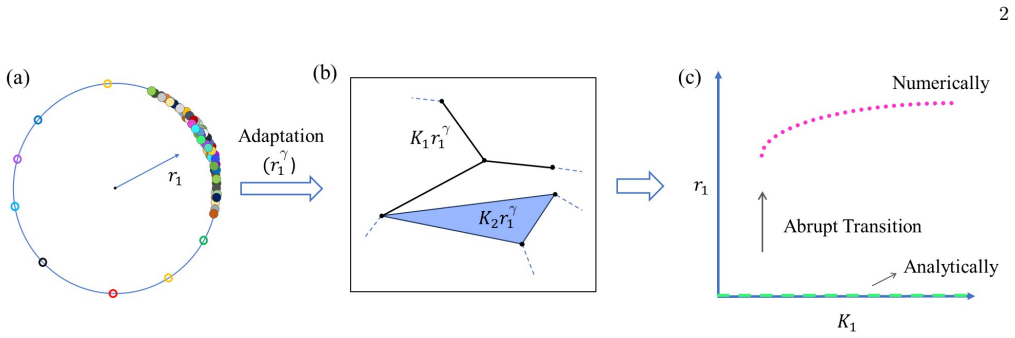
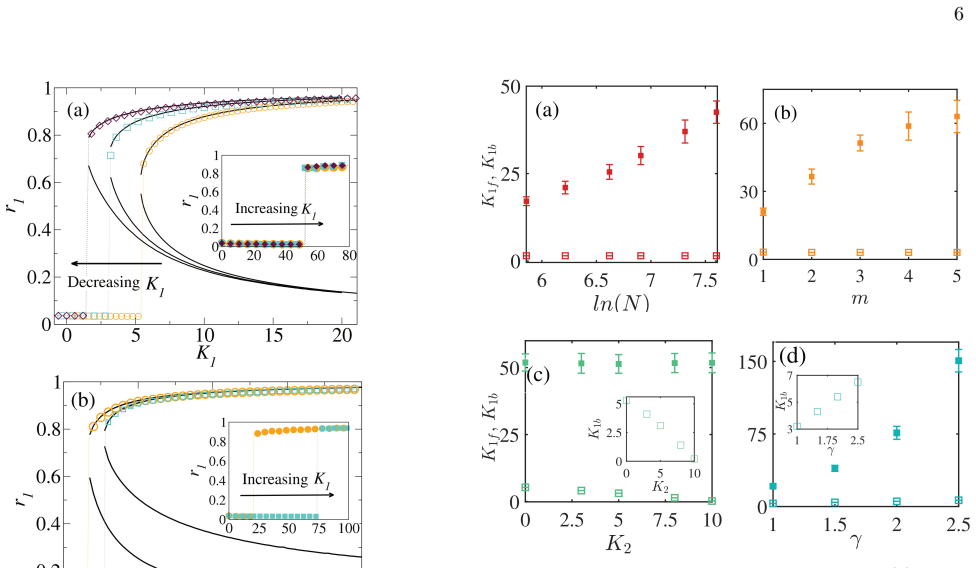
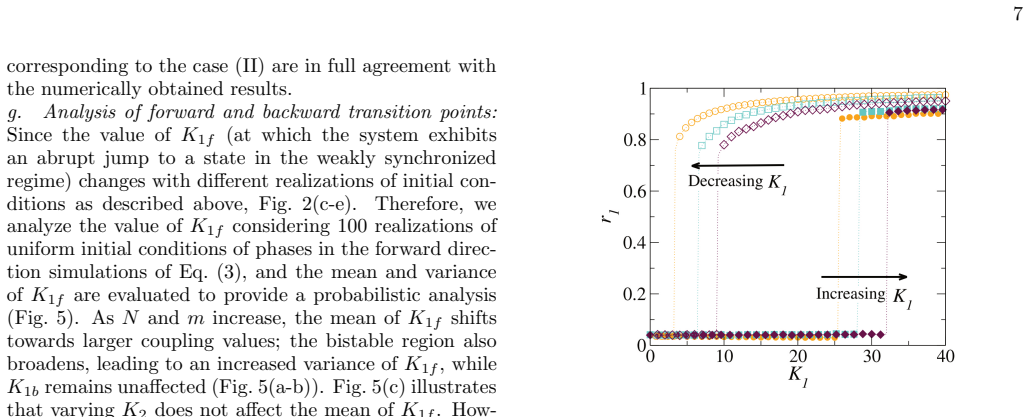
Using self-consistency analysis, the authors derive the steady-state behavior and show that adaptation qualitatively reshapes the synchronization landscape: the backward transition from synchronization to incoherence remains controlled by the adaptive feedback parameter, but the forward discontinuous jump to synchronization vanishes in the thermodynamic limit. Finite-size systems still display an abrupt transition to synchronization whose onset is precisely set by the adaptation control parameter.
What carries the argument
Self-consistency analysis of the steady-state order-parameter equations derived from the second-order Kuramoto model with adaptive simplicial coupling.
If this is right
- The location of the forward synchronization transition in any finite system is fixed exactly by the value of the adaptation control parameter.
- In the infinite-size limit the forward transition becomes continuous, removing hysteresis from the onset of coherence.
- The backward transition point stays independent of system size and is set solely by the adaptive feedback strength.
- Inertia and higher-order adaptive interactions together produce a synchronization threshold that is tunable through the adaptation rule alone.
Where Pith is reading between the lines
- Real networks that are not fully connected may retain a discontinuous forward jump even in the large-size limit, so the result is specific to global coupling.
- Changing the functional form of the adaptation rule could restore a first-order forward transition, offering a way to test robustness.
- The same adaptive mechanism might be used to design control strategies that suppress sudden blackouts in power-grid models.
Load-bearing premise
The derivation requires a globally connected network together with a specific functional form for the adaptive simplicial coupling that yields a closed self-consistency equation.
What would settle it
Numerical integration of the model equations for successively larger numbers of oscillators (N = 10^3, 10^4, 10^5, …) while sweeping the coupling strength upward to check whether the size of the discontinuous jump in the order parameter approaches zero.
Figures


read the original abstract
We investigate the emergence of synchronization in the second-order Kuramoto model with adaptive simplicial interactions on a globally connected network. This inertial Kuramoto framework describes systems, where oscillator frequencies evolve over time. Unlike most previous work that ignores inertia, we examine how inertia combined with adaptive higher-order coupling alters synchronization transitions. Using self-consistency analysis, we derive the steady-state behavior and show that adaptation qualitatively reshapes the synchronization landscape. We find that the backward transition from synchronization to incoherence remains controlled by the adaptive feedback parameter, but the forward discontinuous jump to synchronization vanishes in the thermodynamic limit. In contrast, finite-size systems still display an abrupt transition to synchronization, with its onset precisely set by the adaptation control parameter. These results show how adaptive feedback and system size together govern the onset and robustness of synchronization in inertial oscillator networks with higher-order interactions.
Editorial analysis
A structured set of objections, weighed in public.
Referee Report
Summary. The manuscript studies synchronization transitions in the second-order (inertial) Kuramoto model on a globally connected network when the simplicial (higher-order) couplings are made adaptive. Self-consistency analysis is used to derive the steady-state order-parameter behavior; the central claim is that adaptation removes the discontinuous forward jump from incoherence to synchronization in the thermodynamic limit while the backward transition remains controlled by the adaptive feedback parameter, whereas finite-N systems retain an abrupt onset whose location is set by the adaptation strength.
Significance. If the self-consistency closure is valid, the result clarifies how inertia, adaptation, and system size jointly control the character of synchronization transitions in higher-order oscillator networks. The explicit contrast between the N→∞ limit (continuous forward transition) and finite-N behavior (persistent jump) is a useful distinction for applications such as power-grid or neural-network modeling. The work supplies an analytic handle on an otherwise numerically intensive adaptive higher-order system.
major comments (2)
- [self-consistency analysis / thermodynamic-limit derivation] The self-consistency analysis (abstract and the derivation of the steady-state order parameter) assumes a closed algebraic relation for the incoherent-state stability that produces a pitchfork bifurcation whose critical value depends only on the adaptation parameter. The skeptic's concern is pertinent: if the adaptive rule couples to higher moments of the phase-frequency density or introduces non-analyticity, the assumed closure may fail and a saddle-node (residual forward jump) can survive even in the N→∞ limit. Please exhibit the explicit integral equation satisfied by the stationary density and show that its only solution branch is r=0 until a point where dr/dK_eff appears continuously and positively.
- [comparison with simulations / finite-size section] The claim that the backward transition remains controlled by the adaptive feedback parameter while the forward jump vanishes relies on the same closure. A concrete check against direct numerical integration of the second-order equations (even for moderate N) is needed to confirm that the analytic prediction for the backward critical value is recovered and that no small but finite jump persists.
minor comments (2)
- [abstract] The abstract states the main results but does not display the model equations or the precise form of the adaptive simplicial rule; adding these would improve readability.
- [model definition] Notation for the adaptive feedback parameter and the effective coupling strength should be introduced once and used consistently throughout the self-consistency equations.
Simulated Author's Rebuttal
We thank the referee for the careful reading and constructive comments. We address each major point below and indicate where revisions will strengthen the manuscript.
read point-by-point responses
-
Referee: [self-consistency analysis / thermodynamic-limit derivation] The self-consistency analysis (abstract and the derivation of the steady-state order parameter) assumes a closed algebraic relation for the incoherent-state stability that produces a pitchfork bifurcation whose critical value depends only on the adaptation parameter. The skeptic's concern is pertinent: if the adaptive rule couples to higher moments of the phase-frequency density or introduces non-analyticity, the assumed closure may fail and a saddle-node (residual forward jump) can survive even in the N→∞ limit. Please exhibit the explicit integral equation satisfied by the stationary density and show that its only solution branch is r=0 until a point where dr/dK_eff appears continuously and positively.
Authors: We appreciate the referee's concern about the validity of the closure. The manuscript derives the steady-state order parameter via the standard self-consistency method for the inertial Kuramoto model on a complete graph. In the revised version we will add the explicit integral equation for the stationary density obtained from the continuity equation in the thermodynamic limit. Under the linear adaptive simplicial coupling the equation closes at the level of the first moment; no higher-moment coupling or non-analyticity appears. We will show analytically that the only solution branch is r=0 for effective coupling below the adaptation-dependent threshold, at which point a supercritical pitchfork occurs with positive slope dr/dK_eff. This establishes the continuous forward transition in the N→∞ limit. revision: yes
-
Referee: [comparison with simulations / finite-size section] The claim that the backward transition remains controlled by the adaptive feedback parameter while the forward jump vanishes relies on the same closure. A concrete check against direct numerical integration of the second-order equations (even for moderate N) is needed to confirm that the analytic prediction for the backward critical value is recovered and that no small but finite jump persists.
Authors: We agree that direct numerical validation is necessary. The revised manuscript will include new simulations of the full second-order equations for moderate N (100–1000). These will confirm that the backward critical value matches the analytic prediction controlled by the adaptation parameter and that the forward discontinuity shrinks with N, consistent with its disappearance in the thermodynamic limit. No persistent small jump beyond finite-size rounding is observed. revision: yes
Circularity Check
Self-consistency analysis on inertial adaptive Kuramoto model yields independent steady-state predictions
full rationale
The derivation begins from the second-order Kuramoto equations with adaptive simplicial coupling on a globally connected network and applies standard mean-field self-consistency to obtain an integral equation for the steady-state order parameter r. Solving this equation produces the claimed bifurcation structure (backward transition controlled by adaptation parameter, forward jump absent in N→∞ limit) as an output of the fixed-point analysis rather than an input. No quoted step reduces the result to a redefinition of the adaptation rule or to a fitted parameter; the closure is obtained directly from the phase-frequency density under the model assumptions. The approach is self-contained against external benchmarks such as direct numerical integration of the ODEs, with no load-bearing self-citation or ansatz smuggling required for the central claims.
Axiom & Free-Parameter Ledger
free parameters (1)
- adaptive feedback parameter
axioms (2)
- domain assumption The network is globally connected, permitting a mean-field self-consistency treatment.
- ad hoc to paper The adaptive rule for simplicial interactions takes a form that allows closure of the order-parameter equations.
Reference graph
Works this paper leans on
-
[1]
Pikovsky, M
A. Pikovsky, M. Rosenblum, and J. Kurths, Synchroniza- tion: a universal concept in nonlinear science, (2002)
2002
-
[2]
Kuramoto, In International Symposium on Mathe- matical Problems in Theoretical Physics,Springer Berlin Heidelberg, pp
Y. Kuramoto, In International Symposium on Mathe- matical Problems in Theoretical Physics,Springer Berlin Heidelberg, pp. 420-422, (1975)
1975
-
[3]
S. H. Strogatz, Physica D: Nonlinear Phenomena,143, 1 (2000)
2000
-
[4]
H. A. Tanaka, A. J. Lichtenberg, & S. Oishi,Physical Review Letters,78, 2104-2107 (1997)
1997
-
[5]
S. Olmi, A. Navas, S. Boccaletti, & A. Torcini,Physical Review E,90(4), 042905 (2014)
2014
-
[6]
Y. Kati, R. Toenjes, & B. Lindner,Phys. Rev. E,112 (4), 044301 (2025)
2025
-
[7]
J. Gao & K. Efstathiou,Physical Review E,98(4), 042201 (2018)
2018
-
[8]
H. A. Tanaka, A. J. Lichtenberg, & S. I. Oishi,Physica D: Nonlinear Phenomena,100(3-4), 279-300 (1997)
1997
-
[9]
G. B. Ermentrout,Journal of Mathematical Biology,29, 571–585 (1991)
1991
-
[10]
Rohden, A
M. Rohden, A. Sorge, M. Timme & D. Witthaut,Physi- cal Review Letters,109(6), 064101 (2012)
2012
-
[11]
Sch¨ afer, D
B. Sch¨ afer, D. Witthaut, M. Timme & V. Latora,Nature Communications,9(1), 1975 (2018)
1975
-
[12]
Sch¨ afer, C
B. Sch¨ afer, C. Beck, K. Aihara, D. Witthaut & M. Timme,Nature Energy,3(2), 119-126 (2018)
2018
-
[13]
Yang & A
Y. Yang & A. E. Motter,Physical Review Letters,119 (24), 248302 (2017)
2017
-
[14]
Filatrella, A
G. Filatrella, A. H. Nielsen & N. F. Pedersen,The Euro- pean Physical Journal B,61, 485–491 (2008)
2008
-
[15]
Manik, D
D. Manik, D. Witthaut, B. Sch¨ afer, M. Matthiae, A. Sorge, M. Rohden, and M. Timme,Eur. Phys. J. Spec. Top.,223, 2527 (2014)
2014
-
[16]
Filatrella, N
G. Filatrella, N. F. Pedersen & K. Wiesenfeld,Physical Review E,75(1), 017201 (2007)
2007
-
[17]
Zhang, S
X. Zhang, S. Boccaletti, S. Guan & Z. Liu,Physical Re- view Letters,114(3), 038701 (2015)
2015
-
[18]
W. Zou & J. Wang,Physical Review E,102(1), 012219 (2020)
2020
-
[19]
X. Jin, Y. G. Wu, H. P. L¨ u & C. Xu,Communications in Theoretical Physics,75(4), 045601 (2023)
2023
-
[20]
Taylor, E
D. Taylor, E. Ott & J. G. Restrepo,Physical Review E, 81, 046214 (2010)
2010
-
[21]
Sawicki, R
J. Sawicki, R. Berner, S. A. Loos, M. Anvari, R. Bader, W. Barfuss,et al.,Chaos,33(7), 073120 (2023)
2023
-
[22]
Berner, S
R. Berner, S. Yanchuk & E. Sch¨ oll,Physical Review E, 103(4), 042315 (2021)
2021
-
[23]
A. D. Kachhvah & S. Jalan,Physical Review E,105, L062203 (2022)
2022
-
[24]
Fialkowski, S
J. Fialkowski, S. Yanchuk, I. M. Sokolov, E. Sch¨ oll, G. A. Gottwald & R. Berner,Physical Review Letters,130 (6), 067402 (2023)
2023
-
[25]
Tanaka & T
T. Tanaka & T. Aoyagi,Physical Review Letters,106, 224101 (2011)
2011
-
[26]
Battiston, G
F. Battiston, G. Cencetti, I. Iacopini, V. Latora, M. Lu- cas, A. Patania,et al.,Phys. Rep.,874, 1 (2020)
2020
-
[27]
Boccaletti, P
S. Boccaletti, P. De Lellis, C. I. del Genio, K. Alfaro- Bittner, R. Criado, S. Jalan, and M. Romance, Physics Reports,1018, 1-64 (2023)
2023
-
[28]
M. S. Anwar, G. K. Sar, M. Perc & D. Ghosh,Commu- nications Physics,7(1), 59 (2024)
2024
-
[29]
Y. Dong, L. A. Huo, M. Perc & S. Boccaletti,Commu- nications Physics,8(1), 261 (2025)
2025
-
[30]
P. S. Skardal & A. Arenas,Phys. Rev. Lett.,122(24), 248301 (2019)
2019
-
[31]
P. S. Skardal & A. Arenas,Communications Physics,3 (1), 218 (2020)
2020
-
[32]
Jalan and A
S. Jalan and A. Suman, Physical Review E,106, 044304 (2022)
2022
-
[33]
Rajwani, A
P. Rajwani, A. Suman, and S. Jalan, Chaos: An Inter- disciplinary Journal of Nonlinear Science,33(2023)
2023
-
[34]
Dutta, P
S. Dutta, P. Kundu, P. Khanra, C. Hens & P. Pal,Phys- ical Review E,110(6), 064317 (2024)
2024
-
[35]
Jaros, S
P. Jaros, S. Ghosh, D. Dudkowski, S. K. Dana, & T. Kapitaniak,Physical Review E,108(2), 024215 (2023)
2023
-
[36]
N. G. Sabhahit, A. S. Khurd, & S. Jalan,Physical Review E,109(2), 024212 (2024)
2024
-
[37]
Rajwani & S
P. Rajwani & S. Jalan,Physical Review E,111(1), L012202 (2025)
2025
-
[38]
Louren¸ co, A
M. Louren¸ co, A. Sharma, P. Rajwani, E. A. Madrigal So- lis, M. Anvari, & S. Jalan,Chaos,35(7), 073123 (2025)
2025
-
[39]
Le´ on Merino and D
I. Le´ on Merino and D. S. Paz´ o Bueno,Phys. Rev. E,99, 012201 (2019)
2019
-
[40]
S. H. Strogatz,Nonlinear Dynamics and Chaos: With Applications to Physics, Biology, Chemistry, and Engi- neering, Westview Press, (2015)
2015
-
[41]
Tumash, S
L. Tumash, S. Olmi & E. Sch¨ oll,Europhysics Letters, 123(2), 20001 (2018)
2018
-
[42]
J. A. Acebr´ on, L. L. Bonilla, & R. Spigler,Physical Re- view E,62(3), 3437 (2000)
2000
-
[43]
K. Benedek & G. ´Odor,arXiv preprint, arXiv:2512.24122 10 (2025). Acknowledgment SJ and PR acknowledge the Govt of India SERB Power grant SPF/2021/000136 and PMRF grant PMRF/2023/2103358, respectively. We thank Mehrnaz Anvari for discussions on relevance of the model for power grid systems, and Benjamin Sch¨ afer for insightful com- ments and suggestions....
discussion (0)
Sign in with ORCID, Apple, or X to comment. Anyone can read and Pith papers without signing in.