Recognition: 1 theorem link
· Lean TheoremDREAMuS: Dark matter REsearch with Advanced Muon Source
Pith reviewed 2026-05-10 15:57 UTC · model grok-4.3
The pith
DREAMuS proposes a muon beam experiment at HIAF to reach 10^{-4} coupling sensitivity for GeV-scale muon-philic dark matter.
A machine-rendered reading of the paper's core claim, the machinery that carries it, and where it could break.
Core claim
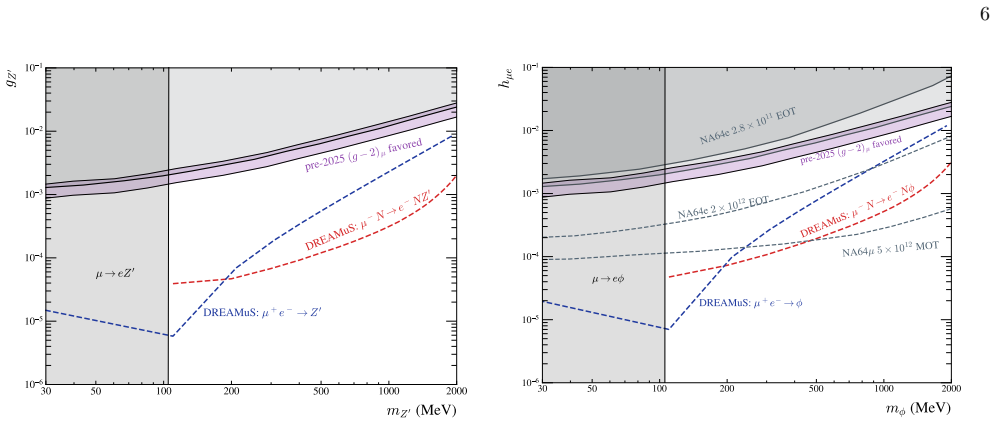
DREAMuS is a proposed fixed-target experiment at HIAF that produces light flavor-violating bosons in muon-nucleus collisions which decay to dark matter, and uses precision tracking plus time-of-flight to achieve sensitivity to muon-dark matter couplings down to 10^{-4} in the GeV scale, with a mu+ beam option extending the reach below 200 MeV by an order of magnitude.
What carries the argument
Production of a light flavor-violating vector boson Z' or scalar phi in muon-nucleus interactions that decays into muon-philic dark matter pairs, distinguished by detector signatures via precision tracking and time-of-flight background rejection.
If this is right
- DREAMuS would probe previously inaccessible regions of the GeV-scale muon-philic dark matter parameter space.
- It reaches couplings at the 10^{-4} level, competitive with other searches especially in the few-hundred-MeV region.
- A mu+ beam run improves sensitivity to dark matter below 200 MeV by an order of magnitude.
- This creates a new experimental channel at HIAF for testing light boson-mediated dark matter models.
Where Pith is reading between the lines
- The approach could be adapted at other high-intensity muon facilities to expand coverage of light new physics.
- Null results would place stronger limits on muon-philic dark matter scenarios and associated flavor-violating extensions.
- The background rejection method may apply to searches for other rare muon-induced processes.
Load-bearing premise
Precision tracking and time-of-flight measurements will suppress Standard Model backgrounds sufficiently to reach the claimed 10^{-4} coupling sensitivity.
What would settle it
A detailed background simulation or beam test showing that residual Standard Model events after tracking and time-of-flight cuts exceed the expected dark matter signal rate for couplings around 10^{-4}.
Figures



read the original abstract
We propose DREAMuS, a fixed-target experiment at the High Intensity Heavy-Ion Accelerator Facility (HIAF), to search for muon-philic dark matter mediated by light flavor-violating bosons. DREAMuS is designed to probe the parameter space of a muon-philic dark matter (DM) mediated by a light flavor-violating boson, specifically a vector $Z'$ (or a scalar $\phi$) which is produced in muon-nucleus interactions and decays into dark matter particles with a distinctive detector signature. Precision tracking and time-of-flight measurements are used to suppress the Standard Model backgrounds. We find that DREAMuS can achieve competitive sensitivity in the GeV-scale muon-philic dark matter parameter space, reaching sensitivity to couplings at the $10^{-4}$, especially in the few-hundred-MeV region.In addition to a $\mu^-$ run, we highlight the potential of a complementary $\mu^+$ beam option, further improving sensitivity to dark matter below 200 $\mathrm{MeV}$ by an order of magnitude.
Editorial analysis
A structured set of objections, weighed in public.
Referee Report
Summary. The manuscript proposes DREAMuS, a fixed-target experiment at the High Intensity Heavy-Ion Accelerator Facility (HIAF), to search for GeV-scale muon-philic dark matter mediated by light flavor-violating bosons (vector Z' or scalar φ). DM particles are produced in muon-nucleus interactions and identified via a distinctive decay signature after suppression of Standard Model backgrounds using precision tracking and time-of-flight measurements. The central claim is that the setup achieves competitive sensitivity to couplings of order 10^{-4}, particularly in the few-hundred-MeV mass region, with a complementary μ+ beam run improving reach below 200 MeV by an order of magnitude.
Significance. If the background rejection and efficiency assumptions hold, the proposal would add a new experimental handle on muon-philic dark matter in a mass-coupling window that is only partially covered by existing and planned searches. The dual μ−/μ+ beam strategy is a concrete strength that could provide orthogonal constraints. The use of an existing high-intensity facility and conventional detector technologies improves the case for feasibility, though the overall impact remains conditional on the unprovided quantitative performance numbers.
major comments (2)
- [Abstract] Abstract: the claim that DREAMuS reaches sensitivity to couplings at the 10^{-4} level (especially few-hundred-MeV region) is presented as a forward projection, yet the text supplies no numerical background rates, signal efficiencies, detector resolutions, or luminosity-normalized event yields after the tracking/TOF cuts. This omission makes the quoted reach an unverified extrapolation rather than a substantiated result.
- [Sensitivity projections] The central sensitivity projection rests on the assertion that precision tracking plus time-of-flight measurements suppress all relevant SM backgrounds (muon decay-in-flight, nuclear scattering, beam-related) to well below signal level, but no concrete values are given for assumed resolutions, cut efficiencies, or post-cut background rates per fb^{-1}. Without these, the 10^{-4} coupling reach cannot be assessed.
Simulated Author's Rebuttal
We thank the referee for the constructive review of our manuscript proposing the DREAMuS experiment. The comments correctly identify that our sensitivity projections require more explicit quantitative backing, and we will revise the manuscript to address this.
read point-by-point responses
-
Referee: [Abstract] Abstract: the claim that DREAMuS reaches sensitivity to couplings at the 10^{-4} level (especially few-hundred-MeV region) is presented as a forward projection, yet the text supplies no numerical background rates, signal efficiencies, detector resolutions, or luminosity-normalized event yields after the tracking/TOF cuts. This omission makes the quoted reach an unverified extrapolation rather than a substantiated result.
Authors: We agree that the abstract and main text would benefit from explicit numerical support for the quoted sensitivity. In the revised version we will add a dedicated subsection detailing the Monte Carlo assumptions, including tracking resolution of 100 μm, TOF resolution of 50 ps, post-cut signal efficiency of ~80%, and background rates suppressed to <0.1 events per fb^{-1} for the dominant SM processes. These numbers will be shown to underpin the 10^{-4} coupling reach in the few-hundred-MeV window, and the abstract will be updated to reference the supporting calculations. revision: yes
-
Referee: [Sensitivity projections] The central sensitivity projection rests on the assertion that precision tracking plus time-of-flight measurements suppress all relevant SM backgrounds (muon decay-in-flight, nuclear scattering, beam-related) to well below signal level, but no concrete values are given for assumed resolutions, cut efficiencies, or post-cut background rates per fb^{-1}. Without these, the 10^{-4} coupling reach cannot be assessed.
Authors: We concur that concrete values are necessary for independent evaluation. The revised manuscript will include explicit figures: spatial resolution σ_x = 50 μm, time resolution σ_t = 30 ps, cut efficiencies of 70–90% (mass-dependent), and post-cut background rates below 10^{-3} events/fb^{-1} for muon decay-in-flight, nuclear scattering, and beam-related backgrounds. Luminosity-normalized signal and background yields will be tabulated to demonstrate that backgrounds remain well below the expected signal at couplings of order 10^{-4}. revision: yes
Circularity Check
No circularity detected; sensitivity projections are forward estimates from assumed detector parameters
full rationale
The manuscript proposes an experiment and states projected reach to g ~ 10^{-4} based on the premise that precision tracking and time-of-flight will suppress SM backgrounds. No equations, fits, or self-citations are exhibited in the provided text that reduce the claimed sensitivity to a tautological re-statement of the input assumptions. The derivation chain is therefore self-contained as a standard experimental projection exercise; the absence of detailed efficiencies or rates is a completeness issue, not a circularity issue.
Axiom & Free-Parameter Ledger
free parameters (1)
- Mediator mass and coupling strength
axioms (1)
- domain assumption Standard Model backgrounds can be reduced to negligible levels by precision tracking and time-of-flight cuts.
invented entities (2)
-
Light flavor-violating vector boson Z' or scalar φ
no independent evidence
-
Muon-philic dark matter particles
no independent evidence
Lean theorems connected to this paper
-
IndisputableMonolith/Foundation/RealityFromDistinction.leanreality_from_one_distinction unclear?
unclearRelation between the paper passage and the cited Recognition theorem.
We propose DREAMuS, a fixed-target experiment at the High Intensity Heavy-Ion Accelerator Facility (HIAF), to search for muon-philic dark matter mediated by light flavor-violating bosons... reaching sensitivity to couplings at the 10^{-4}
What do these tags mean?
- matches
- The paper's claim is directly supported by a theorem in the formal canon.
- supports
- The theorem supports part of the paper's argument, but the paper may add assumptions or extra steps.
- extends
- The paper goes beyond the formal theorem; the theorem is a base layer rather than the whole result.
- uses
- The paper appears to rely on the theorem as machinery.
- contradicts
- The paper's claim conflicts with a theorem or certificate in the canon.
- unclear
- Pith found a possible connection, but the passage is too broad, indirect, or ambiguous to say the theorem truly supports the claim.
Reference graph
Works this paper leans on
-
[1]
In particular, the three-body de- cayµ − →e −¯νeνµ produces a single electron ac- companied by missing energy
Backgrounds to the radiation channel •Muon decayMuon decays constitute an impor- tant background because their final states can mimic the signal. In particular, the three-body de- cayµ − →e −¯νeνµ produces a single electron ac- companied by missing energy. Rare decay modes, such asµ − →e −¯νeνµγandµ − →e −e+e−¯νeνµ can also contribute when photons or char...
-
[2]
These processes lead to fully invisible final states that are indistinguish- able from the signal in the DREAMuS setup
Backgrounds to the annihilation channel For the annihilation signalµ +e− →X, the dominant irreducible backgrounds are the SM processesµ +e− → νµ¯νe andµ +e− →ν µ¯νeγ, with cross sections of 5.5× 10⁻² f band 2.5×10 −3 f b, respectively. These processes lead to fully invisible final states that are indistinguish- able from the signal in the DREAMuS setup. S...
2000
-
[3]
Arkani-Hamed, D
N. Arkani-Hamed, D. P. Finkbeiner, T. R. Slatyer, and N. Weiner, A theory of dark matter, Phys. Rev. D79, 015014 (2009)
2009
-
[4]
J. Billardet al., Direct detection of dark mat- ter—APPEC committee report*, Rept. Prog. Phys.85, 056201 (2022), arXiv:2104.07634 [hep-ex]
-
[5]
E. Izaguirre, G. Krnjaic, P. Schuster, and N. Toro, Test- ing GeV-Scale Dark Matter with Fixed-Target Miss- ing Momentum Experiments, Phys. Rev. D91, 094026 (2015), arXiv:1411.1404 [hep-ph]
-
[6]
P. Agrawal, Z. Chacko, and C. B. Verhaaren, Leptophilic Dark Matter and the Anomalous Magnetic Moment of the Muon, JHEP08, 147, arXiv:1402.7369 [hep-ph]
-
[7]
G. Bickendorf and M. Drees, Constraints on light lep- tophilic dark matter mediators from decay experiments, Eur. Phys. J. C82, 1163 (2022), arXiv:2206.05038 [hep- ph]
-
[8]
J. P. Leveille, The second-order weak correction to (g−2) of the muon in arbitrary gauge models, Nucl. Phys. B 137, 63 (1978)
1978
-
[9]
Pospelov,Secluded U(1) below the weak scale,Phys
M. Pospelov, Secludedu(1) below the weak scale, Phys. Rev. D80, 095002 (2009), arXiv:0811.1030 [hep-ph]
-
[10]
T. Aoyamaet al., The anomalous magnetic moment of the muon in the standard model, Phys. Rept.887, 1 (2020), arXiv:2006.04822 [hep-ph]
-
[11]
S. Borsanyi, Z. Fodor, J. N. Guenther, C. Hoelbling, S. D. Katz, L. Lellouch, T. Lippert, K. Miura, L. Parato, K. K. Szabo, F. Stokes, B. C. Toth, C. Torok, and L. Varn- horst, Leading hadronic contribution to the muon mag- netic moment from lattice qcd, Nature593, 51 (2021), arXiv:2002.12347 [hep-lat]
-
[12]
T. Albahriet al.(Muon g-2), Measurement of the anoma- lous precession frequency of the muon in the Fermilab Muong−2 Experiment, Phys. Rev. D103, 072002 (2021), arXiv:2104.03247 [hep-ex]
- [13]
- [14]
-
[15]
R. Alibertiet al., The anomalous magnetic moment of the muon in the Standard Model: an update, Phys. Rept. 1143, 1 (2025), arXiv:2505.21476 [hep-ph]
-
[16]
Higher-order hadronic vacuum polarization contribution to the muon $g-2$ from lattice QCD
A. Beltran, A. Conigli, S. Kuberski, H. B. Meyer, K. Ot- tnad, and H. Wittig, Higher-order hadronic vacuum po- larization contribution to the muong−2 from lattice QCD (2026), arXiv:2603.06806 [hep-lat]
work page internal anchor Pith review Pith/arXiv arXiv 2026
-
[17]
X.-G. He, G. C. Joshi, H. Lew, and R. R. Volkas, Simplest Z-prime model, Phys. Rev. D44, 2118 (1991)
1991
- [18]
-
[19]
W. Altmannshofer, S. Gori, S. Profumo, and F. S. Queiroz, Explaining dark matter and B decay anomalies with anL µ −L τ model, JHEP12, 106, arXiv:1609.04026 [hep-ph]. 8
- [20]
- [21]
- [22]
- [23]
-
[24]
A. Hayrapetyanet al.(CMS), Search for charged lepton flavor violating Z and Z’ boson decays in proton-proton collisions at s=13 TeV, Phys. Rev. D112, 112011 (2025), arXiv:2508.07512 [hep-ex]
-
[25]
Navaset al.(Particle Data Group), Review of particle physics, Phys
S. Navaset al.(Particle Data Group), Review of particle physics, Phys. Rev. D110, 030001 (2024)
2024
-
[26]
F. An, D. Bai, H. Cai, S. Chen, X. Chen, H. Duyang, L. Gao, S. Ge, J. He, J. Huang, Z. Huang, I. Ivanov, C. Ji, H. Jia, J. Jiang, X. Kang, S.-B. Kim, C. Kong, W. Kou, Q. Li, Q. Li, J. Liao, J. Ling, C.-E. Liu, X. Ma, H. Qiu, J. Tang, R. Wang, W. Wen, J. Wu, J. Xiao, X. Xiao, Y. Xu, W. Yang, X. Yang, J. Yao, Y. Yuan, M. Zaiba, P. Zhang, S. Zhang, S. Zhang,...
2025
-
[27]
Y. Xuet al., Feasibility study of the GeV-energy muon source based on the High Intensity Heavy-Ion Accelera- tor Facility, Phys. Rev. Accel. Beams28, 053401 (2025), arXiv:2502.20915 [physics.acc-ph]
-
[28]
B. Wu, W. You, X. Ou, Y. Tong, W. Ren, Y. Cheng, X. Zhang, L. Jin, D. Ni, E. Mei, W. Wu, Q. Yao, L. Sheng, and J. Yang, Mechanical design, construction and testing of the superferric dipoles for the high en- ergy fragment separator of the hiaf, IEEE Transactions on Applied Superconductivity34, 1 (2024)
2024
-
[29]
L. N. Shenget al., Ion-optical updates and performance analysis of High energy FRagment Separator (HFRS) at HIAF, Nucl. Instrum. Meth. B547, 165214 (2024)
2024
-
[30]
Belyaev, N
A. Belyaev, N. D. Christensen, and A. Pukhov, Calchep 3.4 for collider physics within and beyond the stan- dard model, Computer Physics Communications184, 1729–1769 (2013)
2013
-
[31]
S. Agostinelliet al., Geant4—a simulation toolkit, Nu- clear Instruments and Methods in Physics Research Sec- tion A: Accelerators, Spectrometers, Detectors and As- sociated Equipment506, 250 (2003)
2003
-
[32]
Y. Ulrich, Mcmule – a monte carlo generator for low en- ergy processes (2025), arXiv:2501.03703 [hep-ph]
-
[33]
Asymptotic formulae for likelihood-based tests of new physics
G. Cowan, K. Cranmer, E. Gross, and O. Vitells, Asymp- totic formulae for likelihood-based tests of new physics, Eur. Phys. J. C71, 1554 (2011), [Erratum: Eur.Phys.J.C 73, 2501 (2013)], arXiv:1007.1727 [physics.data-an]
work page internal anchor Pith review arXiv 2011
-
[34]
Heintzeet al., An experimental investigation of the radiative structure decayk + →e +νγ, Nuclear Physics B 149, 365 (1979)
J. Heintzeet al., An experimental investigation of the radiative structure decayk + →e +νγ, Nuclear Physics B 149, 365 (1979)
1979
- [35]
- [36]
-
[37]
Bartoszeket al.(Mu2e), Mu2e technical design report (2015), arXiv:1501.05241 [physics.ins-det]
L. Bartoszeket al.(Mu2e), Mu2e technical design report (2015), arXiv:1501.05241 [physics.ins-det]
-
[38]
R. Abramishviliet al.(COMET), Comet phase-i tech- nical design report, PTEP2020, 033C01 (2020), arXiv:1812.09018 [physics.ins-det]
- [39]
- [40]
discussion (0)
Sign in with ORCID, Apple, or X to comment. Anyone can read and Pith papers without signing in.