Recognition: unknown
Some progress on the use of the variational method in quantum field theory
Pith reviewed 2026-05-10 15:22 UTC · model grok-4.3
The pith
Relativistic continuous matrix product states optimized via Riemannian methods give accurate non-perturbative results for strongly coupled 1+1D quantum field theories.
A machine-rendered reading of the paper's core claim, the machinery that carries it, and where it could break.
Core claim
Using Riemannian optimization on the manifold of relativistic continuous matrix product states, competitive non-perturbative approximations are obtained to ground state energies and local observables in the phi^4, Sine-Gordon, and Sinh-Gordon models in strongly coupled regimes.
What carries the argument
Riemannian optimization on the manifold of relativistic continuous matrix product states (RCMPS), a variational ansatz tailored to (1+1)-dimensional QFT.
Load-bearing premise
Finite-parameter relativistic continuous matrix product states are sufficiently expressive to approximate the true ground states of these models to the accuracy achieved.
What would settle it
A high-precision numerical computation or exact result for the ground state energy in one of the models that significantly disagrees with the variational approximation obtained from RCMPS optimization.
Figures





read the original abstract
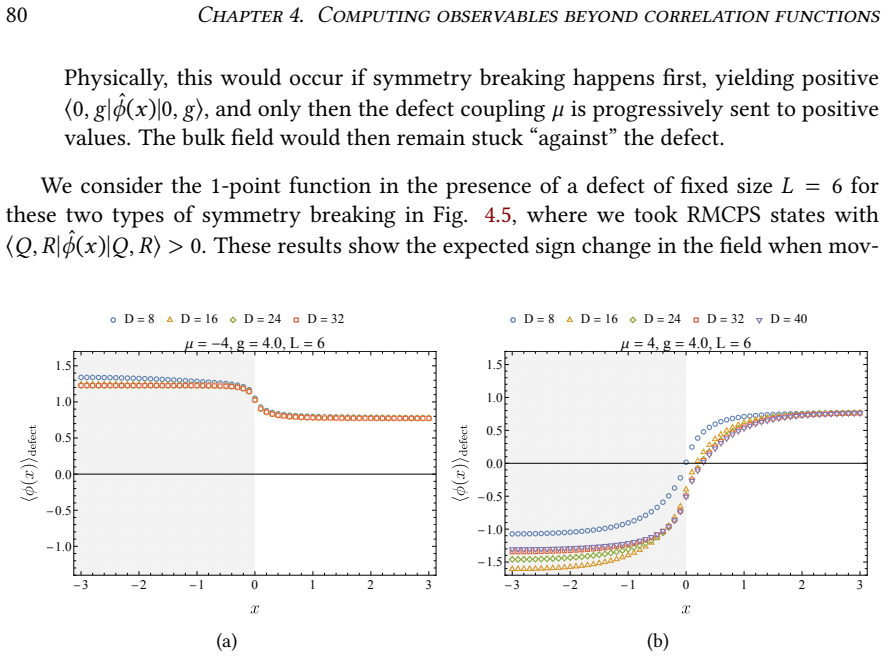
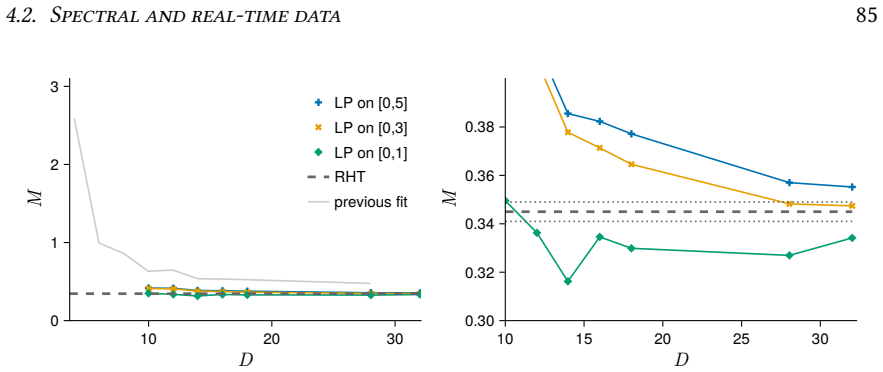
Strongly coupled quantum field theories in $(1+1)$ dimensions are notoriously hard to solve non-perturbatively. Variational methods, despite their success for quantum many-body physics on the lattice, have long lacked a natural ansatz adapted to the relativistic setting. This monograph explains the intuition behind relativistic continuous matrix product states (RCMPS), a variational ansatz tailored to $(1+1)$-dimensional QFT, and reports on several years of progress in developing and applying this approach. Using Riemannian optimization on the manifold of RCMPS, we obtain competitive non-perturbative approximations to ground state energies and local observables in the $\phi^4$, Sine-Gordon, and Sinh-Gordon models, including in strongly coupled regimes where perturbation theory fails. We then describe extensions to models with several interacting fields. Beyond energy density and local observables, we show how the framework can be used to evaluate non-local observables (defects) and, through an original linear programming approach, to extract spectral data such as particle masses. We close by discussing the current limitations of the method and the most promising directions for future work.
Editorial analysis
A structured set of objections, weighed in public.
Referee Report
Summary. The manuscript introduces relativistic continuous matrix product states (RCMPS) as a variational ansatz for (1+1)-dimensional QFTs and applies Riemannian optimization on this manifold to compute ground-state energies and local observables for the φ⁴, Sine-Gordon, and Sinh-Gordon models, including strongly coupled regimes. It further extends the framework to multi-field models, non-local observables (defects), and spectral data extraction via a linear programming approach, while discussing limitations and future directions.
Significance. If the numerical results are substantiated, the work provides a tailored variational method for relativistic QFTs that could bridge gaps left by perturbation theory and lattice approaches in 1+1 dimensions. The use of Riemannian optimization, the linear-programming spectral extraction, and the treatment of defects represent concrete technical advances that, if controlled, would be useful for non-perturbative studies.
major comments (2)
- [Abstract / numerical results] Abstract and numerical-results sections: the headline claim of obtaining 'competitive non-perturbative approximations' in strongly coupled regimes is load-bearing yet unsupported by any quantitative benchmarks, error bars, or direct comparisons to independent methods or exact results; without these, it is impossible to assess whether the finite-parameter RCMPS ansatz actually captures the essential ground-state features.
- [RCMPS ansatz and optimization sections] Sections describing the RCMPS manifold and optimization: the central assumption that a finite bond-dimension or parameter-count RCMPS is expressive enough for the reported accuracy in the φ⁴, Sine-Gordon, and Sinh-Gordon models at strong coupling is not accompanied by convergence studies with respect to matrix size or explicit error estimates against known benchmarks; this directly affects the reliability of all subsequent claims about energies, observables, and spectra.
minor comments (2)
- [Introduction / ansatz definition] Notation for the RCMPS parameters and the Riemannian metric should be introduced more explicitly at first use to aid readability for readers outside the immediate subfield.
- [Numerical results] The manuscript would benefit from a short table summarizing the models, coupling ranges, and any available reference values used for validation.
Simulated Author's Rebuttal
We thank the referee for their careful reading of the manuscript and for highlighting these important points regarding the substantiation of our numerical claims. We address each major comment below.
read point-by-point responses
-
Referee: [Abstract / numerical results] Abstract and numerical-results sections: the headline claim of obtaining 'competitive non-perturbative approximations' in strongly coupled regimes is load-bearing yet unsupported by any quantitative benchmarks, error bars, or direct comparisons to independent methods or exact results; without these, it is impossible to assess whether the finite-parameter RCMPS ansatz actually captures the essential ground-state features.
Authors: We agree that quantitative benchmarks, error bars, and direct comparisons are necessary to support the headline claim. The current manuscript presents variational results for the indicated models but does not include systematic side-by-side comparisons. In the revised version we will add: (i) comparisons to weak-coupling perturbation theory for all three models, (ii) comparisons to exact results for the Sine-Gordon model (soliton masses and ground-state energy density), and (iii) comparisons to existing lattice or tensor-network data for the φ⁴ model at selected couplings. We will also report error bars obtained from the convergence of the Riemannian optimizer and from runs at neighboring bond dimensions. These additions will allow readers to evaluate the accuracy of the finite-parameter RCMPS ansatz in the strongly coupled regime. revision: yes
-
Referee: [RCMPS ansatz and optimization sections] Sections describing the RCMPS manifold and optimization: the central assumption that a finite bond-dimension or parameter-count RCMPS is expressive enough for the reported accuracy in the φ⁴, Sine-Gordon, and Sinh-Gordon models at strong coupling is not accompanied by convergence studies with respect to matrix size or explicit error estimates against known benchmarks; this directly affects the reliability of all subsequent claims about energies, observables, and spectra.
Authors: We acknowledge that explicit convergence studies with bond dimension and error estimates against benchmarks are required to substantiate the expressiveness of the ansatz. Although the manuscript already optimizes at several finite matrix sizes, we will expand the relevant sections with dedicated convergence tables and plots for ground-state energies and local observables as a function of bond dimension for each model. We will further include explicit error estimates obtained by comparing RCMPS results to independent benchmarks (perturbative, exact, or lattice) in regimes where such data exist, and we will propagate these uncertainties to the extracted spectral quantities obtained via the linear-programming procedure. These revisions will directly address the reliability of the reported energies, observables, and spectra. revision: yes
Circularity Check
No significant circularity in the RCMPS variational method
full rationale
The paper describes a standard variational procedure: parameterizing trial states via the RCMPS ansatz and minimizing the energy expectation value through Riemannian optimization on the associated manifold. The reported ground-state energies and observables are outputs of this numerical minimization rather than quantities defined in terms of themselves or fitted parameters that are then relabeled as predictions. No equations or steps in the provided description reduce by construction to the inputs (e.g., no self-definitional relations where an observable is both the fit target and the reported result). Self-citations, if present for prior RCMPS development, are not invoked as load-bearing uniqueness theorems that would force the central claims; the method remains independently falsifiable via convergence with bond dimension and external benchmarks. The derivation chain is therefore self-contained as a computational approximation technique.
Axiom & Free-Parameter Ledger
free parameters (1)
- RCMPS variational parameters (including bond dimension)
axioms (1)
- domain assumption The ground state of the target QFTs can be well approximated by an RCMPS with finite parameters.
invented entities (1)
-
Relativistic continuous matrix product state (RCMPS)
no independent evidence
Reference graph
Works this paper leans on
-
[1]
Antoine Tilloy. Interacting quantum field theories as relativistic statistical field the- ories of local beables, 2017. URLhttps://arxiv.org/abs/1702.06325. 2
-
[2]
The symmetric phase beyond NNNNNNNNLO.Journal of High Energy Physics, 2018 (8):148, Aug 2018
Marco Serone, Gabriele Spada, and Giovanni Villadoro.𝜆𝜙4 theory — Part I. The symmetric phase beyond NNNNNNNNLO.Journal of High Energy Physics, 2018 (8):148, Aug 2018. ISSN 1029-8479. doi: 10.1007/JHEP08(2018)148. URLhttps: //doi.org/10.1007/JHEP08(2018)148. 3, 47, 69
-
[3]
the broken phase beyond NNNN(NNNN)LO.Journal of High Energy Physics, 2019(5):47, May 2019
Marco Serone, Gabriele Spada, and Giovanni Villadoro.𝜆𝜙4 theory — Part II. the broken phase beyond NNNN(NNNN)LO.Journal of High Energy Physics, 2019(5):47, May 2019. ISSN 1029-8479. doi: 10.1007/JHEP05(2019)047. URLhttps://doi.org/ 10.1007/JHEP05(2019)047
-
[4]
Heymans and Marcus Benghi Pinto
Gustavo O. Heymans and Marcus Benghi Pinto. Critical behavior of the 2d scalar theory: resumming the N8LO perturbative mass gap.Journal of High Energy Physics, 2021(7):163, Jul 2021. ISSN 1029-8479. doi: 10.1007/JHEP07(2021)163. URLhttps: //doi.org/10.1007/JHEP07(2021)163. 3, 47
-
[5]
Riccardo Rossi. Determinant Diagrammatic Monte Carlo Algorithm in the Thermo- dynamic Limit.Phys. Rev. Lett., 119:045701, Jul 2017. doi: 10.1103/PhysRevLett.119. 045701. URLhttps://link.aps.org/doi/10.1103/PhysRevLett.119.045701. 3
-
[6]
Yuriel Núñez Fernández, Matthieu Jeannin, Philipp T. Dumitrescu, Thomas Kloss, Jason Kaye, Olivier Parcollet, and Xavier Waintal. Learning Feynman Diagrams with Tensor Trains.Phys. Rev. X, 12:041018, Nov 2022. doi: 10.1103/PhysRevX.12.041018. URLhttps://link.aps.org/doi/10.1103/PhysRevX.12.041018. 3
-
[7]
Michael Borinsky. Tropical Monte Carlo quadrature for Feynman integrals.Annales de l’Institut Henri Poincaré D, 10(4):635–685, 2023. doi: 10.4171/AIHPD/158. 3
-
[8]
Martin Lüscher. Advanced Lattice QCD, 1998. URLhttps://arxiv.org/abs/ hep-lat/9802029. 4
work page internal anchor Pith review arXiv 1998
-
[9]
P. Petreczky and J. H. Weber. Strong coupling constant and heavy quark masses in (2+1)-flavor QCD.Phys. Rev. D, 100:034519, Aug 2019. doi: 10.1103/PhysRevD.100. 034519. URLhttps://link.aps.org/doi/10.1103/PhysRevD.100.034519. 4 113 114BIBLIOGRAPHY
-
[10]
Miranda C. N. Cheng and Niki Stratikopoulou. Lecture notes on normalizing flows for lattice quantum field theories.SciPost Phys. Lect. Notes, page 110, 2026. doi: 10.21468/SciPostPhysLectNotes.110. URLhttps://scipost.org/10.21468/ SciPostPhysLectNotes.110. 4
-
[11]
Feynman.Difficulties in Applying the Variational Principle to Quantum Field Theories, pages 28–40
Richard P. Feynman.Difficulties in Applying the Variational Principle to Quantum Field Theories, pages 28–40. World Scientific Publishing, Singapore, 1987. doi: 10. 1142/9789814390187_0003. 8, 9
1987
-
[12]
Simulating exci- tation spectra with projected entangled-pair states.Phys
Laurens Vanderstraeten, Jutho Haegeman, and Frank Verstraete. Simulating exci- tation spectra with projected entangled-pair states.Phys. Rev. B, 99:165121, Apr
-
[13]
URLhttps://link.aps.org/doi/10.1103/ PhysRevB.99.165121
doi: 10.1103/PhysRevB.99.165121. URLhttps://link.aps.org/doi/10.1103/ PhysRevB.99.165121. 9
-
[14]
Tangent-space methods for uniform matrix product states.SciPost Phys
Laurens Vanderstraeten, Jutho Haegeman, and Frank Verstraete. Tangent-space methods for uniform matrix product states.SciPost Phys. Lect. Notes, page 7, 2019. doi: 10.21468/SciPostPhysLectNotes.7. 9, 39, 40, 74, 102
-
[15]
F. Verstraete, J. J. García-Ripoll, and J. I. Cirac. Matrix Product Density Opera- tors: Simulation of Finite-Temperature and Dissipative Systems.Phys. Rev. Lett., 93:207204, Nov 2004. doi: 10.1103/PhysRevLett.93.207204. URLhttps://link.aps. org/doi/10.1103/PhysRevLett.93.207204. 9
-
[16]
Kshetrimayum, M
A. Kshetrimayum, M. Rizzi, J. Eisert, and R. Orús. Tensor Network Annealing Al- gorithm for Two-Dimensional Thermal States.Phys. Rev. Lett., 122:070502, Feb
-
[17]
URLhttps://link.aps.org/doi/10
doi: 10.1103/PhysRevLett.122.070502. URLhttps://link.aps.org/doi/10. 1103/PhysRevLett.122.070502. 9
-
[18]
Geometry of Variational Methods: Dynamics of Closed Quantum Systems , shorttitle =
Lucas Hackl, Tommaso Guaita, Tao Shi, Jutho Haegeman, Eugene Demler, and J. Ignacio Cirac. Geometry of variational methods: dynamics of closed quan- tum systems.SciPost Phys., 9:48, 2020. doi: 10.21468/SciPostPhys.9.4.048. URL https://scipost.org/10.21468/SciPostPhys.9.4.048. 9
-
[19]
Andrew J A James, Robert M Konik, Philippe Lecheminant, Neil J Robinson, and Alexei M Tsvelik. Non-perturbative methodologies for low-dimensional strongly- correlated systems: From non-Abelian bosonization to truncated spectrum methods. Reports on Progress in Physics, 81(4):046002, feb 2018. doi: 10.1088/1361-6633/aa91ea. 10
-
[20]
J. Elias-Miró, M. Montull, and M. Riembau. The renormalized Hamiltonian trun- cation method in the large E T expansion.Journal of High Energy Physics, 2016 (4):1–34, Apr 2016. ISSN 1029-8479. doi: 10.1007/jhep04(2016)144. URLhttp: //dx.doi.org/10.1007/JHEP04(2016)144. 47
-
[21]
Joan Elias-Miró, Slava Rychkov, and Lorenzo G. Vitale. NLO renormalization in the Hamiltonian truncation.Phys. Rev. D, 96:065024, Sep 2017. doi: 10.1103/PhysRevD. 96.065024. URLhttps://link.aps.org/doi/10.1103/PhysRevD.96.065024. BIBLIOGRAPHY115
-
[22]
Joan Elias-Miró, Slava Rychkov, and Lorenzo G. Vitale. High-precision calculations in strongly coupled quantum field theory with next-to-leading-order renormalized Hamiltonian Truncation.JHEP, 2017(10):213, 2017. ISSN 1029-8479. doi: 10.1007/ JHEP10(2017)213. URLhttps://doi.org/10.1007/JHEP10(2017)213. 82, 85
-
[23]
Slava Rychkov and Lorenzo G. Vitale. Hamiltonian truncation study of the𝜑4 theory in two dimensions.Phys. Rev. D, 91:085011, Apr 2015. doi: 10.1103/PhysRevD.91. 085011. 10, 14, 47, 50
-
[24]
Giuseppe Carleo and Matthias Troyer. Solving the quantum many-body problem with artificial neural networks.Science, 355(6325):602–606, 2017. ISSN 0036-8075. doi: 10.1126/science.aag2302. 10
-
[25]
Fermionic neural-network states for ab-initio electronic structure.Nature communications, 11(1):1–7, 2020
Kenny Choo, Antonio Mezzacapo, and Giuseppe Carleo. Fermionic neural-network states for ab-initio electronic structure.Nature communications, 11(1):1–7, 2020. 10
2020
-
[27]
M. M. Wolf, F. sredVerstraete, M. B. Hastings, and J. I. Cirac. Area Laws in Quantum Systems: Mutual Information and Correlations.Phys. Rev. Lett., 100:070502, Feb
-
[28]
URLhttps://link.aps.org/doi/10
doi: 10.1103/PhysRevLett.100.070502. URLhttps://link.aps.org/doi/10. 1103/PhysRevLett.100.070502
-
[29]
J. Eisert, M. Cramer, and M. B. Plenio. Colloquium: Area laws for the entanglement entropy.Rev. Mod. Phys., 82:277–306, Feb 2010. doi: 10.1103/RevModPhys.82.277. URLhttps://link.aps.org/doi/10.1103/RevModPhys.82.277. 11
-
[30]
Don N. Page. Average entropy of a subsystem.Phys. Rev. Lett., 71:1291–1294, Aug
-
[31]
URLhttps://link.aps.org/doi/10.1103/ PhysRevLett.71.1291
doi: 10.1103/PhysRevLett.71.1291. URLhttps://link.aps.org/doi/10.1103/ PhysRevLett.71.1291. 11
-
[32]
Oscar C O Dahlsten, Cosmo Lupo, Stefano Mancini, and Alessio Serafini. Entangle- ment typicality.Journal of Physics A: Mathematical and Theoretical, 47(36):363001, aug 2014. doi: 10.1088/1751-8113/47/36/363001. 11
-
[33]
Journal of Physics A: Mathematical and Theoretical , abstract =
Jacob C Bridgeman and Christopher T Chubb. Hand-waving and interpretive dance: an introductory course on tensor networks.Journal of Physics A: Mathematical and Theoretical, 50(22):223001, may 2017. doi: 10.1088/1751-8121/aa6dc3. 11
-
[34]
M. Fannes, B. Nachtergaele, and R. F. Werner. Finitely correlated states on quantum spin chains.Commun. Math. Phys., 144(3):443–490, Mar 1992. ISSN 1432-0916. doi: 10.1007/BF02099178. URLhttps://doi.org/10.1007/BF02099178. 11 116BIBLIOGRAPHY
-
[36]
Computing energy density in one dimension, 2015
Yichen Huang. Computing energy density in one dimension, 2015. 12
2015
-
[37]
S. R. White. Density-matrix algorithms for quantum renormalization groups.Phys. Rev. B, 48:10345–10356, Oct 1993. doi: 10.1103/PhysRevB.48.10345. URLhttps: //link.aps.org/doi/10.1103/PhysRevB.48.10345. 12
-
[38]
Verstraete and J
F. Verstraete and J. I. Cirac. Renormalization algorithms for Quantum-Many Body Systems in two and higher dimensions, 2004. 12
2004
-
[39]
G. Vidal. Entanglement Renormalization.Phys. Rev. Lett., 99:220405, Nov 2007. doi: 10.1103/PhysRevLett.99.220405. URLhttps://link.aps.org/doi/10.1103/ PhysRevLett.99.220405. 13
-
[40]
S. Montangero, M. Rizzi, V. Giovannetti, and Rosario Fazio. Critical exponents with a multiscale entanglement renormalization Ansatz channel.Phys. Rev. B, 80:113103, Sep 2009. doi: 10.1103/PhysRevB.80.113103. URLhttps://link.aps.org/doi/10. 1103/PhysRevB.80.113103
-
[41]
Evenbly and G
G. Evenbly and G. Vidal. Quantum Criticality with the Multi-scale Entanglement Renormalization Ansatz. In A. Avella and F. Mancini, editors,Strongly Correlated Systems. Numerical Methods, chapter 4, pages 99–130. Springer-Verlag, Berlin DE,
-
[42]
doi: 10.1007/978-3-642-35106-8
ISBN 978-3-642-35105-1. doi: 10.1007/978-3-642-35106-8. 13
-
[43]
Contracting projected entangled pair states is average-case hard.Phys
Jonas Haferkamp, Dominik Hangleiter, Jens Eisert, and Marek Gluza. Contracting projected entangled pair states is average-case hard.Phys. Rev. Research, 2:013010, Jan 2020. doi: 10.1103/PhysRevResearch.2.013010. URLhttps://link.aps.org/doi/ 10.1103/PhysRevResearch.2.013010. 13
-
[44]
Springer International Publishing, Cham, 2020
Shi-Ju Ran, Emanuele Tirrito, Cheng Peng, Xi Chen, Luca Tagliacozzo, Gang Su, and Maciej Lewenstein.Two-Dimensional Tensor Networks and Contraction Algo- rithms, pages 63–86. Springer International Publishing, Cham, 2020. ISBN 978-3- 030-34489-4. doi: 10.1007/978-3-030-34489-4_3. URLhttps://doi.org/10.1007/ 978-3-030-34489-4_3. 13
-
[45]
E. D. Brooks and S. C. Frautschi. Scalars coupled to fermions in 1+1 dimensions. Zeitschrift für Physik C Particles and Fields, 23(3):263–273, Sep 1984. ISSN 1431-5858. doi: 10.1007/BF01546194. URLhttps://doi.org/10.1007/BF01546194. 13
-
[46]
V. P. YUROV and AL. B. ZAMOLODCHIKOV. TRUNCATED COMFORMAL SPACE APPROACH TO SCALING LEE-YANG MODEL.International Journal of Modern Physics A, 05(16):3221–3245, 1990. doi: 10.1142/S0217751X9000218X. URLhttps: //doi.org/10.1142/S0217751X9000218X. 13 BIBLIOGRAPHY117
-
[47]
F. Verstraete and J. I. Cirac. Continuous Matrix Product States for Quantum Fields. Phys. Rev. Lett., 104:190405, May 2010. doi: 10.1103/PhysRevLett.104.190405. URL https://link.aps.org/doi/10.1103/PhysRevLett.104.190405. 17, 87
-
[48]
Jutho Haegeman, J. Ignacio Cirac, Tobias J. Osborne, and Frank Verstraete. Calculus of continuous matrix product states.Phys. Rev. B, 88:085118, Aug 2013. doi: 10. 1103/PhysRevB.88.085118. URLhttps://link.aps.org/doi/10.1103/PhysRevB.88. 085118. 17, 30, 65, 94
-
[50]
Ashley Milsted, Jutho Haegeman, and Tobias J. Osborne. Matrix product states and variational methods applied to critical quantum field theory.Phys. Rev. D, 88:085030, Oct 2013. doi: 10.1103/PhysRevD.88.085030. URLhttps://link.aps.org/doi/10. 1103/PhysRevD.88.085030. 25, 47
-
[51]
Computing the renormalization group flow of two-dimensional𝜙4 theory with tensor networks.Phys
Clement Delcamp and Antoine Tilloy. Computing the renormalization group flow of two-dimensional𝜙4 theory with tensor networks.Phys. Rev. Res., 2:033278, Aug
-
[52]
URLhttps://link.aps.org/doi/10
doi: 10.1103/PhysRevResearch.2.033278. URLhttps://link.aps.org/doi/10. 1103/PhysRevResearch.2.033278. 25, 26, 27, 47, 78
-
[53]
Will Loinaz and R. S. Willey. Monte Carlo simulation calculation of the critical cou- pling constant for two-dimensional continuum𝜑4 theory.Phys. Rev. D, 58:076003, Sep 1998. doi: 10.1103/PhysRevD.58.076003. 26, 47
-
[54]
Renormalization of tensor networks using graph-independent local truncations.Phys
Markus Hauru, Clement Delcamp, and Sebastian Mizera. Renormalization of tensor networks using graph-independent local truncations.Phys. Rev. B, 97:045111, Jan
-
[55]
URLhttps://link.aps.org/doi/10.1103/ PhysRevB.97.045111
doi: 10.1103/PhysRevB.97.045111. URLhttps://link.aps.org/doi/10.1103/ PhysRevB.97.045111. 26
-
[56]
Aspects of Two-Dimensional Conformal Field Theories.PoS, TASI2017:003,
Xi Yin. Aspects of Two-Dimensional Conformal Field Theories.PoS, TASI2017:003,
-
[57]
doi: 10.22323/1.305.0003. 27
-
[58]
Vid Stojevic, Jutho Haegeman, I. P. McCulloch, Luca Tagliacozzo, and Frank Ver- straete. Conformal data from finite entanglement scaling.Phys. Rev. B, 91:035120, Jan 2015. doi: 10.1103/PhysRevB.91.035120. URLhttps://link.aps.org/doi/10. 1103/PhysRevB.91.035120. 29
-
[59]
Philipp Schmoll, Jan Naumann, Alexander Nietner, Jens Eisert, and Spyros Sotiri- adis. Hamiltonian truncation tensor networks for quantum field theories, 2023. URL https://arxiv.org/abs/2312.12506. 30 118BIBLIOGRAPHY
-
[61]
Fishman, J
Ang-Kun Wu, Benedikt Kloss, Wladislaw Krinitsin, Matthew T. Fishman, J. H. Pixley, and E. M. Stoudenmire. Disentangling interacting systems with fermionic Gaussian circuits: Application to quantum impurity models.Phys. Rev. B, 111:035119, Jan
-
[62]
URLhttps://link.aps.org/doi/10.1103/ PhysRevB.111.035119
doi: 10.1103/PhysRevB.111.035119. URLhttps://link.aps.org/doi/10.1103/ PhysRevB.111.035119. 31
-
[63]
Variational method in relativistic quantum field theory without cut- off.Phys
Antoine Tilloy. Variational method in relativistic quantum field theory without cut- off.Phys. Rev. D, 104:L091904, Nov 2021. doi: 10.1103/PhysRevD.104.L091904. URL https://link.aps.org/doi/10.1103/PhysRevD.104.L091904. 32, 63
-
[64]
Relativistic continuous matrix product states for quantum fields without cutoff.Phys
Antoine Tilloy. Relativistic continuous matrix product states for quantum fields without cutoff.Phys. Rev. D, 104:096007, Nov 2021. doi: 10.1103/PhysRevD.104. 096007. URLhttps://link.aps.org/doi/10.1103/PhysRevD.104.096007. 32, 50, 63
-
[65]
A study of the quantum Sinh-Gordon model with relativistic con- tinuous matrix product states, 2022
Antoine Tilloy. A study of the quantum Sinh-Gordon model with relativistic con- tinuous matrix product states, 2022. URLhttps://arxiv.org/abs/2209.05341. 32, 42, 54, 59, 60, 61, 63
-
[66]
On Automatic Differentiation
Andreas Griewank. On Automatic Differentiation. In Masao Iri and Kunio Tanabe, editors,Mathematical Programming: Recent Developments and Applications, pages 83–108. Kluwer Academic Publishers, Dordrecht, 1989. URLhttps://softlib.rice. edu/pub/CRPC-TRs/reports/CRPC-TR89003.pdf. 40
1989
-
[67]
In: Proceedings of the 2021 ACM-SIAM Symposium on Discrete Algorithms (SODA), pp
Andreas Griewank and Andrea Walther.Evaluating Derivatives: Principles and Techniques of Algorithmic Differentiation. SIAM, 2 edition, 2008. doi: 10.1137/1. 9780898717761. 40
work page doi:10.1137/1 2008
-
[68]
Masatake Mori and Masaaki Sugihara. The double-exponential transformation in numerical analysis.Journal of Computational and Applied Mathematics, 127(1):287– 296, 2001. ISSN 0377-0427. doi: https://doi.org/10.1016/S0377-0427(00)00501-X. URL https://www.sciencedirect.com/science/article/pii/S037704270000501X. Nu- merical Analysis 2000. Vol. V: Quadrature a...
-
[69]
Riemannian opti- mization of isometric tensor networks.SciPost Phys., 10:40, 2021
Markus Hauru, Maarten Van Damme, and Jutho Haegeman. Riemannian opti- mization of isometric tensor networks.SciPost Phys., 10:40, 2021. doi: 10.21468/ SciPostPhys.10.2.040. URLhttps://scipost.org/10.21468/SciPostPhys.10.2.040. 42, 43
-
[70]
Differentialequations.jl–a performant and feature-rich ecosystem for solving differential equations in julia.Journal of Open Research Software, 5(1), 2017
Christopher Rackauckas and Qing Nie. Differentialequations.jl–a performant and feature-rich ecosystem for solving differential equations in julia.Journal of Open Research Software, 5(1), 2017. 43 BIBLIOGRAPHY119
2017
-
[71]
Mathematical theory of ele- mentary particles
E Nelson. A quartic interaction in two dimensions, in" Mathematical theory of ele- mentary particles", eds. R. Goodman and I. Segal, 1966. 46
1966
-
[72]
Ed Nelson’s work in quantum theory.Diffusion, Quantum Theory, and Radically Elementary Mathematics (WG Faris, ed.), 47:75–93, 2004
Barry Simon. Ed Nelson’s work in quantum theory.Diffusion, Quantum Theory, and Radically Elementary Mathematics (WG Faris, ed.), 47:75–93, 2004. doi: 10.1515/ 9781400865253.75. 46
2004
-
[73]
Paul Federbush. Partially Alternate Derivation of a Result of Nelson.Journal of Mathematical Physics, 10(1):50–52, 01 1969. ISSN 0022-2488. doi: 10.1063/1.1664760. URLhttps://doi.org/10.1063/1.1664760. 46
-
[74]
Matthijs Hogervorst, Slava Rychkov, and Balt C. van Rees. Truncated conformal space approach in𝑑dimensions: A cheap alternative to lattice field theory?Phys. Rev. D, 91:025005, Jan 2015. doi: 10.1103/PhysRevD.91.025005. URLhttps://link. aps.org/doi/10.1103/PhysRevD.91.025005. 47
-
[75]
Entanglement scaling for𝜆𝜙4 2.Phys
Bram Vanhecke, Frank Verstraete, and Karel Van Acoleyen. Entanglement scaling for𝜆𝜙4 2.Phys. Rev. D, 106:L071501, Oct 2022. doi: 10.1103/PhysRevD.106.L071501. URLhttps://link.aps.org/doi/10.1103/PhysRevD.106.L071501. 47, 49, 78
-
[76]
Liam Fitzpatrick, Emanuel Katz, Zuhair U
Nikhil Anand, A. Liam Fitzpatrick, Emanuel Katz, Zuhair U. Khandker, Matthew T. Walters, and Yuan Xin. Introduction to Lightcone Conformal Truncation: QFT Dy- namics from CFT Data, 2020. URLhttps://arxiv.org/abs/2005.13544. 47
-
[77]
Liam Fitzpatrick, Emanuel Katz, and Matthew T
A. Liam Fitzpatrick, Emanuel Katz, and Matthew T. Walters. Nonperturbative matching between equal-time and lightcone quantization.Journal of High Energy Physics, 2020(10):92, Oct 2020. ISSN 1029-8479. doi: 10.1007/JHEP10(2020)092. URL https://doi.org/10.1007/JHEP10(2020)092. 48
-
[78]
Computing energy density in one dimension, 2015
Yichen Huang. Computing energy density in one dimension, 2015. URLhttps: //arxiv.org/abs/1505.00772. 50
-
[79]
Approaching the self- dual point of the sinh-Gordon model.JHEP, 2021(1):1–85, 2021
Robert Konik, Márton Lájer, and Giuseppe Mussardo. Approaching the self- dual point of the sinh-Gordon model.JHEP, 2021(1):1–85, 2021. doi: 10.1007/ JHEP01(2021)014. 54, 55, 56, 57, 58
2021
-
[80]
Denis Bernard and André LeClair. The sinh-Gordon model beyond the self dual point and the freezing transition in disordered systems.Journal of High Energy Physics, 2022(5):22, May 2022. ISSN 1029-8479. doi: 10.1007/JHEP05(2022)022. URLhttps: //doi.org/10.1007/JHEP05(2022)022. 54
-
[81]
Jürg Fröhlich. Quantized "Sine-Gordon" Equation with a Nonvanishing Mass Term in Two Space-Time Dimensions.Phys. Rev. Lett., 34:833–836, Mar 1975. doi: 10. 1103/PhysRevLett.34.833. URLhttps://link.aps.org/doi/10.1103/PhysRevLett. 34.833. 56 120BIBLIOGRAPHY
-
[82]
Remarks on exponential interactions and the quantum sine-Gordon equation in two space-time dimensions.Helvetica Physica Acta, 50(3):315–329, 1977
Jürg Fröhlich and Yong Moon Park. Remarks on exponential interactions and the quantum sine-Gordon equation in two space-time dimensions.Helvetica Physica Acta, 50(3):315–329, 1977. URLhttps://www.e-periodica.ch/cntmng?pid=hpa-001% 3A1977%3A50%3A%3A982. 56
1977
-
[83]
J Dimock and TR Hurd. Construction of the two-dimensional Sine-Gordon model for𝛽 <8𝜋.Communications in mathematical physics, 156(3):547–580, 1993. doi: 10.1007/BF02096863. 56
-
[84]
Quantum sine-Gordon equation as the massive Thirring model
Sidney Coleman. Quantum sine-Gordon equation as the massive Thirring model. Phys. Rev. D, 11:2088–2097, Apr 1975. doi: 10.1103/PhysRevD.11.2088. URLhttps: //link.aps.org/doi/10.1103/PhysRevD.11.2088. 57
discussion (0)
Sign in with ORCID, Apple, or X to comment. Anyone can read and Pith papers without signing in.