Recognition: unknown
Power laws in the sea ice floe size distribution: a stochastic theory
Pith reviewed 2026-05-10 15:37 UTC · model grok-4.3
The pith
A stochastic model for sea ice produces exact power-law floe size distributions whose exponents depend on fracture and welding rates.
A machine-rendered reading of the paper's core claim, the machinery that carries it, and where it could break.
Core claim
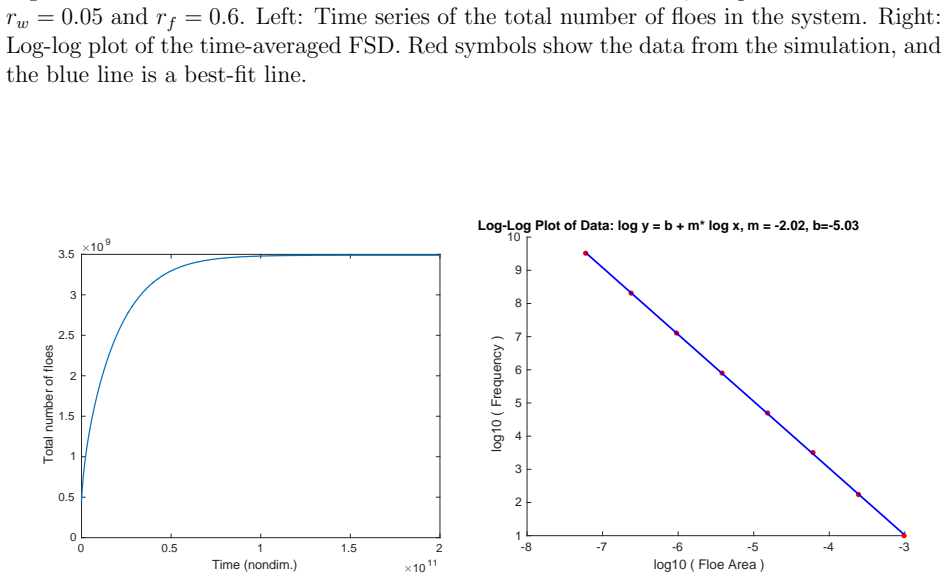
A stochastic fragmentation-coagulation equation for floe number density admits closed-form power-law solutions. The exponent of the power law is an explicit function of the fracture rate and the welding rate, both treated as size-dependent inputs. Exact solvability follows from balancing the loss and gain terms for each size bin under power-law assumptions for the rates.
What carries the argument
The stochastic master equation that tracks the number density of floes of each size under size-dependent fracture (splitting) and welding (coagulation) rates.
If this is right
- The power-law exponent is not universal but varies with the ratio of fracture to welding rates, allowing different distributions under different seasonal or regional conditions.
- The model supplies a direct route from measured event rates to the macroscopic size distribution without requiring full mechanical simulation of every floe.
- Seasonal changes in observed exponents arise naturally when fracture and welding rates change with temperature, waves, or ice strength.
- The framework can be used to predict how altered environmental forcing would shift the entire floe size spectrum in future climates.
Where Pith is reading between the lines
- The same stochastic balance could be applied to other fragmented geophysical systems such as sea-ice leads, rock debris, or floating ice shelves to test whether power laws emerge from analogous rate competitions.
- Deriving the fracture and welding rates from underlying wave-stress or thermal models would turn the present theory into a closed physical prediction rather than a rate-parameterized description.
- Climate models that currently impose fixed power-law exponents could instead evolve the exponent dynamically from simulated fracture and welding statistics, altering heat and momentum fluxes through changes in floe perimeter.
Load-bearing premise
Fracture and welding can be treated as independent stochastic processes whose rates depend only on floe size and are supplied as external inputs rather than derived from stress, temperature, or wave mechanics.
What would settle it
Record the frequency of fracture and welding events versus floe size in a controlled experiment or high-resolution simulation under fixed conditions, insert those measured rates into the model, and test whether the predicted exponent matches the observed floe size distribution to within statistical error.
Figures




read the original abstract
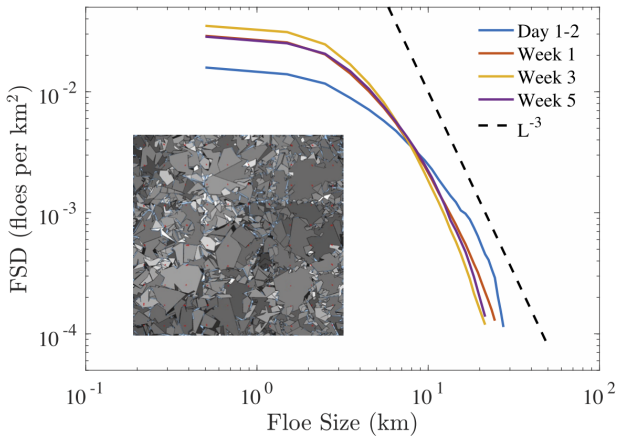
Sea ice is a complex system, and observations have shown that ice segments (i.e., floes) have a wide range of sizes, with a floe size distribution that follows a power law. However, a theory for the power law and its exponent have remained elusive. Here, floe-resolving numerical simulations are investigated with a discrete element model, in order to gain further information by gathering statistics of fracture and welding events. Then, based on the insights from the floe-resolving simulations, a stochastic fragmentation-coagulation theory is proposed. Exact solutions are found with a power law. The power-law exponent can take a variety of values, and it depends on the fracture and welding rates. Such behavior is reminiscent of seasonal changes in the power-law exponent, which have been reported in past analyses of observational data.
Editorial analysis
A structured set of objections, weighed in public.
Referee Report
Summary. The paper analyzes fracture and welding statistics from discrete-element simulations of sea ice, then constructs a stochastic fragmentation-coagulation master equation whose stationary solutions are exact power laws. The exponent of the floe-size distribution is shown to depend on the functional forms of the size-dependent fracture rate λ_f(s) and welding rate λ_w(s), providing a mechanism that can account for observed seasonal variations in the exponent.
Significance. If the derivation is correct, the work supplies a clean, exactly solvable stochastic model that links microscopic event rates to the macroscopic power-law form of the floe-size distribution. The explicit dependence of the exponent on the rates offers a compact explanation for variability seen in observations. The use of simulation statistics to inform the rates is a positive step toward grounding the model, though the overall significance remains limited by the phenomenological status of those rates.
major comments (2)
- [§3] §3 (stochastic theory): The master equation is stated to admit exact power-law stationary solutions whose exponent is set by λ_f(s) and λ_w(s). The manuscript must show the explicit derivation steps from the integro-differential master equation to the closed-form power-law solution (including any assumptions on the functional forms of the rates) so that the exactness claim can be verified independently.
- [§2.2 and §4] §2.2 and §4: The fracture and welding rates are extracted as size-dependent functions from the discrete-element simulations and then inserted as independent inputs into the master equation. Because the exponent is a direct algebraic function of these chosen rates, the power-law form is guaranteed once the rates are specified; this reduces the central claim to a statement about the chosen functional forms rather than an emergent prediction from first-principles mechanics.
minor comments (2)
- [Abstract] Abstract: The statement that 'exact solutions are found' appears without any equation or key step, which is atypical and forces the reader to reach the main text before any assessment is possible.
- [Throughout] Notation: Define the master-equation kernel and the precise dependence of λ_f and λ_w on floe size s at the first appearance of the model, and keep the notation consistent between the simulation analysis and the analytic section.
Simulated Author's Rebuttal
We thank the referee for their detailed and constructive comments on our manuscript. We address each of the major comments below, indicating where revisions will be made.
read point-by-point responses
-
Referee: §3 (stochastic theory): The master equation is stated to admit exact power-law stationary solutions whose exponent is set by λ_f(s) and λ_w(s). The manuscript must show the explicit derivation steps from the integro-differential master equation to the closed-form power-law solution (including any assumptions on the functional forms of the rates) so that the exactness claim can be verified independently.
Authors: We agree with this comment. The revised manuscript will include a detailed, step-by-step derivation in §3, starting from the integro-differential master equation, specifying the assumed forms of the rate functions λ_f(s) and λ_w(s) (power-law forms fitted to simulation statistics), and arriving at the exact stationary power-law solution for the floe size distribution. revision: yes
-
Referee: §2.2 and §4: The fracture and welding rates are extracted as size-dependent functions from the discrete-element simulations and then inserted as independent inputs into the master equation. Because the exponent is a direct algebraic function of these chosen rates, the power-law form is guaranteed once the rates are specified; this reduces the central claim to a statement about the chosen functional forms rather than an emergent prediction from first-principles mechanics.
Authors: The rates are indeed extracted from the DEM simulations, which are grounded in mechanical principles of ice fracture and contact. The stochastic model shows that for these specific rate forms, the stationary distribution is exactly a power law with exponent determined by the rate parameters. This provides a direct link between the micro-scale event rates (from simulations) and the macro-scale distribution, explaining seasonal variations. We will revise §4 to include additional discussion on how the simulation-derived rates connect the model to first-principles mechanics, rather than treating them as purely phenomenological. revision: partial
Circularity Check
No significant circularity; power-law solutions derived mathematically from rate-dependent master equation
full rationale
The paper proposes a stochastic fragmentation-coagulation master equation informed by fracture and welding statistics from discrete-element simulations, then derives exact power-law stationary solutions whose exponent depends on the functional forms of the phenomenological rates λ_f(s) and λ_w(s). This is a direct mathematical consequence of solving the master equation and does not reduce to a self-definition, fitted parameter renamed as prediction, or self-citation chain. The rates function as inputs that allow the model to reproduce a range of exponents consistent with observations, but the derivation of the power-law form itself is independent and self-contained against external benchmarks such as seasonal variability in data. No load-bearing step equates the output to the inputs by construction.
Axiom & Free-Parameter Ledger
free parameters (2)
- fracture rate
- welding rate
axioms (1)
- domain assumption Floe size evolution can be modeled as a continuous-time stochastic process of fragmentation and coagulation events.
Reference graph
Works this paper leans on
-
[1]
doi: 10.3189/2013AoG62A055. A. Herman. Discrete-element bonded-particle sea ice model design, version 1.3 a–model description and implementation.Geoscientific Model Development, 9(3):1219–1241,
-
[2]
Holt and S
10 B. Holt and S. Martin. The effect of a storm on the 1992 summer sea ice cover of the Beaufort, Chukchi, and East Siberian seas.Journal of Geophysical Research: Oceans, 106 (C1):1017–1032,
1992
-
[3]
Kusahara and H
K. Kusahara and H. Tatebe. Causes of the abrupt and sustained 2016–2023 Antarctic sea- ice decline: A sea ice–ocean model perspective.Geophysical Research Letters, 52(15): e2025GL115256,
2016
-
[4]
B. P. Montemuro and G. E. Manucharyan. The role of islands in sea ice transport through Nares Strait.Journal of Geophysical Research: Oceans, page in press, 2025a. https://eartharxiv.org/repository/view/7715/, https://doi.org/10.31223/X5J12G. B. P. Montemuro and G. E. Manucharyan. SubZero: a discrete element sea ice model that simulates floes as evolving ...
-
[5]
Peters, A
O. Peters, A. Deluca, ´A. Corral, J. D. Neelin, and C. E. Holloway. Universality of rain event size distributions.Journal of Statistical Mechanics: Theory and Experiment, 2010(11): P11030,
2010
-
[6]
J. Weiss. Fracture and fragmentation of ice: a fractal analysis of scale invariance.Engineering Fracture Mechanics, 68(17-18):1975–2012,
1975
-
[7]
The setup of the simulation is as follows
14 Supporting Information A Simulation setup: Subzero model In the main text, the SubZero discrete element model (DEM) was used in an idealized configuration to allow us to gain insight into the fundamental statistical nature of fracture and welding events and justify some assumptions in our analytical model. The setup of the simulation is as follows. The...
2022
-
[8]
We have modified the SubZero code to monitor individual fracturing and welding events
As the eastward wind causes floes to exit the domain at its eastern side, new floes are only created when the western ice edge moves 50 km to maintain a relatively constant stress in the simulation. We have modified the SubZero code to monitor individual fracturing and welding events. The floes are categorized based on their size, and we record each occur...
2011
-
[9]
molecule
and a smallest size category (j=J), and the largest floes do not weld together, and the smallest floes do not fracture. Other specifications could potentially be used instead, although it is not clear if other specifications would lead to an exact solution in power-law form. Also note that, for each particular size categoryj, the evolution equation has th...
2011
-
[10]
B.2 Derivation #2 The master equation or Kolmogorov forward equation [Gardiner, 2021] offers a second deriva- tion of the evolution equation forf j(t) in (24)
Instead, here we will just assume that the values ofη(j, t) are always sufficiently large so that (22) is always true, in order to simplify the presentation.) In this case of linear reaction rates, the evolution ofE[η(j, t)] in (21) simplifies to E[η(j, t)] =E[η(j,0)]−r f,j Z t 0 E[ηj(t′)]dt ′ + 2rf,j−1 Z t 0 E[ηj−1(t′)]dt ′ −2r w,j Z t 0 E[ηj(t′)]dt ′ +r...
2021
discussion (0)
Sign in with ORCID, Apple, or X to comment. Anyone can read and Pith papers without signing in.