Recognition: unknown
SatReg: Regression-based Neural Architecture Search for Lightweight Satellite Image Segmentation
Pith reviewed 2026-05-10 15:37 UTC · model grok-4.3
The pith
SatReg fits low-order regression surrogates to a few profiled width-scaled CM-UNet variants so that latency and power targets for satellite image segmentation can be met without exhaustive architecture search.
A machine-rendered reading of the paper's core claim, the machinery that carries it, and where it could break.
Core claim
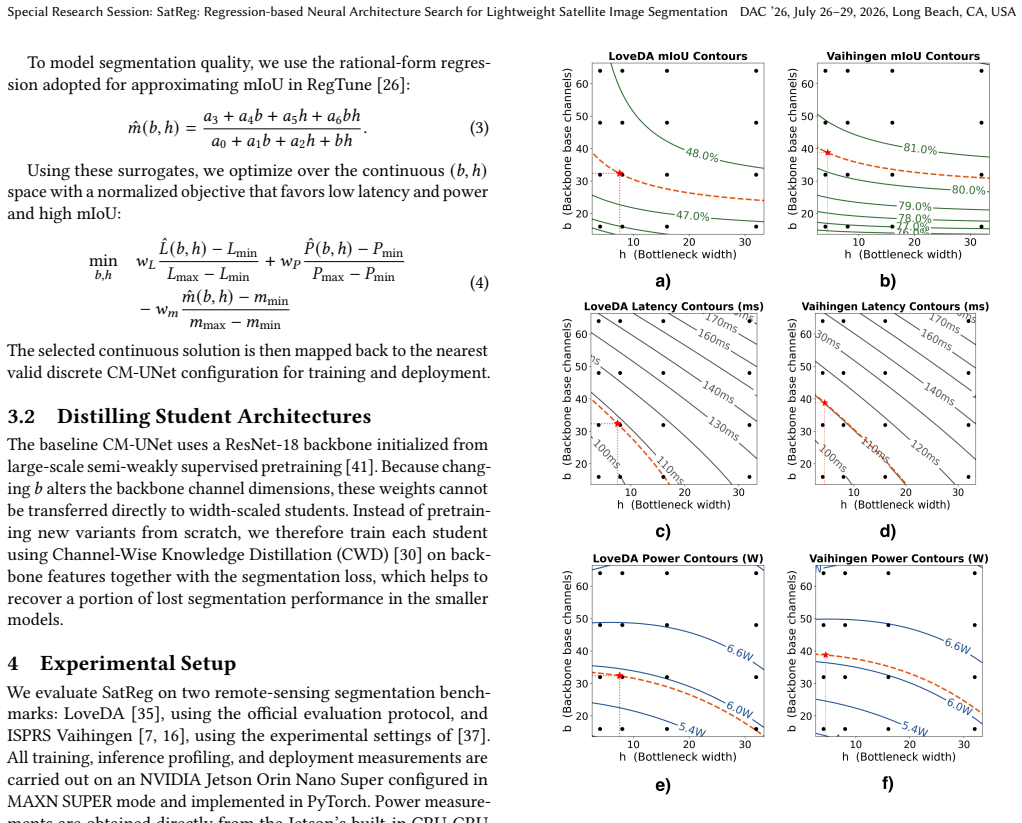
SatReg reduces the neural architecture search space for lightweight remote-sensing segmentation to two dominant width-related variables in CM-UNet variants. A small set of student models is profiled on an NVIDIA Jetson Orin Nano after training via knowledge distillation. Low-order surrogate models are fitted to the resulting measurements of mean intersection over union, latency, and power. These surrogates enable fast selection of near-optimal architecture settings for given deployment targets without exhaustive search. The selected variables affect task accuracy and hardware cost differently, making reduced-space regression a practical strategy for adapting hybrid CNN-Mamba segmentation to
What carries the argument
Low-order surrogate regression models for mIoU, latency, and power, fitted to measurements from a reduced search space of two width-related variables in CM-UNet student models.
If this is right
- The two width variables produce distinct effects on segmentation accuracy versus hardware cost.
- Knowledge distillation allows the sampled student models to be trained efficiently before profiling.
- The fitted surrogates support rapid selection of settings for arbitrary latency or power targets.
- Reduced-space regression offers a workable route for adapting hybrid CNN-Mamba models to future edge systems.
Where Pith is reading between the lines
- The same reduced-space regression tactic could be tested on other hybrid segmentation backbones beyond CM-UNet.
- Surrogate predictions might be updated periodically on the target hardware itself as new profiling data arrives.
- Extending the approach to include one or two additional variables could be compared directly against the current two-variable fits to measure any accuracy gain.
Load-bearing premise
That the two dominant width-related variables capture the main accuracy-hardware trade-offs in CM-UNet variants.
What would settle it
Profiling additional CM-UNet variants outside the two-variable space, measuring their actual mIoU latency and power, and checking whether the surrogate predictions remain accurate or whether a full search finds markedly better trade-offs.
Figures




read the original abstract
As Earth-observation workloads move toward onboard and edge processing, remote-sensing segmentation models must operate under tight latency and energy constraints. We present SatReg, a regression-based hardware-aware tuning framework for lightweight remote-sensing segmentation on edge platforms. Using CM-UNet as the teacher architecture, we reduce the search space to two dominant width-related variables, profile a small set of student models on an NVIDIA Jetson Orin Nano, and fit low-order surrogate models for mIoU, latency, and power. Knowledge distillation is used to efficiently train the sampled students. The learned surrogates enable fast selection of near-optimal architecture settings for deployment targets without exhaustive search. Results show that the selected variables affect task accuracy and hardware cost differently, making reduced-space regression a practical strategy for adapting hybrid CNN-Mamba segmentation models to future space-edge systems.
Editorial analysis
A structured set of objections, weighed in public.
Referee Report
Summary. The paper introduces SatReg, a regression-based hardware-aware NAS framework for lightweight satellite image segmentation. It uses CM-UNet as the teacher model, reduces the search space to two dominant width-related variables, profiles a small set of student models on an NVIDIA Jetson Orin Nano with knowledge distillation, and fits low-order surrogate models for mIoU, latency, and power. These surrogates are claimed to enable rapid selection of near-optimal architecture settings for given deployment targets without exhaustive search, with the authors noting that the variables affect accuracy and hardware cost differently.
Significance. If the surrogate models are accurate and generalizable, the approach would offer a low-overhead, practical method for hardware-aware optimization of hybrid CNN-Mamba segmentation models on edge platforms, addressing key constraints in onboard Earth-observation processing and reducing the cost of NAS for remote-sensing applications.
major comments (1)
- [Abstract] Abstract: The central claim that the fitted low-order surrogates enable reliable fast selection of near-optimal CM-UNet width settings is not supported by any reported quantitative validation of surrogate quality (e.g., R², cross-validation error, held-out prediction error, or residual analysis). Without these metrics, it cannot be determined whether the low-order fits accurately capture the accuracy-cost trade-offs or whether selected configurations are artifacts of under-fitting.
Simulated Author's Rebuttal
We thank the referee for the constructive feedback on our manuscript. We address the major comment below and will revise the paper to strengthen the presentation of the surrogate models.
read point-by-point responses
-
Referee: [Abstract] Abstract: The central claim that the fitted low-order surrogates enable reliable fast selection of near-optimal CM-UNet width settings is not supported by any reported quantitative validation of surrogate quality (e.g., R², cross-validation error, held-out prediction error, or residual analysis). Without these metrics, it cannot be determined whether the low-order fits accurately capture the accuracy-cost trade-offs or whether selected configurations are artifacts of under-fitting.
Authors: We agree that explicit quantitative validation of the surrogate models is required to support the central claim. The current manuscript demonstrates the end-to-end utility of the selected architectures through measured mIoU, latency, and power on the Jetson Orin Nano, but does not report R², cross-validation error, or residual diagnostics for the fitted low-order polynomials. In the revised version we will add a new subsection (or appendix) that reports R² values, leave-one-out cross-validation MSE, and residual plots for the mIoU, latency, and power surrogates. These additions will allow readers to assess whether the low-order fits are adequate or whether higher-order terms or alternative models would be preferable. revision: yes
Circularity Check
No circularity: empirical profiling and surrogate fitting are independent of target claims
full rationale
The paper profiles a small set of CM-UNet variants on target hardware, records mIoU/latency/power, and fits low-order regression models to those measurements. The surrogates are then used to select configurations. This chain contains no self-definitional steps, no fitted inputs renamed as predictions, no load-bearing self-citations, and no uniqueness theorems imported from prior author work. The central claim (fast near-optimal selection via surrogates) rests on the empirical accuracy of the fits, which is an external, falsifiable property rather than a definitional equivalence. No equations or text reduce any output to the input data by construction.
Axiom & Free-Parameter Ledger
free parameters (1)
- coefficients of low-order surrogate models
axioms (1)
- domain assumption Two dominant width-related variables suffice to capture accuracy and hardware cost variations in CM-UNet
Reference graph
Works this paper leans on
- [1]
-
[2]
Konstantinos-Panagiotis Bouzoukis, Georgios Moraitis, Vassilis Kostopoulos, and Vaios Lappas. 2025. An overview of CubeSat missions and applications.Aerospace 12, 6 (2025), 550
2025
-
[3]
Clifford Broni-Bediako, Yuki Murata, Luiz H Mormille, and Masayasu Atsumi
-
[4]
Evolutionary NAS for aerial image segmentation with gene expression programming of cellular encoding.Neural Computing and Applications34, 17 (2022), 14185–14204
2022
-
[5]
Trong-An Bui, Pei-Jun Lee, Chun-Sheng Liang, Pei-Hsiang Hsu, Shiuan-Hal Shiu, and Chen-Kai Tsai. 2024. Edge-computing-enabled deep learning approach for low-light satellite image enhancement.IEEE Journal of Selected Topics in Applied Earth Observations and Remote Sensing17 (2024), 4071–4083
2024
-
[6]
Guanzhou Chen, Xiaodong Zhang, Xiaoliang Tan, Yufeng Cheng, Fan Dai, Kun Zhu, Yuanfu Gong, and Qing Wang. 2018. Training small networks for scene classification of remote sensing images via knowledge distillation.Remote Sensing 10, 5 (2018), 719
2018
- [7]
-
[8]
Michael Cramer. 2010. The DGPF-test on digital airborne camera evaluation overview and test design.Photogrammetrie-Fernerkundung-Geoinformation(2010), 73–82
2010
-
[9]
Angela Cratere, Marcello Asciolla, and Francesco Dell’Olio. 2025. Towards the Integration of FPGA-based Deep Learning Edge Computing on SmallSats for Low-Latency Autonomous Decision-Making. In2025 IEEE Sensors Applications Symposium (SAS). IEEE, 1–6
2025
-
[10]
Tri Dao and Albert Gu. 2024. Transformers are SSMs: generalized models and efficient algorithms through structured state space duality. InProceedings of the 41st International Conference on Machine Learning. 10041–10071
2024
-
[11]
Alexey Dosovitskiy, Lucas Beyer, Alexander Kolesnikov, Dirk Weissenborn, Xi- aohua Zhai, Thomas Unterthiner, Mostafa Dehghani, Matthias Minderer, Georg Heigold, Sylvain Gelly, et al. 2020. An image is worth 16x16 words: Transformers for image recognition at scale.arXiv preprint arXiv:2010.11929(2020)
work page internal anchor Pith review Pith/arXiv arXiv 2020
-
[12]
Gianluca Giuffrida, Luca Fanucci, Gabriele Meoni, Matej Batič, Léonie Buckley, Aubrey Dunne, Chris Van Dijk, Marco Esposito, John Hefele, Nathan Vercruyssen, et al. 2021. The Φ-Sat-1 mission: The first on-board deep neural network demon- strator for satellite earth observation.IEEE Transactions on Geoscience and Remote Sensing60 (2021), 1–14
2021
-
[13]
Albert Gu and Tri Dao. 2024. Mamba: Linear-time sequence modeling with selective state spaces. InFirst conference on language modeling
2024
-
[14]
Giorgia Guerrisi, Fabio Del Frate, and Giovanni Schiavon. 2023. Artificial intelli- gence based on-board image compression for the Φ-Sat-2 mission.IEEE Journal of Selected Topics in Applied Earth Observations and Remote Sensing16 (2023), 8063–8075
2023
-
[15]
Kaiming He, Xiangyu Zhang, Shaoqing Ren, and Jian Sun. 2016. Deep residual learning for image recognition. InProceedings of the IEEE conference on computer vision and pattern recognition. 770–778
2016
-
[16]
Morteza Hosseini and Tinoosh Mohsenin. 2021. QS-NAS: Optimally Quantized Scaled Architecture Search to Enable Efficient On-Device Micro-AI.IEEE Journal on Emerging and Selected Topics in Circuits and Systems(2021)
2021
-
[17]
International Society for Photogrammetry and Remote Sensing. n.d.. 2D Se- mantic Labeling - Vaihingen data. https://www.isprs.org/resources/datasets/ benchmarks/UrbanSemLab/2d-sem-label-vaihingen.aspx. Accessed: 2026-03-11
2026
- [18]
-
[19]
Uttej Kallakuri, Edward Humes, and Tinoosh Mohsenin. 2024. Resource-Aware Saliency-Guided Differentiable Pruning for Deep Neural Networks. InProceedings of the Great Lakes Symposium on VLSI 2024. 694–699
2024
-
[20]
Uttej Kallakuri, Edward Humes, Hasib-Al Rashid, and Tinoosh Mohsenin. 2025. MaGrIP: Magnitude and Gradient-Informed Pruning for Task-Agnostic Large Language Models.ACM Transactions on Embedded Computing Systems(2025)
2025
-
[21]
Hoàng-Ân Lê and Minh-Tan Pham. 2024. Leveraging knowledge distillation for partial multi-task learning from multiple remote sensing datasets. InIGARSS 2024-2024 IEEE International Geoscience and Remote Sensing Symposium. IEEE, 8019–8023
2024
-
[22]
Rui Li, Shunyi Zheng, Ce Zhang, Chenxi Duan, Jianlin Su, Libo Wang, and Peter M Atkinson. 2021. Multiattention network for semantic segmentation of fine-resolution remote sensing images.IEEE Transactions on Geoscience and Remote Sensing60 (2021), 1–13
2021
- [23]
-
[24]
Yue Liu, Yunjie Tian, Yuzhong Zhao, Hongtian Yu, Lingxi Xie, Yaowei Wang, Qixiang Ye, Jianbin Jiao, and Yunfan Liu. 2024. Vmamba: Visual state space model. Advances in neural information processing systems37 (2024), 103031–103063
2024
-
[25]
Xianping Ma, Xiaokang Zhang, and Man-On Pun. 2024. Rs 3 mamba: Visual state space model for remote sensing image semantic segmentation.IEEE Geoscience and Remote Sensing Letters21 (2024), 1–5
2024
-
[26]
Arnab Neelim Mazumder and Tinoosh Mohsenin. 2023. Reg-TuneV2: Hardware- Aware and Multi-Objective Regression-Based Fine-Tuning Approach for DNNs on Embedded Platforms.IEEE Micro(2023)
2023
-
[27]
Arnab Neelim Mazumder, Farshad Safavi, Maryam Rahnemoonfar, and Tinoosh Mohsenin. 2024. Reg-tune: A regression-focused fine-tuning approach for pro- filing low energy consumption and latency.ACM Transactions on Embedded Computing Systems23, 3 (2024), 1–28
2024
-
[28]
Mozhgan Navardi, Shang Gao, Mikolaj Walczak, Fernando Camacho, and Tinoosh Mohsenin. 2025. Metareasoning for Edge-Cloud Collaborative LLM Planning for Efficient Autonomous Navigation.ACM Transactions on Embedded Computing Systems(2025)
2025
-
[29]
Ioan Octavian Rad. 2023. Preliminary evaluation of commercial off-the-shelf gpus for machine learning applications in space.MSc Aerospace - Semester Thesis- Technical University of Munich(2023)
2023
-
[30]
Md Ragib Shaharear, Arnab Neelim Mazumder, and Tinoosh Mohsenin. 2024. Vit- reg: Regression-focused hardware-aware fine-tuning for vit on tinyml platforms. IEEE Design & Test(2024)
2024
-
[31]
Changyong Shu, Yifan Liu, Jianfei Gao, Zheng Yan, and Chunhua Shen. 2021. Channel-wise knowledge distillation for dense prediction. InProceedings of the IEEE/CVF international conference on computer vision. 5311–5320
2021
-
[32]
Windy S Slater, Nayana P Tiwari, Tyler M Lovelly, and Jesse K Mee. 2020. Total ionizing dose radiation testing of NVIDIA Jetson nano GPUs. In2020 IEEE High Performance Extreme Computing Conference (HPEC). IEEE, 1–3
2020
-
[33]
Ashish Vaswani, Noam Shazeer, Niki Parmar, Jakob Uszkoreit, Llion Jones, Aidan N Gomez, Łukasz Kaiser, and Illia Polosukhin. 2017. Attention is all you need.Advances in neural information processing systems30 (2017)
2017
-
[34]
Mikolaj Walczak, Uttej Kallakuri, Edward Humes, Xiaomin Lin, and Tinoosh Mohsenin. 2025. BitMedViT: Ternary-Quantized Vision Transformer for Med- ical AI Assistants on the Edge. In2025 IEEE/ACM International Conference On Computer Aided Design (ICCAD). IEEE, 1–7
2025
-
[35]
Guoqing Wang, Ning Zhang, Jue Wang, Wenchao Liu, Yizhuang Xie, and He Chen. 2024. Knowledge distillation-based lightweight change detection in high- resolution remote sensing imagery for on-board processing.IEEE Journal of Selected Topics in Applied Earth Observations and Remote Sensing17 (2024), 3860– 3877
2024
-
[36]
Junjue Wang, Zhuo Zheng, Xiaoyan Lu, Yanfei Zhong, et al. [n. d.]. LoveDA: A Remote Sensing Land-Cover Dataset for Domain Adaptive Semantic Segmenta- tion. InThirty-fifth Conference on Neural Information Processing Systems Datasets and Benchmarks Track (Round 2)
-
[37]
Libo Wang, Rui Li, Chenxi Duan, Ce Zhang, Xiaoliang Meng, and Shenghui Fang. 2022. A novel transformer based semantic segmentation scheme for fine- resolution remote sensing images.IEEE Geoscience and Remote Sensing Letters19 (2022), 1–5
2022
-
[38]
Libo Wang, Rui Li, Ce Zhang, Shenghui Fang, Chenxi Duan, Xiaoliang Meng, and Peter M Atkinson. 2022. UNetFormer: A UNet-like transformer for efficient semantic segmentation of remote sensing urban scene imagery.ISPRS Journal of Photogrammetry and Remote Sensing190 (2022), 196–214
2022
-
[39]
Yu Wang, Yansheng Li, Wei Chen, Yunzhou Li, and Bo Dang. 2022. DNAS: Decoupling neural architecture search for high-resolution remote sensing image semantic segmentation.Remote Sensing14, 16 (2022), 3864
2022
-
[40]
Timo Wekerle, José Bezerra Pessoa, Luís Eduardo Vergueiro Loures da Costa, and Luís Gonzaga Trabasso. 2017. Status and trends of smallsats and their launch vehicles—An up-to-date review.Journal of Aerospace Technology and Management 9 (2017), 269–286
2017
-
[41]
Zhiyong Xu, Weicun Zhang, Tianxiang Zhang, Zhifang Yang, and Jiangyun Li
-
[42]
Efficient transformer for remote sensing image segmentation.Remote Sensing13, 18 (2021), 3585
2021
-
[43]
I Zeki Yalniz, Hervé Jégou, Kan Chen, Manohar Paluri, and Dhruv Mahajan. 2019. Billion-scale semi-supervised learning for image classification.arXiv preprint arXiv:1905.00546(2019)
work page Pith review arXiv 2019
-
[44]
Tianwei Yan, Ning Zhang, Jie Li, Wenchao Liu, and He Chen. 2022. Automatic deployment of convolutional neural networks on FPGA for spaceborne remote sensing application.Remote Sensing14, 13 (2022), 3130
2022
-
[45]
Enze Zhu, Zhan Chen, Dingkai Wang, Hanru Shi, Xiaoxuan Liu, and Lei Wang
-
[46]
Unetmamba: An efficient unet-like mamba for semantic segmentation of high-resolution remote sensing images.IEEE Geoscience and Remote Sensing Letters22 (2024), 1–5
2024
-
[47]
Qinfeng Zhu, Yuanzhi Cai, Yuan Fang, Yihan Yang, Cheng Chen, Lei Fan, and Anh Nguyen. 2024. Samba: Semantic segmentation of remotely sensed images with state space model.Heliyon10, 19 (2024)
2024
discussion (0)
Sign in with ORCID, Apple, or X to comment. Anyone can read and Pith papers without signing in.