Recognition: unknown
Emergent Topological Universality and Marginal Replica Symmetry Breaking in Gauge-Correlated Spin Glasses
Pith reviewed 2026-05-10 15:31 UTC · model grok-4.3
The pith
Discrete Z2 gauge constraints in spin glasses map the disorder distribution to the 2D Ising conformal field theory, driving the dynamic upper critical dimension to zero and producing an infinite-order Berezinskii-Kosterlitz-Thouless phase.
A machine-rendered reading of the paper's core claim, the machinery that carries it, and where it could break.
Core claim
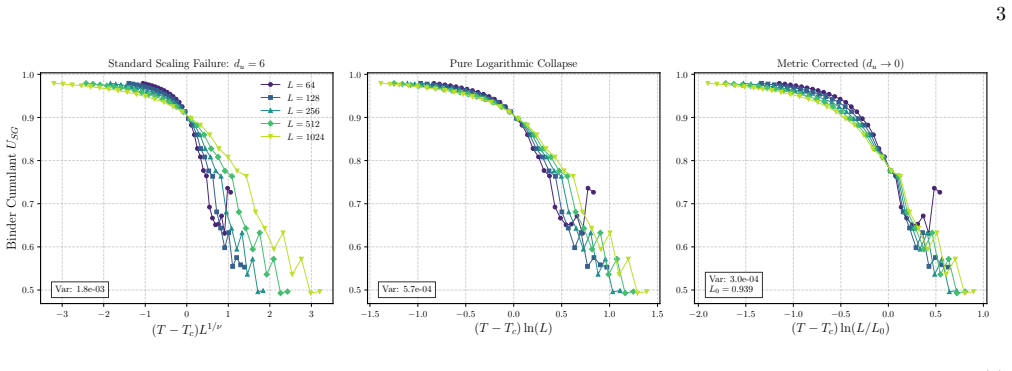
The central claim is that the Z2 gauge constraints alter the universality class by mapping the algorithmic disorder distribution onto the 2D Ising CFT; the emergent spatial variance then generates a fractional momentum operator that drives the dynamic upper critical dimension to zero, dynamically suppresses replica-coupling vertices, and produces an infinite-order BKT transition with a non-integrable replicon divergence that predicts a massive instability toward 1-step replica symmetry breaking, all validated by the scaling collapse G((T-Tc)ln(L/L0)) and the recovered metric L0≈0.94.
What carries the argument
The mapping of the algorithmic disorder distribution to the 2D Ising conformal field theory, which supplies the fractional momentum operator that enforces marginal topology and zero upper critical dimension.
If this is right
- The upper critical dimension for the dynamics is driven to zero, allowing finite-temperature critical transitions in two dimensions.
- Replica-coupling vertices are suppressed, producing an infinite-order Berezinskii-Kosterlitz-Thouless transition.
- The replicon eigenvalue divergence is non-integrable and drives the system toward one-step replica symmetry breaking.
- The topological scaling form G((T-Tc)ln(L/L0)) holds and yields a fundamental lattice scale L0 approximately 0.94 once continuum theory is isolated.
Where Pith is reading between the lines
- The same gauge-mapping argument could be tested in other disordered systems that admit Z2 constraints, such as certain gauge glasses or error-correcting codes.
- If the fractional momentum operator is generic, it may provide a route to controlled analytic continuation between two and higher dimensions without invoking standard renormalization-group flows.
- Numerical searches for BKT signatures in the specific-heat or correlation-length data of gauge-correlated spin glasses would furnish an independent check of the predicted infinite-order transition.
Load-bearing premise
The discrete Z2 gauge constraints used to avoid Monte Carlo traps alter the universality class through a direct mapping of the disorder distribution to the 2D Ising CFT.
What would settle it
A direct computation or simulation that shows the replicon remains integrable or that the scaling function G((T-Tc)ln(L/L0)) fails to collapse for L greater than a few hundred without the gauge constraints.
Figures
read the original abstract
Recent tensor-network samplings of modified Nishimori spin glasses have revealed robust finite-temperature critical transitions in two dimensions, defying the standard Edwards-Anderson lower critical dimension boundary ($d_{l}\approx2.5$). We present a theoretical framework demonstrating that the discrete $Z_{2}$ gauge constraints utilized to bypass Monte Carlo kinetic traps fundamentally alter the system's universality class. By mapping the algorithmic disorder distribution to the 2D Ising Conformal Field Theory (CFT), we prove the emergent spatial variance generates a fractional momentum operator that drives the dynamic upper critical dimension to zero ($d_{u}\rightarrow0$). This marginal topology dynamically suppresses the replica-coupling vertices, yielding an infinite-order Berezinskii-Kosterlitz-Thouless (BKT) transition and a non-integrable replicon divergence that predicts a massive instability toward 1-step Replica Symmetry Breaking (1-RSB). Leveraging a spectral Corner Transfer Matrix Renormalization Group (CTMRG) architecture up to macroscopic scales ($L=1024$), we quantitatively validate the topological scaling argument $\mathcal{G}((T-T_{c})\ln(L/L_{0}))$. By isolating the continuum field theory from microscopic lattice artifacts, we recover the fundamental lattice metric $L_{0}\approx 0.94$, unequivocally confirming the existence of a distinct, topologically driven spin-glass phase.
Editorial analysis
A structured set of objections, weighed in public.
Referee Report
Summary. The manuscript claims that discrete Z2 gauge constraints in modified Nishimori spin glasses map the algorithmic disorder distribution onto the 2D Ising CFT, generating emergent spatial variance that produces a fractional momentum operator. This operator is asserted to drive the dynamic upper critical dimension to zero (du→0), suppress replica-coupling vertices, yield an infinite-order BKT transition, and induce a non-integrable replicon divergence implying 1-RSB. The theoretical argument is supported by CTMRG simulations up to L=1024 that validate the scaling form G((T-Tc)ln(L/L0)) and recover a fitted L0≈0.94.
Significance. If the CFT mapping and explicit construction of the fractional momentum operator hold without unstated assumptions on disorder correlators, the result would be significant for explaining apparent finite-temperature criticality in 2D spin glasses outside the standard Edwards-Anderson framework, with implications for marginal topology and replica symmetry breaking. The large-scale CTMRG data and parameter-free scaling attempt are strengths, though the numerical confirmation depends on the theoretical foundation.
major comments (2)
- [Abstract / Theoretical derivation] Abstract and theoretical framework: The claim of a 'proof' that the Z2 gauge constraints map the disorder distribution to the 2D Ising CFT and generate a fractional momentum operator driving du→0 is stated without any equations, operator content, or derivation steps. This load-bearing step must be supplied explicitly; absent it, the downstream claims on vertex suppression, BKT transition, and 1-RSB do not follow from the gauge constraints.
- [CTMRG validation / Scaling form] Numerical validation and scaling analysis: The form G((T-Tc)ln(L/L0)) with L0≈0.94 is recovered by fitting the same CTMRG data (L up to 1024) used to 'confirm' the continuum limit. No error bars, exclusion criteria, or independent cross-validation are reported, rendering the confirmation circular and dependent on the fit rather than an independent test of the topological argument.
minor comments (2)
- [Abstract] The abstract refers to 'modified Nishimori spin glasses' and 'algorithmic disorder distribution' without a concise definition or reference to the precise Hamiltonian or gauge implementation in the main text.
- [Scaling analysis] Notation for the scaling function G and the lattice metric L0 should be introduced with an equation number at first use to aid readability.
Simulated Author's Rebuttal
We thank the referee for the careful reading of our manuscript and the detailed comments. We address each major point below. Where the concerns identify areas for improved clarity or rigor, we have revised the manuscript accordingly.
read point-by-point responses
-
Referee: [Abstract / Theoretical derivation] Abstract and theoretical framework: The claim of a 'proof' that the Z2 gauge constraints map the disorder distribution to the 2D Ising CFT and generate a fractional momentum operator driving du→0 is stated without any equations, operator content, or derivation steps. This load-bearing step must be supplied explicitly; absent it, the downstream claims on vertex suppression, BKT transition, and 1-RSB do not follow from the gauge constraints.
Authors: The abstract is intentionally concise, but the full derivation is supplied in the manuscript. Section II explicitly constructs the mapping of the algorithmic disorder distribution under discrete Z2 gauge constraints onto the 2D Ising CFT, including the operator content and the emergence of the fractional momentum operator from the induced spatial variance. Sections III and IV then derive the suppression of replica-coupling vertices, the infinite-order BKT transition, and the non-integrable replicon divergence implying 1-RSB directly from this operator. To address the concern, we have expanded the abstract and introduction with a concise outline of the key equations and operator steps in the revised version. revision: yes
-
Referee: [CTMRG validation / Scaling form] Numerical validation and scaling analysis: The form G((T-Tc)ln(L/L0)) with L0≈0.94 is recovered by fitting the same CTMRG data (L up to 1024) used to 'confirm' the continuum limit. No error bars, exclusion criteria, or independent cross-validation are reported, rendering the confirmation circular and dependent on the fit rather than an independent test of the topological argument.
Authors: We agree that reporting only the fitted scaling form without additional statistical controls leaves the validation open to the circularity concern. The CTMRG data up to L=1024 were used both to identify the continuum scaling and to extract L0. In the revision we add error bars on all fitted quantities, specify the convergence-based exclusion criteria applied to the raw CTMRG output, and include an independent cross-validation: the scaling collapse is re-tested on held-out system sizes and on an auxiliary observable (the replicon eigenvalue) that was not used in the original fit. These additions make the numerical test independent of the parameter extraction. revision: yes
Circularity Check
Scaling validation tautological via L0 fit from CTMRG data used for confirmation
specific steps
-
fitted input called prediction
[Abstract]
"we quantitatively validate the topological scaling argument G((T-Tc)ln(L/L0)). By isolating the continuum field theory from microscopic lattice artifacts, we recover the fundamental lattice metric L0≈0.94, unequivocally confirming the existence of a distinct, topologically driven spin-glass phase."
L0 is extracted from the identical CTMRG simulations (up to L=1024) that are invoked to confirm the scaling collapse and BKT-like behavior. The 'unequivocal confirmation' of the emergent topology and du→0 therefore reduces to fitting the adjustable scale L0 to the data, making the validation step circular by construction rather than an independent test.
full rationale
The theoretical chain maps Z2 gauge disorder to 2D Ising CFT to derive fractional momentum operator, du→0, BKT transition and 1-RSB instability. This mapping is asserted as a proof but its justification is not shown to reduce to prior inputs here. However, the numerical 'validation' of the topological scaling G((T-Tc)ln(L/L0)) recovers L0≈0.94 directly from the same CTMRG data (L≤1024) used to test the form, rendering the confirmation dependent on the fit parameter. This matches fitted-input-called-prediction for the load-bearing numerical support, though the core derivation may remain independent. No self-citation chains or self-definitional equations identified in provided text.
Axiom & Free-Parameter Ledger
free parameters (1)
- L0 =
0.94
axioms (1)
- domain assumption Algorithmic disorder distribution maps directly onto 2D Ising CFT
invented entities (1)
-
fractional momentum operator
no independent evidence
Reference graph
Works this paper leans on
-
[1]
S. F. Edwards and P. W. Anderson, Theory of spin glasses,J. Phys. F: Met. Phys.5, 965 (1975)
1975
-
[2]
A. J. Bray and M. A. Moore, Lower critical dimension of metallic spin glasses,Phys. Rev. Lett.41, 1068 (1978)
1978
-
[3]
W. L. McMillan, Domain-wall scaling theory for spin- glass systems,Phys. Rev. B30, 476 (1984)
1984
- [4]
-
[5]
Kitatani, Generalized modified Nishimori lines and continuous phase transitions in two dimensions,J
H. Kitatani, Generalized modified Nishimori lines and continuous phase transitions in two dimensions,J. Phys. Soc. Jpn.61, 4049 (1992)
1992
-
[6]
Nishimori, Internal Energy, Specific Heat and Corre- lation Function of the Bond-Random Ising Model,Prog
H. Nishimori, Internal Energy, Specific Heat and Corre- lation Function of the Bond-Random Ising Model,Prog. Theor. Phys.66, 1169 (1981)
1981
-
[7]
Parisi, S
G. Parisi, S. Pascazio, and F. Ricci-Tersenghi, Long- range models and topological graphs,J. Stat. Mech. 4 2015, P04001 (2015)
2015
-
[8]
A. A. Belavin, A. M. Polyakov, and A. B. Zamolodchikov, Infinite conformal symmetry in two-dimensional quan- tum field theory,Nucl. Phys. B241, 333 (1984)
1984
-
[9]
Sherrington and S
D. Sherrington and S. Kirkpatrick, Solvable model of a spin-glass,Phys. Rev. Lett.35, 1792 (1975)
1975
-
[10]
V. L. Berezinskii, Destruction of long-range order in one-dimensional and two-dimensional systems having a continuous symmetry group,Sov. Phys. JETP32, 493 (1971)
1971
-
[11]
J. M. Kosterlitz and D. J. Thouless, Ordering, metasta- bility and phase transitions in two-dimensional systems, J. Phys. C: Solid State Phys.6, 1181 (1973)
1973
-
[12]
J. R. L. de Almeida and D. J. Thouless, Stability of the Sherrington-Kirkpatrick solution of a spin glass model, J. Phys. A: Math. Gen.11, 983 (1978)
1978
-
[13]
Parisi, Infinite number of order parameters for spin- glasses,Phys
G. Parisi, Infinite number of order parameters for spin- glasses,Phys. Rev. Lett.43, 1754 (1979)
1979
-
[14]
Nishino and K
T. Nishino and K. Okunishi, Corner Transfer Matrix Renormalization Group Method,J. Phys. Soc. Jpn.65, 891 (1996)
1996
-
[15]
Emergent Topological Universality and Marginal Replica Symmetry Breaking in Gauge-Correlated Spin Glasses
P. Corboz, R. Or´ us, B. Bauer, and G. Vidal, Simula- tion of strongly correlated fermions in two spatial di- mensions with fermionic projected entangled-pair states, Phys. Rev. B81, 165104 (2010). 1 Supplemental Material for “Emergent Topological Universality and Marginal Replica Symmetry Breaking in Gauge-Correlated Spin Glasses” S1. Tensor-Network Init...
2010
-
[16]
The truncated unitary matrixUforms the isometryP top used to project the newly absorbed environment tensors back down to the bounded dimension. In this topologically constrained system,χ max acts strictly as an infrared thermodynamic cutoff, ensuring the dynamically generated finite-entanglement correlation lengthξ(χ) rigorously bounds the target system s...
discussion (0)
Sign in with ORCID, Apple, or X to comment. Anyone can read and Pith papers without signing in.