Recognition: unknown
CWCD: Category-Wise Contrastive Decoding for Structured Medical Report Generation
Pith reviewed 2026-05-10 16:33 UTC · model grok-4.3
The pith
Category-wise contrastive decoding generates more accurate structured radiology reports from chest X-rays by reducing reliance on language priors.
A machine-rendered reading of the paper's core claim, the machinery that carries it, and where it could break.
Core claim
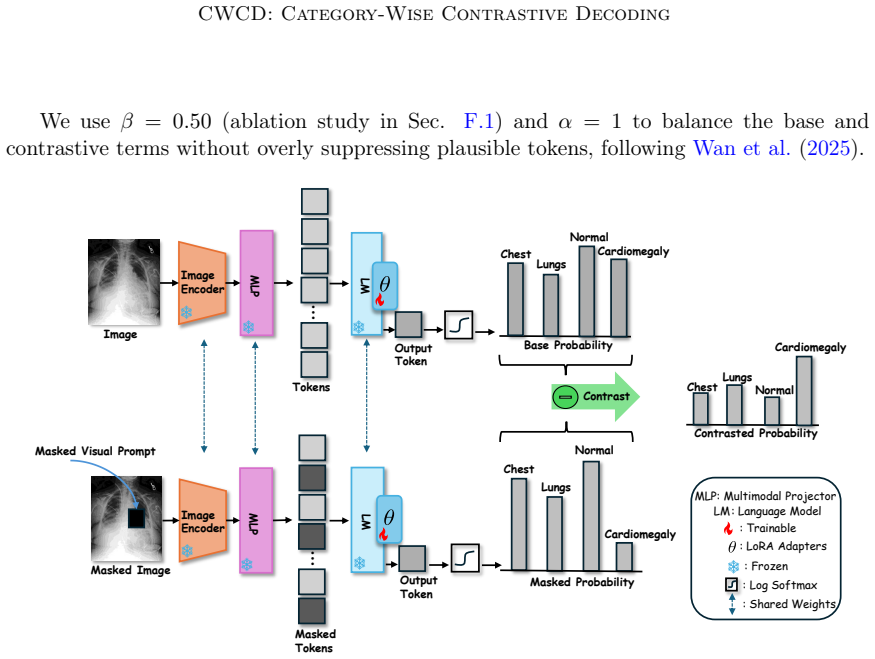
Current foundation models generate radiology reports in a single forward pass, which diminishes attention to visual tokens and increases reliance on language priors, introducing spurious pathology co-occurrences. CWCD introduces category-specific parameterization and generates category-wise reports by contrasting normal X-rays with masked X-rays using category-specific visual prompts, yielding consistent gains on both clinical efficacy and natural language generation metrics.
What carries the argument
Category-Wise Contrastive Decoding (CWCD), which applies category-specific visual prompts to contrast a normal chest X-ray against its masked counterpart for each pathology category during report generation.
If this is right
- Generated reports contain fewer incorrect combinations of pathologies.
- Clinical efficacy metrics improve because factual alignment with image findings rises.
- Natural language generation metrics improve due to better coherence within each category.
- The method integrates modularly with existing models such as LLaVA-Rad without requiring new end-to-end training.
Where Pith is reading between the lines
- The same contrastive masking idea could extend to other medical imaging modalities where language priors dominate over visual detail.
- Category-wise structure may improve clinician trust by making it easier to verify each section against the image.
- If masking is learned rather than fixed, the approach might adapt to new categories without manual prompt engineering.
Load-bearing premise
Single-pass decoding in multi-modal models necessarily reduces attention to the image and that contrasting against masked X-rays will correct this without creating new errors or biases.
What would settle it
On a test set of X-rays with known independent pathologies, CWCD-generated reports would show no reduction in the rate of spurious co-occurrence pairs compared with single-pass baselines.
Figures



read the original abstract
Interpreting chest X-rays is inherently challenging due to the overlap between anatomical structures and the subtle presentation of many clinically significant pathologies, making accurate diagnosis time-consuming even for experienced radiologists. Recent radiology-focused foundation models, such as LLaVA-Rad and Maira-2, have positioned multi-modal large language models (MLLMs) at the forefront of automated radiology report generation (RRG). However, despite these advances, current foundation models generate reports in a single forward pass. This decoding strategy diminishes attention to visual tokens and increases reliance on language priors as generation proceeds, which in turn introduces spurious pathology co-occurrences in the generated reports. To mitigate these limitations, we propose Category-Wise Contrastive Decoding (CWCD), a novel and modular framework designed to enhance structured radiology report generation (SRRG). Our approach introduces category-specific parameterization and generates category-wise reports by contrasting normal X-rays with masked X-rays using category-specific visual prompts. Experimental results demonstrate that CWCD consistently outperforms baseline methods across both clinical efficacy and natural language generation metrics. An ablation study further elucidates the contribution of each architectural component to overall performance.
Editorial analysis
A structured set of objections, weighed in public.
Referee Report
Summary. The paper proposes Category-Wise Contrastive Decoding (CWCD), a modular framework for structured radiology report generation (SRRG) from chest X-rays using MLLMs. It identifies single-pass decoding as causing diminished visual attention and spurious pathology co-occurrences, then introduces category-specific parameterization to generate reports by contrasting normal X-rays against masked versions via category-specific visual prompts. The central claim is consistent outperformance over baselines on clinical efficacy and NLG metrics, supported by an ablation study.
Significance. If the empirical results and mechanism hold, CWCD provides a practical, modular addition to existing radiology MLLMs that could reduce reliance on language priors and improve report accuracy in a domain where anatomical overlap and subtle pathologies make automation error-prone. The emphasis on category-wise handling and contrastive decoding aligns with needs for more reliable structured outputs in clinical AI.
major comments (2)
- [Method] Method section (description of CWCD): the claim that contrasting normal X-rays with masked X-rays using category-specific prompts reliably corrects diminished visual attention rests on the unverified assumption that masking isolates relevant visual evidence without residual cues or cross-category leakage; given heavy anatomical overlap in chest X-rays, the paper must supply masking details, visualizations, or quantitative checks showing the contrast isolates pathologies rather than introducing artifacts.
- [Experiments] Experiments section: the abstract asserts 'consistent outperformance' on clinical and NLG metrics, yet no numerical results, baseline specifications, statistical tests, or effect sizes are referenced in the provided text; without these, the central claim cannot be evaluated and the ablation's contribution remains unquantified.
minor comments (1)
- [Abstract] Abstract: the phrasing 'Experimental results demonstrate...' would be clearer if it previewed at least one key metric or baseline name rather than remaining purely qualitative.
Simulated Author's Rebuttal
We thank the referee for the constructive feedback on our manuscript. We address each major comment point by point below, providing clarifications and indicating revisions where the manuscript will be updated to strengthen the presentation and address the concerns raised.
read point-by-point responses
-
Referee: [Method] Method section (description of CWCD): the claim that contrasting normal X-rays with masked X-rays using category-specific prompts reliably corrects diminished visual attention rests on the unverified assumption that masking isolates relevant visual evidence without residual cues or cross-category leakage; given heavy anatomical overlap in chest X-rays, the paper must supply masking details, visualizations, or quantitative checks showing the contrast isolates pathologies rather than introducing artifacts.
Authors: We agree that the current description of the masking procedure is insufficient to fully substantiate the isolation of visual evidence, particularly given the anatomical overlap in chest X-rays. In the revised manuscript, we will expand the Method section with a detailed specification of the category-specific masking algorithm (including mask generation parameters and application to visual tokens), add example visualizations comparing original, masked, and contrasted images, and include quantitative checks such as pathology co-occurrence rates and attention map comparisons before/after masking to demonstrate reduced leakage and artifact introduction. revision: yes
-
Referee: [Experiments] Experiments section: the abstract asserts 'consistent outperformance' on clinical and NLG metrics, yet no numerical results, baseline specifications, statistical tests, or effect sizes are referenced in the provided text; without these, the central claim cannot be evaluated and the ablation's contribution remains unquantified.
Authors: The full experiments section provides numerical results in tables comparing CWCD to baselines (LLaVA-Rad, Maira-2) on clinical efficacy (CheXbert F1) and NLG metrics (BLEU, ROUGE), along with ablation scores and statistical tests. However, to improve immediate evaluability as noted, we will revise the abstract to reference key quantitative improvements and effect sizes, and ensure the experiments section explicitly highlights baseline specifications, p-values from significance tests, and the ablation's per-component contributions with specific metric deltas. revision: partial
Circularity Check
No circularity: method presented as independent architectural addition without self-referential derivations
full rationale
The paper introduces CWCD as a modular framework using category-specific parameterization, contrastive decoding between normal and masked X-rays, and category-wise visual prompts. No equations, derivations, or first-principles results are shown that reduce any claimed improvement to a fitted parameter, self-definition, or input by construction. The central claims rest on experimental outperformance and ablation studies rather than any load-bearing self-citation chain or renamed known result. The derivation chain is self-contained as an empirical architectural proposal.
Axiom & Free-Parameter Ledger
axioms (1)
- domain assumption Single forward pass decoding in MLLMs diminishes attention to visual tokens and increases reliance on language priors as generation proceeds
invented entities (1)
-
Category-Wise Contrastive Decoding (CWCD)
no independent evidence
Reference graph
Works this paper leans on
-
[1]
URLhttps://arxiv.org/abs/2401.12208. Wei-Lin Chiang, Zhuohan Li, Zi Lin, Ying Sheng, Zhanghao Wu, Hao Zhang, Lianmin Zheng, Siyuan Zhuang, Yonghao Zhuang, Joseph E. Gonzalez, Ion Stoica, and Eric P. Xing. Vicuna: An open-source chatbot impressing gpt-4 with 90%* chatgpt quality, March 2023. URLhttps://lmsys.org/blog/2023-03-30-vicuna/. Eric W. Christensen...
-
[2]
Xu Chu, Xinrong Chen, Guanyu Wang, Zhijie Tan, Kui Huang, Wenyu Lv, Tong Mo, and Weiping Li
Publisher Copyright:©2024 American College of Radiology. Xu Chu, Xinrong Chen, Guanyu Wang, Zhijie Tan, Kui Huang, Wenyu Lv, Tong Mo, and Weiping Li. Qwen look again: Guiding vision-language reasoning models to re-attention visual information, 2025. URLhttps://arxiv.org/abs/2505.23558. DeepSeek-AI. Deepseek-r1: Incentivizing reasoning capability in llms v...
-
[3]
URLhttps://arxiv.org/abs/2408.15802. Alexey Dosovitskiy, Lucas Beyer, Alexander Kolesnikov, Dirk Weissenborn, Xiaohua Zhai, Thomas Unterthiner, Mostafa Dehghani, Matthias Minderer, Georg Heigold, Sylvain Gelly, Jakob Uszkoreit, and Neil Houlsby. An image is worth 16×16 words: Transformers for image recognition at scale.Proceedings of the 9th International...
-
[4]
B leu: a method for automatic evaluation of machine translation
Association for Computational Linguistics. doi: 10.3115/1073083.1073135. URL https://aclanthology.org/P02-1040/. Chantal Pellegrini, Ege Özsoy, Benjamin Busam, Benedikt Wiestler, Nassir Navab, and Matthias Keicher. Radialog: Large vision-language models for x-ray reporting and dialog- driven assistance. InMedical Imaging with Deep Learning, 2025. Alec Rad...
-
[5]
Learning Transferable Visual Models From Natural Language Supervision
URLhttps://arxiv.org/abs/2103.00020. Hamid Rezatofighi, Nathan Tsoi, JunYoung Gwak, Amir Sadeghian, Ian Reid, and Silvio Savarese. Generalized intersection over union: A metric and a loss for bounding box regression, 2019. URLhttps://arxiv.org/abs/1902.09630. Omar Sabri, Bassam Al-Shargabi, and Abdelrahman Abuarqoub. The role of artificial intelligence in...
work page internal anchor Pith review Pith/arXiv arXiv doi:10.32604/cmc.2025.066987 2019
-
[6]
Springer International Publishing. ISBN 978-3-030-32226-7. Juan Manuel Zambrano Chaves, Shih-Cheng Huang, Yanbo Xu, Hanwen Xu, Naoto Usuyama, Sheng Zhang, Fei Wang, Yujia Xie, Mahmoud Khademi, Ziyi Yang, Hany Awadalla, Julia Gong, Houdong Hu, Jianwei Yang, Chunyuan Li, Jianfeng Gao, Yu Gu, Cliff Wong, Mu Wei, Tristan Naumann, Muhao Chen, Matthew P. Lungre...
discussion (0)
Sign in with ORCID, Apple, or X to comment. Anyone can read and Pith papers without signing in.