Recognition: unknown
CHAIRO: Contextual Hierarchical Analogical Induction and Reasoning Optimization for LLMs
Pith reviewed 2026-05-10 16:05 UTC · model grok-4.3
The pith
A framework retrieving analogical examples to induce and optimize rules lets LLMs moderate content more accurately and interpretably than fine-tuning or static retrieval.
A machine-rendered reading of the paper's core claim, the machinery that carries it, and where it could break.
Core claim
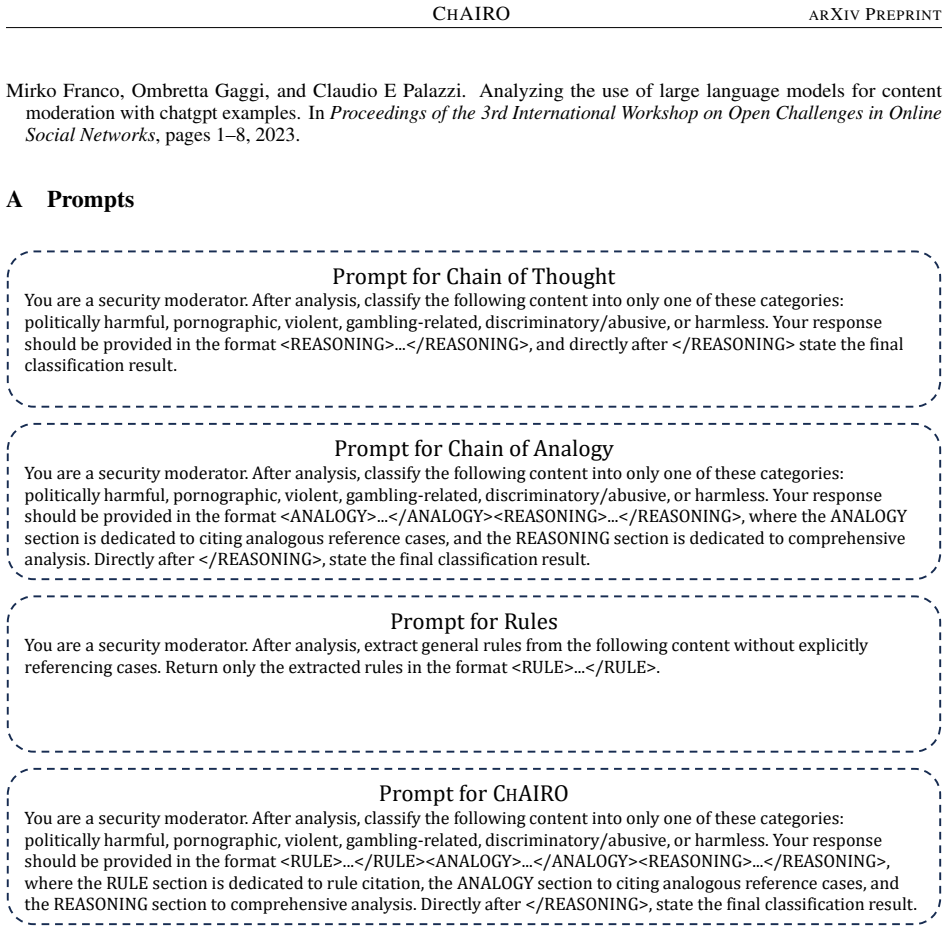
The paper claims that contextual hierarchical analogical induction and reasoning optimization, by retrieving relevant examples and deriving rules from them in an integrated pipeline, produces moderation decisions with higher accuracy and rules of better quality, including improved clarity, interpretability, and applicability to unseen cases, relative to rule-injected fine-tuning baselines and multi-stage static RAG pipelines.
What carries the argument
The end-to-end optimization of analogical example retrieval, hierarchical rule generation from those examples, and moderation classification decisions.
If this is right
- Higher moderation accuracy on challenging and ambiguous cases
- Rules with greater clarity, interpretability, and applicability
- Outperformance over rule-injected fine-tuning baselines
- Outperformance over multi-stage static RAG pipelines
- Confirmation of benefits through human assessments and external model tests
Where Pith is reading between the lines
- The method may lower the need for repeated large-scale fine-tuning by adapting via examples instead
- It could extend to other LLM tasks that require both accurate decisions and explainable rules, such as policy enforcement or diagnostic support
- Ongoing collection of new examples might support continuous rule refinement without manual intervention
Load-bearing premise
Retrieving and optimizing over analogical examples will reliably produce rules that generalize to unseen or ambiguous content without introducing selection bias or reducing performance on standard cases.
What would settle it
Apply the method to a held-out test set containing newly emerging or highly ambiguous content categories and check whether the claimed advantages in accuracy and rule quality over the baselines disappear.
Figures


read the original abstract
Content moderation in online platforms faces persistent challenges due to the evolving complexity of user-generated content and the limitations of traditional rule-based and machine learning approaches. While recent advances in large language models (LLMs) have enabled more sophisticated moderation via direct prompting or fine-tuning, these approaches often exhibit limited generalization, interpretability, and adaptability to unseen or ambiguous cases. In this work, we propose a novel moderation framework that leverages analogical examples to enhance rule induction and decision reliability. Our approach integrates end-to-end optimization of analogical retrieval, rule generation, and moderation classification, enabling the dynamic adaptation of moderation rules to diverse content scenarios. Through comprehensive experiments, we demonstrate that our method significantly outperforms both rule-injected fine-tuning baselines and multi-stage static RAG pipelines in terms of moderation accuracy and rule quality. Further evaluations, including human assessments and external model generalization tests, confirm that our framework produces rules with better clarity, interpretability, and applicability. These findings show that analogical example-driven methods can advance robust, explainable, and generalizable content moderation in real-world applications.
Editorial analysis
A structured set of objections, weighed in public.
Referee Report
Summary. The paper introduces CHAIRO, a framework for LLM-based content moderation that integrates contextual hierarchical analogical induction with end-to-end optimization of analogical retrieval, rule generation, and classification. It claims to dynamically adapt moderation rules to complex and ambiguous cases, outperforming rule-injected fine-tuning baselines and multi-stage static RAG pipelines on moderation accuracy and rule quality, with additional support from human assessments and external generalization tests.
Significance. If the empirical claims hold, the work could meaningfully advance explainable and adaptive content moderation by demonstrating that analogical example-driven rule induction improves generalization and interpretability over static or fine-tuned approaches. The end-to-end optimization of retrieval and rule generation is a technically interesting direction. However, the absence of any reported metrics, datasets, or methodology prevents assessment of whether these advantages are realized.
major comments (2)
- Abstract: The central claim that CHAIRO 'significantly outperforms' baselines on moderation accuracy and rule quality is stated without any metrics, datasets, data splits, baseline implementations, ablation results, or statistical tests. This is load-bearing for the paper's contribution, as the abstract supplies only the assertion and no evidence against which the claim can be checked.
- Methods/Experiments (implied sections): No description is provided of the end-to-end optimization procedure, loss functions, how gradients flow through the retrieval and rule-generation components, or safeguards against circularity when the same data may be used for both rule optimization and evaluation. This directly affects the weakest assumption that analogical retrieval will produce generalizable rules without selection bias or degradation on standard cases.
Simulated Author's Rebuttal
We thank the referee for the constructive feedback. The comments correctly identify areas where the original manuscript was insufficiently explicit. We have revised the paper to supply the missing quantitative details and technical descriptions, and we respond to each point below.
read point-by-point responses
-
Referee: Abstract: The central claim that CHAIRO 'significantly outperforms' baselines on moderation accuracy and rule quality is stated without any metrics, datasets, data splits, baseline implementations, ablation results, or statistical tests. This is load-bearing for the paper's contribution, as the abstract supplies only the assertion and no evidence against which the claim can be checked.
Authors: We agree that the abstract as originally submitted presented the performance claim without supporting numbers or references. In the revised version we have added a concise statement of the primary accuracy gains, the main datasets and splits employed, and the use of statistical significance testing. The Experiments section now contains the full baseline implementations, ablation tables, and metric values so that readers can directly evaluate the claim. The abstract revision is limited to one additional sentence to respect length constraints while still grounding the assertion. revision: yes
-
Referee: Methods/Experiments (implied sections): No description is provided of the end-to-end optimization procedure, loss functions, how gradients flow through the retrieval and rule-generation components, or safeguards against circularity when the same data may be used for both rule optimization and evaluation. This directly affects the weakest assumption that analogical retrieval will produce generalizable rules without selection bias or degradation on standard cases.
Authors: We acknowledge that the original manuscript omitted an explicit account of the joint optimization. The revised Methods section now includes a new subsection that defines the composite loss, describes the differentiable retrieval module and the gradient paths (including straight-through estimation for discrete rule tokens), and specifies the data-partitioning protocol. Separate held-out sets are used for rule optimization versus final evaluation to prevent circularity and selection bias; we also report results on standard cases to demonstrate that performance does not degrade. These additions directly address the generalizability concern. revision: yes
Circularity Check
No significant circularity; derivation chain is self-contained with no reductions to inputs by construction.
full rationale
The provided abstract and placeholder full-text reference contain no equations, no explicit optimization procedures that fit parameters on evaluation data, and no self-citations or uniqueness theorems invoked to justify core claims. The central assertions rest on experimental outcomes (outperformance on moderation accuracy and rule quality) presented as independent results rather than tautological redefinitions or fitted predictions. Without load-bearing steps that equate outputs to inputs via definition or self-reference, the paper's framework description does not exhibit circularity under the specified criteria.
Axiom & Free-Parameter Ledger
Reference graph
Works this paper leans on
-
[1]
Exploring the orthogonality and linearity of backdoor attacks,
doi: 10.1109/SP54263.2024.00181. URLhttps://doi.org/10.1109/SP54263.2024.00181. Sarah Masud, Sahajpreet Singh, Viktor Hangya, Alexander Fraser, and Tanmoy Chakraborty. Hate personified: Investigating the role of llms in content moderation. In Yaser Al-Onaizan, Mohit Bansal, and Yun-Nung Chen, editors,Proceedings of the 2024 Conference on Empirical Methods...
-
[2]
Yaqiong Li, Peng Zhang, Hansu Gu, Tun Lu, Siyuan Qiao, Yubo Shu, Yiyang Shao, and Ning Gu
URLhttps://doi.org/10.18653/v1/2025.naacl-long.441. Yaqiong Li, Peng Zhang, Hansu Gu, Tun Lu, Siyuan Qiao, Yubo Shu, Yiyang Shao, and Ning Gu. Demod: A holistic tool with explainable detection and personalized modification for toxicity censorship.Proc. ACM Hum. Comput. Interact., 9(2):1–24, 2025. Paul Röttger, Bertie Vidgen, Dirk Hovy, and Janet Pierrehum...
discussion (0)
Sign in with ORCID, Apple, or X to comment. Anyone can read and Pith papers without signing in.