Recognition: unknown
On Some Multivariate Extensions to Zenga Curve: Properties and Applications
Pith reviewed 2026-05-10 16:28 UTC · model grok-4.3
The pith
Bivariate Zenga surfaces defined from quantile functions extend inequality measurement to the joint distribution of two variables.
A machine-rendered reading of the paper's core claim, the machinery that carries it, and where it could break.
Core claim
Bivariate quantile functions yield well-defined Zenga surfaces whose values at each probability pair quantify inequality in the joint distribution, together with a vector-valued curve that decomposes the inequality contribution of each margin; these objects satisfy natural ordering and monotonicity properties and admit consistent nonparametric estimation.
What carries the argument
Bivariate quantile functions, which replace the univariate inverse distribution function and serve as the direct input for constructing the Zenga surfaces and the associated vector-valued curve.
If this is right
- The surfaces make visible the conditional inequality of one variable given the quantile level of the other.
- The vector-valued curve supplies separate components for each variable while preserving the joint information.
- The nonparametric estimator can be applied directly to sample data without parametric assumptions on the joint law.
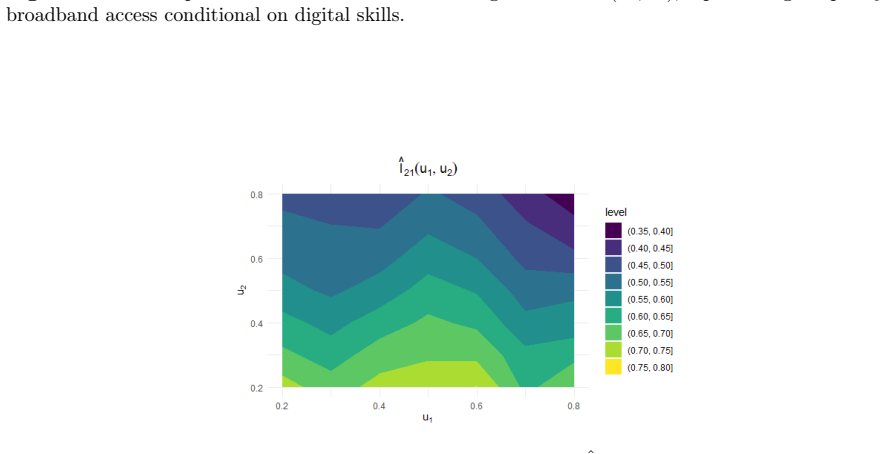
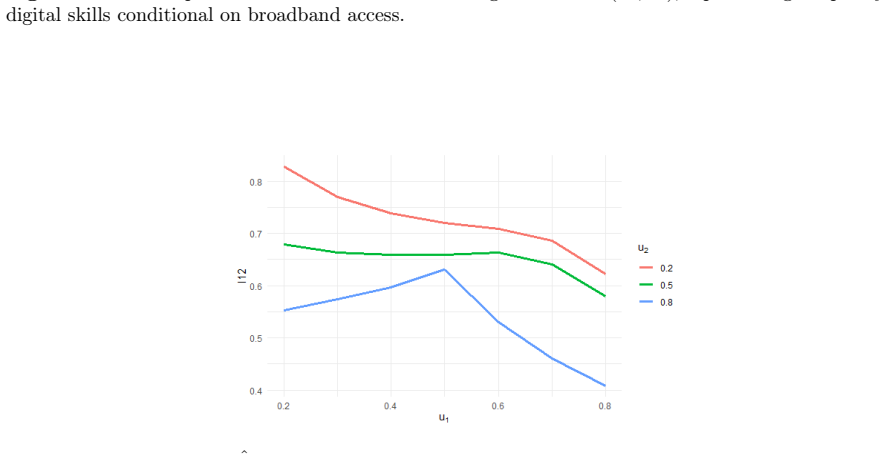
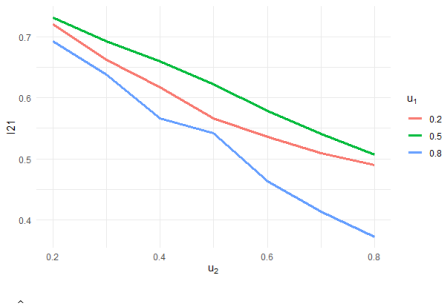
- Real-world application to paired digital indicators demonstrates that the surfaces detect inequality patterns missed by separate univariate calculations.
Where Pith is reading between the lines
- The same quantile-function route could be iterated to three or more variables, producing hypersurfaces for broader multidimensional inequality studies.
- Policy analysts could use the surfaces to locate regions of the joint distribution where two disadvantages reinforce each other.
- Direct numerical comparison with other bivariate inequality functionals on the same datasets would clarify whether the Zenga construction adds distinct interpretive value.
Load-bearing premise
The quantile-function definitions produce numerical values that correspond to the intuitive notion of multidimensional inequality in the joint distribution.
What would settle it
A controlled simulation in which two variables are made increasingly dependent while each marginal inequality is held fixed, yet the proposed surface values remain unchanged or move in the opposite direction from the expected rise in joint disparity.
Figures


read the original abstract
Measures of inequality are often limited in their ability to capture multidimensional aspects that arise from the joint distribution of multiple socio-economic variables. In this paper, we develop bivariate extensions of the Zenga inequality measure using bivariate quantile functions. We propose new bivariate Zenga surfaces and study their theoretical properties. A vector-valued bivariate Zenga curve is also introduced to provide a more detailed characterization of inequality. A non-parametric estimator is proposed and methods are evaluated through simulation studies and applied to the analysis of digital inequality across countries using indicators such as broadband penetration and digital literacy. The results highlight the effectiveness of the proposed framework in capturing multidimensional inequality.
Editorial analysis
A structured set of objections, weighed in public.
Referee Report
Summary. The paper develops bivariate extensions of the Zenga inequality measure using bivariate quantile functions. It proposes new bivariate Zenga surfaces, studies their theoretical properties, introduces a vector-valued bivariate Zenga curve for more detailed characterization, proposes a non-parametric estimator, evaluates it via simulation studies, and applies the framework to digital inequality across countries using indicators such as broadband penetration and digital literacy.
Significance. If the central definitions are made robust and the properties hold under a canonical choice, the work could offer useful tools for multidimensional inequality analysis that capture joint distributional features beyond univariate Zenga measures. The combination of theoretical properties, simulations, and a real-data application on digital inequality adds practical value, though the overall significance hinges on resolving ambiguities in the bivariate quantile construction.
major comments (2)
- [Abstract and §3] The central construction of the bivariate Zenga surfaces and vector-valued curve (abstract; likely §3) relies on bivariate quantile functions, but no unique canonical definition exists (unlike the univariate Q(p) = inf{x : F(x) ≥ p}). The manuscript adopts one specific version without proving invariance properties or comparing alternatives such as geometric, conditional, or spatial quantiles; this choice directly determines the level sets and thus the inequality surfaces, leaving the claim that they 'accurately reflect multidimensional inequality aspects in joint distributions' unsecured by the construction itself.
- [§4 and application section] The theoretical properties studied for the proposed surfaces (likely §4) and the effectiveness highlighted in the application (§6 or §7) rest on the above definitions; without addressing non-uniqueness, the properties may not be intrinsic and the simulation results may not generalize across plausible bivariate quantile choices.
minor comments (2)
- [Abstract] The abstract states that 'the results highlight the effectiveness' but does not include any quantitative summary of simulation performance or application findings; adding one or two key metrics would improve clarity.
- [§3] Notation for the bivariate quantile function and the resulting surfaces should be introduced with explicit reference to the chosen definition to avoid ambiguity for readers.
Simulated Author's Rebuttal
We thank the referee for the thoughtful and constructive comments, which help clarify important aspects of our bivariate extensions. We address each major comment below and outline the revisions we will make to strengthen the manuscript.
read point-by-point responses
-
Referee: [Abstract and §3] The central construction of the bivariate Zenga surfaces and vector-valued curve (abstract; likely §3) relies on bivariate quantile functions, but no unique canonical definition exists (unlike the univariate Q(p) = inf{x : F(x) ≥ p}). The manuscript adopts one specific version without proving invariance properties or comparing alternatives such as geometric, conditional, or spatial quantiles; this choice directly determines the level sets and thus the inequality surfaces, leaving the claim that they 'accurately reflect multidimensional inequality aspects in joint distributions' unsecured by the construction itself.
Authors: We appreciate the referee highlighting the non-uniqueness of bivariate quantile functions. Our paper adopts the definition of the bivariate quantile function obtained as the generalized inverse of the joint cumulative distribution function, which provides a direct and natural multivariate extension of the univariate quantile used in the original Zenga measure. While the original manuscript did not include an explicit comparison to alternatives (such as conditional, geometric, or spatial quantiles), we agree this should be addressed for transparency. In the revised version, we will expand §3 to (i) state the chosen definition explicitly, (ii) briefly discuss why it is suitable for inequality analysis (preserving monotonicity and allowing level-set interpretations for joint distributions), and (iii) note that other definitions exist and may yield different surfaces. We will also tone down the abstract claim to indicate that the surfaces accurately reflect multidimensional aspects under this construction. These changes secure the claims without requiring invariance proofs across all definitions. revision: yes
-
Referee: [§4 and application section] The theoretical properties studied for the proposed surfaces (likely §4) and the effectiveness highlighted in the application (§6 or §7) rest on the above definitions; without addressing non-uniqueness, the properties may not be intrinsic and the simulation results may not generalize across plausible bivariate quantile choices.
Authors: We concur that the properties in §4 and the simulation/application results are specific to the adopted bivariate quantile definition. In the revision, we will modify §4 to state explicitly that all derived properties (e.g., bounds, monotonicity with respect to joint distributions) hold for the proposed surfaces under the chosen quantile construction. In the simulation studies, we will add a clarifying sentence noting that estimator performance is assessed for this definition and that results pertain to it. For the digital inequality application, we will similarly emphasize that the observed patterns illustrate the framework with the selected quantile. While a full comparative simulation across multiple quantile definitions lies outside the paper's scope, the revisions will make the dependence clear and prevent any implication that the properties are definition-independent. revision: partial
Circularity Check
No circularity: bivariate Zenga extensions are explicit new definitions
full rationale
The paper starts from the univariate Zenga measure and explicitly constructs bivariate extensions via bivariate quantile functions, then derives properties of the resulting surfaces and vector-valued curve, proposes a nonparametric estimator, and validates via simulation and data application. None of these steps reduce by construction to fitted parameters renamed as predictions, self-definitional loops, or load-bearing self-citations; the central objects are introduced as novel constructs whose properties are examined independently. The provided abstract and description contain no equations or claims that collapse the output back to the input definitions.
Axiom & Free-Parameter Ledger
Reference graph
Works this paper leans on
-
[1]
and Rigo, P
Berti, P. and Rigo, P. (1995). A note on Zenga concentration index.Journal of the Italian Statistical Society, 4(3):397–404. Billon, M., Marco, R., and Lera-Lopez, F. (2009). Disparities in ICT adoption: A mul- tidimensional approach to study the cross-country digital divide.Telecommunications Policy, 33(10-11):596–610. 28 Chinn, M. D. and Fairlie, R. W. ...
1995
-
[2]
Greselin, F., Pasquazzi, L., and Zitikis, R. (2010). Zenga’s new index of economic in- equality, its estimation, and an analysis of incomes in italy.Journal of Probability and Statistics, 2010(1):718905. Jain, K. and Nanda, A. K. (1995). On multivariate weighted distributions.Communica- tions in Statistics-Theory and Methods, 24(10):2517–2539. Langel, M. ...
2010
-
[3]
29 Shifna, P. R. and Sunoj, S. M. (2025). Extending the Lorenz curve to higher dimensions: A multivariate quantile function approach.Research Square. Preprint. Thoene, U. and García Alonso, R. (2025). Broadband disparities and policy responses in Latin America and the Caribbean.Digital Policy, Regulation and Governance, 27(5):588–606. Vineshkumar, B. and ...
2025
discussion (0)
Sign in with ORCID, Apple, or X to comment. Anyone can read and Pith papers without signing in.