Recognition: unknown
The spontaneous disentanglement hypothesis and causality
Pith reviewed 2026-05-10 16:05 UTC · model grok-4.3
The pith
A maximum-entropy formulation of spontaneous disentanglement respects causality in any finite-dimensional quantum system.
A machine-rendered reading of the paper's core claim, the machinery that carries it, and where it could break.
Core claim
The proposed formulation for the spontaneous disentanglement hypothesis, which is based on the maximum entropy principle, is applicable for any quantum system having a Hilbert space of finite dimensionality and ensures consistency with causality via the method of Lagrange multipliers.
What carries the argument
The maximum entropy principle applied to spontaneous disentanglement dynamics, with causality enforced through Lagrange multipliers.
If this is right
- Spontaneous disentanglement becomes compatible with causality for every finite-dimensional quantum system.
- The hypothesis can now be studied without immediate contradiction to relativistic principles.
- The formulation supplies a well-defined dynamical rule that can be applied to any finite Hilbert space.
- Causality is maintained by treating it as an explicit constraint rather than an emergent feature.
Where Pith is reading between the lines
- The same maximum-entropy-plus-Lagrange approach might be used to derive consistent disentanglement rates in small systems such as trapped ions or superconducting qubits.
- If the formulation holds, it could be compared with standard decoherence models to see whether spontaneous disentanglement produces distinguishable predictions.
- The method might be adapted to approximate infinite-dimensional cases by taking controlled limits of finite-dimensional truncations.
Load-bearing premise
The maximum entropy principle can be imposed directly on the spontaneous disentanglement process without creating inconsistencies in the time evolution or measurement rules.
What would settle it
An explicit calculation for a two-qubit entangled state showing that the Lagrange-multiplier constraints still permit a superluminal signaling channel.
Figures

read the original abstract
The hypothesis that disentanglement spontaneously occurs in quantum systems is motivated by some outstanding issues in the foundations of quantum mechanics. However, for some cases, spontaneous disentanglement enables the violation of the causality principle. To mitigate the conflict with causality, a formulation for the hypothesis, which is based on the maximum entropy principle, is proposed. The method of Lagrange multipliers is implemented to ensure consistency with causality. The proposed formulation is applicable for any quantum system having a Hilbert space of finite dimensionality.
Editorial analysis
A structured set of objections, weighed in public.
Referee Report
Summary. The paper proposes a formulation of the spontaneous disentanglement hypothesis motivated by foundational issues in quantum mechanics. It applies the maximum entropy principle with the method of Lagrange multipliers as a constraint to ensure consistency with causality. The formulation is claimed to be applicable to any quantum system with a finite-dimensional Hilbert space.
Significance. If the Lagrange multiplier constraint produces a valid causal dynamics, the work would offer a parameter-free way to incorporate spontaneous disentanglement while respecting no-signaling, using only standard tools from statistical mechanics and constrained optimization. This is a strength, as the approach avoids new free parameters or ad-hoc entities. However, the significance is currently limited because the central consistency claim is not yet supported by an explicit dynamical map or proof.
major comments (2)
- [Abstract and main formulation] Abstract and formulation section: the claim that the maximum entropy principle with Lagrange multipliers 'ensures consistency with causality' is stated without deriving the resulting time evolution (e.g., a master equation or quantum channel) or verifying that the reduced dynamics on subsystems preserve the no-signaling condition for arbitrary initial states and bipartitions. This is load-bearing for the central claim, as the skeptic note correctly identifies that the max-ent procedure must yield a completely positive trace-preserving map whose generator commutes appropriately with local observables.
- [Implementation of Lagrange multipliers] The applicability statement for finite-dimensional Hilbert spaces is not accompanied by an explicit check that the constrained optimization produces a valid quantum dynamical map; without this step the consistency with causality remains an unexamined assumption rather than a demonstrated result.
minor comments (2)
- [Abstract] The abstract would be clearer if it briefly indicated the form of the causality constraint (e.g., which local observables are held fixed by the multipliers).
- Notation for the entropy functional and the constraint equations could be introduced earlier to improve readability for readers outside the immediate subfield.
Simulated Author's Rebuttal
We thank the referee for the careful and constructive review. The comments correctly identify that the central claim of causal consistency requires explicit verification through derivation of the dynamics. We will revise the manuscript to include these derivations and checks while preserving the original formulation.
read point-by-point responses
-
Referee: [Abstract and main formulation] Abstract and formulation section: the claim that the maximum entropy principle with Lagrange multipliers 'ensures consistency with causality' is stated without deriving the resulting time evolution (e.g., a master equation or quantum channel) or verifying that the reduced dynamics on subsystems preserve the no-signaling condition for arbitrary initial states and bipartitions. This is load-bearing for the central claim, as the skeptic note correctly identifies that the max-ent procedure must yield a completely positive trace-preserving map whose generator commutes appropriately with local observables.
Authors: We agree that the original manuscript states the consistency claim via the constrained maximum-entropy procedure but does not derive the explicit time evolution or perform the no-signaling verification. The Lagrange-multiplier term is introduced precisely to enforce the causality constraint on the entropy maximization; however, to demonstrate that this yields a valid CPTP generator commuting with local observables, we will add in the revision a general derivation of the resulting master equation for finite-dimensional systems and an explicit check that the reduced dynamics on any subsystem satisfy the no-signaling condition for arbitrary initial states and bipartitions. revision: yes
-
Referee: [Implementation of Lagrange multipliers] The applicability statement for finite-dimensional Hilbert spaces is not accompanied by an explicit check that the constrained optimization produces a valid quantum dynamical map; without this step the consistency with causality remains an unexamined assumption rather than a demonstrated result.
Authors: We acknowledge that the manuscript asserts applicability to any finite-dimensional Hilbert space without supplying the explicit verification that the constrained optimization produces a CPTP map. In the revised version we will provide a general argument showing that the Lagrange-multiplier constraint, when solved within the space of density operators, yields a completely positive trace-preserving evolution whose generator respects the required commutation relations with local observables, thereby confirming the causal consistency for the stated class of systems. revision: yes
Circularity Check
No circularity: constructive proposal of max-ent formulation with Lagrange constraint
full rationale
The paper advances a hypothesis formulation by directly applying the maximum entropy principle subject to a causality constraint implemented via Lagrange multipliers. This is presented as a constructive method applicable to any finite-dimensional Hilbert space, without any equations that reduce by construction to fitted parameters, self-citations, or prior results from the same authors. No uniqueness theorems, ansatzes smuggled via citation, or renamings of known results are invoked. The central claim of causality consistency is asserted as a property of the proposed method rather than derived from a self-referential loop or statistically forced prediction, leaving the derivation chain self-contained.
Axiom & Free-Parameter Ledger
axioms (1)
- domain assumption The maximum entropy principle can be used to select the form of spontaneous disentanglement consistent with causality.
Forward citations
Cited by 1 Pith paper
-
Quasilinear evolution versus von Neumann selective measurement
Quasilinear evolution replaces von Neumann projection for selective measurements, providing continuous state reduction without collapse while satisfying no-signaling and Born rule.
Reference graph
Works this paper leans on
-
[1]
This detectability arguably enables superluminal signaling
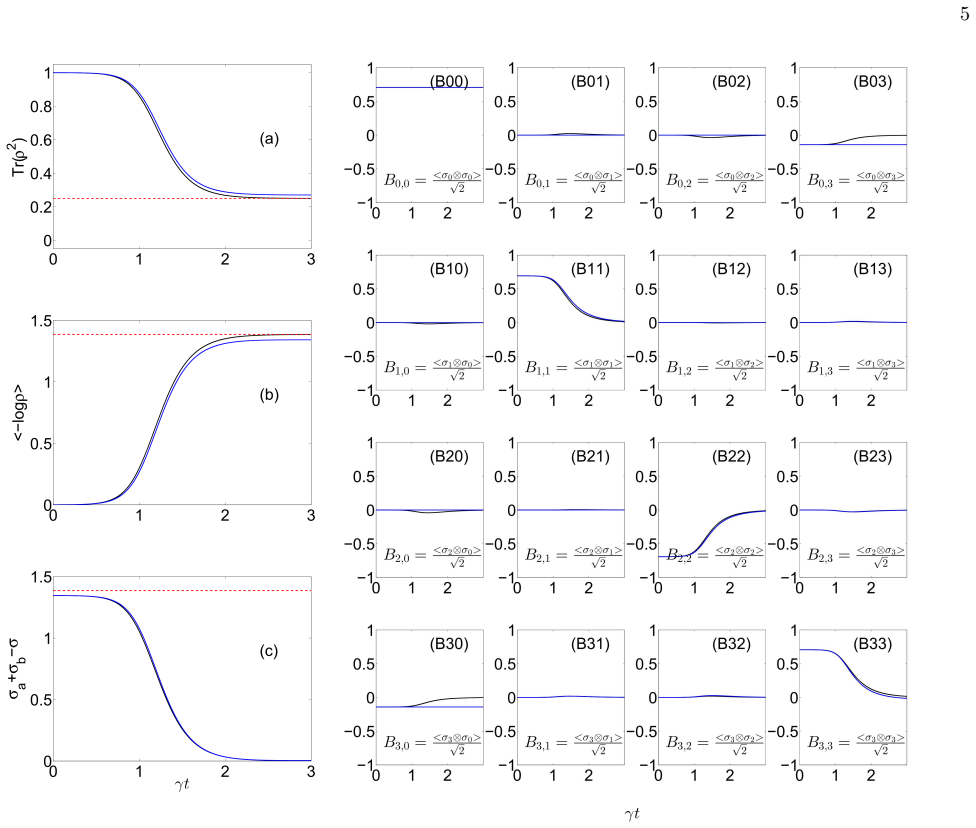
Both states |+⟩B and|−⟩B are fully entangled, and thus a disentan- glement process occurring after Alice’s measurement, is expected to give rise to an impact that can be detected by Bob (for example, by measuring the expectation values of Bell operators for the pair he owns). This detectability arguably enables superluminal signaling. For the same above–d...
-
[2]
laws of thermodynamics. As was discussed above, the conflict with the causality principle can be avoided, provided that the reduced density operatorsρa (the quan- tum system) and ρb (the measurement apparatus) are unaffected by the process of disentanglement. According to the Klein subadditivity inequality [64, 65] σ≤ σa +σb , (8) and σ = σa +σb if and only...
-
[3]
Die gegenwartige situation in der quan- tenmechanik
E. Schrodinger, “Die gegenwartige situation in der quan- tenmechanik”, Naturwissenschaften, vol. 23, pp. 807, 1935
1935
-
[4]
Uncertainty in quantum mechanics: faith or fantasy?
Roger Penrose, “Uncertainty in quantum mechanics: faith or fantasy?”, Philosophical Transactions of the Royal Society A: Mathematical, Physical and Engineer- ing Sciences, vol. 369, no. 1956, pp. 4864–4890, 2011
1956
-
[5]
Precision tests of quantum mechan- ics
Steven Weinberg, “Precision tests of quantum mechan- ics”, in THE OSKAR KLEIN MEMORIAL LECTURES 1988–1999, pp. 61–68. World Scientific, 2014
1988
-
[6]
Nonlinear relaxation and fluctuations of damped quantum systems
H Grabert, “Nonlinear relaxation and fluctuations of damped quantum systems”, Zeitschrift f¨ ur Physik B Condensed Matter, vol. 49, no. 2, pp. 161–172, 1982
1982
-
[7]
Introducing non- linear gauge transformations in a family of nonlinear schr¨ odinger equations
H-D Doebner and Gerald A Goldin, “Introducing non- linear gauge transformations in a family of nonlinear schr¨ odinger equations”,Physical Review A , vol. 54, no. 5, pp. 3764, 1996
1996
-
[8]
The quantum-state diffusion model applied to open systems
Nicolas Gisin and Ian C Percival, “The quantum-state diffusion model applied to open systems”, Journal of Physics A: Mathematical and General , vol. 25, no. 21, pp. 5677, 1992
1992
-
[9]
A simple nonlinear dissipative quantum evolution equation
Nicolas Gisin, “A simple nonlinear dissipative quantum evolution equation”, Journal of Physics A: Mathematical and General , vol. 14, no. 9, pp. 2259, 1981
1981
-
[10]
Causal frame- work for nonlinear quantum mechanics
David E Kaplan and Surjeet Rajendran, “Causal frame- work for nonlinear quantum mechanics”, Physical Review D, vol. 105, no. 5, pp. 055002, 2022
2022
-
[11]
Simulating nonlinear dynamics of collective spins via quantum measurement and feedback
Manuel H Mu˜ noz-Arias, Pablo M Poggi, Poul S Jessen, and Ivan H Deutsch, “Simulating nonlinear dynamics of collective spins via quantum measurement and feedback”, Physical review letters, vol. 124, no. 11, pp. 110503, 2020
2020
-
[12]
Fast quantum state discrimination with nonlinear positive trace-preserving channels
Michael R Geller, “Fast quantum state discrimination with nonlinear positive trace-preserving channels”, Ad- vanced Quantum Technologies, p. 2200156, 2023
2023
-
[13]
Unified dynamics for microscopic and macroscopic sys- tems
Gian Carlo Ghirardi, Alberto Rimini, and Tullio Weber, “Unified dynamics for microscopic and macroscopic sys- tems”, Physical review D , vol. 34, no. 2, pp. 470, 1986
1986
-
[14]
A postquantum theory of clas- sical gravity
Jonathan Oppenheim, “A postquantum theory of clas- sical gravity”, Physical Review X , vol. 13, no. 4, pp. 041040, 2023
2023
-
[15]
Can closed timelike curves or nonlin- ear quantum mechanics improve quantum state discrim- ination or help solve hard problems?
Charles H Bennett, Debbie Leung, Graeme Smith, and John A Smolin, “Can closed timelike curves or nonlin- ear quantum mechanics improve quantum state discrim- ination or help solve hard problems?”, Physical review letters, vol. 103, no. 17, pp. 170502, 2009
2009
-
[16]
Nonlocal-looking equations can make nonlinear quantum dynamics local
Marek Czachor, “Nonlocal-looking equations can make nonlinear quantum dynamics local”, Physical Review A , vol. 57, no. 6, pp. 4122, 1998
1998
-
[17]
Models of wave-function collapse, underlying theories, and experimental tests
Angelo Bassi, Kinjalk Lochan, Seema Satin, Tejinder P Singh, and Hendrik Ulbricht, “Models of wave-function collapse, underlying theories, and experimental tests”, Reviews of Modern Physics , vol. 85, no. 2, pp. 471, 2013
2013
-
[18]
Reduction of the state vector by a non- linear schr¨ odinger equation
Philip Pearle, “Reduction of the state vector by a non- linear schr¨ odinger equation”,Physical Review D , vol. 13, no. 4, pp. 857, 1976
1976
-
[19]
Linear and integrable nonlinear evolution of the qutrit
Krzysztof Kowalski, “Linear and integrable nonlinear evolution of the qutrit”, Quantum Information Process- ing, vol. 19, no. 5, pp. 1–31, 2020. 7
2020
-
[20]
Bifurcations and chaos in nonlinear lindblad equations
Bernd Fernengel and Barbara Drossel, “Bifurcations and chaos in nonlinear lindblad equations”, Journal of Physics A: Mathematical and Theoretical , vol. 53, no. 38, pp. 385701, 2020
2020
-
[21]
Present status and future challenges of non- interferometric tests of collapse models
Matteo Carlesso, Sandro Donadi, Luca Ferialdi, Mauro Paternostro, Hendrik Ulbricht, and Angelo Bassi, “Present status and future challenges of non- interferometric tests of collapse models”, Nature Physics, vol. 18, no. 3, pp. 243–250, 2022
2022
-
[22]
Underground test of gravity-related wave function col- lapse
Sandro Donadi, Kristian Piscicchia, Catalina Curceanu, Lajos Di´ osi, Matthias Laubenstein, and Angelo Bassi, “Underground test of gravity-related wave function col- lapse”, Nature Physics , vol. 17, no. 1, pp. 74–78, 2021
2021
-
[23]
Principles of maximum entropy and maximum cal- iber in statistical physics
Steve Press´ e, Kingshuk Ghosh, Julian Lee, and Ken A Dill, “Principles of maximum entropy and maximum cal- iber in statistical physics”, Reviews of Modern Physics , vol. 85, no. 3, pp. 1115–1141, 2013
2013
-
[24]
Two recent theoretical ad- vances with potential impact on quantum technology
Hans Christian ¨Ottinger, “Two recent theoretical ad- vances with potential impact on quantum technology”, APL Quantum , vol. 2, no. 2, pp. 026121, 2025
2025
-
[25]
Taking thermodynamics too seri- ously
Craig Callender, “Taking thermodynamics too seri- ously”, Studies in history and philosophy of science part B: studies in history and philosophy of modern physics , vol. 32, no. 4, pp. 539–553, 2001
2001
-
[26]
Disentanglement-induced multistability
Eyal Buks, “Disentanglement-induced multistability”, Physical Review A , vol. 110, no. 1, pp. 012439, 2024
2024
-
[27]
Nonlinear quantum mechan- ics
Zakarias Laberg Hejlesen, “Nonlinear quantum mechan- ics”, Master’s thesis, 2019
2019
-
[28]
Assumptions that imply quantum dynamics is linear
Thomas F. Jordan, “Assumptions that imply quantum dynamics is linear”, Phys. Rev. A , vol. 73, pp. 022101, Feb 2006
2006
-
[29]
Why quantum dynamics is linear
Thomas F Jordan, “Why quantum dynamics is linear”, in Journal of Physics: Conference Series . IOP Publish- ing, 2009, vol. 196, p. 012010
2009
-
[30]
No-faster-than-light- signaling implies linear evolution. a re-derivation
Angelo Bassi and Kasra Hejazi, “No-faster-than-light- signaling implies linear evolution. a re-derivation”, Eu- ropean Journal of Physics , vol. 36, no. 5, pp. 055027, 2015
2015
-
[31]
Weinberg’s nonlinear quantum me- chanics and the einstein-podolsky-rosen paradox
Joseph Polchinski, “Weinberg’s nonlinear quantum me- chanics and the einstein-podolsky-rosen paradox”, Phys- ical Review Letters , vol. 66, no. 4, pp. 397, 1991
1991
-
[32]
Extensions of born’s rule to non-linear quantum mechanics, some of which do not imply superluminal communication
Bassam Helou and Yanbei Chen, “Extensions of born’s rule to non-linear quantum mechanics, some of which do not imply superluminal communication”, in Journal of Physics: Conference Series . IOP Publishing, 2017, vol. 880, p. 012021
2017
-
[33]
Nonlinear evo- lution and signaling
Jakub Rembieli´ nski and Pawe/suppress l Caban, “Nonlinear evo- lution and signaling”, Physical Review Research , vol. 2, no. 1, pp. 012027, 2020
2020
-
[34]
Nonlinear exten- sion of the quantum dynamical semigroup
Jakub Rembieli´ nski and Pawe/suppress l Caban, “Nonlinear exten- sion of the quantum dynamical semigroup”, Quantum, vol. 5, pp. 420, 2021
2021
-
[35]
States and ob- servables in relativistic quantum field theories
Yakir Aharonov and David Z Albert, “States and ob- servables in relativistic quantum field theories”, Physical Review D , vol. 21, no. 12, pp. 3316, 1980
1980
-
[36]
State updates and useful qubits in relativistic quantum information
Jos´ e Polo-G´ omez, T Rick Perche, and Eduardo Mart ´ ın- Mart ´ ınez, “State updates and useful qubits in relativistic quantum information”, arXiv:2506.18906, 2025
-
[37]
Julia Oskeka-Lenart, Marcin P/suppress lodzie´ n, Maciej Lewen- stein, and Micha/suppress l Eckstein, “Quantifying super- luminal signalling in schr \ ” odinger-newton model”, arXiv:2512.19260, 2025
-
[38]
Can we make sense out of the measurement process in relativistic quan- tum mechanics?
Yakir Aharonov and David Z. Albert, “Can we make sense out of the measurement process in relativistic quan- tum mechanics?”, Phys. Rev. D , vol. 24, no. 2, pp. 359– 370, Jul 1981
1981
-
[39]
Vi: tun- neling times and superluminality
Raymond Y Chiao and Aephraim M Steinberg, “Vi: tun- neling times and superluminality”, in Progress in Optics, vol. 37, pp. 345–405. Elsevier, 1997
1997
-
[40]
Effects of relativity on the time-resolved tunneling of electron wave packets
P Krekora, Q Su, and Rainer Grobe, “Effects of relativity on the time-resolved tunneling of electron wave packets”, Physical Review A , vol. 63, no. 3, pp. 032107, 2001
2001
-
[41]
Weinberg’s non-linear quantum mechan- ics and supraluminal communications
Nicolas Gisin, “Weinberg’s non-linear quantum mechan- ics and supraluminal communications”, Physics Letters A, vol. 143, no. 1-2, pp. 1–2, 1990
1990
-
[42]
Nonlinear schr¨ odinger equation in founda- tions: summary of 4 catches
Lajos Di´ osi, “Nonlinear schr¨ odinger equation in founda- tions: summary of 4 catches”, in Journal of Physics: Conference Series . IOP Publishing, 2016, vol. 701, p. 012019
2016
-
[43]
Disentanglement by deranking and by sup- pression of correlation
Eyal Buks, “Disentanglement by deranking and by sup- pression of correlation”, Advanced Quantum Technolo- gies, p. e00986, 2026
2026
-
[44]
On quantum theory of transport phenomena: Steady diffusion
Sadao Nakajima, “On quantum theory of transport phenomena: Steady diffusion”, Progress of Theoretical Physics, vol. 20, no. 6, pp. 948–959, 1958
1958
-
[45]
Memory effects in irreversible ther- modynamics
Robert Zwanzig, “Memory effects in irreversible ther- modynamics”, Physical Review, vol. 124, no. 4, pp. 983, 1961
1961
-
[46]
Eyal Buks, Quantum mechanics - Lecture Notes , http://buks.net.technion.ac.il/teaching/, 2026
2026
-
[47]
Stochastic quantum dynamics and rel- ativity
Nicolas Gisin, “Stochastic quantum dynamics and rel- ativity”, Helv. Phys. Acta , vol. 62, no. 4, pp. 363–371, 1989
1989
-
[48]
Derivations of the born rule
Lev Vaidman, “Derivations of the born rule”, Quan- tum, probability, logic: The work and influence of itamar pitowsky, pp. 567–584, 2020
2020
-
[49]
Continuous spontaneous localization as the white-noise limit of spon- taneous unitarity violation
Aritro Mukherjee and Jasper van Wezel, “Continuous spontaneous localization as the white-noise limit of spon- taneous unitarity violation”, Proceedings of the Royal Society A , vol. 481, no. 2323, pp. 20250254, 2025
2025
-
[50]
Superluminal signalling witness for quantum state reduction
Aritro Mukherjee, Lisa Lenstra, Lotte Mertens, and Jasper van Wezel, “Superluminal signalling witness for quantum state reduction”, arXiv:2410.08844, 2024
-
[51]
Nonlinearity without superluminality
Adrian Kent, “Nonlinearity without superluminality”, Physical Review A , vol. 72, no. 1, pp. 012108, 2005
2005
-
[52]
Superluminal signalling and chaos in non- linear quantum dynamics
Marta Emilia Bieli´ nska, Micha/suppress l Eckstein, and Pawe/suppress l Horodecki, “Superluminal signalling and chaos in non- linear quantum dynamics”, New Journal of Physics , vol. 27, no. 5, pp. 053002, 2025
2025
-
[53]
Correlation experi- ments in nonlinear quantum mechanics
Marek Czachor and H-D Doebner, “Correlation experi- ments in nonlinear quantum mechanics”, Physics Letters A, vol. 301, no. 3-4, pp. 139–152, 2002
2002
-
[54]
Correlations and signaling in the schr¨ odinger–newton model
Jacek Aleksander Gruca, Ankit Kumar, Ray Ganardi, Paramasivan Arumugam, Karolina Kropielnicka, and Tomasz Paterek, “Correlations and signaling in the schr¨ odinger–newton model”, Classical and Quantum Gravity, vol. 41, no. 24, pp. 245014, 2024
2024
-
[55]
Mixed-state entanglement from local randomized measurements
Andreas Elben, Richard Kueng, Hsin-Yuan Robert Huang, Rick van Bijnen, Christian Kokail, Marcello Dalmonte, Pasquale Calabrese, Barbara Kraus, John Preskill, Peter Zoller, et al., “Mixed-state entanglement from local randomized measurements”, Physical Review Letters, vol. 125, no. 20, pp. 200501, 2020
2020
-
[56]
Non- hermitian quantum dynamics of a two-level system and models of dissipative environments
Alessandro Sergi and Konstantin G Zloshchastiev, “Non- hermitian quantum dynamics of a two-level system and models of dissipative environments”, International Jour- nal of Modern Physics B , vol. 27, no. 27, pp. 1350163, 2013. 8
2013
-
[57]
Mixed-state evo- lution in the presence of gain and loss
Dorje C Brody and Eva-Maria Graefe, “Mixed-state evo- lution in the presence of gain and loss”, Physical review letters, vol. 109, no. 23, pp. 230405, 2012
2012
-
[58]
Non-unitarity maximizing unraveling of open quantum dynamics
Ruben Daraban, Fabrizio Salas-Ram ´ ırez, and Johannes Schachenmayer, “Non-unitarity maximizing unraveling of open quantum dynamics”, SciPost Physics , vol. 18, no. 2, pp. 048, 2025
2025
-
[59]
Exactly solvable time-dependent pseudo-hermitian su (1, 1) hamiltonian models
R Grimaudo, Asm De Castro, M Ku´ s, and A Messina, “Exactly solvable time-dependent pseudo-hermitian su (1, 1) hamiltonian models”, Physical Review A , vol. 98, no. 3, pp. 033835, 2018
2018
-
[60]
Integrable nonlinear evolution of the qubit
K Kowalski and J Rembieli´ nski, “Integrable nonlinear evolution of the qubit”, Annals of Physics , vol. 411, pp. 167955, 2019
2019
-
[61]
Completely positive dy- namical semigroups of n-level systems
Vittorio Gorini, Andrzej Kossakowski, and Ennackal Chandy George Sudarshan, “Completely positive dy- namical semigroups of n-level systems”, Journal of Math- ematical Physics , vol. 17, no. 5, pp. 821–825, 1976
1976
-
[62]
The minimum entropy production principle
Edwin T Jaynes, “The minimum entropy production principle”, Annual Review of Physical Chemistry , vol. 31, no. 1, pp. 579–601, 1980
1980
-
[63]
Area laws in quantum systems: mutual information and correlations
Michael M Wolf, Frank Verstraete, Matthew B Hastings, and J Ignacio Cirac, “Area laws in quantum systems: mutual information and correlations”, Physical review letters, vol. 100, no. 7, pp. 070502, 2008
2008
-
[64]
Second law-like inequalities with quantum relative entropy: An introduction
Takahiro Sagawa, “Second law-like inequalities with quantum relative entropy: An introduction”, Tech. Rep., 2023
2023
-
[65]
Thermodynamics from relative entropy
Stefan Floerchinger and Tobias Haas, “Thermodynamics from relative entropy”, Physical Review E , vol. 102, no. 5, pp. 052117, 2020
2020
-
[66]
Zur quantenmechanischen begr¨ undung des zweiten hauptsatzes der w¨ armelehre
Otto Klein, “Zur quantenmechanischen begr¨ undung des zweiten hauptsatzes der w¨ armelehre”, Zeitschrift f¨ ur Physik, vol. 72, no. 11, pp. 767–775, 1931
1931
-
[67]
General properties of entropy
Alfred Wehrl, “General properties of entropy”, Reviews of Modern Physics , vol. 50, no. 2, pp. 221, 1978
1978
-
[68]
Bloch vectors for qudits
Reinhold A Bertlmann and Philipp Krammer, “Bloch vectors for qudits”, Journal of Physics A: Mathematical and Theoretical, vol. 41, no. 23, pp. 235303, 2008
2008
-
[69]
Separable decomposi- tions of bipartite mixed states
Jun-Li Li and Cong-Feng Qiao, “Separable decomposi- tions of bipartite mixed states”, Quantum Information Processing, vol. 17, no. 4, pp. 92, 2018
2018
-
[70]
Dirac brackets and the lindblad equation: A correspondence
Aleek Maity and VV Sreedhar, “Dirac brackets and the lindblad equation: A correspondence”, Physical Review A, vol. 111, no. 2, pp. 022202, 2025
2025
-
[71]
Quantifying entanglement
Vlatko Vedral, Martin B Plenio, Michael A Rippin, and Peter L Knight, “Quantifying entanglement”, Physical Review Letters, vol. 78, no. 12, pp. 2275, 1997
1997
-
[72]
Gravity from entropy
Ginestra Bianconi, “Gravity from entropy”, Physical Review D , vol. 111, no. 6, pp. 066001, 2025
2025
-
[73]
Disentanglement–induced superconductiv- ity
Eyal Buks, “Disentanglement–induced superconductiv- ity”, Entropy, vol. 27, no. 6, pp. 630, 2025
2025
-
[74]
Parametric excitation of a ferrimagnetic sphere resonator
Eyal Buks, “Parametric excitation of a ferrimagnetic sphere resonator”, Advanced Quantum Technologies , p. e00909, 2025
2025
discussion (0)
Sign in with ORCID, Apple, or X to comment. Anyone can read and Pith papers without signing in.