Recognition: unknown
Quasilinear evolution versus von Neumann selective measurement
Pith reviewed 2026-05-14 17:52 UTC · model grok-4.3
The pith
A nonlinear generalization of the von Neumann equation replaces instantaneous projection with continuous quasilinear evolution in selective quantum measurements.
A machine-rendered reading of the paper's core claim, the machinery that carries it, and where it could break.
Core claim
The central claim is that a nonlinear generalization of the von Neumann equation can govern quasilinear evolution that performs selective measurement, replacing the projection postulate while preserving the equivalence of quantum ensembles and satisfying the no-signaling principle, so that the stochastic character of measurement and the Born rule remain intact.
What carries the argument
The quasilinear evolution equation, a nonlinear generalization of the von Neumann equation, that continuously drives the post-measurement state reduction.
If this is right
- Selective measurements are described as continuous dynamical processes rather than instantaneous collapses.
- The no-signaling principle remains satisfied, preserving consistency with relativity.
- Born-rule probabilities and the stochastic nature of outcomes are unchanged.
- Numerical solutions for two-level systems agree with von Neumann projections except in narrow parameter regions.
- The Stern-Gerlach experiment admits an analytical solution within the quasilinear framework.
Where Pith is reading between the lines
- The continuous description might allow measurement to be embedded in a single dynamical law without hybrid unitary-plus-collapse rules.
- Narrow instability regions could be searched for in precision spin or photon experiments to distinguish the model from standard projection.
- Similar nonlinear extensions could be examined for compatibility with other measurement scenarios such as sequential or non-projective measurements.
Load-bearing premise
The chosen nonlinear generalization of the von Neumann equation is assumed to preserve ensemble equivalence and the no-signaling condition without extra constraints or post-selection.
What would settle it
An experimental observation of signaling between separated ensembles or a clear violation of ensemble equivalence under the quasilinear dynamics in a two-level system would falsify the central claim.
Figures




read the original abstract
In this article, we introduce a new form of quantum selective measurement in which the von Neumann projection postulate is replaced by quasilinear evolution, governed by a nonlinear generalization of the von Neumann equation. We demonstrate that this equation preserves the equivalence of quantum ensembles and, consequently, satisfies the no-signalling principle, ensuring consistency with both quantum mechanics and Einstein causality. Our approach eliminates the need for instantaneous, discontinuous state collapse and provides a unified description of the postmeasurement quantum state reduction as a form of quantum state evolution. Notably, it does not require invoking concepts such as the quantum state assigned to a classical apparatus. At the same time, the stochastic character of selective measurement and the Born rule remain unchanged. We present several numerical solutions of the evolution equation for quasilinear selective measurement in two-level quantum systems and compare them with the standard von Neumann projection. The results demonstrate agreement between the two measurement schemes in their fundamental properties. Furthermore, we investigate phenomena associated with the structural instability of the evolution equation and identify very narrow parameter regions in which the outcomes deviate from those predicted by the von Neumann projection. These regions may offer opportunities to test the proposed approach experimentally. Finally, using specific analytical solutions, we discuss the Stern-Gerlach experiment within the framework of quasilinear measurement.
Editorial analysis
A structured set of objections, weighed in public.
Referee Report
Summary. The paper proposes replacing the von Neumann projection postulate with quasilinear evolution governed by a nonlinear generalization of the von Neumann equation for selective quantum measurements. It claims this preserves equivalence of quantum ensembles (hence no-signaling), maintains the Born rule and stochasticity of outcomes, eliminates discontinuous collapse, and agrees with standard QM except in narrow parameter regions of structural instability; numerical solutions for two-level systems and analytical Stern-Gerlach results are presented to support agreement with von Neumann projections.
Significance. If the no-signaling preservation holds rigorously beyond the presented cases, the approach would supply a continuous dynamical alternative to state collapse that remains consistent with relativity and ensemble equivalence, offering a potential unification of unitary evolution and measurement without invoking apparatus states. The numerical agreement and identification of testable instability regions add concrete value, though the overall significance depends on establishing the central invariance property analytically.
major comments (2)
- [evolution equation and no-signaling claims] The central claim that the nonlinear generalization preserves ensemble equivalence (and thus no-signaling) for entangled states rests on numerical solutions for two-level systems and Stern-Gerlach analytics, without a general analytical derivation showing that the nonlinear term vanishes under partial trace Tr_B[ρ_AB(t)] for arbitrary dimensions and initial entanglement (see the evolution equation section and the no-signaling discussion).
- [numerical solutions and instability regions] The noted structural instability in narrow parameter regions is stated to produce deviations from von Neumann predictions, but no analysis is given of whether these regions preserve or violate the ensemble equivalence property required for no-signaling (see the numerical solutions and instability discussion).
minor comments (2)
- [Abstract] The abstract asserts preservation of key properties without referencing the specific equation form or the scope of the supporting derivations.
- [figures and numerics] Figure captions for the numerical comparisons could more explicitly state the initial states, parameter values, and error metrics used to quantify agreement with von Neumann evolution.
Circularity Check
No circularity: preservation of ensemble equivalence shown via explicit demonstration and numerics rather than by definition or self-citation
full rationale
The paper defines a specific nonlinear generalization of the von Neumann equation for quasilinear selective measurement and states that it preserves quantum ensemble equivalence (hence no-signaling). The abstract and description indicate this is demonstrated through numerical solutions for two-level systems, analytical Stern-Gerlach comparisons, and agreement with von Neumann properties, without reducing the no-signaling claim to a fitted parameter, ansatz smuggled via self-citation, or renaming of a known result. The derivation chain supplies independent content via the explicit evolution equation and its solutions; no load-bearing step collapses to the input by construction. This is the expected honest non-finding for a proposal whose central property is asserted to be verified rather than presupposed.
Axiom & Free-Parameter Ledger
axioms (1)
- domain assumption Nonlinear generalization of von Neumann equation preserves equivalence of quantum ensembles and satisfies no-signaling
Reference graph
Works this paper leans on
-
[1]
Quasilinear evolution versus von Neumann selective measurement
or theory of decoherence [10], to date, there is no consensus among physicists regarding the acceptance of a realistic measurement scheme that either explains or replaces the von Neumann model. It is evident that unitary evolution cannot transform a ∗jaremb@uni.lodz.pl mixed state into a pure state. Furthermore, the outcome of a linear evolution, e.g., Kr...
work page internal anchor Pith review Pith/arXiv arXiv 2026
-
[2]
Variation of the scaleg 0 The potentialg(t)may have a different scale, quanti- fied byg 0. The following figure presents the state dy- namics under the scaleg0 much lower and much higher than in previous examples. The remaining parameters of the evolution are the same as in Fig. 4. The initial state is taken to be one more mixed staten0 = [ 0,−1 2,−1 2 ] ...
-
[3]
Figure 7 presents the state dynamics for two orientations ofg
Variation of the orientation ofg The second thing we can change in the potentialg(t) is its orientation. Figure 7 presents the state dynamics for two orientations ofg. We focus on the angleΘdeter- mining the orientation ofgrelative to the vectorω. The initial state isn 0 = [ 0,−1 2,−1 2 ] again. The remaining parameters of the evolution are the same as in...
-
[4]
In the case of the inverted Morse potential, the shape parameterκmay be adjusted
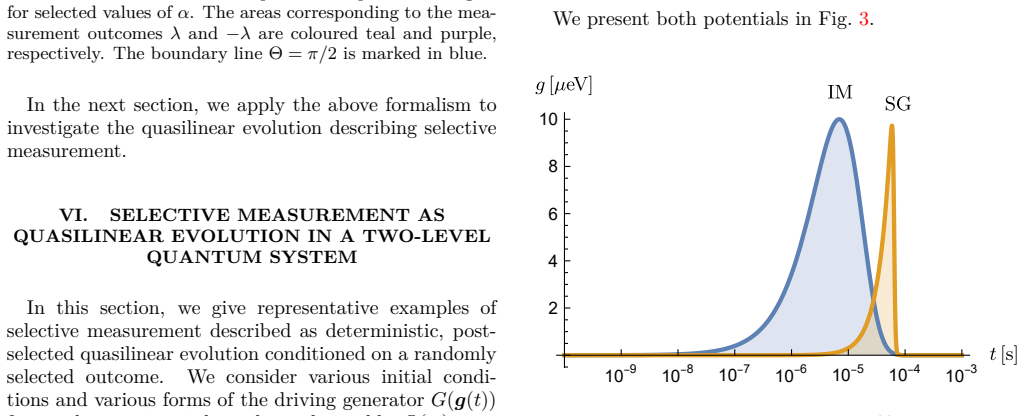
Variation of the form ofg(t) Finally, the functional form of the potentialg(t)can be chosen in various ways. In the case of the inverted Morse potential, the shape parameterκmay be adjusted. More generally, the inverted Morse potential can be re- placed by a completely different potential, provided that it decays to zero—at least asymptotically—outside th...
work page 2024
-
[5]
J. Rembieliński and P. Caban, Physical Review Research 2, 012027 (2020)
work page 2020
-
[6]
J. Rembieliński and P. Caban, Quantum5, 420 (2021), arXiv:2003.09170 [quant-ph]
-
[7]
J. Rembieliński and J. Ciborowski, Annals of Physics 458, 169481 (2023)
work page 2023
-
[8]
J. A. Wheeler and W. H. Zurek,Quantum Theory and Measurement(Princeton University Press, Princeton, NJ, 1983)
work page 1983
-
[9]
G. C. Ghirardi, A. Rimini, and T. Weber, Physical Re- view D34, 470 (1986)
work page 1986
- [10]
-
[11]
D.Z.Albert,A Guess at the Riddle: Essays on the Physi- cal Underpinnings of Quantum Mechanics(Harvard Uni- versity Press, Cambridge, MA, 2023)
work page 2023
-
[12]
Penrose, General Relativity and Gravitation28, 581 (1996)
R. Penrose, General Relativity and Gravitation28, 581 (1996)
work page 1996
-
[13]
B. d’Espagnat,Veiled Reality: An Analysis of Present- Day Quantum Mechanical Concepts(Westview Press, 2003)
work page 2003
-
[14]
Decoherence, the measurement problem, and interpretations of quantum mechanics
M. Schlosshauer, Reviews of Modern Physics76, 1267 (2004), arXiv:quant-ph/0312059 [quant-ph]
work page internal anchor Pith review Pith/arXiv arXiv 2004
-
[15]
G. C. Ghirardi,Sneaking a Look at God’s Cards: Unrav- eling the Mysteries of Quantum Mechanics(Princeton University Press, Princeton, NJ, 2005)
work page 2005
-
[16]
Maudlin,Quantum Non-Locality and Relativity: Metaphysical Intimations of Modern Physics, 3rd ed
T. Maudlin,Quantum Non-Locality and Relativity: Metaphysical Intimations of Modern Physics, 3rd ed. (Wiley-Blackwell, 2011)
work page 2011
-
[17]
M. F. Pusey, J. Barrett, and T. Rudolph, Nature Physics 8, 475 (2012)
work page 2012
- [18]
-
[19]
J. R. Hance and S. Hossenfelder, Journal of Physics Com- munications6, 102001 (2022)
work page 2022
-
[20]
A. A. Tomaz, R. S. Mattos, and M. Barbatti, Philosophi- cal Magazine 10.1080/14786435.2025.2601922 (2025), ad- vance online publication
-
[21]
Kraus,States, Effects, and Operations: Fundamental Notions of Quantum Theory(Springer, Berlin, 1983)
K. Kraus,States, Effects, and Operations: Fundamental Notions of Quantum Theory(Springer, Berlin, 1983)
work page 1983
-
[22]
M. E. Bielińska, M. Eckstein, and P. Horodecki, New Journal of Physics27, 053002 (2025)
work page 2025
-
[23]
I. Białynicki-Birula and J. Mycielski, Annals of Physics 100, 62 (1976)
work page 1976
-
[24]
Weinberg, Annals of Physics194, 336 (1989)
S. Weinberg, Annals of Physics194, 336 (1989)
work page 1989
-
[25]
Weinberg, Physical Review Letters62, 485 (1989)
S. Weinberg, Physical Review Letters62, 485 (1989)
work page 1989
- [26]
- [27]
-
[28]
Czachor, Physical Review A57, 4122 (1998)
M. Czachor, Physical Review A57, 4122 (1998)
work page 1998
- [29]
-
[30]
Nonlinearity without Superluminality
A. Kent, Physical Review A72, 012108 (2005), arXiv:quant-ph/0204106 [quant-ph]
work page internal anchor Pith review Pith/arXiv arXiv 2005
-
[31]
D. A. Meyer and T. G. Wong, Physical Review A89, 012312 (2014)
work page 2014
-
[32]
B. Helou and Y. Chen, Journal of Physics: Conference Series880, 012021 (2017)
work page 2017
-
[33]
Buks, Advanced Quantum Technologies6, 2300103 (2023)
E. Buks, Advanced Quantum Technologies6, 2300103 (2023)
work page 2023
- [34]
-
[35]
Buks, Physical Review A110, 012439 (2024), arXiv:2405.17145 [quant-ph]
E. Buks, Physical Review A110, 012439 (2024), arXiv:2405.17145 [quant-ph]
-
[36]
R. K. Ray and G. P. Beretta, Entropy27, 1018 (2025)
work page 2025
-
[37]
The spontaneous disentanglement hypothesis and causality
E. Buks, The spontaneous disentanglement hypothesis and causality (2026), arXiv:2604.10562 [quant-ph]
work page internal anchor Pith review Pith/arXiv arXiv 2026
-
[38]
Gisin, Helvetica Physica Acta62, 363 (1989)
N. Gisin, Helvetica Physica Acta62, 363 (1989)
work page 1989
- [39]
- [40]
-
[41]
J. Rembieliński and K. Ławniczak (2026), companion let- ter, submitted together with this paper
work page 2026
- [42]
- [43]
-
[44]
M. G. A. Paris, The European Physical Journal Special Topics203, 61 (2012)
work page 2012
- [45]
-
[46]
Lindblad, Communications in Mathematical Physics 48, 119 (1976)
G. Lindblad, Communications in Mathematical Physics 48, 119 (1976)
work page 1976
-
[47]
Gisin, Journal of Physics A: Mathematical and Gen- eral14, 2259 (1981)
N. Gisin, Journal of Physics A: Mathematical and Gen- eral14, 2259 (1981)
work page 1981
-
[48]
V. I. Arnol’d, V. S. Afrajmovich, Y. S. Il’yashenko, and L. P. Shil’nikov,Dynamical Systems V: Bifurcation The- ory and Catastrophe Theory(Springer, Berlin and Hei- delberg, 1994)
work page 1994
- [49]
-
[50]
W. D. Heiss, Journal of Physics A: Mathematical and Theoretical45, 444016 (2012)
work page 2012
- [51]
-
[52]
P. Alstrøm, P. Hjorth, and R. Mattuck, American Jour- nal of Physics50, 697 (1982)
work page 1982
-
[53]
D. E. Platt, American Journal of Physics60, 306 (1992)
work page 1992
-
[54]
H. Wennerström and P.-O. Westlund, Physical Chem- istry Chemical Physics14, 1677 (2012)
work page 2012
-
[55]
S. K. Sahoo, R. Vathsan, and T. Qureshi, Annalen der Physik535, 2200627 (2023)
work page 2023
discussion (0)
Sign in with ORCID, Apple, or X to comment. Anyone can read and Pith papers without signing in.