Recognition: unknown
Direct Lagrangian tracking simulation of droplet growth in vertically-developing turbulent cloud
Pith reviewed 2026-05-10 15:46 UTC · model grok-4.3
The pith
Turbulence speeds droplet collisions in clouds, causing earlier precipitation with larger first raindrops at the ground.
A machine-rendered reading of the paper's core claim, the machinery that carries it, and where it could break.
Core claim
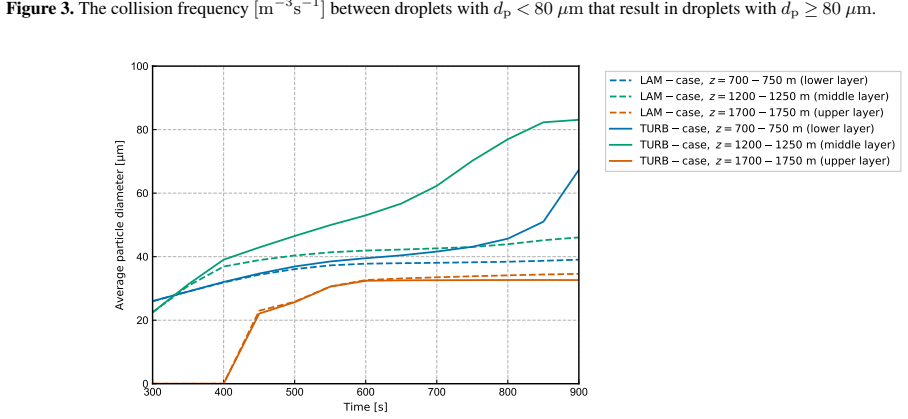
Turbulence promotes collision-coalescence: early autoconversions between similar-sized droplets occur in the middle layer during the updraft phase, followed by accretions of small droplets by larger ones in middle and lower layers, so precipitation arrives earlier at the ground and the first raindrop is larger than in the corresponding non-turbulent run.
What carries the argument
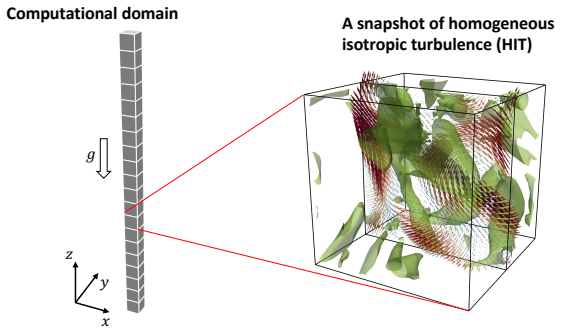
Vertically-elongated quasi-1D domain with Lagrangian particle tracking of all warm-rain processes plus an embedded homogeneous isotropic turbulence field.
If this is right
- Turbulence shortens the time from cloud formation to surface rain.
- Autoconversion dominates early growth in the middle cloud levels while updrafts persist.
- Accretion takes over later and lower, where larger drops have already formed.
- Box-domain DNS without vertical structure or turbulence underestimates rain formation speed.
Where Pith is reading between the lines
- If real cloud turbulence is stronger or more organized than the homogeneous field used here, the speedup of precipitation could be even greater.
- Weather and climate models that ignore turbulence-enhanced collisions will tend to delay predicted rain onset.
- The same vertical tracking method could test how changes in updraft strength or aerosol loading alter the turbulence effect.
Load-bearing premise
The added uniform random turbulence field stands in for the real, spatially varying motions that arise from the cloud's own updraft and developing structure.
What would settle it
Measurements or simulations that find identical precipitation onset times and identical sizes of the first ground-level raindrops in turbulent versus non-turbulent conditions would falsify the claim.
Figures




read the original abstract
We developed a new explicit cloud microphysical model, based on direct numerical simulation (DNS) with Lagrangian particle tracking. The model employs a vertically-elongated quasi-1D computational domain extending from the ground to the cloud top to explicitly capture the vertical structure of clouds. This allows us to simulate the all warm-cloud microphysical processes, including activation, condensation growth, collision-coalescence growth, and sedimentation. A homogeneous isotropic turbulence field is incorporated into this domain to explicitly resolve the turbulent wind fluctuations. Cloud microphysics simulations with and without turbulent wind fluctuations were performed to clarify the impact of turbulence on droplet growth. We obtained new insights into the altitude- and time-dependent microphysical statistics, which cannot be obtained through conventional DNS researches for a cubic box domain with periodic boundaries. The comparison have shown that turbulence promoted the collision-coalescence growth of droplets. During the early developing stage, where the updraft was present, turbulence promoted the collisions between droplets with similar sizes (autoconversions) in the middle layer of the cloud. In later stage, relatively large droplets produced by autoconversions actively collected smaller droplets (accretions) in the middle and lower layers. The onset of precipitation at the ground occurred earlier and the first raindrop at the ground was larger in turbulence case than that in non-turbulence case.
Editorial analysis
A structured set of objections, weighed in public.
Referee Report
Summary. This paper introduces a DNS model with Lagrangian particle tracking for warm-cloud microphysics in a vertically elongated domain from ground to cloud top. It adds a homogeneous isotropic turbulence field and compares runs with and without turbulence to isolate effects on activation, condensation, collision-coalescence, and sedimentation. The central claim is that turbulence promotes autoconversion in the middle layer during the early updraft stage and accretion in middle/lower layers later, producing earlier surface precipitation onset and a larger first raindrop.
Significance. The vertically elongated domain is a clear strength, enabling explicit capture of vertical structure, updraft interactions, and altitude-dependent statistics unavailable in periodic-box DNS. The direct with/without comparison cleanly isolates turbulence effects on specific growth stages. If the turbulence representation and numerics are shown to be adequate, the work would provide useful mechanistic insights into turbulence-enhanced droplet growth.
major comments (3)
- [Methods] Methods section on turbulence implementation: The homogeneous isotropic field is superimposed on a vertically developing flow containing an updraft; no quantitative comparison is given to observed cloud dissipation rates, anisotropy, or vertical correlation lengths at droplet scales. This directly affects whether the reported layer-specific autoconversion and accretion enhancements can be attributed to realistic turbulence rather than the forcing choice.
- [Results] Results on collision statistics: No grid-resolution convergence tests or sensitivity to Lagrangian collision kernel parameters are presented, despite the fact that collision rates depend on resolved velocity gradients and interpolation. Without these, the claimed differences between turbulent and non-turbulent cases lack demonstrated numerical robustness.
- [Results] Results, early and late stages: Collision-rate differences are reported without error bars, ensemble variability, or statistical significance tests. This undermines the quantitative statements on promotion of autoconversion versus accretion and the timing of surface precipitation.
minor comments (3)
- [Abstract] Abstract: grammatical error ('The comparison have shown' should be 'The comparison has shown').
- [Results] Figures and text: the precise altitude ranges defining 'middle' and 'lower' layers should be stated explicitly when discussing layer-specific statistics.
- [Introduction] Introduction: additional citations to existing Lagrangian cloud DNS studies would better situate the vertically elongated domain approach.
Simulated Author's Rebuttal
We thank the referee for their thorough and constructive review of our manuscript. We address each of the major comments in detail below, indicating the revisions we plan to make to strengthen the paper.
read point-by-point responses
-
Referee: [Methods] Methods section on turbulence implementation: The homogeneous isotropic field is superimposed on a vertically developing flow containing an updraft; no quantitative comparison is given to observed cloud dissipation rates, anisotropy, or vertical correlation lengths at droplet scales. This directly affects whether the reported layer-specific autoconversion and accretion enhancements can be attributed to realistic turbulence rather than the forcing choice.
Authors: Our study is designed as an idealized numerical experiment to isolate the impact of turbulence on droplet growth processes by direct comparison of otherwise identical simulations with and without the superimposed HIT field. The turbulence intensity and scales were selected to be representative of typical warm cloud conditions based on established literature values for the dissipation rate and integral scales. We agree that additional context would be beneficial. In the revised manuscript, we will expand the Methods section to provide a more detailed rationale for the chosen turbulence parameters, including comparisons to typical observed values from the literature (e.g., dissipation rates in the range of 10^{-4} to 10^{-2} m^2 s^{-3}), and explicitly discuss the assumptions and limitations of superimposing isotropic turbulence on a developing updraft flow. This will help clarify that the enhancements are due to the presence of turbulence rather than specific forcing details. revision: partial
-
Referee: [Results] Results on collision statistics: No grid-resolution convergence tests or sensitivity to Lagrangian collision kernel parameters are presented, despite the fact that collision rates depend on resolved velocity gradients and interpolation. Without these, the claimed differences between turbulent and non-turbulent cases lack demonstrated numerical robustness.
Authors: We acknowledge this as a valid concern for ensuring the robustness of the collision statistics. The spatial resolution in our DNS was chosen to resolve the smallest turbulent scales (Kolmogorov length) relevant to droplet interactions, consistent with previous validated studies. However, explicit convergence tests were not included. In the revised manuscript, we will add convergence tests by comparing results at the current resolution with a higher-resolution run for a subset of the simulation period, focusing on collision rates and droplet size distributions. We will also include a sensitivity analysis to the Lagrangian particle interpolation scheme and collision kernel parameters to demonstrate that the differences between the turbulent and non-turbulent cases are robust. revision: yes
-
Referee: [Results] Results, early and late stages: Collision-rate differences are reported without error bars, ensemble variability, or statistical significance tests. This undermines the quantitative statements on promotion of autoconversion versus accretion and the timing of surface precipitation.
Authors: We appreciate the referee's emphasis on statistical presentation. Given the substantial computational expense associated with DNS in a vertically elongated domain, performing multiple ensemble realizations was not feasible within the scope of this study. The reported results are from single, well-resolved deterministic simulations. In the revision, we will add a discussion in the Results section addressing potential sources of variability, such as by examining statistics over different horizontal subdomains or time windows to provide informal estimates of uncertainty. We will also moderate the language around quantitative claims to focus on the qualitative and mechanistic differences observed, while noting the limitations regarding formal error bars and significance testing. This approach maintains the integrity of the findings without overclaiming statistical precision. revision: partial
- Conducting full ensemble simulations to provide error bars and statistical significance tests, due to the prohibitive computational cost of the DNS setup.
Circularity Check
No significant circularity; results from direct comparative simulations
full rationale
The paper reports results from explicit DNS Lagrangian simulations of warm-cloud microphysics in a vertically-elongated domain, with one run including an added homogeneous isotropic turbulence field and the other without. All reported effects (enhanced autoconversion early, accretion later, earlier surface precipitation) are direct numerical outputs of the differential comparison between these two explicitly constructed cases. No fitted parameters are renamed as predictions, no equations reduce to self-definition, and no load-bearing claims rest on self-citations or imported uniqueness theorems. The derivation chain is therefore self-contained and does not collapse to its inputs by construction.
Axiom & Free-Parameter Ledger
free parameters (2)
- turbulence intensity
- domain aspect ratio and grid spacing
axioms (2)
- domain assumption Lagrangian particle tracking accurately captures droplet motion and collisions under the resolved flow field
- domain assumption Homogeneous isotropic turbulence can be superimposed without altering the mean updraft or cloud development
Reference graph
Works this paper leans on
-
[1]
Ababaei, A., Michel, A., and Rosa, B.: Collision statistics of droplets in turbulence considering lubrication interactions, mobility of interfaces and non-continuum molecular effects, Flow, Turbulence and Combustion, 112, 33–59, https://doi.org/https://doi.org/10.1007/s10494-023- 00450-1,
-
[2]
Ayala, O., Grabowski, W. W., and Wang, L. P.: A hybrid approach for simulating turbulent collisions of hydrodynamically-interacting particles, J. Comput. Phys., 225, 51–73, https://doi.org/https://doi.org/10.1016/j.jcp.2006.11.016,
-
[4]
Chen, S., Yau, M. K., and Bartello, P.: Turbulence effects of collision efficiency and broadening of droplet size distribution in cumulus clouds, J. Atmos. Sci., 75, 203–217, https://doi.org/https://doi.org/10.1175/JAS-D-17-0123.1,
-
[5]
Franklin, C. N., Vaillancourt, P. A., Yau, M. K., and Bartello, P.: Collision rates of cloud droplets in turbulent flow, J. Atmos. Sci., 62, 2451–2466, https://doi.org/https://doi.org/10.1175/JAS3493.1,
-
[6]
Grabowski, W. W. and Wang, L. P.: Growth of cloud droplets in a turbulent environment, Annu. Rev. Fluid Mech., 45, 293–324, https://doi.org/https://doi.org/10.1146/annurev-fluid-011212-140750,
-
[7]
W., Morrison, H., Shima, S., Abade, G
Grabowski, W. W., Morrison, H., Shima, S., Abade, G. C., Dziekan, P., and Pawlowska, H.: Modeling of cloud microphysics: Can we do better?, Bulletin of the American Meteorological Society, 100, 655–672, https://doi.org/https://doi.org/10.1175/BAMS-D-18-0005.1,
-
[8]
Hill, A. A., Lebo, Z. J., Andrejczuk, M., Arabas, S., Dziekan, P., Field, P., Gettelman, A., Hoffmann, F., Pawlowska, H., Onishi, R., and Vie, B.: Toward a numerical benchmark for warm rain processes, J. Atmos. Sci., 80, 1329–1359, https://doi.org/https://doi.org/10.1175/JAS- D-21-0275.1,
-
[9]
Kunishima, Y . and Onishi, R.: Direct Lagrangian tracking simulation of droplet growth in vertically developing cloud, Atmos. Chem. Phys., 18, 16 619–16 630, https://doi.org/https://doi.org/10.5194/acp-18-16619-2018,
-
[10]
Li, X., Tao, W. K., Khain, A. P., Simpson, J., and Johnson, D. E.: Sensitivity of a cloud-resolving model to bulk and explicit bin microphysical schemes. Part I: Comparisons, J. Atmos. Sci., 66, 3–21, https://doi.org/https://doi.org/10.1175/2008JAS2646.1,
-
[11]
Lin, Y . L., Farley, R. D., and Orville, H. D.: Bulk parameterization of the snow field in a cloud model, J. Climate Appl. Meteorol., 22, 1065–1092, https://doi.org/https://doi.org/10.1175/1520-0450(1983)022<1065:BPOTSF>2.0.CO;2,
-
[12]
Liu, Y ., Yau, M. K., Shima, S., Lu, C., and Chen, S.: Parameterization and explicit modeling of cloud microphysics: approaches, challenges, and future directions, Adv. Atmos. Sci., 40, 747–790, https://doi.org/https://doi.org/10.1007/s00376-022-2077-3,
-
[13]
Michel, A., Ababaei, A., and Rosa, B.: The influence of gravity and mass loading on the coalescence of aerodynamically interacting droplets in homogeneous isotropic turbulence, J. Atmos. Sci., 80, 2207–2220, https://doi.org/https://doi.org/10.1175/JAS-D-22-0267.1,
-
[14]
and Takahashi, K.: A warm-bin-cold-bulk hybrid cloud microphysical model, J
Onishi, R. and Takahashi, K.: A warm-bin-cold-bulk hybrid cloud microphysical model, J. Atmos. Sci., 69, 1474–1497, https://doi.org/https://doi.org/10.1175/JAS-D-11-0166.1,
-
[15]
Onishi, R., Baba, Y ., and Takahashi, K.: Large-scale forcing with less communication in finite-difference simulations of stationary isotropic turbulence, Journal of Computational Physics, 230, 4088–4099, https://doi.org/https://doi.org/10.1016/j.jcp.2011.02.034,
-
[16]
Onishi, R., Takahashi, K., and Vassilicos, J. C.: An efficient parallel simulation of interacting inertial particles in homogeneous isotropic turbulence, J. Comput. Phys., 242, 809–827, https://doi.org/https://doi.org/10.1016/j.jcp.2013.02.027,
-
[17]
15 Onishi, R., Matsuda, K., and Takahashi, K.: Lagrangian tracking simulation of droplet growth in turbulence-turbulence enhancement of autoconversion rate, J. Atmos. Sci., 72, 2591–2607, https://doi.org/https://doi.org/10.1175/JAS-D-14-0292.1,
-
[18]
Reade, W. C. and Collins, L. R.: A numerical study of the particle size distribution of an aerosol undergoing turbulent coagulation, J. Fluid Mech., 415, 45–64, https://doi.org/https://doi.org/10.1017/S0022112000008521,
-
[19]
Saffman, P. G. and Turner, J. S.: On the collision of drops in turbulent clouds, J. Fluid Mech., 1, 16–30, https://doi.org/https://doi.org/10.1017/S0022112056000020,
-
[20]
and Gotoh, T.: Turbulence and cloud droplets in cumulus clouds, New J
Saito, I. and Gotoh, T.: Turbulence and cloud droplets in cumulus clouds, New J. Phys., 20, 023 001, https://doi.org/https://doi.org/10.1088/1367-2630/aaa229,
-
[21]
A.: Particle-turbulence interactions in atmospheric clouds, Annu
Shaw, R. A.: Particle-turbulence interactions in atmospheric clouds, Annu. Rev. Fluid Mech., 35, 183–227, https://doi.org/https://doi.org/10.1146/annurev.fluid.35.101101.161125,
-
[22]
Shima, S., Kusano, K., Kawano, A., Sugiyama, T., and Kawahara, S.: The super-droplet method for the numerical simulation of clouds and precipitation: a particle-based and probabilistic microphysics model coupled with a non-hydrostatic model, Q. J. Roy. Meteorol. Soc., 135, 1307–1320, https://doi.org/https://doi.org/10.1002/qj.441,
-
[23]
Model Dev., 13, 4107–4157, https://doi.org/https://doi.org/10.5194/gmd-13-4107-2020,
Shima, S., Sato, Y ., Hashimoto, A., and Hisumi, R.: Predicting the morphology of ice particles in deep convection using the super- droplet method: development and evaluation of SCALE-SDM 0.2.5-2.2.0, -2.2.1, and -2.2.2, Geosci. Model Dev., 13, 4107–4157, https://doi.org/https://doi.org/10.5194/gmd-13-4107-2020,
-
[24]
Shipway, B. J. and Hill, A. A.: Diagnosis of systematic differences between multiple parametrizations of warm rain microphysics using a kinematic framework, Q. J. Roy. Meteorol. Soc., 138, 2196–2211, https://doi.org/https://doi.org/10.1002/qj.1913,
-
[25]
Squires, K. D. and Eaton, J. K.: Particle response and turbulence modification in isotropic turbulence, Phys. Fluids, 2, 1191–1203, https://doi.org/https://doi.org/10.1063/1.857620,
-
[26]
Fluid Mech., 335, 75–109, https://doi.org/https://doi.org/10.1017/S0022112096004454,
Direct numerical simulations, J. Fluid Mech., 335, 75–109, https://doi.org/https://doi.org/10.1017/S0022112096004454,
-
[27]
Twomey, S.: The nuclei of natural cloud formation part II: The supersaturation in natural clouds and the variation of cloud droplet concen- tration, Geofisica Pura e Applicata, 43, 243–249, https://doi.org/https://doi.org/10.1007/BF01993560,
-
[28]
Vaillancourt, P. A. and Yau, M. K.: Review of particle-turbulence interactions and consequences for cloud physics, Bull. Am. Meteorol. Soc., 81, 285–298, https://doi.org/https://doi.org/10.1175/1520-0477(2000)081<0285:ROPIAC>2.3.CO;2,
-
[29]
Vaillancourt, P. A., Yau, M. K., and Grabowski, W. W.: Microscopic approach to cloud droplet growth by condensation. Part I: Model description and results without turbulence, J. Atmos. Sci., 58, 1945–1964, https://doi.org/https://doi.org/10.1175/1520- 0469(2001)058<1945:MATCDG>2.0.CO;2,
-
[30]
Wang, L. P. and Maxey, M. R.: Settling velocity and concentration distribution of heavy particles in homogeneous isotropic turbulence, J. Fluid Mech., 256, 27–68, https://doi.org/https://doi.org/10.1017/S0022112093002708,
-
[31]
Wang, L. P., Wexler, A. S., and Zhou, Y .: Statistical mechanical descriptions of turbulent coagulation, Phys. Fluids, 10, 2647–2651, https://doi.org/https://doi.org/10.1063/1.869777,
-
[32]
D., and Myers, C.: A Numerical Model of a Hail-Bearing Cloud, J
Wisner, C., Orville, H. D., and Myers, C.: A Numerical Model of a Hail-Bearing Cloud, J. Atmos. Sci., 29, 1160–1181, https://doi.org/https://doi.org/10.1175/1520-0469(1972)029<1160:ANMOAH>2.0.CO;2,
-
[33]
Woittiez, E. J. P., Jonker, H. J. J., and Portela, L. M.: On the combined effects of turbulence and gravity on droplet collisions in clouds: a numerical study, J. Atmos. Sci., 66, 1926–1943, https://doi.org/https://doi.org/10.1175/2005JAS2669.1,
discussion (0)
Sign in with ORCID, Apple, or X to comment. Anyone can read and Pith papers without signing in.