Microscopic model for the ground state, 1/3 plateau and excitations of γ-Mn₃(PO₄)₂
Pith reviewed 2026-05-10 15:42 UTC · model grok-4.3
The pith
A magnetic model for γ-Mn₃(PO₄)₂ needs both biquadratic coupling and single-ion anisotropy to explain its 1/3 plateau and multiple susceptibility transitions.
A machine-rendered reading of the paper's core claim, the machinery that carries it, and where it could break.
Core claim
An exchange Hamiltonian fitted to magnetization data for γ-Mn₃(PO₄)₂ incorporates biquadratic coupling and single-ion anisotropy; both terms are necessary to reproduce the multiple phase transitions observed in magnetic susceptibility, while the calculated magnetic spectrum accounts for the low-temperature specific-heat data.
What carries the argument
The trimer lattice of Mn²⁺ (S = 5/2) ions together with the fitted exchange Hamiltonian that includes bilinear, biquadratic, and single-ion anisotropy terms.
If this is right
- The 1/3 plateau is stabilized by the combined action of biquadratic coupling and anisotropy on the trimer lattice.
- The sequence of susceptibility transitions arises directly from the inclusion of these two terms.
- The low-energy magnetic excitations computed from the Hamiltonian reproduce the measured specific heat.
- The ground state remains antiferromagnetic under the fitted interactions.
Where Pith is reading between the lines
- The same Hamiltonian could be applied to predict the material's response to hydrostatic pressure or chemical substitution.
- Other Mn²⁺ compounds with trimer or triangular motifs may require analogous biquadratic and anisotropy terms to describe their plateaus.
- Direct verification of the excitation spectrum by neutron scattering would test the uniqueness of the parameter set.
Load-bearing premise
The minimal set of fitted exchange parameters that includes biquadratic coupling and single-ion anisotropy is assumed to be unique and sufficient to match both the magnetization curve and the specific-heat data.
What would settle it
An inelastic neutron scattering measurement that finds an excitation spectrum differing substantially from the one calculated with the fitted Hamiltonian would falsify the necessity of the biquadratic and anisotropy terms.
Figures



read the original abstract
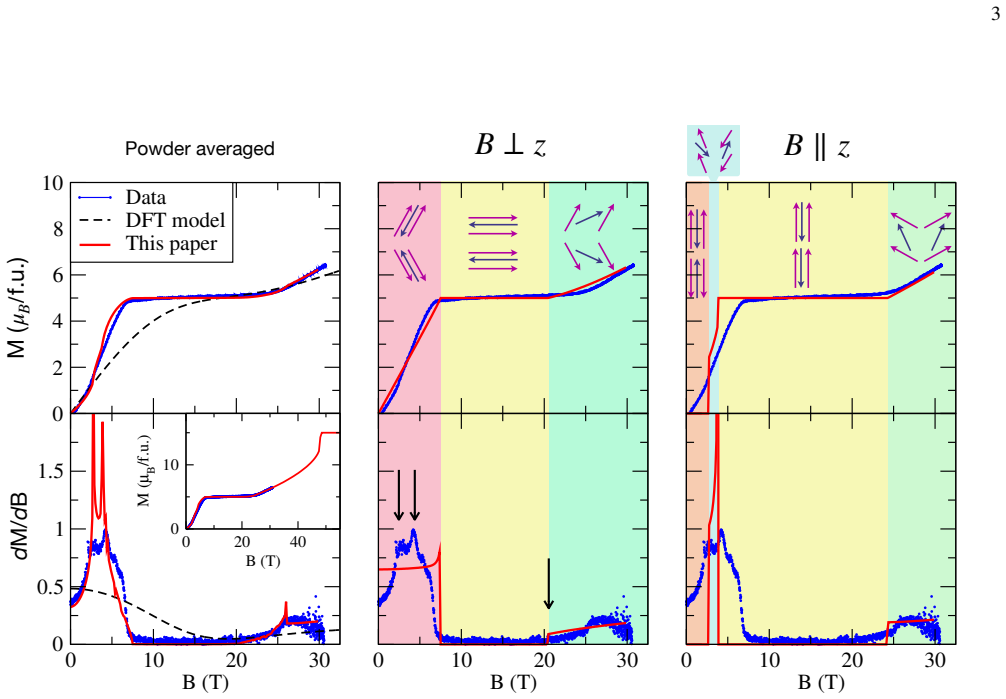
We present a magnetic model for an antiferromagnetic compound $\gamma$-Mn$_3$(PO$_4$)$_2$, which was previously shown to exhibit a 1/3 magnetization plateau due to the trimer-based structure of the lattice of magnetic Mn$^{2+}$ ions with $S=5/2$. An exchange Hamiltonian that yields observed field transitions is obtained from fitting magnetization data. It is shown that both biquadratic coupling and single-ion anisotropy are necessary to be present in the magnetic model to explain multiple phase transitions in the magnetic susceptibility data. The calculated magnetic spectrum is in agreement with the low-temperature specific heat data.
Editorial analysis
A structured set of objections, weighed in public.
Referee Report
Summary. The paper presents a microscopic magnetic model for the antiferromagnetic compound γ-Mn₃(PO₄)₂ featuring a trimer-based lattice of Mn²⁺ (S=5/2) ions. An exchange Hamiltonian including nearest-neighbor J, biquadratic K, single-ion anisotropy D, and further-neighbor terms is obtained by fitting to magnetization data. The authors demonstrate that both K and D are necessary to reproduce multiple phase transitions in the susceptibility, and show that the resulting magnetic spectrum is consistent with low-temperature specific-heat data, thereby accounting for the observed 1/3 magnetization plateau.
Significance. If the fitted model is robust, this provides a concrete microscopic understanding of the ground state, plateau, and excitations in this frustrated trimer antiferromagnet. The explicit test that removing K or D destroys the transitions is a positive feature, and the specific-heat consistency offers a useful cross-check. Such detailed models are valuable for interpreting data in related materials and for guiding future experiments or theory on biquadratic and anisotropic effects in S=5/2 systems.
major comments (3)
- [Hamiltonian fitting and results] The necessity of biquadratic coupling and single-ion anisotropy is shown by demonstrating that their removal eliminates the observed transitions in the magnetization data. However, the fitting procedure lacks reported quantitative metrics (chi-squared, residuals, parameter error bars, or covariance), which are required to assess fit quality and parameter uniqueness.
- [Model construction and necessity tests] The central claim that the minimal model (J, K, D plus further neighbors) is required assumes uniqueness. No exhaustive search over alternative interaction sets, different lattice distortions, or other exchange topologies is presented that might reproduce the same magnetization curve and specific-heat agreement, leaving the necessity open to alternative explanations.
- [Excitations and specific-heat comparison] The magnetic spectrum is computed from the fitted parameters and compared to specific-heat data. Because the parameters are determined from magnetization fitting, this is a post-fit consistency check rather than an independent prediction; the manuscript should address the resulting circularity burden explicitly.
minor comments (1)
- [Abstract] The abstract could include the numerical values of the fitted parameters (J, K, D) to allow readers to quickly assess the scale of the interactions.
Simulated Author's Rebuttal
We thank the referee for the constructive and detailed report. We address each major comment below and will revise the manuscript accordingly to improve clarity and rigor.
read point-by-point responses
-
Referee: The necessity of biquadratic coupling and single-ion anisotropy is shown by demonstrating that their removal eliminates the observed transitions in the magnetization data. However, the fitting procedure lacks reported quantitative metrics (chi-squared, residuals, parameter error bars, or covariance), which are required to assess fit quality and parameter uniqueness.
Authors: We agree that quantitative fit metrics are essential for assessing robustness. In the revised manuscript we will report the chi-squared value of the fit to the magnetization data, the residuals, and estimated parameter uncertainties (including covariance where available) obtained from the fitting procedure. These additions will allow readers to evaluate parameter uniqueness and fit quality directly. revision: yes
-
Referee: The central claim that the minimal model (J, K, D plus further neighbors) is required assumes uniqueness. No exhaustive search over alternative interaction sets, different lattice distortions, or other exchange topologies is presented that might reproduce the same magnetization curve and specific-heat agreement, leaving the necessity open to alternative explanations.
Authors: We acknowledge that a fully exhaustive enumeration of all conceivable interaction sets or lattice distortions is computationally infeasible and outside the scope of the present study. Our model is instead constructed from the known crystal structure and symmetry of γ-Mn₃(PO₄)₂, beginning with nearest-neighbor exchanges and introducing additional terms (K, D, further neighbors) only when required by the data. We have already demonstrated that removing K or D destroys the observed transitions. In the revision we will add an explicit discussion of why physically motivated alternatives (e.g., strong next-nearest-neighbor exchanges without biquadratic terms) are unlikely to reproduce the full set of features, while noting that complete uniqueness cannot be proven. revision: partial
-
Referee: The magnetic spectrum is computed from the fitted parameters and compared to specific-heat data. Because the parameters are determined from magnetization fitting, this is a post-fit consistency check rather than an independent prediction; the manuscript should address the resulting circularity burden explicitly.
Authors: We agree that the specific-heat comparison constitutes a post-fit consistency check rather than an a priori prediction. In the revised manuscript we will explicitly discuss this point, clarifying that the magnetization curve (including the 1/3 plateau and multiple transitions) supplies the primary constraints on the parameters, while the low-temperature specific heat provides an independent cross-validation of the resulting excitation spectrum. We will also note the limitations this imposes and the value of future inelastic neutron scattering measurements for further tests. revision: yes
Circularity Check
Fitted Hamiltonian parameters yield post-fit consistency with specific heat
specific steps
-
fitted input called prediction
[Abstract]
"An exchange Hamiltonian that yields observed field transitions is obtained from fitting magnetization data. It is shown that both biquadratic coupling and single-ion anisotropy are necessary to be present in the magnetic model to explain multiple phase transitions in the magnetic susceptibility data. The calculated magnetic spectrum is in agreement with the low-temperature specific heat data."
Parameters are determined exclusively by fitting to magnetization/susceptibility data; the spectrum (excitations) is then derived from the identical fitted Hamiltonian and compared to specific heat. The agreement is therefore a post-fit consistency test on the same model rather than an independent result.
full rationale
The derivation obtains the exchange Hamiltonian (including biquadratic and anisotropy terms) by fitting to magnetization data that reproduces the 1/3 plateau and field transitions. The magnetic spectrum is then computed from these fitted parameters and shown to agree with specific-heat data. This constitutes a consistency check on the fit rather than an independent derivation or first-principles prediction. No self-definitional loops, self-citation load-bearing steps, or uniqueness theorems are present in the provided text. The necessity claim for the extra terms rests on the fit without an exhaustive alternative-model search, but the central chain remains anchored in external data rather than reducing exactly to its inputs by construction. Score kept moderate because the specific-heat comparison is a distinct observable and the paper does not rename the fit as a prediction.
Axiom & Free-Parameter Ledger
free parameters (4)
- nearest-neighbor exchange J
- biquadratic coupling K
- single-ion anisotropy D
- further-neighbor exchanges
axioms (2)
- domain assumption The magnetic lattice consists of isolated trimers of Mn²⁺ S=5/2 ions with the geometry previously determined by crystallography.
- domain assumption The system can be described by a spin Hamiltonian containing bilinear, biquadratic, and single-ion terms without higher-order interactions.
Reference graph
Works this paper leans on
-
[1]
L. Shvanskaya, O. Volkova, and A. Vasiliev, A review on crystal structure and properties of 3d transition metal (II) or- thophosphates𝑀 3(PO4)2, Journal of Alloys and Compounds 835, 155028 (2020)
work page 2020
-
[2]
J. S. Stephens and C. Calvo, Crystal structure of𝛽 ′Mn3(PO4)2, Canadian Journal of Chemistry47, 2215 (1969)
work page 1969
-
[3]
A. G. Nord and H. Annersten, A high-pressure phase of man- ganese (II) orthophosphate, Mn 3(PO4)2, Acta chemica Scan- dinavica. Series A. Physical and inorganic chemistry41, 56 (1987)
work page 1987
-
[4]
B. El-Bali, A. Boukhari, R. Glaum, M. Gerk, and K. Maaß, Preparation and Structure Determination of SrMn 2(PO4)2 and Redetermination of b’-Mn3(PO4)2, Zeitschrift f¨ ur anorganische und allgemeine Chemie626, 2557 (2000)
work page 2000
-
[5]
D. Yan, Y. Zhao, Y. Dong, Z. Liang, and X. Lin, Phase relations of Li2O-MnO-P2O5 system and the electrochemical properties of Li 1+𝑥 Mn1−𝑥 PO4 compounds, Journal of Alloys and Com- pounds636, 73 (2015)
work page 2015
- [6]
-
[7]
O. S. Volkova, L. V. Shvanskaya, E. A. Ovchenkov, E. A. Zvereva, A. S. Volkov, D. A. Chareev, K. Molla, B. Rahaman, T. Saha-Dasgupta, and A. N. Vasiliev, Structure–Property Rela- tionships in𝛼-,𝛽 ′-, and𝛾-Modifications of Mn 3(PO4)2, Inor- ganic Chemistry55, 10692 (2016), pMID: 27661209
work page 2016
-
[8]
A. V. Chubukov and D. I. Golosov, Quantum theory of an anti- ferromagnet on a triangular lattice in a magnetic field, Journal of Physics: Condensed Matter3, 69 (1991)
work page 1991
-
[9]
L. E. Svistov, A. I. Smirnov, L. A. Prozorova, O. A. Petrenko, L. N. Demianets, and A. Y. Shapiro, Quasi-two-dimensional an- tiferromagnet on a triangular lattice RbFe(MoO 4)2, Phys. Rev. B67, 094434 (2003)
work page 2003
-
[10]
G. Koutroulakis, T. Zhou, Y. Kamiya, J. D. Thompson, H. D. Zhou, C. D. Batista, and S. E. Brown, Quantum phase diagram of the𝑆= 1 2 triangular-lattice antiferromagnet Ba 3CoSb2O9, Phys. Rev. B91, 024410 (2015)
work page 2015
-
[11]
M.-H. Whangbo, H.-J. Koo, R. K. Kremer, and A. N. Vasiliev, Magnetization Plateaus by the Field-Induced Partitioning of Spin Lattices, Condensed Matter9, 10.3390/condmat9040045 (2024)
-
[12]
L. P. Regnault, P. Burlet, and J. Rossat-Mignod, Magnetic order- ing in a planar X-Y model: BaCo2(AsO4)2, Physica B+C86-88, 660 (1977)
work page 1977
- [13]
-
[14]
P. A. Maksimov, Proximity-induced sequence of field transi- tions in the Kitaev candidate BaCo2 (AsO4)2, Phys. Rev. B108, L180405 (2023)
work page 2023
-
[15]
S. Lee, S. Zhang, S. M. Thomas, L. Pressley, C. A. Bridges, E. S. Choi, V. S. Zapf, S. M. Winter, and M. Lee, Quantum order by disorder is a key to understanding the magnetic phases of BaCo2(AsO4)2, npj Quantum Mater.10, 11 (2025)
work page 2025
-
[16]
T. Yang, Y. Zhang, S. Yang, G. Li, M. Xiong, F. Liao, and J. Lin, Four Isomorphous Phosphates AM 3P4O14 (A = Sr, Ba; M = Co, Mn) with Antiferromagnetic-Antiferromagnetic- Ferromagnetic Trimerized Chains, Showing 1/3 Quantum Mag- netization Plateaus Only in the Manganese(II) System, Inorganic Chemistry47, 2562 (2008), pMID: 18333609
work page 2008
-
[17]
M. Hase, T. Yang, R. Cong, J. Lin, A. Matsuo, K. Kindo, K. Ozawa, and H. Kitazawa, High-field magnetization of SrMn3P4O14 exhibiting a quantum-mechanical magnetization plateau and classical magnetic long-range order, Phys. Rev. B 80, 054402 (2009)
work page 2009
-
[18]
M. Hase, V. Y. Pomjakushin, A. D ¨onni, T. Yang, R. Cong, and J. Lin, Direct Observation of the Ground State of a 1/3 Quantum Magnetization Plateau in SrMn3P4O14 Using Neutron Diffraction Measurements, Journal of the Physical Society of Japan83, 104701 (2014)
work page 2014
-
[19]
A. N. Vasiliev, O. S. Volkova, E. A. Zvereva, E. A. Ovchenkov, I. Muna`o, L. Clark, P. Lightfoot, E. L. Vavilova, S. Kamusella, H.-H. Klauss, J. Werner, C. Koo, R. Klingeler, and A. A. Tsirlin, 1/3 magnetization plateau and frustrated ferrimagnetism in a sodium iron phosphite, Phys. Rev. B93, 134401 (2016)
work page 2016
-
[20]
L. E. Svistov, A. I. Smirnov, L. A. Prozorova, O. A. Petrenko, A. Micheler, N. B¨ uttgen, A. Y. Shapiro, and L. N. Demianets, Magnetic phase diagram, critical behavior, and two-dimensional to three-dimensional crossover in the triangular lattice antifer- romagnet RbFeMoO4, Phys. Rev. B74, 024412 (2006)
work page 2006
-
[21]
R. Ishii, S. Tanaka, K. Onuma, Y. Nambu, M. Toku- naga, T. Sakakibara, N. Kawashima, Y. Maeno, C. Broholm, D. P. Gautreaux, J. Y. Chan, and S. Nakatsuji, Successive phase transitions and phase diagrams for the quasi-two-dimensional 7 M (μB/f.u.)dM/dB Powder averaged B∥zB⊥z 0 2 4 6 8 10 Data b-only Dz-only 0 10 20 30 B (T) 0 10 20 30 B (T) 0 10 20 30 B (T)...
work page 2011
-
[22]
M. Lee, E. S. Choi, X. Huang, J. Ma, C. R. Dela Cruz, M. Mat- suda, W. Tian, Z. L. Dun, S. Dong, and H. D. Zhou, Mag- netic phase diagram and multiferroicity of Ba 3MnNb2O9: A spin- 5 2 triangular lattice antiferromagnet with weak easy-axis anisotropy, Phys. Rev. B90, 224402 (2014)
work page 2014
- [23]
-
[24]
M.-H. Whangbo, H.-J. Koo, and O. S. Volkova, Le Chatelier’s Principle and Field-Induced Change in Magnetic Entropy Lead- ing to Spin–Lattice Partitioning and Magnetization Plateau, The Journal of Physical Chemistry C129, 17797 (2025)
work page 2025
- [25]
-
[26]
W. Szuszkiewicz, E. Dynowska, B. Witkowska, and B. Hen- nion, Spin-wave measurements on hexagonal MnTe of NiAs- type structure by inelastic neutron scattering, Phys. Rev. B73, 104403 (2006)
work page 2006
-
[27]
S. V. Grigoriev, S. V. Maleyev, A. I. Okorokov, Y. O. Chetverikov, P. B ¨oni, R. Georgii, D. Lamago, H. Eckerlebe, and K. Pranzas, Magnetic structure of MnSi under an applied field probed by polarized small-angle neutron scattering, Phys. Rev. B74, 214414 (2006)
work page 2006
-
[28]
B. Pato-Dold ´an, L. C. G ´omez-Aguirre, A. P. Hansen, J. Mira, S. Castro-Garc ´ıa, M. S ´anchez-And´ ujar, M. A. Se ˜nar´ıs- Rodr´ıguez, V. S. Zapf, and J. Singleton, Magnetic transi- tions and isotropic versus anisotropic magnetic behaviour of [CH 3NH3][M(HCOO)3] M = Mn 2+, Co 2+, Ni 2+, Cu 2+ metal–organic perovskites, J. Mater. Chem. C4, 11164 (2016)
work page 2016
-
[29]
J. K. Clark, V. Yannello, A. M. Samarakoon, C. Ross, M. C. Uible, V. O. Garlea, and M. Shatruk, Inelastic Neutron Scatter- ing Study of Magnetic Exchange Pathways in MnS, The Journal of Physical Chemistry C125, 16183 (2021)
work page 2021
-
[30]
E. A. Harris and J. Owen, Biquadratic Exchange Between Mn2+ Ions in MgO, Phys. Rev. Lett.11, 9 (1963)
work page 1963
-
[31]
Sy ˆozi, Statistics of Kagom ´e Lattice, Progress of Theoretical Physics6, 306 (1951)
I. Sy ˆozi, Statistics of Kagom ´e Lattice, Progress of Theoretical Physics6, 306 (1951)
work page 1951
-
[32]
N. Pomata and T.-C. Wei, AKLT models on decorated square lattices are gapped, Phys. Rev. B100, 094429 (2019)
work page 2019
-
[33]
F. A. Kassan-Ogly, A. I. Proshkin, A. K. Murtazaev, and V. A. 8 Mutailamov, Decorated Ising Square Lattice in a Magnetic Field, Physics of the Solid State62, 770 (2020)
work page 2020
-
[34]
F. Mila and F.-C. Zhang, On the origin of biquadratic exchange in spin 1 chains, The European Physical Journal B - Condensed Matter and Complex Systems16, 7 (2000)
work page 2000
- [35]
-
[36]
A. R. Wildes, M. E. Zhitomirsky, T. Ziman, D. Lanc ¸on, and H. C. Walker, Evidence for biquadratic exchange in the quasi-two- dimensional antiferromagnet FePS3, Journal of Applied Physics 127, 223903 (2020)
work page 2020
-
[37]
A. Kartsev, M. Augustin, R. F. L. Evans, K. S. Novoselov, and E. J. G. Santos, Biquadratic exchange interactions in two-dimensional magnets, npj Computational Materials6, 150 (2020)
work page 2020
-
[38]
A. L. Chernyshev and O. A. Starykh, Roller Coaster in a Flat- land: Magnetoresistivity in Eu-Intercalated Graphite, Phys. Rev. X12, 021010 (2022)
work page 2022
-
[39]
P. Sindzingre, N. Shannon, and T. Momoi, Phase diagram of the spin-1/2 J1-J2-J3 Heisenberg model on the square lattice, Journal of Physics: Conference Series200, 022058 (2010)
work page 2010
-
[40]
M. G. Gonzalez, E. A. Ghioldi, C. J. Gazza, L. O. Manuel, and A. E. Trumper, Interplay between spatial anisotropy and next- nearest-neighbor exchange interactions in the triangular Heisen- berg model, Phys. Rev. B102, 224410 (2020)
work page 2020
-
[41]
M. Mohylna, F. A. G ´omez Albarrac ´ın, M. ˇZukoviˇc, and H. D. Rosales, Spontaneous antiferromagnetic skyrmion/antiskyrmion lattice and spiral spin-liquid states in the frustrated triangular lattice, Phys. Rev. B106, 224406 (2022)
work page 2022
-
[42]
S. Toth and B. Lake, Linear spin wave theory for single-Q incom- mensurate magnetic structures, Journal of Physics: Condensed Matter27, 166002 (2015)
work page 2015
-
[43]
K. E. Avers, P. A. Maksimov, P. F. S. Rosa, S. M. Thomas, J. D. Thompson, W. P. Halperin, R. Movshovich, and A. L. Cherny- shev, Fingerprinting triangular-lattice antiferromagnet by exci- tation gaps, Phys. Rev. B103, L180406 (2021)
work page 2021
-
[44]
Y. Kamiya, L. Ge, T. Hong, Y. Qiu, D. L. Quintero-Castro, Z. Lu, H. B. Cao, M. Matsuda, E. S. Choi, C. D. Batista, M. Mourigal, H. D. Zhou, and J. Ma, The nature of spin excitations in the one-third magnetization plateau phase of Ba 3CoSb2O9, Nature Communications9, 2666 (2018)
work page 2018
discussion (0)
Sign in with ORCID, Apple, or X to comment. Anyone can read and Pith papers without signing in.