Recognition: unknown
One-Step Score-Based Density Ratio Estimation
Pith reviewed 2026-05-10 15:30 UTC · model grok-4.3
The pith
OS-DRE makes density ratio estimation possible with one function evaluation by analytically approximating the temporal score component.
A machine-rendered reading of the paper's core claim, the machinery that carries it, and where it could break.
Core claim
OS-DRE decomposes the time score into spatial and temporal components and represents the temporal component using an analytic radial basis function frame. This turns the intractable temporal integral into a closed-form weighted sum, enabling density ratio estimation with only one function evaluation. The paper analyzes approximation conditions for the frame and establishes error bounds for both finitely and infinitely smooth temporal kernels.
What carries the argument
Analytic radial basis function frame for the temporal component of the time score that converts the integral to a closed-form weighted sum
If this is right
- Density ratio estimation requires only one function evaluation.
- No numerical solvers are needed for the temporal integral.
- Approximation error bounds are provided for smooth and non-smooth kernels.
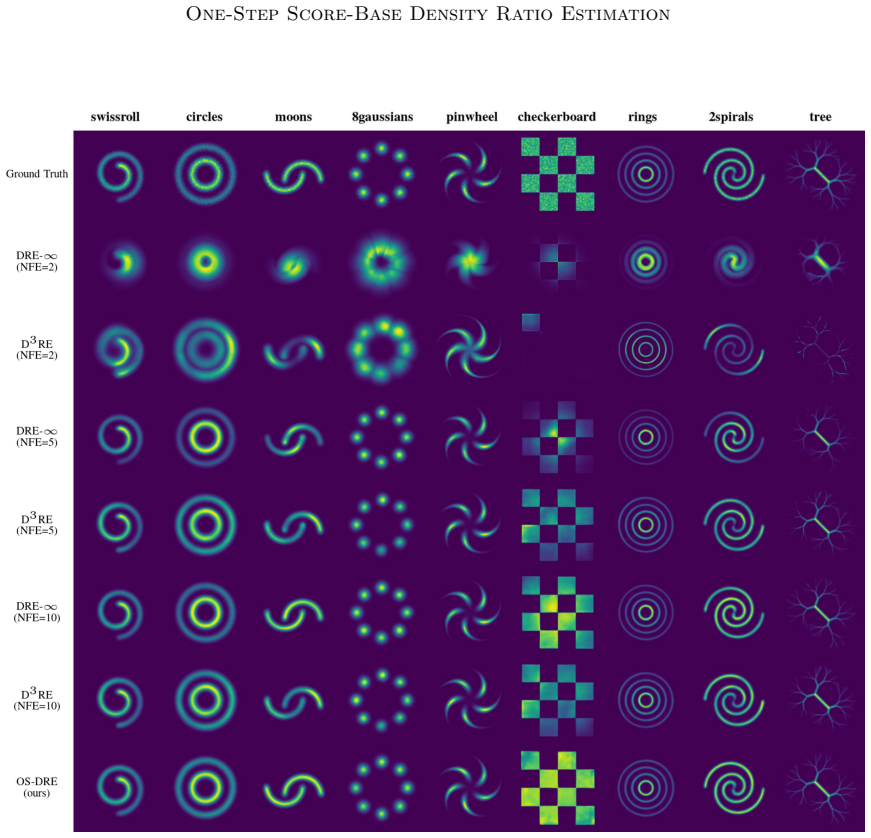
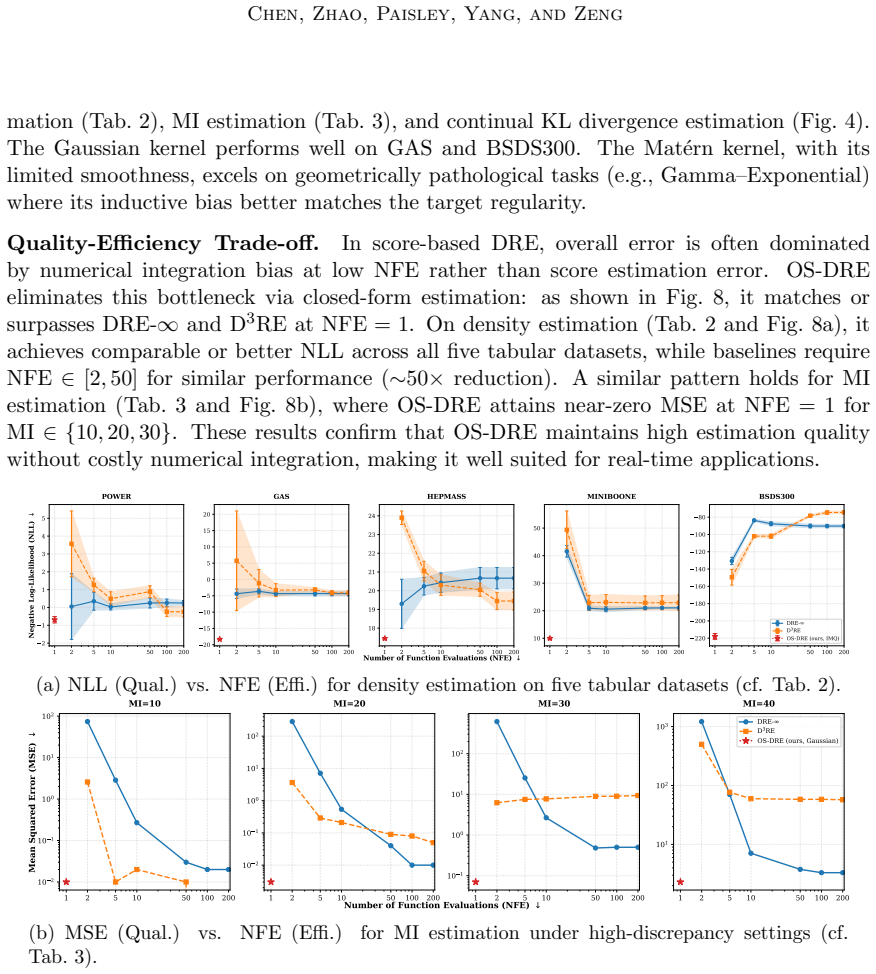
- Experiments show good performance in density estimation, KL estimation, and out-of-distribution detection.
Where Pith is reading between the lines
- This could make repeated density ratio calculations much faster in settings like continual learning.
- The analytic approach might inspire similar closed-form solutions in other time-dependent statistical estimation problems.
- The choice of radial basis function parameters will likely affect how well the error bounds translate to real data.
Load-bearing premise
The temporal component of the time score can be accurately represented by a closed-form weighted sum using the analytic radial basis function frame under the paper's stated approximation conditions.
What would settle it
Demonstrating cases where the single-evaluation estimates from OS-DRE show substantially higher error than multi-step numerical methods even when the RBF approximation conditions are met.
Figures




read the original abstract
Density ratio estimation (DRE) is a useful tool for quantifying discrepancies between probability distributions, but existing approaches often involve a trade-off between estimation quality and computational efficiency. Classical direct DRE methods are usually efficient at inference time, yet their performance can seriously deteriorate when the discrepancy between distributions is large. In contrast, score-based DRE methods often yield more accurate estimates in such settings, but they typically require considerable repeated function evaluations and numerical integration. We propose One-step Score-based Density Ratio Estimation (OS-DRE), a partly analytic and solver-free framework designed to combine these complementary advantages. OS-DRE decomposes the time score into spatial and temporal components, representing the latter with an analytic radial basis function (RBF) frame. This formulation converts the otherwise intractable temporal integral into a closed-form weighted sum, thereby removing the need for numerical solvers and enabling DRE with only one function evaluation. We further analyze approximation conditions for the analytic frame, and establish approximation error bounds for both finitely and infinitely smooth temporal kernels, grounding the framework in existing approximation theory. Experiments across density estimation, continual Kullback-Leibler and mutual information estimation, and near out-of-distribution detection demonstrate that OS-DRE offers a favorable balance between estimation quality and inference efficiency.
Editorial analysis
A structured set of objections, weighed in public.
Referee Report
Summary. The manuscript proposes One-Step Score-Based Density Ratio Estimation (OS-DRE), a framework that decomposes the time score into spatial and temporal components and represents the temporal component via an analytic radial basis function (RBF) frame. This converts the temporal integral into a closed-form weighted sum, enabling density ratio estimation with a single function evaluation and no numerical solvers. The paper analyzes approximation conditions for the RBF frame and derives error bounds for finitely and infinitely smooth temporal kernels from existing approximation theory. Empirical results are presented for density estimation, continual KL and mutual information estimation, and near out-of-distribution detection.
Significance. If the central claims hold, OS-DRE would provide a favorable accuracy-efficiency trade-off for density ratio estimation, particularly when distributions differ substantially, by eliminating repeated evaluations and integration while grounding the approach in standard approximation theory. The solver-free design, explicit error bounds, and validation across multiple tasks represent clear strengths that could benefit applications requiring fast, reliable ratio estimates.
major comments (1)
- [Theoretical analysis section] Theoretical analysis section: The error bounds are derived for the approximation of the temporal kernel by the RBF frame, but the manuscript does not explicitly propagate these bounds to the final density ratio estimator. This propagation is load-bearing for the claim that the one-step method maintains reliable accuracy without significant loss relative to full numerical integration.
minor comments (3)
- [Method section] Method section: The precise form of the analytic RBF frame (including how centers and widths are chosen under the stated approximation conditions) should be given explicitly, as this is central to reproducibility of the closed-form sum.
- [Experiments] Experiments: Tables reporting performance should include the number of function evaluations for all baselines to directly substantiate the one-evaluation claim; current comparisons focus on accuracy metrics but leave efficiency implicit.
- [Notation] Notation: Several symbols in the score decomposition (e.g., the separation into spatial and temporal parts) are introduced without a dedicated table or appendix reference, which can slow reading.
Simulated Author's Rebuttal
We thank the referee for the supportive review and recommendation for minor revision. The feedback on error propagation is well-taken and will be addressed directly.
read point-by-point responses
-
Referee: [Theoretical analysis section] Theoretical analysis section: The error bounds are derived for the approximation of the temporal kernel by the RBF frame, but the manuscript does not explicitly propagate these bounds to the final density ratio estimator. This propagation is load-bearing for the claim that the one-step method maintains reliable accuracy without significant loss relative to full numerical integration.
Authors: We agree that an explicit propagation step would make the theoretical guarantees more self-contained. The RBF-frame error bounds control the discrepancy in the temporal integral that appears inside the score-based density ratio. Under the standard Lipschitz continuity of the spatial score function (already assumed for the existence of the score) and boundedness of the data distributions, a direct application of the triangle inequality yields that the error in the estimated density ratio is at most a multiplicative constant (depending only on the spatial Lipschitz constant and the measure of the support) times the kernel approximation error. We will insert a short subsection in the revised theoretical analysis that states this propagation explicitly, thereby confirming that the one-step estimator inherits the same convergence rate as the underlying RBF approximation without additional degradation. revision: yes
Circularity Check
No significant circularity detected
full rationale
The derivation decomposes the time score into spatial and temporal parts, then replaces the temporal integral with a closed-form RBF-frame weighted sum whose error is bounded using standard approximation theory for smooth kernels. This step is grounded in external approximation results rather than being defined by the target density ratio or fitted to the final output; the one-step solver-free property follows directly from the analytic representation without reducing to a self-referential fit or self-citation chain. No load-bearing premise collapses to a parameter estimated from the result itself, and the framework remains self-contained against external benchmarks.
Axiom & Free-Parameter Ledger
axioms (1)
- standard math Standard results from approximation theory for radial basis function frames apply to the temporal score component
invented entities (1)
-
Analytic radial basis function frame for the temporal score component
no independent evidence
Reference graph
Works this paper leans on
-
[1]
A. F. Agarap. Deep learning using rectified linear units (relu).arXiv preprint arXiv:1803.08375,
work page internal anchor Pith review Pith/arXiv arXiv
-
[2]
W. Chen, S. Li, J. Li, J. Xu, Z. Lin, J. Yang, D. Zeng, J. Paisley, and Q. Zhao. Diffusion se- cant alignment for score-based density ratio estimation.arXiv preprint arXiv:2509.04852, 2025a. W. Chen, S. Li, J. Li, J. Yang, J. Paisley, and D. Zeng. Dequantified diffusion-schr¨ odinger bridge for density ratio estimation. InInternational Conference on Machi...
-
[3]
URLhttps://openreview.net/forum? id=vf16PZJWD1. Y. Chen, S. Liu, T. Diethe, and P. Flach. Continual density ratio estimation. InNeurIPS 2021 Workshop on Distribution Shifts: Connecting Methods and Applications,
2021
-
[4]
A. A. L. I. Norcliffe and M. P. Deisenroth. Faster training of neural odes using gauß-legendre quadrature.Transactions on Machine Learning Research, 2023(8),
2023
-
[5]
41 Chen, Zhao, Paisley, Yang, and Zeng A. v. d. Oord, Y. Li, and O. Vinyals. Representation learning with contrastive predictive coding.arXiv preprint arXiv:1807.03748,
work page internal anchor Pith review Pith/arXiv arXiv
-
[6]
Torralba, R
A. Torralba, R. Fergus, and W. T. Freeman. 80 million tiny images: A large data set for nonparametric object and scene recognition.IEEE transactions on pattern analysis and machine intelligence, 30(11):1958–1970,
1958
-
[7]
net/forum?id=MgNeJO0PcF
URLhttps://openreview. net/forum?id=MgNeJO0PcF. S. Xiang, K.-m. Wang, Y.-t. Ai, Y.-d. Sha, and H. Shi. Trigonometric variable shape parameter and exponent strategy for generalized multiquadric radial basis function ap- proximation.Applied Mathematical Modelling, 36(5):1931–1938,
1931
-
[8]
J. Zhang, J. Yang, P. Wang, H. Wang, Y. Lin, H. Zhang, Y. Sun, X. Du, Y. Li, Z. Liu, Y. Chen, and H. Li. Openood v1.5: Enhanced benchmark for out-of-distribution detec- tion.arXiv preprint arXiv:2306.09301, 2023a. M. Zhang, A. Zhang, T. Z. Xiao, Y. Sun, and S. McDonagh. OOD detection with class ratio estimation. InNeurIPS ML Safety Workshop,
discussion (0)
Sign in with ORCID, Apple, or X to comment. Anyone can read and Pith papers without signing in.