Recognition: 1 theorem link
· Lean TheoremDiscontinuous transition to synchrony in the Kuramoto-Sakaguchi model with a uniform distribution of frequencies
Pith reviewed 2026-05-10 15:56 UTC · model grok-4.3
The pith
Adding a phase shift to the Kuramoto coupling leaves the transition from disorder to partial synchrony discontinuous for any shift value.
A machine-rendered reading of the paper's core claim, the machinery that carries it, and where it could break.
Core claim
In the thermodynamic limit the self-consistent equations for the order parameters of the Kuramoto-Sakaguchi model with uniform frequency distribution yield a discontinuous jump from incoherence to partial synchrony at a critical coupling strength for every phase shift; a second continuous or discontinuous transition to complete synchrony occurs at larger coupling. The magnitude of the first jump is exponentially small only when the phase shift is close to π/2.
What carries the argument
Self-consistent mean-field equations for the complex order parameter that incorporate the sine of the phase difference plus the fixed phase shift.
If this is right
- The transition to partial synchrony remains discontinuous for every fixed phase shift.
- The jump size at onset decreases exponentially only when the phase shift approaches π/2.
- A second transition from partial to complete synchrony exists at higher coupling.
- Explicit analytic expressions for the order-parameter curves are available for any phase shift.
Where Pith is reading between the lines
- Small phase lags therefore do not smooth the onset of synchrony in the way a continuous transition would require.
- Finite-size or noisy realizations may round the jump into a steep but continuous rise.
- The same mean-field structure can be used to examine synchronization in systems with distributed or time-varying phase shifts.
Load-bearing premise
The derivation assumes an infinite number of oscillators so that fluctuations can be neglected and the mean-field description closes exactly.
What would settle it
Numerical simulations of the finite-N model equations with several thousand oscillators should display an abrupt rise in the measured order parameter at the analytically predicted coupling value, with the rise size matching the exponential dependence on the phase shift.
Figures




read the original abstract
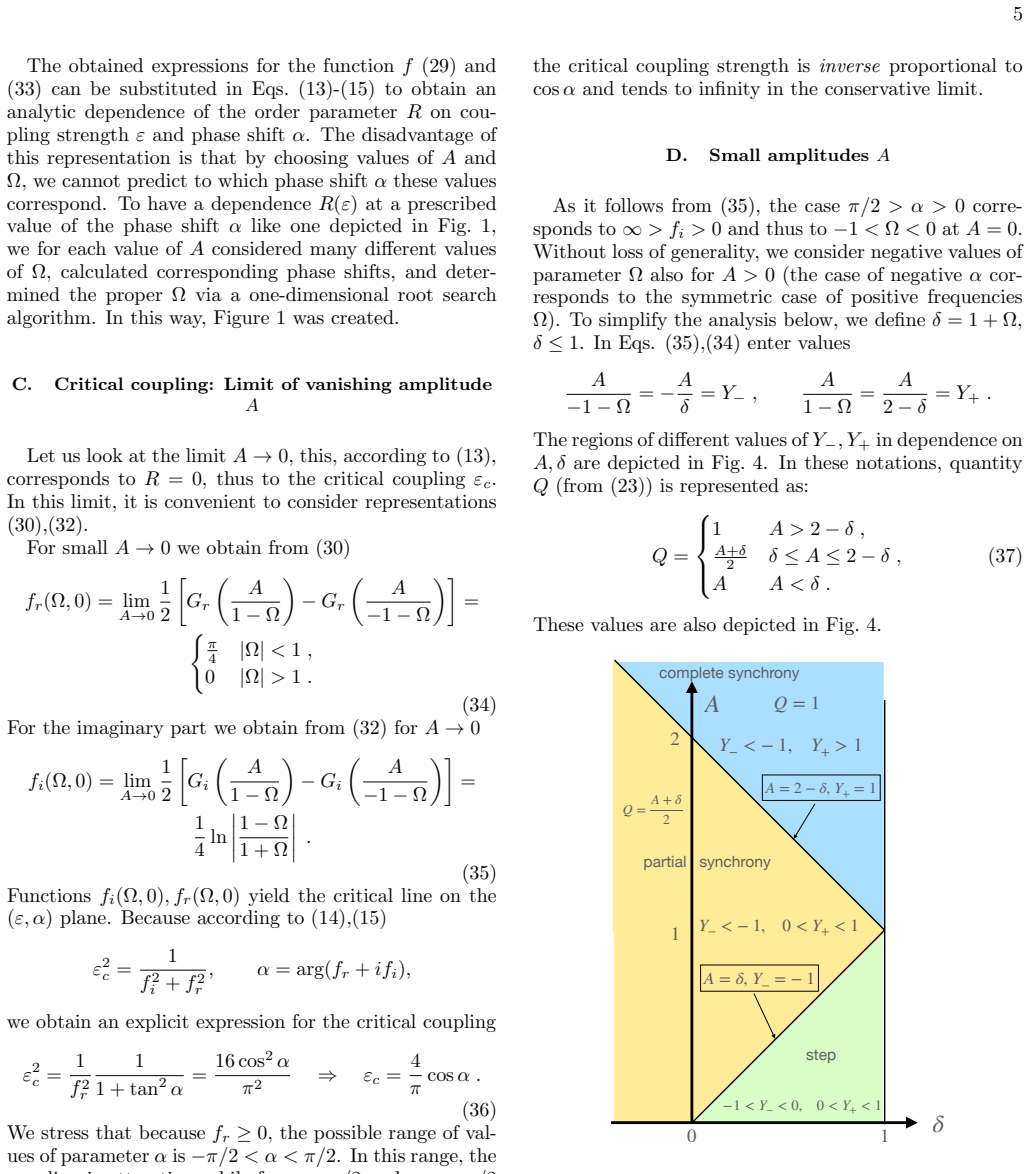
The transition to synchrony in the Kuramoto model of globally coupled phase oscillators with a uniform distribution of natural frequencies is discontinuous. We extend the theory of this transition to the Kuramoto-Sakaguchi model, taking into account a phase shift in coupling. In the thermodynamic limit, we derive dependencies of the order parameters on the coupling strength and the phase shift, and describe two transitions from disorder to partial synchrony and from partial synchrony to complete synchrony. In all cases, the first transition is discontinuous, although for phase shifts close to $\pi/2$, the jump is exponentially small.
Editorial analysis
A structured set of objections, weighed in public.
Referee Report
Summary. The paper analyzes the Kuramoto-Sakaguchi model with uniform natural frequency distribution in the thermodynamic limit. It derives explicit dependencies of the synchronization order parameters on coupling strength K and phase shift α, identifying a discontinuous transition from incoherence to partial synchrony (with jump size exponentially small as α → π/2) followed by a transition to full synchrony.
Significance. If the results hold, the work provides a parameter-free analytical extension of the known discontinuous transition in the standard Kuramoto model to the phase-shifted case. The direct mean-field treatment of the infinite-N equations yields exact expressions for the order parameters and critical points, which is a clear strength and avoids fitting to the target transition. This clarifies how phase lags modulate the abruptness of synchronization onset and connects continuously to the α = π/2 limit.
major comments (2)
- [§3, Eq. (15)] §3, Eq. (15): the self-consistency equation for the partially synchronized order parameter predicts a finite jump at onset for all α, but the asymptotic evaluation establishing the exponential smallness of this jump as α → π/2 is not shown explicitly; the integral or expansion yielding exp(−c/(π/2−α)) must be supplied to support the central claim.
- [§4.1] §4.1: the analysis of the second transition (partial to complete synchrony) relies on the same infinite-N closure, yet no check is given that the incoherent or partially synchronized states remain unstable exactly where claimed once the first jump has occurred.
minor comments (2)
- [Figure 1] Figure 1 caption omits the precise value of α used for the numerical curves, preventing direct comparison with the analytic expressions.
- [Notation] The symbol r is used both for the modulus of the complex order parameter and for its real part in different paragraphs; a single consistent notation would reduce ambiguity.
Simulated Author's Rebuttal
We thank the referee for their careful reading and constructive comments on our manuscript. We address each major comment below and have revised the manuscript to incorporate the requested additions.
read point-by-point responses
-
Referee: [§3, Eq. (15)] §3, Eq. (15): the self-consistency equation for the partially synchronized order parameter predicts a finite jump at onset for all α, but the asymptotic evaluation establishing the exponential smallness of this jump as α → π/2 is not shown explicitly; the integral or expansion yielding exp(−c/(π/2−α)) must be supplied to support the central claim.
Authors: We agree that the explicit asymptotic analysis of the jump size was not provided in the original manuscript. In the revised version, we will add a dedicated derivation following Eq. (15). This will consist of an asymptotic expansion of the integral expression for the partially synchronized order parameter as α approaches π/2 from below, demonstrating that the discontinuity in the order parameter scales as exp(−c/(π/2 − α)) for a positive constant c that we will compute explicitly. This addition will rigorously support the claim of an exponentially small but finite jump. revision: yes
-
Referee: [§4.1] §4.1: the analysis of the second transition (partial to complete synchrony) relies on the same infinite-N closure, yet no check is given that the incoherent or partially synchronized states remain unstable exactly where claimed once the first jump has occurred.
Authors: The referee is correct that explicit stability verification after the first transition was omitted. In the revised manuscript, we will augment §4.1 with a stability analysis of the incoherent and partially synchronized states in the infinite-N limit. Using the mean-field closure, we will linearize the dynamics around these states and show that the incoherent state remains unstable for K > K_c1(α) following the jump, while the partially synchronized state is stable until the second critical point K_c2(α). This will be presented via the relevant eigenvalue conditions derived from the infinite-N equations. revision: yes
Circularity Check
No circularity: direct analytic derivation from infinite-N mean-field equations
full rationale
The paper performs a direct analysis of the closed mean-field equations obtained in the thermodynamic limit for the Kuramoto-Sakaguchi model with uniform frequency distribution. Order-parameter dependencies on coupling strength and phase shift are derived analytically, and the discontinuous nature of the first transition (including the exponentially small jump near π/2) follows from solving these equations without fitting parameters to the transition itself or invoking self-citations as load-bearing premises. The thermodynamic-limit assumption is standard and external to the result; no step reduces by construction to a fitted input, self-definition, or prior author work.
Axiom & Free-Parameter Ledger
axioms (2)
- domain assumption Thermodynamic limit (N→∞) with global all-to-all coupling
- domain assumption Natural frequencies drawn from a uniform distribution
Lean theorems connected to this paper
-
IndisputableMonolith.Foundation.RealityFromDistinctionreality_from_one_distinction unclear?
unclearRelation between the paper passage and the cited Recognition theorem.
In the thermodynamic limit, we derive dependencies of the order parameters on the coupling strength and the phase shift... ε_c = 4/π cosα
What do these tags mean?
- matches
- The paper's claim is directly supported by a theorem in the formal canon.
- supports
- The theorem supports part of the paper's argument, but the paper may add assumptions or extra steps.
- extends
- The paper goes beyond the formal theorem; the theorem is a base layer rather than the whole result.
- uses
- The paper appears to rely on the theorem as machinery.
- contradicts
- The paper's claim conflicts with a theorem or certificate in the canon.
- unclear
- Pith found a possible connection, but the passage is too broad, indirect, or ambiguous to say the theorem truly supports the claim.
Reference graph
Works this paper leans on
-
[1]
Gupta, A
S. Gupta, A. Campa, and S. Ruffo,Statistical physics of synchronization(Springer, 2018)
2018
-
[2]
Kuramoto, Self-entrainment of a population of cou- pled nonlinear oscillators, inInternational Symposium on Mathematical Problems in Theoretical Physics, edited by H
Y. Kuramoto, Self-entrainment of a population of cou- pled nonlinear oscillators, inInternational Symposium on Mathematical Problems in Theoretical Physics, edited by H. Araki (Springer Lecture Notes Phys., v. 39, New York,
-
[3]
Kuramoto,Chemical Oscillations, Waves and Turbu- lence(Springer, Berlin, 1984)
Y. Kuramoto,Chemical Oscillations, Waves and Turbu- lence(Springer, Berlin, 1984)
1984
-
[4]
J. A. Acebr´ on, L. L. Bonilla, C. J. P. Vicente, F. Ritort, and R. Spigler, The Kuramoto model: A simple paradigm for synchronization phenomena, Rev. Mod. Phys.77, 137 (2005)
2005
-
[5]
Paz´ o, Thermodynamic limit of the first-order phase transition in the Kuramoto model, Physical Review E—Statistical, Nonlinear, and Soft Matter Physics72, 046211 (2005)
D. Paz´ o, Thermodynamic limit of the first-order phase transition in the Kuramoto model, Physical Review E—Statistical, Nonlinear, and Soft Matter Physics72, 046211 (2005). 8
2005
-
[6]
Ghosh and S
A. Ghosh and S. Gupta, Relaxation dynamics of the Kuramoto model with uniformly distributed natural fre- quencies, Physica A: Statistical Mechanics and its Appli- cations392, 3812 (2013)
2013
-
[7]
Yuan and J.-Z
D. Yuan and J.-Z. Yang, Conformists and contrarians in a Kuramoto model with uniformly distributed natural frequencies, Communications in Theoretical Physics59, 684 (2013)
2013
-
[8]
Ottino-L¨ offler and S
B. Ottino-L¨ offler and S. H. Strogatz, Kuramoto model with uniformly spaced frequencies: Finite-nasymptotics of the locking threshold, Phys. Rev. E93, 062220 (2016)
2016
-
[9]
Yagasaki, Bifurcations and stability of synchronized solutions in the Kuramoto model with uniformly spaced natural frequencies, Nonlinearity38, 075032 (2025)
K. Yagasaki, Bifurcations and stability of synchronized solutions in the Kuramoto model with uniformly spaced natural frequencies, Nonlinearity38, 075032 (2025)
2025
-
[10]
Sakaguchi and Y
H. Sakaguchi and Y. Kuramoto, A soluble active rotator model showing phase transition via mutual entrainment, Prog. Theor. Phys.76, 576 (1986)
1986
-
[11]
Ott and T
E. Ott and T. M. Antonsen, Low dimensional behavior of large systems of globally coupled oscillators, CHAOS 18, 037113 (2008)
2008
-
[12]
O. E. Omel’chenko and M. Wolfrum, Nonuniversal tran- sitions to synchrony in the Sakaguchi-Kuramoto model, Physical Review Letters109, 164101 (2012)
2012
-
[13]
Omel’chenko and M
E. Omel’chenko and M. Wolfrum, Bifurcations in the Sakaguchi–Kuramoto model, Physica D: Nonlinear Phe- nomena263, 74 (2013)
2013
discussion (0)
Sign in with ORCID, Apple, or X to comment. Anyone can read and Pith papers without signing in.