Recognition: unknown
Anderson localization via Peierls phase modulation
Pith reviewed 2026-05-10 15:23 UTC · model grok-4.3
The pith
Random Peierls phases localize all eigenstates in a two-leg ladder, while quasiperiodic phases produce a tunable delocalized-to-localized transition.
A machine-rendered reading of the paper's core claim, the machinery that carries it, and where it could break.
Core claim
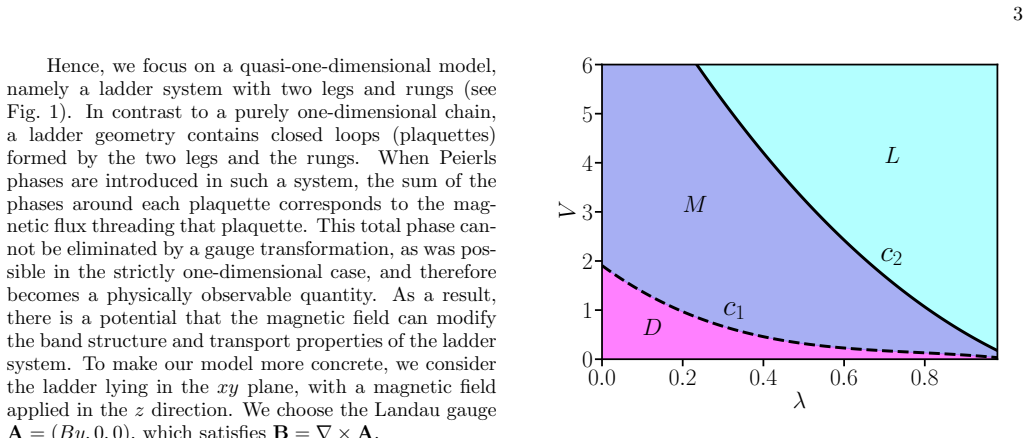
In a two-leg ladder described by a clean tight-binding model, uniform Peierls phases keep all eigenstates delocalized, random Peierls phases produce complete Anderson localization of every eigenstate, and quasiperiodic Peierls phase modulations induce a transition from delocalized to localized phases whose diagram for the two-parameter case shows extended, localized, and intermediate mixed regimes.
What carries the argument
Peierls phases inserted into the hopping amplitudes along the ladder legs to encode the magnetic flux in the Landau gauge.
If this is right
- Random Peierls phases induce complete Anderson localization without introducing disorder in onsite potentials or hopping magnitudes.
- Quasiperiodic modulation of the Peierls phase drives a transition from a fully delocalized to a fully localized phase as the quasiperiodicity parameter is tuned.
- The phase diagram for the two-parameter quasiperiodic Peierls phase contains distinct regions of delocalized states, localized states, and intermediate mixed phases.
- Semiclassical analysis qualitatively reproduces the same localization transition and phase boundaries found in the full quantum treatment.
Where Pith is reading between the lines
- Phase-only modulation separates the control of localization from potential disorder, which may simplify experiments in artificial gauge-field platforms.
- The mixed-phase regions could contain states with intermediate localization lengths or multifractal properties that affect transport in distinct ways.
- Analogous phase-engineering mechanisms might produce localization transitions in other quasi-one-dimensional or ladder geometries.
Load-bearing premise
The magnetic field affects the ladder only by adding phases to the hopping terms via the Peierls substitution, with the tight-binding model remaining valid and no extra orbital or interaction effects present.
What would settle it
Numerical diagonalization or an experiment that finds extended eigenstates persisting under fully random Peierls phases, or that shows no localization transition as the quasiperiodicity strength is increased, would falsify the central claims.
Figures






read the original abstract
We investigate a two leg ladder system subjected to an external magnetic field. In the absence of a magnetic field, the system is described by a clean tight binding model, with no disorder in either the onsite potential or the hopping amplitudes. The effect of magnetic field in this system is studied by introducing the Peierls phases in the hopping amplitudes along a leg (appropriate when the Landau gauge is chosen). For a uniform magnetic field, characterized by a constant Peierls phase, we find that all eigenstates remain delocalized. In contrast, random Peierls phases, representing a random magnetic field, lead to complete localization of the eigenstates. We further show that a quasiperiodic modulation of the Peierls phase can drive a transition from a fully delocalized to a fully localized phase upon tuning the quasiperiodicity. For a two parameter quasiperiodic Peierls phase, varying analogously to a generalized Aubry Andre type potential, we construct the phase diagram of the system. The phase diagram exhibits regions of delocalized and localized phases, separated by intermediate regimes of mixed phase. We also perform a semiclassical analysis that qualitatively yields a similar phase diagram, capturing the localization transition. Our results demonstrate a mechanism for controlling transport properties via the Peierls phase engineering.
Editorial analysis
A structured set of objections, weighed in public.
Referee Report
Summary. The manuscript examines Anderson localization in a two-leg tight-binding ladder by introducing Peierls phases into the hopping terms along one leg. Uniform (constant) phases leave all eigenstates delocalized, while random phases produce complete localization. Quasiperiodic modulation of the phases, constructed analogously to a generalized Aubry-André potential, drives a delocalized-to-localized transition; the resulting two-parameter phase diagram contains delocalized, localized, and intermediate mixed-phase regions. A semiclassical analysis is shown to reproduce the qualitative features of the numerically obtained diagram.
Significance. If the central claims hold, the work demonstrates a route to localization that relies solely on phase modulation of hoppings rather than onsite disorder, which is directly relevant to synthetic gauge-field experiments in cold atoms and superconducting circuits. The direct mapping of the quasiperiodic phase problem onto an Aubry-André-like model, together with the supporting semiclassical treatment, provides a clean and falsifiable extension of known localization physics to ladder geometries.
minor comments (4)
- The numerical section should state the system sizes, boundary conditions, and convergence criteria used for the inverse participation ratio (IPR) calculations that underlie the phase diagram; without these details the sharpness of the reported transitions cannot be assessed.
- The precise operational definition of the 'mixed phase' (e.g., any IPR threshold, fraction of states, or finite-size scaling criterion) is not given; this quantity appears in the abstract and phase-diagram discussion and should be defined explicitly.
- The semiclassical analysis is described as qualitative; a brief outline of the key approximations (e.g., which terms are retained in the effective potential) would help readers judge the regime of validity.
- Figure captions should indicate the precise parameter values and system sizes corresponding to each panel so that the data can be reproduced from the text alone.
Simulated Author's Rebuttal
We thank the referee for the positive and accurate summary of our manuscript, the recognition of its significance for synthetic gauge-field experiments, and the recommendation of minor revision. No specific major comments were provided in the report.
Circularity Check
No significant circularity detected
full rationale
The paper's derivation proceeds from the standard two-leg ladder tight-binding Hamiltonian with Peierls phases inserted on one leg. Random phases produce effective disorder because rung couplings prevent global gauging, directly yielding Anderson localization via standard numerics (IPR, participation ratio). Quasiperiodic modulation is constructed analogously to the Aubry-André potential but applied to the phase channel, with the phase diagram obtained from direct diagonalization. The semiclassical analysis is presented as a qualitative independent check that reproduces the same transition boundaries without fitting parameters to the numerical data. No equation reduces a claimed prediction to an input by construction, no load-bearing self-citation justifies a uniqueness theorem or ansatz, and the model assumptions (Peierls substitution validity) are stated explicitly without circular redefinition. The results are self-contained against external benchmarks of Anderson localization and quasiperiodic models.
Axiom & Free-Parameter Ledger
axioms (2)
- domain assumption The ladder is described by a non-interacting tight-binding Hamiltonian with Peierls phases in the hoppings.
- domain assumption Localization is diagnosed from eigenstate properties such as inverse participation ratio.
Reference graph
Works this paper leans on
-
[1]
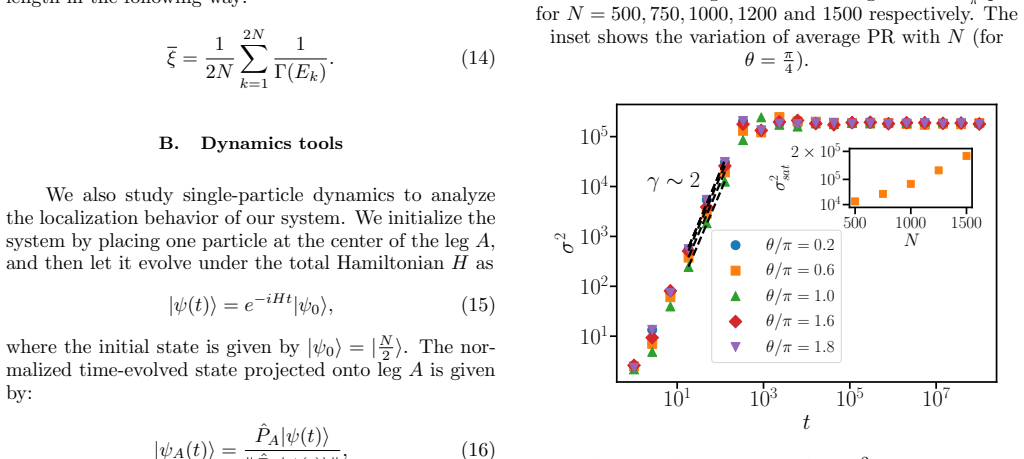
Interestingly, we also get the crossover linec 2 by studying the long-time saturation value of the variance (σ2 sat) and its system size dependence
inLphase. Interestingly, we also get the crossover linec 2 by studying the long-time saturation value of the variance (σ2 sat) and its system size dependence. 4 III. DIAGNOSTIC TOOLS We employ different diagnostic tools to analyze lo- calization properties of our model. In this section we briefly discuss them. In the following discussion,|ξ k⟩ represents ...
2000
-
[2]
P. W. Anderson, Absence of diffusion in certain random lattices, Phys. Rev.109, 1492 (1958)
1958
-
[3]
P. A. Lee and T. V. Ramakrishnan, Disordered elec- tronic systems, Rev. Mod. Phys.57, 287 (1985)
1985
-
[4]
Abrahams, P
E. Abrahams, P. W. Anderson, D. C. Licciardello, and T. V. Ramakrishnan, Scaling theory of localization: Ab- sence of quantum diffusion in two dimensions, Phys. Rev. Lett.42, 673 (1979)
1979
-
[5]
Thouless, Electrons in disordered systems and the theory of localization, Physics Reports13, 93 (1974)
D. Thouless, Electrons in disordered systems and the theory of localization, Physics Reports13, 93 (1974)
1974
-
[6]
Evers and A
F. Evers and A. D. Mirlin, Anderson transitions, Rev. Mod. Phys.80, 1355 (2008)
2008
-
[7]
ˇZnidariˇ c, T
M. ˇZnidariˇ c, T. c. v. Prosen, and P. Prelovˇ sek, Many- body localization in the heisenbergxxzmagnet in a random field, Phys. Rev. B77, 064426 (2008)
2008
-
[8]
Pal and D
A. Pal and D. A. Huse, Many-body localization phase transition, Phys. Rev. B82, 174411 (2010)
2010
-
[9]
J. H. Bardarson, F. Pollmann, and J. E. Moore, Un- bounded growth of entanglement in models of many- body localization, Phys. Rev. Lett.109, 017202 (2012). 13
2012
-
[10]
D. J. Luitz, N. Laflorencie, and F. Alet, Many-body localization edge in the random-field heisenberg chain, Phys. Rev. B91, 081103 (2015)
2015
-
[11]
D. A. Abanin, E. Altman, I. Bloch, and M. Serbyn, Col- loquium: Many-body localization, thermalization, and entanglement, Rev. Mod. Phys.91, 021001 (2019)
2019
-
[12]
Nandkishore and D
R. Nandkishore and D. A. Huse, Many-body localiza- tion and thermalization in quantum statistical mechan- ics, Annu. Rev. Condens. Matter Phys.6, 15 (2015)
2015
-
[13]
J. M. Deutsch, Quantum statistical mechanics in a closed system, Phys. Rev. A43, 2046 (1991)
2046
-
[14]
Srednicki, Chaos and quantum thermalization, Phys
M. Srednicki, Chaos and quantum thermalization, Phys. Rev. E50, 888 (1994)
1994
-
[15]
Rigol and M
M. Rigol and M. Srednicki, Alternatives to eigenstate thermalization, Physical review letters108, 110601 (2012)
2012
-
[16]
Morningstar, L
A. Morningstar, L. Colmenarez, V. Khemani, D. J. Luitz, and D. A. Huse, Avalanches and many-body res- onances in many-body localized systems, Phys. Rev. B 105, 174205 (2022)
2022
-
[17]
Sels, Bath-induced delocalization in interacting dis- ordered spin chains, Phys
D. Sels, Bath-induced delocalization in interacting dis- ordered spin chains, Phys. Rev. B106, L020202 (2022)
2022
-
[18]
ˇSuntajs, J
J. ˇSuntajs, J. Bonˇ ca, T. c. v. Prosen, and L. Vid- mar, Quantum chaos challenges many-body localiza- tion, Phys. Rev. E102, 062144 (2020)
2020
-
[19]
H. Yao, A. Khoudli, L. Bresque, and L. Sanchez- Palencia, Critical behavior and fractality in shallow one- dimensional quasiperiodic potentials, Phys. Rev. Lett. 123, 070405 (2019)
2019
-
[20]
Roy and A
N. Roy and A. Sharma, Fraction of delocalized eigen- states in the long-range aubry-andr´ e-harper model, Phys. Rev. B103, 075124 (2021)
2021
-
[21]
Y. Wang, X. Xia, L. Zhang, H. Yao, S. Chen, J. You, Q. Zhou, and X.-J. Liu, One-dimensional quasiperiodic mosaic lattice with exact mobility edges, Phys. Rev. Lett.125, 196604 (2020)
2020
-
[23]
T. Liu, X. Xia, S. Longhi, and L. Sanchez-Palencia, Anomalous mobility edges in one-dimensional quasiperi- odic models, SciPost Phys.12, 027 (2022)
2022
-
[24]
Fraxanet, U
J. Fraxanet, U. Bhattacharya, T. Grass, M. Lewenstein, and A. Dauphin, Localization and multifractal proper- ties of the long-range kitaev chain in the presence of an aubry-andr´ e-harper modulation, Phys. Rev. B106, 024204 (2022)
2022
-
[25]
Gon¸ calves, B
M. Gon¸ calves, B. Amorim, E. V. Castro, and P. Ribeiro, Hidden dualities in 1D quasiperiodic lattice models, Sci- Post Phys.13, 046 (2022)
2022
-
[26]
Y. Wang, L. Zhang, S. Niu, D. Yu, and X.-J. Liu, Re- alization and detection of nonergodic critical phases in an optical raman lattice, Phys. Rev. Lett.125, 073204 (2020)
2020
-
[27]
Y. Wang, L. Zhang, W. Sun, T.-F. J. Poon, and X.- J. Liu, Quantum phase with coexisting localized, ex- tended, and critical zones, Phys. Rev. B106, L140203 (2022)
2022
-
[28]
X. Deng, S. Ray, S. Sinha, G. V. Shlyapnikov, and L. Santos, One-dimensional quasicrystals with power- law hopping, Phys. Rev. Lett.123, 025301 (2019)
2019
-
[29]
X. Li, X. Li, and S. Das Sarma, Mobility edges in one-dimensional bichromatic incommensurate poten- tials, Phys. Rev. B96, 085119 (2017)
2017
-
[30]
Das Sarma, A
S. Das Sarma, A. Kobayashi, and R. E. Prange, Pro- posed experimental realization of anderson localization in random and incommensurate artificially layered sys- tems, Phys. Rev. Lett.56, 1280 (1986)
1986
-
[31]
Biddle and S
J. Biddle and S. Das Sarma, Predicted mobility edges in one-dimensional incommensurate optical lattices: An exactly solvable model of anderson localization, Phys. Rev. Lett.104, 070601 (2010)
2010
-
[32]
Ganeshan, J
S. Ganeshan, J. H. Pixley, and S. Das Sarma, Nearest neighbor tight binding models with an exact mobility edge in one dimension, Phys. Rev. Lett.114, 146601 (2015)
2015
-
[33]
M. L. Sun, G. Wang, N. B. Li, and T. Nakayama, Localization-delocalization transition in self-dual quasi- periodic lattices, Europhysics Letters110, 57003 (2015)
2015
-
[34]
Gopalakrishnan, Self-dual quasiperiodic systems with power-law hopping, Phys
S. Gopalakrishnan, Self-dual quasiperiodic systems with power-law hopping, Phys. Rev. B96, 054202 (2017)
2017
-
[35]
Purkayastha, A
A. Purkayastha, A. Dhar, and M. Kulkarni, Nonequilib- rium phase diagram of a one-dimensional quasiperiodic system with a single-particle mobility edge, Phys. Rev. B96, 180204 (2017)
2017
-
[36]
F. A. An, K. Padavi´ c, E. J. Meier, S. Hegde, S. Gane- shan, J. H. Pixley, S. Vishveshwara, and B. Gadway, Interactions and mobility edges: Observing the general- ized aubry-andr´ e model, Phys. Rev. Lett.126, 040603 (2021)
2021
-
[37]
Fallani, J
L. Fallani, J. E. Lye, V. Guarrera, C. Fort, and M. In- guscio, Ultracold atoms in a disordered crystal of light: Towards a bose glass, Phys. Rev. Lett.98, 130404 (2007)
2007
-
[38]
D’Errico, E
C. D’Errico, E. Lucioni, L. Tanzi, L. Gori, G. Roux, I. P. McCulloch, T. Giamarchi, M. Inguscio, and G. Mod- ugno, Observation of a disordered bosonic insulator from weak to strong interactions, Phys. Rev. Lett.113, 095301 (2014)
2014
-
[39]
M. Schreiber, S. S. Hodgman, P. Bordia, H. P. L¨ uschen, M. H. Fischer, R. Vosk, E. Altman, U. Schneider, and I. Bloch, Observation of many- body localization of interacting fermions in a quasir- andom optical lattice, Science349, 842 (2015), https://www.science.org/doi/pdf/10.1126/science.aaa7432
-
[40]
Bordia, H
P. Bordia, H. P. L¨ uschen, S. S. Hodgman, M. Schreiber, I. Bloch, and U. Schneider, Coupling identical one- dimensional many-body localized systems, Phys. Rev. Lett.116, 140401 (2016)
2016
-
[41]
Bordia, H
P. Bordia, H. L¨ uschen, S. Scherg, S. Gopalakrishnan, M. Knap, U. Schneider, and I. Bloch, Probing slow re- laxation and many-body localization in two-dimensional quasiperiodic systems, Phys. Rev. X7, 041047 (2017)
2017
-
[42]
H. P. L¨ uschen, P. Bordia, S. Scherg, F. Alet, E. Alt- man, U. Schneider, and I. Bloch, Observation of slow dynamics near the many-body localization transition in one-dimensional quasiperiodic systems, Phys. Rev. Lett. 119, 260401 (2017)
2017
-
[44]
Wang, J.-H
Y. Wang, J.-H. Zhang, Y. Li, J. Wu, W. Liu, F. Mei, Y. Hu, L. Xiao, J. Ma, C. Chin, and S. Jia, Observation of interaction-induced mobility edge in an atomic aubry- andr´ e wire, Phys. Rev. Lett.129, 103401 (2022)
2022
-
[45]
Lahini, R
Y. Lahini, R. Pugatch, F. Pozzi, M. Sorel, R. Moran- dotti, N. Davidson, and Y. Silberberg, Observation of 14 a localization transition in quasiperiodic photonic lat- tices, Phys. Rev. Lett.103, 013901 (2009)
2009
-
[46]
Merlin, K
R. Merlin, K. Bajema, R. Clarke, F. Y. Juang, and P. K. Bhattacharya, Quasiperiodic gaas-alas het- erostructures, Phys. Rev. Lett.55, 1768 (1985)
1985
-
[47]
Tanese, E
D. Tanese, E. Gurevich, F. Baboux, T. Jacqmin, A. Lemaˆ ıtre, E. Galopin, I. Sagnes, A. Amo, J. Bloch, and E. Akkermans, Fractal energy spectrum of a po- lariton gas in a fibonacci quasiperiodic potential, Phys. Rev. Lett.112, 146404 (2014)
2014
-
[48]
P. Roushan, C. Neill, J. Tangpanitanon, V. M. Basti- das, A. Megrant, R. Barends, Y. Chen, Z. Chen, B. Chiaro, A. Dunsworth, A. Fowler, B. Foxen, M. Giustina, E. Jeffrey, J. Kelly, E. Lucero, J. Mutus, M. Neeley, C. Quintana, D. Sank, A. Vainsencher, J. Wenner, T. White, H. Neven, D. G. Ange- lakis, and J. Martinis, Spectroscopic signatures of localizatio...
-
[49]
Goblot, A
V. Goblot, A. ˇStrkalj, N. Pernet, J. L. Lado, C. Dorow, A. Lemaˆ ıtre, L. Le Gratiet, A. Harouri, I. Sagnes, S. Ravets, A. Amo, J. Bloch, and O. Zilberberg, Emer- gence of criticality through a cascade of delocalization transitions in quasiperiodic chains, Nature Physics16, 832 (2020)
2020
-
[50]
Li, Y.-Y
H. Li, Y.-Y. Wang, Y.-H. Shi, K. Huang, X. Song, G.- H. Liang, Z.-Y. Mei, B. Zhou, H. Zhang, J.-C. Zhang, S. Chen, S. P. Zhao, Y. Tian, Z.-Y. Yang, Z. Xiang, K. Xu, D. Zheng, and H. Fan, Observation of criti- cal phase transition in a generalized aubry-andr´ e-harper model with superconducting circuits, npj Quantum In- formation9, 40 (2023)
2023
-
[51]
Hatsugai and M
Y. Hatsugai and M. Kohmoto, Energy spectrum and the quantum hall effect on the square lattice with next-nearest-neighbor hopping, Phys. Rev. B42, 8282 (1990)
1990
-
[52]
J. H. Han, D. J. Thouless, H. Hiramoto, and M. Kohmoto, Critical and bicritical properties of harper’s equation with next-nearest-neighbor coupling, Phys. Rev. B50, 11365 (1994)
1994
-
[53]
F. Liu, S. Ghosh, and Y. D. Chong, Localization and adiabatic pumping in a generalized aubry-andr´ e-harper model, Phys. Rev. B91, 014108 (2015)
2015
-
[54]
Wang, X.-J
J. Wang, X.-J. Liu, G. Xianlong, and H. Hu, Phase di- agram of a non-abelian aubry-andr´ e-harper model with p-wave superfluidity, Phys. Rev. B93, 104504 (2016)
2016
-
[55]
Y. Wang, C. Cheng, X.-J. Liu, and D. Yu, Many-body critical phase: Extended and nonthermal, Phys. Rev. Lett.126, 080602 (2021)
2021
-
[56]
Takada, K
Y. Takada, K. Ino, and M. Yamanaka, Statistics of spectra for critical quantum chaos in one-dimensional quasiperiodic systems, Phys. Rev. E70, 066203 (2004)
2004
-
[57]
Geisel, R
T. Geisel, R. Ketzmerick, and G. Petschel, New class of level statistics in quantum systems with unbounded diffusion, Phys. Rev. Lett.66, 1651 (1991)
1991
-
[58]
Machida and M
K. Machida and M. Fujita, Quantum energy spectra and one-dimensional quasiperiodic systems, Phys. Rev. B34, 7367 (1986)
1986
-
[59]
C. L. Bertrand and A. M. Garc´ ıa-Garc´ ıa, Anomalous thouless energy and critical statistics on the metallic side of the many-body localization transition, Phys. Rev. B94, 144201 (2016)
2016
-
[60]
T. C. Halsey, M. H. Jensen, L. P. Kadanoff, I. Procaccia, and B. I. Shraiman, Fractal measures and their singu- larities: The characterization of strange sets, Phys. Rev. A33, 1141 (1986)
1986
-
[61]
A. D. Mirlin, Y. V. Fyodorov, A. Mildenberger, and F. Evers, Exact relations between multifractal expo- nents at the anderson transition, Phys. Rev. Lett.97, 046803 (2006)
2006
-
[62]
Dubertrand, I
R. Dubertrand, I. Garc´ ıa-Mata, B. Georgeot, O. Gi- raud, G. Lemari´ e, and J. Martin, Two scenarios for quantum multifractality breakdown, Phys. Rev. Lett. 112, 234101 (2014)
2014
-
[63]
Ketzmerick, K
R. Ketzmerick, K. Kruse, S. Kraut, and T. Geisel, What determines the spreading of a wave packet?, Phys. Rev. Lett.79, 1959 (1997)
1959
-
[64]
Larcher, F
M. Larcher, F. Dalfovo, and M. Modugno, Effects of interaction on the diffusion of atomic matter waves in one-dimensional quasiperiodic potentials, Phys. Rev. A 80, 053606 (2009)
2009
-
[65]
Modak and S
R. Modak and S. Mukerjee, Many-body localization in the presence of a single-particle mobility edge, Phys. Rev. Lett.115, 230401 (2015)
2015
-
[66]
Modak, S
R. Modak, S. Ghosh, and S. Mukerjee, Criterion for the occurrence of many-body localization in the presence of a single-particle mobility edge, Phys. Rev. B97, 104204 (2018)
2018
-
[67]
X. Li, S. Ganeshan, J. H. Pixley, and S. Das Sarma, Many-body localization and quantum nonergodicity in a model with a single-particle mobility edge, Phys. Rev. Lett.115, 186601 (2015)
2015
-
[68]
D.-L. Deng, S. Ganeshan, X. Li, R. Modak, S. Mukerjee, and J. Pixley, Many-body localization in incommensu- rate models with a mobility edge, Annalen der Physik 529, 1600399 (2017)
2017
-
[70]
S. Roy, T. Mishra, B. Tanatar, and S. Basu, Reentrant localization transition in a quasiperiodic chain, Phys. Rev. Lett.126, 106803 (2021)
2021
-
[71]
Karmakar, S
S. Karmakar, S. Ganguly, and S. K. Maiti, Reentrant lo- calization in a quasiperiodic chain with correlated hop- ping sequences, Journal of Physics: Condensed Matter 37, 375402 (2025)
2025
-
[72]
Goswami, P
A. Goswami, P. Chatterjee, R. Modak, and S. Sahoo, Subsystem localization in a two-leg ladder system, Phys. Rev. B112, 144205 (2025)
2025
-
[73]
K. v. Klitzing, G. Dorda, and M. Pepper, New method for high-accuracy determination of the fine-structure constant based on quantized hall resistance, Phys. Rev. Lett.45, 494 (1980)
1980
-
[74]
B. A. Bernevig, T. L. Hughes, and S.-C. Zhang, Quantum spin hall effect and topological phase transi- tion in hgte quantum wells, Science314, 1757 (2006), https://www.science.org/doi/pdf/10.1126/science.1133734
-
[75]
M. K¨ onig, S. Wiedmann, C. Br¨ une, A. Roth, H. Buhmann, L. W. Molenkamp, X.-L. Qi, and S.-C. Zhang, Quantum spin hall insulator state in hgte quantum wells, Science318, 766 (2007), https://www.science.org/doi/pdf/10.1126/science.1148047
-
[76]
C. L. Kane and E. J. Mele, Quantum spin hall effect in graphene, Phys. Rev. Lett.95, 226801 (2005)
2005
-
[77]
D. Hsieh, Y. Xia, L. Wray, D. Qian, A. Pal, J. H. Dil, J. Osterwalder, F. Meier, G. Bihlmayer, C. L. 15 Kane, Y. S. Hor, R. J. Cava, and M. Z. Hasan, Observation of unconventional quantum spin tex- tures in topological insulators, Science323, 919 (2009), https://www.science.org/doi/pdf/10.1126/science.1167733
-
[78]
Y. Liu, Y. Li, and J. Teng, Anisotropic magnetore- sistance and planar hall effect in an antiferromagnetic insulator-topological insulator heterostructure, Phys. Rev. Res.7, 033182 (2025)
2025
-
[79]
D´ esir´ e Pomar, A
T. D´ esir´ e Pomar, A. E. Frackowiak, R. Erlandsen, D. Valbjørn Christensen, and R. Bjørk, Enhancing ex- traordinary magnetoresistance devices through geomet- ric variations of the outer boundary, Journal of Applied Physics133(2023)
2023
-
[80]
A. M. Marques, Effects of peierls phases in open linear chains, Phys. Rev. B110, 115156 (2024)
2024
-
[81]
F. A. An, E. J. Meier, and B. Gadway, Engineering a flux-dependent mobility edge in disordered zigzag chains, Phys. Rev. X8, 031045 (2018)
2018
-
[82]
D. R. Hofstadter, Energy levels and wave functions of bloch electrons in rational and irrational magnetic fields, Phys. Rev. B14, 2239 (1976)
1976
-
[83]
C. R. Dean, L. Wang, P. Maher, C. Forsythe, F. Gha- hari, Y. Gao, J. Katoch, M. Ishigami, P. Moon, M. Koshino,et al., Hofstadter’s butterfly and the fractal quantum hall effect in moir´ e superlattices, Nature497, 598 (2013)
2013
discussion (0)
Sign in with ORCID, Apple, or X to comment. Anyone can read and Pith papers without signing in.