Recognition: 2 theorem links
· Lean TheoremVacancy-driven inverse Lieb geometry: A general route to d-wave altermagnetism in two dimensions
Pith reviewed 2026-05-12 02:48 UTC · model grok-4.3
The pith
Vacancy-induced reconstruction creates inverse Lieb structures that host d-wave altermagnetism in two dimensions.
A machine-rendered reading of the paper's core claim, the machinery that carries it, and where it could break.
Core claim
Vacancy-driven structural reconstruction in two-dimensional systems produces an inverse Lieb magnetic network in which two inequivalent vanadium sites, related by C4 symmetry and carrying opposite exchange fields, yield zero net magnetization while breaking both time-reversal and PT symmetries. A minimal tight-binding model that incorporates anisotropic second-order hopping between these sites, mediated by a nonmagnetic corner atom, generates spin splitting with a (cos kx − cos ky) form factor that quantitatively reproduces first-principles results, exhibits strong anisotropy peaked at the X and Y points, and enforces nodal degeneracy at M, confirming the d_{x^2−y^2} altermagnetic character.
What carries the argument
The inverse Lieb magnetic network arising from vacancy reconstruction, in which anisotropic second-order hopping between inequivalent magnetic sites mediated by a nonmagnetic corner site produces the d-wave spin-splitting form factor.
If this is right
- Vacancy engineering supplies a general microscopic route for realizing d-wave altermagnetism across a family of two-dimensional materials.
- Reconstructed V2S2 and V2Se2 monolayers are predicted to be room-temperature stable and to exhibit the required spin texture.
- The resulting spin splitting is maximized near X and Y points while symmetry-enforced nodes appear at M.
- The approach yields zero-net-magnetization altermagnets whose d-wave character can be directly verified by the fourfold Fermi-surface pattern.
Where Pith is reading between the lines
- The same vacancy-reconstruction strategy could be tested in other transition-metal dichalcogenide or oxide monolayers to generate altermagnetism with different orbital characters.
- If the monolayers can be grown, heterostructuring them with superconductors or ferromagnets would allow experimental probes of how the d-wave spin texture couples to other ordered phases.
- The mechanism suggests a broader class of defect-engineered lattices in which local symmetry breaking produces higher-angular-momentum altermagnetic order parameters.
Load-bearing premise
The vacancy-reconstructed inverse Lieb structure remains energetically stable, synthesizable, and faithfully described by a minimal tight-binding model without significant corrections from higher-order interactions.
What would settle it
Angle-resolved photoemission spectroscopy on synthesized V2S2 monolayers that either shows or fails to show the predicted strongly anisotropic spin splitting with (cos kx − cos ky) symmetry, nodes at M, and fourfold Fermi-surface pattern would confirm or refute the central claim.
Figures



read the original abstract
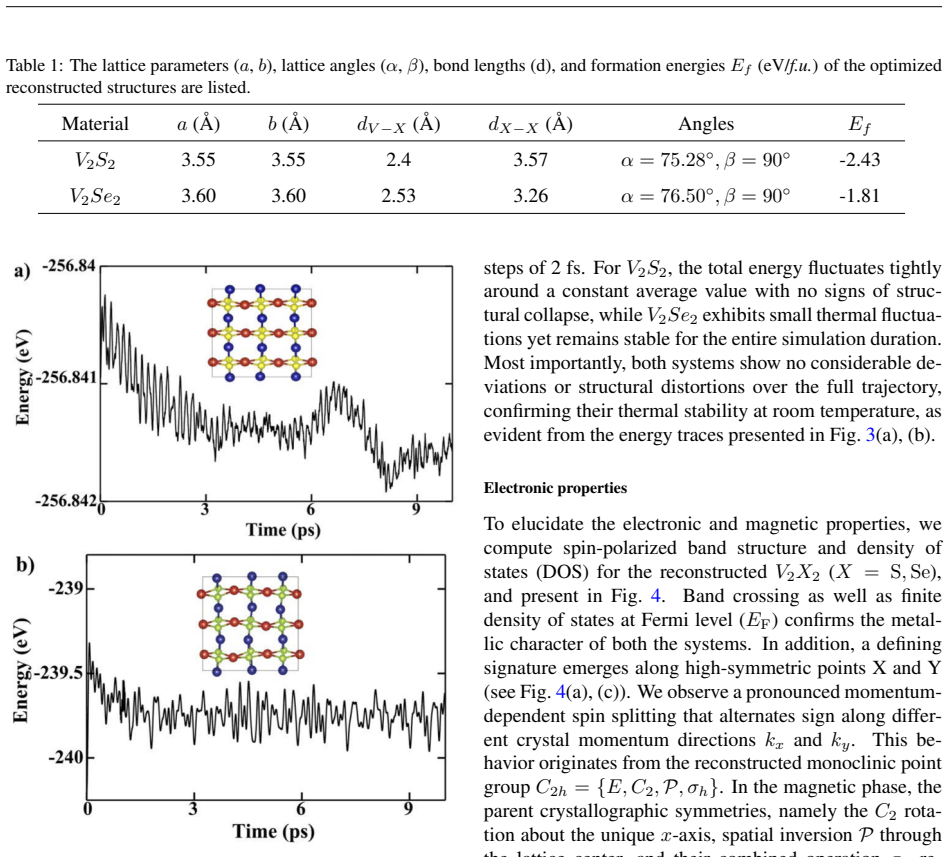
Vacancy-induced structural reconstruction provides a general microscopic route to $d$-wave altermagnetism in two-dimensional systems. As a concrete realization, reconstructed $\mathrm{V_2X_2}$ ($\mathrm{X}=\mathrm{S}, \mathrm{Se}$) monolayers form an inverse Lieb magnetic network in which two inequivalent edge vanadium sites, related by $C_4$ lattice rotational symmetry and carrying opposite exchange fields, yield zero net magnetization despite broken time-reversal ($\mathcal{T}$) and combined inversion--time-reversal ($\mathcal{PT}$) symmetries. Structural stability is confirmed by formation energies, phonon spectra, and $ab$ $ initio$ molecular dynamics simulations at room temperature. A minimal tight-binding model, incorporating anisotropic second-order hopping between the inequivalent magnetic sites mediated by a nonmagnetic corner site, produces spin splitting with a $(\cos k_x - \cos k_y)$ form factor in quantitative agreement with first-principles calculations. The resulting spin splitting is strongly anisotropic, maximized near the $X$ and $Y$ high-symmetry points and exhibiting a symmetry-enforced nodal degeneracy at $M$, consistent with a $d_{x^2-y^2}$ altermagnetic form factor confirmed by the fourfold Fermi surface pattern. These findings establish vacancy-driven reconstruction of an inverse Lieb magnetic network as a general design principle for two-dimensional $d$-wave altermagnets.
Editorial analysis
A structured set of objections, weighed in public.
Referee Report
Summary. The manuscript claims that vacancy-induced structural reconstruction provides a general microscopic route to d-wave altermagnetism in two-dimensional systems. As a concrete realization, reconstructed V₂X₂ (X=S, Se) monolayers form an inverse Lieb magnetic network in which two inequivalent edge vanadium sites, related by C₄ lattice rotational symmetry and carrying opposite exchange fields, yield zero net magnetization despite broken time-reversal (T) and combined inversion–time-reversal (PT) symmetries. Structural stability is confirmed by formation energies, phonon spectra, and ab initio molecular dynamics simulations at room temperature. A minimal tight-binding model, incorporating anisotropic second-order hopping between the inequivalent magnetic sites mediated by a nonmagnetic corner site, produces spin splitting with a (cos k_x - cos k_y) form factor in quantitative agreement with first-principles calculations. The resulting spin splitting is strongly anisotropic, maximized near the X and Y high-symmetry points and exhibiting a symmetry-enforced nodal degeneracy at M, consistent with a d_{x²-y²} altermagnetic form factor confirmed by the fourfold Fermi surface pattern.
Significance. If the central results hold, the work identifies a concrete, vacancy-driven mechanism for realizing d-wave altermagnetism in 2D via an inverse Lieb network, supported by explicit stability checks (formation energies, phonons, MD) and a symmetry-based TB model that reproduces the DFT spin-splitting form factor. This could serve as a useful design principle for 2D altermagnets with anisotropic spin textures and zero net moment, relevant to spintronics.
major comments (2)
- [Abstract and §1] Abstract and §1 (Introduction): The central claim that vacancy-induced reconstruction 'provides a general microscopic route' to d-wave altermagnetism rests on a single material family (reconstructed V₂X₂). No general symmetry argument, proof, or explicit calculations for other 2D lattices are provided to show that the required C₄-related opposite exchange fields and anisotropic hopping necessarily emerge from vacancy reconstruction in arbitrary cases; this makes the generality assertion an extrapolation rather than a demonstrated principle.
- [§3.2] §3.2 (Tight-binding model): The minimal TB model introduces anisotropic second-order hopping amplitudes as free parameters that are adjusted to achieve quantitative agreement with the DFT spin splitting of (cos k_x - cos k_y) form. The manuscript does not demonstrate that these amplitudes are fixed by the lattice geometry alone or that the agreement persists without fitting; this weakens the claim that the model fully captures the spin splitting from symmetry and hopping anisotropy without significant higher-order corrections.
minor comments (2)
- [Figure 2] Figure 2 (or equivalent band-structure figure): The plotted spin-split bands and Fermi surface should include explicit labeling of the high-symmetry points (X, Y, M) and a direct overlay of the TB versus DFT curves to make the quantitative agreement visually verifiable.
- [Methods] Methods section: The DFT computational details (functional, cutoff energy, k-mesh, pseudopotentials) and the precise definition of the formation-energy reference states are not fully specified, which hinders reproducibility of the stability results.
Simulated Author's Rebuttal
We thank the referee for the thorough review and constructive feedback on our manuscript. We address each major comment below and have made revisions to strengthen the presentation of our results.
read point-by-point responses
-
Referee: [Abstract and §1] Abstract and §1 (Introduction): The central claim that vacancy-induced reconstruction 'provides a general microscopic route' to d-wave altermagnetism rests on a single material family (reconstructed V₂X₂). No general symmetry argument, proof, or explicit calculations for other 2D lattices are provided to show that the required C₄-related opposite exchange fields and anisotropic hopping necessarily emerge from vacancy reconstruction in arbitrary cases; this makes the generality assertion an extrapolation rather than a demonstrated principle.
Authors: We agree that our explicit demonstration is for the V₂X₂ monolayers. However, the inverse Lieb geometry arises specifically from the vacancy-driven reconstruction, which enforces the C₄ symmetry relating the two inequivalent V sites with opposite exchange fields. This structural motif provides a general route because any 2D lattice undergoing similar vacancy ordering to form an inverse Lieb network will exhibit the same symmetry properties leading to d-wave altermagnetism with zero net magnetization. We have revised the introduction (§1) to include a more detailed symmetry analysis explaining why this is general, without requiring material-specific details beyond the lattice reconstruction. While we have not performed calculations on additional material families, the symmetry argument is now more explicitly laid out. revision: partial
-
Referee: [§3.2] §3.2 (Tight-binding model): The minimal TB model introduces anisotropic second-order hopping amplitudes as free parameters that are adjusted to achieve quantitative agreement with the DFT spin splitting of (cos k_x - cos k_y) form. The manuscript does not demonstrate that these amplitudes are fixed by the lattice geometry alone or that the agreement persists without fitting; this weakens the claim that the model fully captures the spin splitting from symmetry and hopping anisotropy without significant higher-order corrections.
Authors: The referee is correct that the hopping amplitudes are adjusted to match the DFT results quantitatively. The lattice geometry dictates the presence of anisotropy in the second-order hopping paths (due to different distances and angles in the inverse Lieb structure), and the (cos k_x - cos k_y) form factor is protected by the C₄ symmetry and the opposite exchange fields, independent of the specific values. We have revised §3.2 to clarify this distinction: we now show that the qualitative spin-splitting form factor and nodal structure are reproduced even when using equal hopping amplitudes (demonstrating the symmetry origin), while the fitted values provide the quantitative match to DFT. This addresses the concern about higher-order corrections by emphasizing the minimal model's sufficiency for the key features. revision: yes
Circularity Check
No significant circularity; derivation remains self-contained
full rationale
The paper constructs its central result by building a minimal tight-binding model whose hopping terms and exchange fields are dictated by the explicit C4 symmetry and site inequivalence of the vacancy-reconstructed inverse Lieb lattice. The (cos kx − cos ky) spin-splitting form factor then follows directly from symmetry-allowed second-order processes mediated by the non-magnetic corner site; the subsequent comparison to DFT serves as external validation rather than a redefinition of the input. No load-bearing step reduces to a fitted parameter renamed as prediction, a self-citation chain, or an ansatz smuggled in from prior work by the same authors. The generality claim is an extrapolation from one material family, but that is a question of evidential scope, not a circular reduction within the derivation itself.
Axiom & Free-Parameter Ledger
free parameters (1)
- anisotropic second-order hopping amplitudes
axioms (2)
- domain assumption Density functional theory accurately predicts formation energies, phonon spectra, and magnetic exchange in these 2D chalcogenides
- domain assumption The minimal tight-binding model with only second-order anisotropic hopping captures the essential low-energy spin physics
Lean theorems connected to this paper
-
IndisputableMonolith/Foundation/AbsoluteFloorClosure.leanreality_from_one_distinction unclear?
unclearRelation between the paper passage and the cited Recognition theorem.
reconstructed V2X2 monolayers form an inverse Lieb magnetic network... minimal tight-binding model... (cos kx - cos ky) form factor... d_{x^2-y^2} altermagnetic form factor
-
IndisputableMonolith/Foundation/ArithmeticFromLogic.leanLogicNat (8-tick period forcing) echoes?
echoesECHOES: this paper passage has the same mathematical shape or conceptual pattern as the Recognition theorem, but is not a direct formal dependency.
eight-membered atomic ring vacancy motif
What do these tags mean?
- matches
- The paper's claim is directly supported by a theorem in the formal canon.
- supports
- The theorem supports part of the paper's argument, but the paper may add assumptions or extra steps.
- extends
- The paper goes beyond the formal theorem; the theorem is a base layer rather than the whole result.
- uses
- The paper appears to rely on the theorem as machinery.
- contradicts
- The paper's claim conflicts with a theorem or certificate in the canon.
- unclear
- Pith found a possible connection, but the passage is too broad, indirect, or ambiguous to say the theorem truly supports the claim.
Reference graph
Works this paper leans on
-
[1]
Emerging research landscape of altermagnetism
Libor S mejkal, Jairo Sinova, and Tomas Jungwirth. Emerging research landscape of altermagnetism. Physical Review X , 12(4):040501, 2022
work page 2022
-
[2]
Altermagnetism—a new punch line of fundamental magnetism
Igor Mazin and PRX editors. Altermagnetism—a new punch line of fundamental magnetism. Physical Review X , 12(4):040002, 2022
work page 2022
-
[3]
Altermagnetism: Exploring new frontiers in magnetism and spintronics
Ling Bai, Wanxiang Feng, Siyuan Liu, Libor S mejkal, Yuriy Mokrousov, and Yugui Yao. Altermagnetism: Exploring new frontiers in magnetism and spintronics. Advanced Functional Materials , 34(49):2409327, 2024
work page 2024
-
[4]
Chemical design of monolayer altermagnets
Runzhang Xu, Yifan Gao, and Junwei Liu. Chemical design of monolayer altermagnets. arXiv preprint arXiv:2505.15484 , 2025
-
[5]
Crystal chemistry and design principles of altermagnets
Chao-Chun Wei, Erick Lawrence, Alyssa Tran, and Huiwen Ji. Crystal chemistry and design principles of altermagnets. ACS Organic & Inorganic Au , 4(6):604--619, 2024
work page 2024
-
[6]
Crystal time-reversal symmetry breaking and spontaneous Hall effect in collinear antiferromagnets
Libor S mejkal, Rafael Gonz \'a lez-Hern \'a ndez, Tom \'a s Jungwirth, and Jairo Sinova. Crystal time-reversal symmetry breaking and spontaneous Hall effect in collinear antiferromagnets. Science advances , 6(23):eaaz8809, 2020
work page 2020
-
[7]
Anomalous Hall antiferromagnets
Libor S mejkal, Allan H MacDonald, Jairo Sinova, Satoru Nakatsuji, and Tomas Jungwirth. Anomalous Hall antiferromagnets. Nature Reviews Materials , 7(6):482--496, 2022
work page 2022
-
[8]
Crystal Hall and crystal magneto-optical effect in thin films of SrRuO _3
Kartik Samanta, Marjana Le z ai \'c , Maximilian Merte, Frank Freimuth, Stefan Bl \"u gel, and Yuriy Mokrousov. Crystal Hall and crystal magneto-optical effect in thin films of SrRuO _3 . Journal of applied physics , 127(21), 2020
work page 2020
-
[9]
Crystal chirality magneto-optical effects in collinear antiferromagnets
Xiaodong Zhou, Wanxiang Feng, Xiuxian Yang, Guang-Yu Guo, and Yugui Yao. Crystal chirality magneto-optical effects in collinear antiferromagnets. Physical Review B , 104(2):024401, 2021
work page 2021
-
[10]
Yiming Huai, Frank Albert, Paul Nguyen, Mahendra Pakala, and Thierry Valet. Observation of spin-transfer switching in deep submicron-sized and low-resistance magnetic tunnel junctions. Applied Physics Letters , 84(16):3118--3120, 2004
work page 2004
-
[11]
Giant magnetic tunneling effect in Fe/Al _2 O _3 /Fe junction
Terunobu Miyazaki and Nobuki Tezuka. Giant magnetic tunneling effect in Fe/Al _2 O _3 /Fe junction. Journal of magnetism and magnetic materials , 139(3):L231--L234, 1995
work page 1995
-
[12]
Broken Kramers degeneracy in altermagnetic MnTe
Suyoung Lee, Sangjae Lee, Saegyeol Jung, Jiwon Jung, Donghan Kim, Yeonjae Lee, Byeongjun Seok, Jaeyoung Kim, Byeong Gyu Park, Libor S mejkal, et al. Broken Kramers degeneracy in altermagnetic MnTe . Physical review letters , 132(3):036702, 2024
work page 2024
-
[13]
Altermagnetic lifting of Kramers spin degeneracy
J Krempask \`y , L S mejkal, SW D’souza, M Hajlaoui, G Springholz, K Uhl \' r ov \'a , F Alarab, PC Constantinou, V Strocov, D Usanov, et al. Altermagnetic lifting of Kramers spin degeneracy. Nature , 626(7999):517--522, 2024
work page 2024
-
[14]
Observation of a giant band splitting in altermagnetic MnTe
T Osumi, S Souma, T Aoyama, K Yamauchi, A Honma, K Nakayama, T Takahashi, K Ohgushi, and T Sato. Observation of a giant band splitting in altermagnetic MnTe . Physical Review B , 109(11):115102, 2024
work page 2024
-
[15]
Qirui Cui, Yingmei Zhu, Xiong Yao, Ping Cui, and Hongxin Yang. Giant spin- Hall and tunneling magnetoresistance effects based on a two-dimensional nonrelativistic antiferromagnetic metal. Physical Review B , 108(2):024410, 2023
work page 2023
-
[16]
Joachim S dequist and Thomas Olsen. Two-dimensional altermagnets from high throughput computational screening: Symmetry requirements, chiral magnons, and spin-orbit effects. Applied Physics Letters , 124(18), 2024
work page 2024
-
[17]
Interplay of altermagnetism and weak ferromagnetism in two-dimensional RuF _4
Marko Milivojevi \'c , Marko Orozovi \'c , Silvia Picozzi, Martin Gmitra, and Sr an Stavri \'c . Interplay of altermagnetism and weak ferromagnetism in two-dimensional RuF _4 . 2D Materials , 11(3):035025, 2024
work page 2024
-
[18]
Description of two-dimensional altermagnetism: Categorization using spin group theory
Sike Zeng and Yu-Jun Zhao. Description of two-dimensional altermagnetism: Categorization using spin group theory. Physical Review B , 110(5):054406, 2024
work page 2024
-
[19]
Xin Chen, Duo Wang, Linyang Li, and Biplab Sanyal. Giant spin-splitting and tunable spin-momentum locked transport in room temperature collinear antiferromagnetic semimetallic CrO monolayer. Applied Physics Letters , 123(2), 2023
work page 2023
-
[20]
Altermagnetism, piezovalley, and ferroelectricity in two-dimensional Cr _2 SeO altermagnet
Imran Khan, Djamel Bezzerga, Brahim Marfoua, and Jisang Hong. Altermagnetism, piezovalley, and ferroelectricity in two-dimensional Cr _2 SeO altermagnet. npj 2D Materials and Applications , 9(1):18, 2025
work page 2025
-
[21]
Strain-induced phase transition from antiferromagnet to altermagnet
Chakraborty, Atasi and Gonz \'a lez Hern \'a ndez, Rafael and S mejkal, Libor and Sinova, Jairo. Strain-induced phase transition from antiferromagnet to altermagnet. Physical Review B , 109(14):144421, 2024
work page 2024
-
[22]
Achieving altermagnetism in monolayer holey graphyne via atomic manipulation
Han-Bing Li and Zhi-Gang Shao. Achieving altermagnetism in monolayer holey graphyne via atomic manipulation. Physical Review B , 111(21):214420, 2025
work page 2025
-
[23]
Igor Mazin, Rafael Gonz \'a lez-Hern \'a ndez, and Libor S mejkal. Induced monolayer altermagnetism in MnP (S, Se) _3 and FeSe . arXiv preprint arXiv:2309.02355 , 2023
-
[24]
Observation of a spontaneous anomalous Hall response in the Mn _5 Si _3 d-wave altermagnet candidate
Helena Reichlova, Rafael Lopes Seeger, Rafael Gonz \'a lez-Hern \'a ndez, Ismaila Kounta, Richard Schlitz, Dominik Kriegner, Philipp Ritzinger, Michaela Lammel, Miina Leivisk \"a , Anna Birk Hellenes, et al. Observation of a spontaneous anomalous Hall response in the Mn _5 Si _3 d-wave altermagnet candidate. Nature Communications , 15(1):4961, 2024
work page 2024
-
[25]
a , Javier Rial, Anton \' n Bad'ura, Rafael Lopes Seeger, Isma \
Miina Leivisk \"a , Javier Rial, Anton \' n Bad'ura, Rafael Lopes Seeger, Isma \" la Kounta, Sebastian Beckert, Dominik Kriegner, Isabelle Joumard, Eva Schmoranzerov \'a , Jairo Sinova, et al. Anisotropy of the anomalous Hall effect in thin films of the altermagnet candidate Mn _5 Si _3 . Physical Review B , 109(22):224430, 2024
work page 2024
-
[26]
2D materials and van der Waals heterostructures
K S Novoselov, Artem Mishchenko, Alexandra Carvalho, and AH Castro Neto. 2D materials and van der Waals heterostructures. Science , 353(6298):aac9439, 2016
work page 2016
-
[27]
Magnetic 2D materials and heterostructures
Magnetic Gibertini, Maciej Koperski, Alberto F Morpurgo, and Konstantin S Novoselov. Magnetic 2D materials and heterostructures. Nature nanotechnology , 14(5):408--419, 2019
work page 2019
-
[28]
Anisotropic spin transport enhanced by zero-dimensional Weyl nodes in altermagnetic Weyl semimetals
Xiang-Feng Yang, Zhe-Qi Wang, and Hua-Hua Fu. Anisotropic spin transport enhanced by zero-dimensional Weyl nodes in altermagnetic Weyl semimetals. Advanced Functional Materials , page 2502516, 2025
work page 2025
-
[29]
Fengyu Li, Kaixiong Tu, and Zhongfang Chen. Versatile electronic properties of VSe _2 bulk, few-layers, monolayer, nanoribbons, and nanotubes: A computational exploration. The Journal of Physical Chemistry C , 118(36):21264--21274, 2014
work page 2014
-
[30]
Yandong Ma, Ying Dai, Meng Guo, Chengwang Niu, Yingtao Zhu, and Baibiao Huang. Evidence of the existence of magnetism in pristine VX _2 monolayers (X= S, Se) and their strain-induced tunable magnetic properties. ACS nano , 6(2):1695--1701, 2012
work page 2012
-
[31]
Stable, single-layer MX _2 transition-metal oxides and dichalcogenides in a honeycomb-like structure
Can Ataca, Hasan Sahin, and Salim Ciraci. Stable, single-layer MX _2 transition-metal oxides and dichalcogenides in a honeycomb-like structure. The Journal of Physical Chemistry C , 116(16):8983--8999, 2012
work page 2012
-
[32]
Magnetic impurities in an altermagnetic metal
Yu-Li Lee. Magnetic impurities in an altermagnetic metal. The European Physical Journal B , 98(3):43, 2025
work page 2025
-
[33]
Notes on altermagnetism and superconductivity
Igor I Mazin. Notes on altermagnetism and superconductivity. AAPPS Bulletin , 35(1):18, 2025
work page 2025
-
[34]
Xingmin Huo, Xingchuan Zhu, Chang-An Li, Shiping Feng, Song-Bo Zhang, Shengyuan A. Yang, and Huaiming Guo. Altermagnetism and its induced higher-order topology on the Lieb lattice. Phys. Rev. B , 113:024420, Jan 2026
work page 2026
-
[35]
Quantum espresso: a modular and open-source software project for quantumsimulations of materials
Paolo Giannozzi, Stefano Baroni, Nicola Bonini, Matteo Calandra, Roberto Car, Carlo Cavazzoni, Davide Ceresoli, Guido L Chiarotti, Matteo Cococcioni, Ismaila Dabo, et al. Quantum espresso: a modular and open-source software project for quantumsimulations of materials. Journal of physics: Condensed matter , 21(39):395502, 2009
work page 2009
-
[36]
Generalized gradient approximation made simple
John P Perdew, Kieron Burke, and Matthias Ernzerhof. Generalized gradient approximation made simple. Physical review letters , 77(18):3865, 1996
work page 1996
-
[37]
Georg Kresse and J \"u rgen Furthm \"u ller. Efficient iterative schemes for ab initio total-energy calculations using a plane-wave basis set. Physical review B , 54(16):11169, 1996
work page 1996
-
[38]
From ultrasoft pseudopotentials to the projector augmented-wave method
Georg Kresse and Daniel Joubert. From ultrasoft pseudopotentials to the projector augmented-wave method. Physical review b , 59(3):1758, 1999
work page 1999
-
[39]
First principles phonon calculations in materials science
Atsushi Togo and Isao Tanaka. First principles phonon calculations in materials science. Scripta materialia , 108:1--5, 2015
work page 2015
discussion (0)
Sign in with ORCID, Apple, or X to comment. Anyone can read and Pith papers without signing in.