Recognition: unknown
Thermalization Fronts in the Hubbard-Holstein Model
Pith reviewed 2026-05-10 15:13 UTC · model grok-4.3
The pith
Thermalization spreads coherently in the Hubbard-Holstein model with fronts propagating at identical velocities in electrons and phonons.
A machine-rendered reading of the paper's core claim, the machinery that carries it, and where it could break.
Core claim
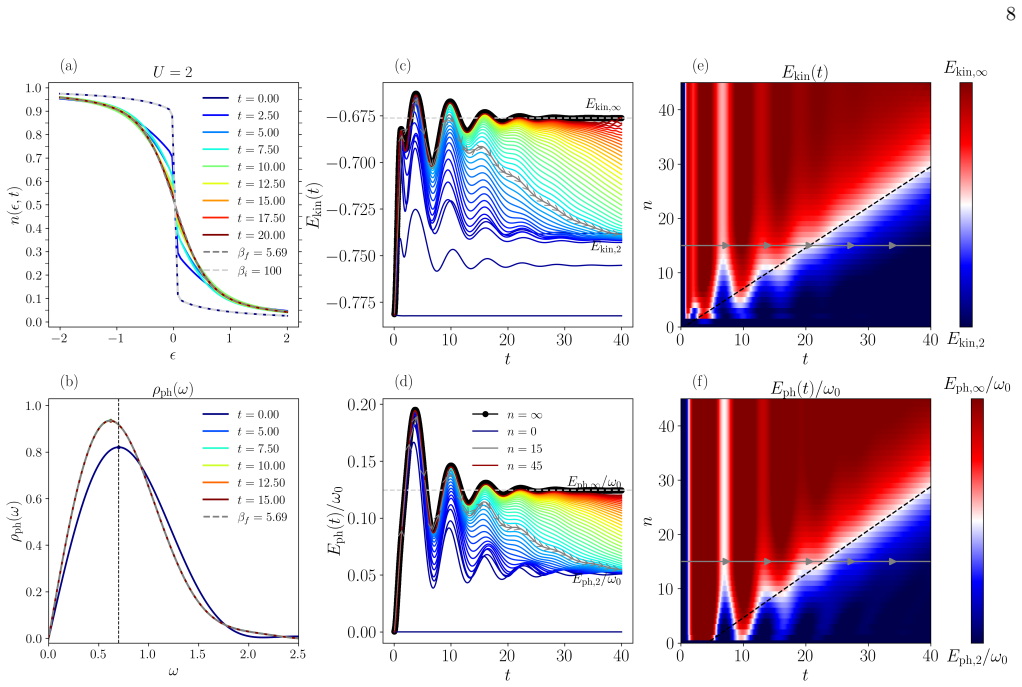
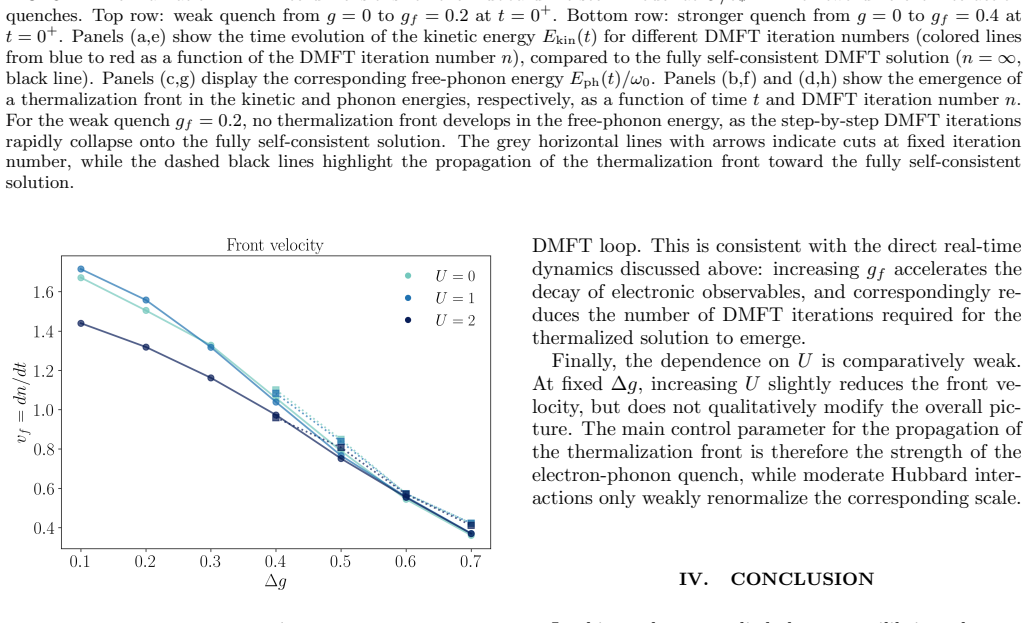
Thermalization is marked by a sharp propagating front in the plane of real time and DMFT iteration number. This front appears in electronic observables already for weak quenches within the simulated time window, whereas the phononic sector exhibits a visible front only at sufficiently strong coupling. Thus, at weak coupling the local dispersionless phonons show a delayed onset of front formation, while near and beyond the crossover the front develops on comparable timescales in both the electronic and phononic sectors. Whenever both fronts are resolved, they propagate with the same velocity, showing that thermalization spreads coherently through the coupled electron-phonon system.
What carries the argument
The Step-by-Step DMFT framework, which tracks dynamics in the real-time versus iteration-number plane to expose sharp propagating fronts that mark the microscopic onset of the thermal state.
Load-bearing premise
The self-consistent Migdal approximation together with second-order perturbation theory for the electron-electron interaction remains accurate enough to capture the microscopic buildup of the thermal state across the simulated quench strengths.
What would settle it
A calculation or experiment in which the resolved electronic and phononic thermalization fronts propagate at different velocities would falsify the claim of coherent spreading.
Figures




read the original abstract
We investigate the nonequilibrium dynamics of the weak-coupling Hubbard-Holstein model after a sudden switch-on of the electron-phonon interaction within nonequilibrium dynamical mean-field theory (DMFT). Using the self-consistent Migdal approximation for the electron-phonon coupling together with second-order perturbation theory for the electron-electron interaction, we show that the relaxation dynamics exhibits a crossover between electron-dominated and phonon-dominated regimes, extending to finite Hubbard interaction the scenario previously identified in the Holstein model. To investigate the microscopic buildup of the thermal state, we analyze the dynamics within the Step-by-Step DMFT framework. In the plane of real time and DMFT iteration number, thermalization is marked by a sharp propagating front. This front appears in electronic observables already for weak quenches within the simulated time window, whereas the phononic sector exhibits a visible front only at sufficiently strong coupling. Thus, at weak coupling the local dispersionless phonons show a delayed onset of front formation, while near and beyond the crossover the front develops on comparable timescales in both the electronic and phononic sectors. Whenever both fronts are resolved, they propagate with the same velocity, showing that thermalization spreads coherently through the coupled electron-phonon system.
Editorial analysis
A structured set of objections, weighed in public.
Referee Report
Summary. The manuscript investigates the nonequilibrium dynamics of the weak-coupling Hubbard-Holstein model after a sudden switch-on of the electron-phonon interaction within nonequilibrium dynamical mean-field theory (DMFT). Using the self-consistent Migdal approximation for the electron-phonon coupling together with second-order perturbation theory for the electron-electron interaction, the authors show that the relaxation dynamics exhibits a crossover between electron-dominated and phonon-dominated regimes, extending prior Holstein-model results. They analyze the microscopic buildup of the thermal state using the Step-by-Step DMFT framework, identifying sharp propagating fronts in the real-time versus DMFT-iteration plane. Electronic fronts appear for weak quenches, while phononic fronts require stronger coupling; when both are resolved, the fronts propagate at identical velocities, indicating coherent thermalization spread through the coupled system.
Significance. If the numerical results hold under the stated approximations, this work meaningfully extends the Holstein-model scenario to finite Hubbard U, offering a microscopic view of how thermalization propagates coherently in coupled electron-phonon systems. The Step-by-Step DMFT diagnostic, which treats DMFT iteration number as a spatial-like coordinate, provides a clear, parameter-free visualization of front formation and velocity equality. Direct observation of matched velocities in electronic and phononic sectors strengthens the central claim of coherent spread.
minor comments (2)
- The abstract refers to 'the simulated time window' and 'sufficiently strong coupling' without quoting specific numerical ranges for U, electron-phonon coupling strength, or quench amplitudes; adding these values would allow readers to assess the extent of the reported crossover and the regimes where both fronts are resolved.
- The Step-by-Step DMFT framework is introduced without a brief definition or citation on first use; a short explanatory sentence or reference would improve accessibility for readers outside the immediate subfield.
Simulated Author's Rebuttal
We thank the referee for the positive assessment of our manuscript and the recommendation for minor revision. The provided summary accurately captures our investigation of nonequilibrium dynamics in the Hubbard-Holstein model, the crossover between electron- and phonon-dominated regimes, and the identification of propagating thermalization fronts via the Step-by-Step DMFT framework.
Circularity Check
No significant circularity
full rationale
The paper's central results follow from direct numerical solution of the nonequilibrium DMFT equations under the self-consistent Migdal approximation for electron-phonon coupling and second-order perturbation theory for electron-electron interactions, within the Step-by-Step DMFT framework. The propagating thermalization fronts and their equal velocities (when both are resolved) are reported as observations from the simulated dynamics in the real-time vs. DMFT-iteration plane, extending prior Holstein-model behavior to finite Hubbard U without any self-referential definitions, fitted parameters renamed as predictions, or load-bearing self-citations that reduce the claim to its inputs. The derivation chain remains self-contained against the stated approximations and numerical outputs.
Axiom & Free-Parameter Ledger
axioms (2)
- domain assumption The self-consistent Migdal approximation accurately describes the electron-phonon interaction in the weak-coupling regime.
- domain assumption Second-order perturbation theory is sufficient for the electron-electron interaction.
Reference graph
Works this paper leans on
-
[1]
conserving approximation
Electronic problem: Second-order perturbation theory In this work, we focus on the weakly correlated electronic regime. We employ the self-consistent 4 second-order perturbation theory (SPT) as an impurity solver [55] which, being a conserving approximation, is particularly suited to studying thermalization in isolated quantum systems and the energy trans...
-
[2]
Phonon problem: Self-consistent Migdal approximation In the Migdal approximation, one treats within a Gaussian approximation the quantum fluctuations of the phonons around the average order parameter, repre- sented by the displacement⟨X⟩of the atoms [35]. The self-consistent Migdal approximation is the lowest or- der approximation for the electronic self-...
-
[3]
Start from a guess for Σ(t, t′) and evaluate the fully- interacting impurity Green’s functionG imp,σ (that in the following will be simplyG) by solving the corresponding Dyson equation: (i∂t +µ)G(t, t ′) −[∆(t, t ′) + Σ(t, t′)]∗G(t, t ′) =δ C(t, t′) (17) in the Keldysh formulation (following the notation for two-time Green’s functions in Ref. [5]). We are...
-
[4]
(9) to fix the hybridiza- tion function of the impurity model: ∆(t, t′) =v 2 ∗G(t, t′) (18)
Use the self-consistency Eq. (9) to fix the hybridiza- tion function of the impurity model: ∆(t, t′) =v 2 ∗G(t, t′) (18)
-
[5]
We implement the self-consistent Migdal approxima- tion for the electron-phonon interaction: (a) Calculate the phonon self-energy Π (polariza- tion operator) with Eq
Solve the impurity model to get Σ el-ph[G, D]. We implement the self-consistent Migdal approxima- tion for the electron-phonon interaction: (a) Calculate the phonon self-energy Π (polariza- tion operator) with Eq. (13) in order to in- clude the back-action of the electrons on the phonons: Π(t, t′) =−i2g(t)g(t ′)G(t, t′)G(t′, t) (19) (b) Solve the Dyson eq...
-
[6]
With SPT as an impu- rity solver, we apply Eq
Solve the impurity model for the electron-electron interaction to get Σ e-e[G]. With SPT as an impu- rity solver, we apply Eq. (15): Σe-e(t, t′) =U(t)U(t ′)G(t, t ′)G(t ′, t)G(t, t ′) (22)
-
[7]
until convergence
Set Σ(t, t ′) = Σ e-e(t, t′) + Σel-ph(t, t′) and iterate steps 1.– 5. until convergence. In the self-consistent Migdal approximation the vibra- tional mode evolves as a consequence of the interaction with the electrons. The expectation value ofXis deter- mined by the exact equation of motion that comes form ˙X= ∂H ∂P =ω 0P=ω 0 i√ 2(a† −a) ˙P=− ∂H ∂X =−ω 0...
-
[8]
Observables The total energy of the system is given by the combi- nation of different energy contributions. Kinetic energy: The kinetic energy of the electrons is calculated as: Ekin(t) =−i X σ [∆σ ∗G imp,σ]< (t, t),(25) Phonon density: The density of phonons⟨a †(t)a(t)⟩, which is proportional to the free-phonon energyE ph(t) = ω0⟨a†(t)a(t)⟩, can be expre...
2020
-
[9]
D. N. Basov, R. D. Averitt, and D. Hsieh, Towards prop- erties on demand in quantum materials, Nature Materials 16, 1077 (2017)
2017
-
[10]
Eckstein and M
M. Eckstein and M. Kollar, Nonthermal Steady States af- ter an Interaction Quench in the Falicov-Kimball Model, Phys. Rev. Lett.100, 120404 (2008)
2008
-
[11]
Eckstein, M
M. Eckstein, M. Kollar, and P. Werner, Thermalization after an interaction quench in the hubbard model, Phys. Rev. Lett.103, 056403 (2009)
2009
-
[12]
Eckstein, M
M. Eckstein, M. Kollar, and P. Werner, Interaction quench in the hubbard model: Relaxation of the spec- tral function and the optical conductivity, Phys. Rev. B 81, 115131 (2010)
2010
-
[13]
H. Aoki, N. Tsuji, M. Eckstein, M. Kollar, T. Oka, and P. Werner, Nonequilibrium dynamical mean-field theory and its applications, Rev. Mod. Phys.86, 779 (2014)
2014
-
[14]
Picano and M
A. Picano and M. Eckstein, Accelerated gap collapse in a slater antiferromagnet, Phys. Rev. B103, 165118 (2021)
2021
-
[15]
Giannetti, M
C. Giannetti, M. Capone, D. Fausti, M. Fabrizio, F. Parmigiani, and D. Mihailovic, Ultrafast optical spectroscopy of strongly correlated materials and high- temperature superconductors: a non-equilibrium ap- proach, Advances in Physics65, 58 (2016)
2016
-
[16]
de la Torre, D
A. de la Torre, D. M. Kennes, M. Claassen, S. Gerber, 11 J. W. McIver, and M. A. Sentef, Colloquium: Nonther- mal pathways to ultrafast control in quantum materials, Rev. Mod. Phys.93, 041002 (2021)
2021
-
[17]
Ogasawara, M
T. Ogasawara, M. Ashida, N. Motoyama, H. Eisaki, S. Uchida, Y. Tokura, H. Ghosh, A. Shukla, S. Mazum- dar, and M. Kuwata-Gonokami, Ultrafast optical non- linearity in the quasi-one-dimensional mott insulator sr2cuo3, Phys. Rev. Lett.85, 2204 (2000)
2000
-
[18]
Perfetti, P
L. Perfetti, P. A. Loukakos, M. Lisowski, U. Bovensiepen, H. Berger, S. Biermann, P. S. Cornaglia, A. Georges, and M. Wolf, Time evolution of the electronic structure of 1t−tas 2 through the insulator-metal transition, Phys. Rev. Lett.97, 067402 (2006)
2006
-
[19]
Stojchevska, I
L. Stojchevska, I. Vaskivskyi, T. Mertelj, P. Kusar, D. Svetin, S. Brazovskii, and D. Mihailovic, Ultrafast Switching to a Stable Hidden Quantum State in an Elec- tronic Crystal, Science344, 177 (2014)
2014
-
[20]
Grandi, A
F. Grandi, A. Picano, R. Thomale, D. M. Kennes, and M. Eckstein, Nonthermal order by disorder, Newton1, 100169 (2025)
2025
-
[21]
Huber, S
T. Huber, S. O. Mariager, A. Ferrer, H. Sch¨ afer, J. A. Johnson, S. Gr¨ ubel, A. L¨ ubcke, L. Huber, T. Kubacka, C. Dornes, C. Laulhe, S. Ravy, G. Ingold, P. Beaud, J. Demsar, and S. L. Johnson, Coherent Structural Dy- namics of a Prototypical Charge-Density-Wave-to-Metal Transition, Phys. Rev. Lett.113, 026401 (2014)
2014
-
[22]
Maklar, Y
J. Maklar, Y. W. Windsor, C. W. Nicholson, M. Pup- pin, P. Walmsley, V. Esposito, M. Porer, J. Rittmann, D. Leuenberger, M. Kubli, M. Savoini, E. Abreu, S. L. Johnson, P. Beaud, G. Ingold, U. Staub, I. R. Fisher, R. Ernstorfer, M. Wolf, and L. Rettig, Nonequilibrium charge-density-wave order beyond the thermal limit, Na- ture Communications12, 2499 (2021)
2021
-
[23]
Vidmar, J
L. Vidmar, J. Bonˇ ca, M. Mierzejewski, P. Prelovˇ sek, and S. A. Trugman, Nonequilibrium dynamics of the holstein polaron driven by an external electric field, Phys. Rev. B 83, 134301 (2011)
2011
-
[24]
Goleˇ z, J
D. Goleˇ z, J. Bonˇ ca, L. Vidmar, and S. A. Trugman, Re- laxation dynamics of the holstein polaron, Phys. Rev. Lett.109, 236402 (2012)
2012
-
[25]
Goleˇ z, J
D. Goleˇ z, J. Bonˇ ca, and L. Vidmar, Dissociation of a hubbard-holstein bipolaron driven away from equilibrium by a constant electric field, Phys. Rev. B85, 144304 (2012)
2012
-
[26]
Jeckelmann, C
E. Jeckelmann, C. Zhang, and S. R. White, Metal- insulator transition in the one-dimensional Holstein model at half filling, Phys. Rev. B60, 7950 (1999)
1999
-
[27]
Ejima and H
S. Ejima and H. Fehske, Luttinger parameters and mo- mentum distribution function for the half-filled spinless fermion holstein model: A dmrg approach, Europhysics Letters87, 27001 (2009)
2009
-
[28]
Jansen, J
D. Jansen, J. Bonˇ ca, and F. Heidrich-Meisner, Finite- temperature density-matrix renormalization group method for electron-phonon systems: Thermodynamics and holstein-polaron spectral functions, Phys. Rev. B 102, 165155 (2020)
2020
-
[29]
De Filippis, V
G. De Filippis, V. Cataudella, E. A. Nowadnick, T. P. Devereaux, A. S. Mishchenko, and N. Nagaosa, Quan- tum dynamics of the hubbard-holstein model in equi- librium and nonequilibrium: Application to pump-probe phenomena, Phys. Rev. Lett.109, 176402 (2012)
2012
-
[30]
Dorfner, L
F. Dorfner, L. Vidmar, C. Brockt, E. Jeckelmann, and F. Heidrich-Meisner, Real-time decay of a highly excited charge carrier in the one-dimensional holstein model, Phys. Rev. B91, 104302 (2015)
2015
-
[31]
Bonˇ ca, S
J. Bonˇ ca, S. A. Trugman, and I. Batisti´ c, Holstein po- laron, Phys. Rev. B60, 1633 (1999)
1999
-
[32]
J. Sous, B. Kloss, D. M. Kennes, D. R. Reichman, and A. J. Millis, Phonon-induced disorder in dynamics of op- tically pumped metals from nonlinear electron-phonon coupling, Nature Communications12, 5803 (2021)
2021
-
[33]
Jansen, C
D. Jansen, C. Jooss, and F. Heidrich-Meisner, Charge density wave breakdown in a heterostructure with electron-phonon coupling, Phys. Rev. B104, 195116 (2021)
2021
-
[34]
Yonemitsu and N
K. Yonemitsu and N. Maeshima, Coupling-dependent rate of energy transfer from photoexcited mott insulators to lattice vibrations, Phys. Rev. B79, 125118 (2009)
2009
-
[35]
H. Matsueda, S. Sota, T. Tohyama, and S. Maekawa, Relaxation dynamics of photocarriers in one-dimensional mott insulators coupled to phonons, Journal of the Physical Society of Japan81, 013701 (2012), https://doi.org/10.1143/JPSJ.81.013701
-
[36]
Sentef, A
M. Sentef, A. F. Kemper, B. Moritz, J. K. Freericks, Z.- X. Shen, and T. P. Devereaux, Examining electron-boson coupling using time-resolved spectroscopy, Phys. Rev. X 3, 041033 (2013)
2013
-
[37]
A. F. Kemper, M. Sentef, B. Moritz, C. C. Kao, Z. X. Shen, J. K. Freericks, and T. P. Devereaux, Mapping of unoccupied states and relevant bosonic modes via the time-dependent momentum distribution, Phys. Rev. B 87, 235139 (2013)
2013
-
[38]
A. F. Kemper, M. A. Sentef, B. Moritz, J. K. Freericks, and T. P. Devereaux, Effect of dynamical spectral weight redistribution on effective interactions in time-resolved spectroscopy, Phys. Rev. B90, 075126 (2014)
2014
-
[39]
Georges, G
A. Georges, G. Kotliar, W. Krauth, and M. J. Rozen- berg, Dynamical mean-field theory of strongly correlated fermion systems and the limit of infinite dimensions, Rev. Mod. Phys.68, 13 (1996)
1996
-
[40]
F. F. Assaad and T. C. Lang, Diagrammatic determinan- tal quantum Monte Carlo methods: Projective schemes and applications to the Hubbard-Holstein model, Phys. Rev. B76, 035116 (2007)
2007
-
[41]
Werner and A
P. Werner and A. J. Millis, Efficient Dynamical Mean Field Simulation of the Holstein-Hubbard Model, Phys. Rev. Lett.99, 146404 (2007)
2007
-
[42]
Murakami, P
Y. Murakami, P. Werner, N. Tsuji, and H. Aoki, In- teraction quench in the Holstein model: Thermalization crossover from electron- to phonon-dominated relaxation, Phys. Rev. B91, 045128 (2015)
2015
-
[43]
Randi, M
F. Randi, M. Esposito, F. Giusti, O. Misochko, F. Parmi- giani, D. Fausti, and M. Eckstein, Probing the Fluc- tuations of Optical Properties in Time-Resolved Spec- troscopy, Phys. Rev. Lett.119, 187403 (2017)
2017
-
[44]
Eckstein and P
M. Eckstein and P. Werner, Nonequilibrium dynamical mean-field calculations based on the noncrossing approx- imation and its generalizations, Phys. Rev. B82, 115115 (2010)
2010
-
[45]
Werner and M
P. Werner and M. Eckstein, Phonon-enhanced relaxation and excitation in the Holstein-Hubbard model, Phys. Rev. B88, 165108 (2013)
2013
-
[46]
Werner and M
P. Werner and M. Eckstein, Field-induced polaron for- mation in the holstein-hubbard model, EPL (Europhysics Letters)109, 37002 (2015)
2015
-
[47]
V. V. Kabanov and A. S. Alexandrov, Electron relaxation in metals: Theory and exact analytical solutions, Phys. Rev. B78, 174514 (2008). 12
2008
-
[48]
R. H. M. Groeneveld, R. Sprik, and A. Lagendijk, Fem- tosecond spectroscopy of electron-electron and electron- phonon energy relaxation in ag and au, Phys. Rev. B51, 11433 (1995)
1995
-
[49]
Picano, J
A. Picano, J. Li, and M. Eckstein, Quantum Boltzmann equation for strongly correlated electrons, Phys. Rev. B 104, 085108 (2021)
2021
-
[50]
Polkovnikov, K
A. Polkovnikov, K. Sengupta, A. Silva, and M. Vengalat- tore, Colloquium: Nonequilibrium dynamics of closed in- teracting quantum systems, Rev. Mod. Phys.83, 863 (2011)
2011
-
[51]
Gogolin and J
C. Gogolin and J. Eisert, Equilibration, thermalisation, and the emergence of statistical mechanics in closed quantum systems, Reports on Progress in Physics79, 056001 (2016)
2016
-
[52]
L. D’Alessio, Y. Kafri, A. Polkovnikov, and M. Rigol, From quantum chaos and eigenstate thermalization to statistical mechanics and ther- modynamics, Advances in Physics65, 239 (2016), https://doi.org/10.1080/00018732.2016.1198134
-
[53]
Picano, G
A. Picano, G. Biroli, and M. Schir` o, Quantum thermal- ization via travelling waves, Phys. Rev. Lett.134, 116503 (2025)
2025
-
[54]
Backes, Y
S. Backes, Y. Murakami, S. Sakai, and R. Arita, Dynam- ical mean-field theory for the hubbard-holstein model on a quantum device, Phys. Rev. B107, 165155 (2023)
2023
-
[55]
J. K. Freericks, Conserving approximations for the at- tractive holstein and hubbard models, Phys. Rev. B50, 403 (1994)
1994
-
[56]
Bauer, J
J. Bauer, J. E. Han, and O. Gunnarsson, Quantitative re- liability study of the migdal-eliashberg theory for strong electron-phonon coupling in superconductors, Phys. Rev. B84, 184531 (2011)
2011
-
[57]
Meyer, A
D. Meyer, A. C. Hewson, and R. Bulla, Gap formation and soft phonon mode in the holstein model, Phys. Rev. Lett.89, 196401 (2002)
2002
-
[58]
Capone and S
M. Capone and S. Ciuchi, Polaron crossover and bipola- ronic metal-insulator transition in the half-filled holstein model, Phys. Rev. Lett.91, 186405 (2003)
2003
-
[59]
Koller, D
W. Koller, D. Meyer, and A. C. Hewson, Dynamic re- sponse functions for the holstein-hubbard model, Phys. Rev. B70, 155103 (2004)
2004
-
[61]
Nandkishore and D
R. Nandkishore and D. A. Huse, Many-Body Localiza- tion and Thermalization in Quantum Statistical Mechan- ics, Annual Review of Condensed Matter Physics6, 15 (2015)
2015
-
[62]
L. P. Kadanoff and G. Baym,Quantum Statistical Me- chanics: Green’s Function Methods in Equilibrium and Nonequilibrium Problems, Frontiers in Physics: A Lec- ture Note and Reprint Series, Vol. 8 (W. A. Benjamin, New York, 1962) p. 203
1962
-
[63]
Tsuji and P
N. Tsuji and P. Werner, Nonequilibrium dynamical mean-field theory based on weak-coupling perturbation expansions: Application to dynamical symmetry break- ing in the hubbard model, Phys. Rev. B88, 165115 (2013)
2013
-
[64]
Baym and L
G. Baym and L. P. Kadanoff, Conservation laws and cor- relation functions, Phys. Rev.124, 287 (1961)
1961
-
[65]
Koller, D
W. Koller, D. Meyer, Y. ¯Ono, and A. C. Hewson, First- and second-order phase transitions in the holstein- hubbard model, Europhysics Letters (EPL)66, 559 (2004)
2004
-
[66]
Baym, Self-consistent approximations in many-body systems, Phys
G. Baym, Self-consistent approximations in many-body systems, Phys. Rev.127, 1391 (1962)
1962
- [67]
-
[68]
Biroli and G
G. Biroli and G. Kotliar, Cluster methods for strongly correlated electron systems, Phys. Rev. B65, 155112 (2002)
2002
-
[69]
K. Aryanpour, M. H. Hettler, and M. Jarrell, Dynami- cal cluster approximation employing the fluctuation ex- change approximation as a cluster solver, Physical Re- view B67, 10.1103/physrevb.67.085101 (2003)
-
[70]
E. Miranda and V. Dobrosavljevic, Dynamical mean- field theories of correlation and disorder (2011), arXiv:1112.6184 [cond-mat.str-el]
-
[71]
Picano, F
A. Picano, F. Grandi, and M. Eckstein, Inhomogeneous disordering at a photo-induced charge density wave tran- sition (2021)
2021
-
[72]
Picano, F
A. Picano, F. Grandi, P. Werner, and M. Eck- stein, Stochastic semiclassical theory for nonequilibrium electron-phonon coupled systems, Phys. Rev. B108, 035115 (2023)
2023
-
[73]
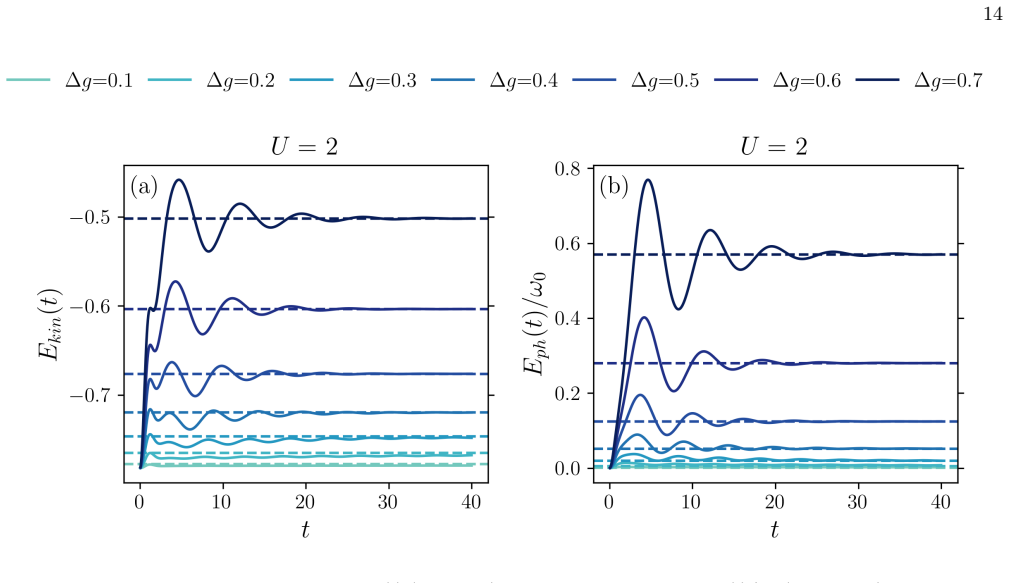
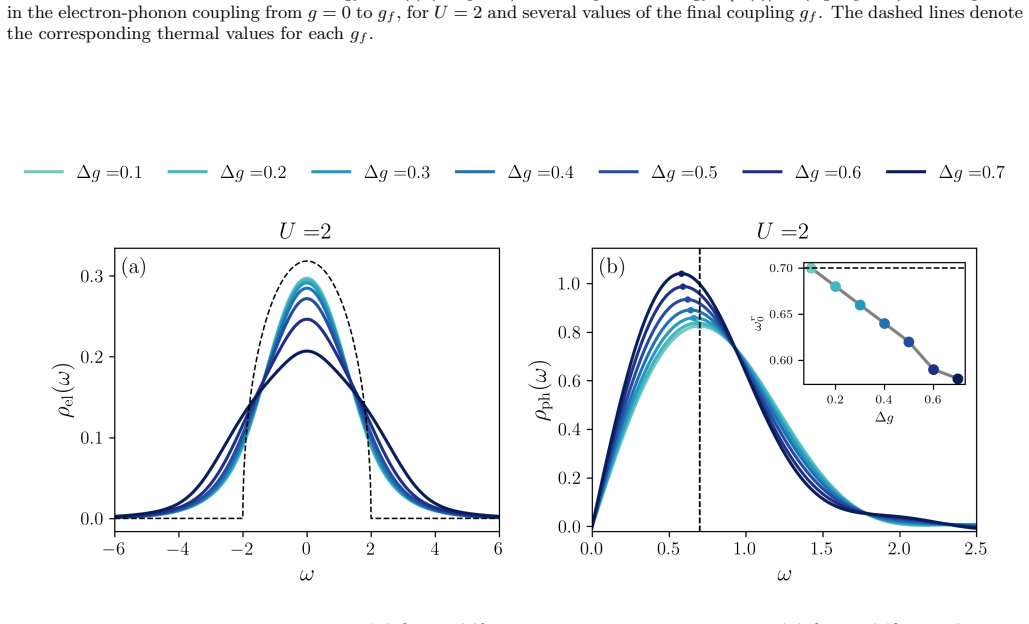
F. Valiera, A. Picano, and M. Eckstein, Stochastic reso- nance in disordered charge-density-wave systems (2025), arXiv:2507.22652 [cond-mat.str-el]. 13 Appendix A: Local relaxation dynamics and equilibrium spectra after the quench In Fig. 5, we show the time evolution of the kinetic energy and the phonon density⟨a †a⟩forU/v ∗ = 2. In analogy with theU= 0 ...
-
[74]
Step-by-Step DMFT atU= 0 For completeness, we briefly discuss the corresponding Step-by-Step DMFT results in the Holstein limitU/v ∗ = 0, shown in Figs. 7 and 8. We keep the same parameters as in the main text, namely half filling,ω 0 = 0.7, and initial inverse temperatureβ i = 100. Figure 7 shows the representative caseg f = 0.5. Pan- els (a) and (b) con...
discussion (0)
Sign in with ORCID, Apple, or X to comment. Anyone can read and Pith papers without signing in.