Recognition: unknown
Power law scalar potential in the Saez-Ballester like theory: Exact solutions in the Bianchi type I case
Pith reviewed 2026-05-10 16:18 UTC · model grok-4.3
The pith
Power-law scalar potentials in a generalized Saez-Ballester theory produce the same universe volume function as exponential potentials in chiral multifield cosmology.
A machine-rendered reading of the paper's core claim, the machinery that carries it, and where it could break.
Core claim
Within the generalized Saez-Ballester-like theory with mixed coupling, the power-law scalar potential V(ψ1,ψ2)=V1ψ1^{±λ1}+V2ψ2^{±λ2} admits exact solutions via a change of variables for the negative-sign case under the required parameter constraint. These solutions show that the universe volume function coincides with the volume function generated by exponential potentials in standard chiral multifield cosmology, while the scalar fields continue to evolve dynamically throughout cosmic history.
What carries the argument
The mixed kinetic coupling term in the action, which imposes an essential parameter constraint for negative-sign power-law potentials and enables the change of variables that produces the volume-function equivalence.
If this is right
- Exact solutions exist for quintessence, quintom, and phantom scenarios in the context of primordial inflation.
- The scalar fields remain dynamically active throughout the entire cosmic evolution instead of becoming constant.
- The Bianchi type I anisotropic model is fully solvable under these power-law potentials once the constraint is satisfied.
- The volume expansion history is identical to the one obtained from exponential potentials in the corresponding chiral multifield setup.
Where Pith is reading between the lines
- The equivalence suggests that background expansion alone cannot distinguish power-law from exponential potentials in this class of models.
- Perturbation spectra or higher-order observables would be needed to test whether the two potential families produce observationally different signatures.
- The parameter constraint required for consistency may restrict the viable range of mixed couplings when matching to late-time dark-energy data.
Load-bearing premise
The mixed coupling term must obey a specific constraint on its associated parameter so that the negative-sign power-law potentials remain consistent with the quintessence, quintom, and phantom regimes.
What would settle it
Integrate the field equations numerically for the negative-sign potentials without imposing the mixed-term parameter constraint and check whether the volume function still matches the exponential case or whether no consistent solutions exist.
Figures





read the original abstract
An anisotropic Bianchi type I cosmological model with power-law scalar-field potentials of the form $V(\psi_1,\psi_2)=V_1\psi_1^{\pm\lambda_1}+V_2\psi_2^{\pm\lambda_2}$ is studied within a generalized S\'aez--Ballester--K-essence-like theory involving standard kinetic terms and a mixed coupling contribution. In order to solve the corresponding field equations, for negative sign case, the mixed term introduces an essential constraint on the associated parameter, which yields relevant contributions to quintessence, quintom, and phantom scenarios in the context of primordial inflation. Exact solutions for these regimes are obtained through an appropriate change of variables. It is shown that the volume function of the universe derived from the present power-law scalar potential coincides with that obtained from exponential scalar potentials in standard chiral multifield cosmology, while the scalar fields remain dynamically present throughout the cosmic evolution.
Editorial analysis
A structured set of objections, weighed in public.
Referee Report
Summary. The paper studies Bianchi type I anisotropic cosmologies in a generalized Saez-Ballester theory with mixed kinetic terms and power-law scalar potentials V(ψ1,ψ2)=V1ψ1^{±λ1}+V2ψ2^{±λ2}. For the negative-exponent case an essential constraint is imposed on the mixed-coupling parameter to close the system, permitting a change of variables that yields exact solutions for quintessence, quintom and phantom regimes; the central claim is that the resulting volume function coincides with the one obtained from exponential potentials in standard chiral multifield cosmology while the scalar fields remain dynamically present.
Significance. If the volume-function identity holds under the stated conditions, the work supplies analytic links between power-law and exponential potentials in multifield anisotropic models, furnishing explicit solutions across several dark-energy regimes. The persistence of scalar-field dynamics throughout evolution is a useful feature for inflation studies.
major comments (2)
- [Negative-sign case and change-of-variables section] In the negative-sign derivation, the mixed term is said to force an 'essential constraint' on the coupling parameter to recover the desired regimes and enable the change of variables. No dynamical or stability argument is supplied showing that this constraint is selected by the equations or initial conditions rather than chosen to permit exact integration; relaxing it prevents reduction to the same first-order system, so the claimed volume-function coincidence with the exponential-potential case in chiral multifield cosmology is not a general property of power-law potentials but holds only on this restricted slice.
- [Exact solutions and verification] The abstract asserts that exact solutions are obtained and that all field equations are satisfied, yet the manuscript does not display the explicit substitution back into the original Einstein and scalar-field equations after the change of variables. Without this verification the support for the volume-function claim remains incomplete.
minor comments (1)
- [Introduction] The relation between the present mixed-coupling term and the original Saez-Ballester action should be stated more explicitly in the introduction to clarify the generalization.
Simulated Author's Rebuttal
We thank the referee for the detailed and constructive report. The comments highlight important points regarding the scope of our results and the need for explicit verification. We address each major comment below and have revised the manuscript to improve clarity and completeness.
read point-by-point responses
-
Referee: [Negative-sign case and change-of-variables section] In the negative-sign derivation, the mixed term is said to force an 'essential constraint' on the coupling parameter to recover the desired regimes and enable the change of variables. No dynamical or stability argument is supplied showing that this constraint is selected by the equations or initial conditions rather than chosen to permit exact integration; relaxing it prevents reduction to the same first-order system, so the claimed volume-function coincidence with the exponential-potential case in chiral multifield cosmology is not a general property of power-law potentials but holds only on this restricted slice.
Authors: We agree that the constraint on the mixed-coupling parameter is imposed specifically to close the system and permit the change of variables that yields exact solutions. The manuscript focuses on this analytically tractable case, which allows us to obtain explicit solutions for quintessence, quintom, and phantom regimes while demonstrating the volume-function coincidence with the exponential-potential chiral multifield case. We do not claim the result holds for arbitrary coupling values; the restriction is necessary for the exact integration. In the revised version we have added explicit language clarifying that the volume coincidence and the persistence of dynamical scalar fields are properties of this constrained slice of parameter space, and we note that relaxing the constraint precludes reduction to the integrable first-order system. revision: yes
-
Referee: [Exact solutions and verification] The abstract asserts that exact solutions are obtained and that all field equations are satisfied, yet the manuscript does not display the explicit substitution back into the original Einstein and scalar-field equations after the change of variables. Without this verification the support for the volume-function claim remains incomplete.
Authors: We accept this criticism. The revised manuscript now includes the explicit substitution of the derived solutions back into the original Einstein and scalar-field equations, confirming that all equations are satisfied identically under the imposed constraint. This verification directly supports the volume-function identity and the continued dynamical presence of the scalar fields. revision: yes
Circularity Check
Volume-function coincidence holds only after an integrability constraint is imposed on the mixed-term parameter
specific steps
-
fitted input called prediction
[Abstract]
"for negative sign case, the mixed term introduces an essential constraint on the associated parameter, which yields relevant contributions to quintessence, quintom, and phantom scenarios in the context of primordial inflation. Exact solutions for these regimes are obtained through an appropriate change of variables. It is shown that the volume function of the universe derived from the present power-law scalar potential coincides with that obtained from exponential scalar potentials in standard chiral multifield cosmology"
The constraint is introduced specifically to permit exact integration and to force the volume function to match the known exponential case; the identity is therefore obtained by construction once the parameter slice is chosen, rather than derived independently from the power-law form.
full rationale
The paper states that for the negative-sign power-law potential the mixed kinetic term 'introduces an essential constraint' that is required to close the system and obtain exact solutions matching quintessence/quintom/phantom regimes. The claimed equality of the volume function to the exponential-potential case in chiral multifield cosmology is obtained only after this constraint plus a change of variables. No independent dynamical argument is supplied showing the constraint arises from initial conditions or stability; relaxing it prevents reduction to the same first-order system. This makes the central coincidence an artifact of the selected parameter slice rather than a general property of the power-law potential.
Axiom & Free-Parameter Ledger
free parameters (2)
- exponents λ1 and λ2
- mixed-coupling parameter
axioms (2)
- domain assumption Field equations of the generalized Saez-Ballester-K-essence-like theory hold
- domain assumption Bianchi type I line element is an appropriate description of the early universe
Reference graph
Works this paper leans on
-
[1]
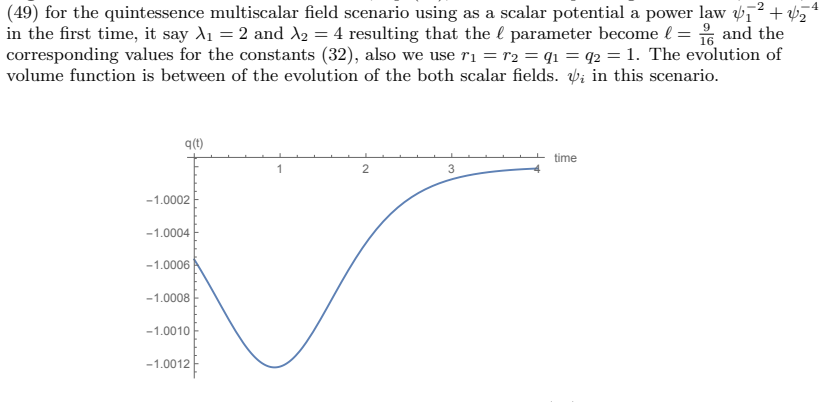
1 2 3 4 time -1.00 -0.95 -0.90 -0.85 -0.80 -0.75 -0.70 q(t) Figure 4:Deceleration parameter using the volume function, eq
We take small value in the anisotropic componentn= 0.1, also we user 1 =r 2 = 2,q 1 =q 2 = 1, to eliminate the imaginary character of the constantp 3. 1 2 3 4 time -1.00 -0.95 -0.90 -0.85 -0.80 -0.75 -0.70 q(t) Figure 4:Deceleration parameter using the volume function, eq. (66), and all the values that were taken in the graphing of the volume function. IV...
-
[2]
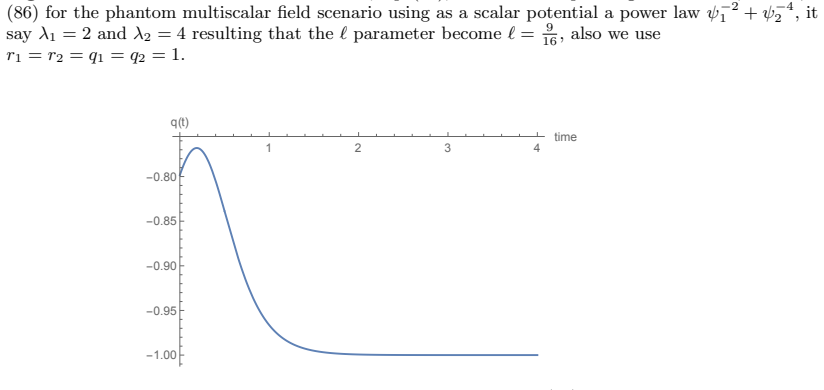
1.5 2.0 2.5 3.0 3.5 4.0 time -1.00 -0.98 -0.96 -0.94 -0.92 q(t) Figure 8:Deceleration parameter using the volume function, eq
Heren= 1, also we user 1 =r 1 =q 1 =q 2 = 1, and we take negativep 3 value. 1.5 2.0 2.5 3.0 3.5 4.0 time -1.00 -0.98 -0.96 -0.94 -0.92 q(t) Figure 8:Deceleration parameter using the volume function, eq. (89), and all the values that were taken in the graphing of the volume function. 17 V. QUINTOM MUL TISCALAR FIELDS,m 11 = +1, m22 =−1 For this scenario of...
-
[3]
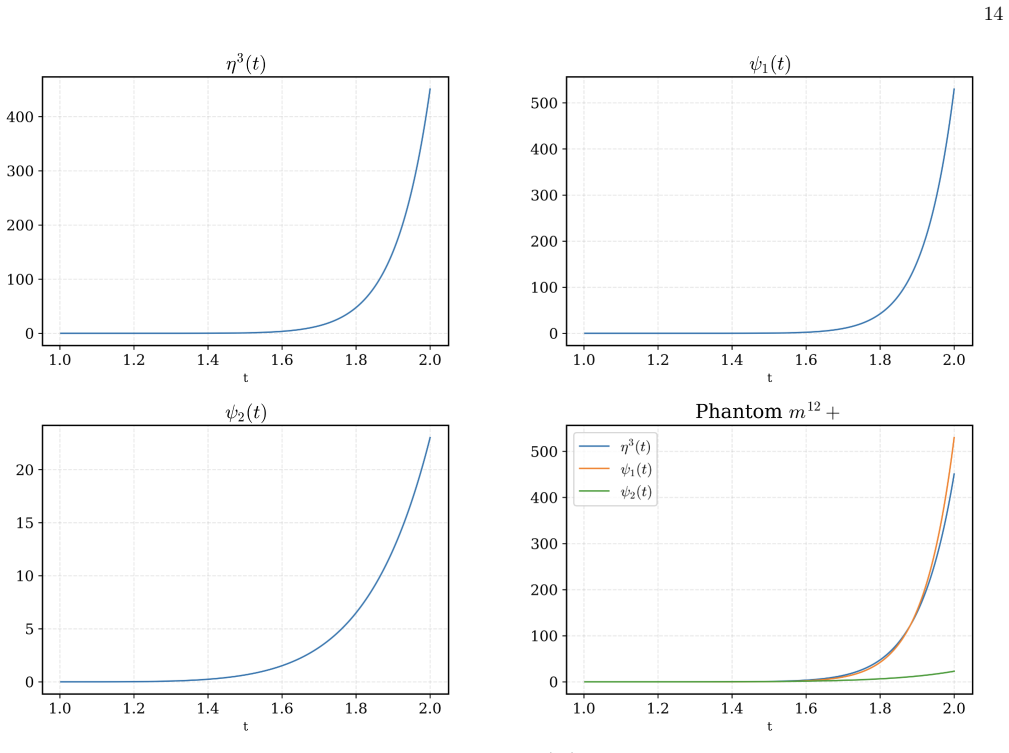
We take small value in the anisotropic componentn= 0.1, also we user 1 =r 2 = 2,q 1 =q 2 = 1, to eliminate the imaginary character of the constantp 3. Finally, the deceleration parameter q(t), (30), for this case, using the volume functionV(t) =η 3 (129), can be see in the figure 12, where this tend to -1, characteristic of accelerated growth. 1 2 3 4 tim...
-
[4]
Jean-Philippe Uzan, Phys. Rev. D59, 123510 (1999),Cosmological scaling solutions of nonminimally coupled scalar fields
1999
-
[5]
Lobo, M.K
Tiberiu Harko, Francisco S.N. Lobo, M.K. Mak, Eur. Phys. J. C74, 2784 (2014),Arbitrary scalar-field and quintessence cosmological models
2014
-
[6]
Murli Manohar Verma and Shankar Dayal Pathak, Astrophysics Space Sci.350, 381 (2014),Cosmic expansion driven by real scalar field for different forms of potential
2014
-
[7]
Leon and Emmanuel N Saridakis, Classical and Quantum Grav31, 075018 (2014),Dynamical analysis of anisotropic scalar-field cosmologies for a wide range of potentials
C.R Fadragas, G. Leon and Emmanuel N Saridakis, Classical and Quantum Grav31, 075018 (2014),Dynamical analysis of anisotropic scalar-field cosmologies for a wide range of potentials
2014
-
[8]
Paliathanasis, Class
A. Paliathanasis, Class. Quant. Grav.37, 19 (2020),Dynamics of a chiral cosmology
2020
- [9]
-
[10]
Genly Leon, Alan Coley, Andronikos Paliathanasis, Jonathan Tot and Balkar Yildirim, Physics of the Dark Universe45, 101503 (2024),Global dynamics of two models for Quintom Friedman-Lemaitre-Robertson-Walker universes
2024
-
[11]
Abraham Espinoza Garc´ ıa, J. Socorro and Luis O. Pimentel, Int. J. of Theor. Phys.53(9), 3066-3077 (2014),Quantum Bianchi type IX cosmology in K-essence theory.DOI: 10.1007/s10773-014-2102-0
-
[12]
Roland de Putter and Eric V. Linder,Astropart. Phys.28, 263 (2007).Kinetic k-essence and Quintessence. [arXiv:0705.0400]
- [13]
-
[14]
N. Bose and A.S. Majumdar,Phys. Rev. D79, 103517 (2009).A k-essence model of inflation, dark matter and dark energy, [arXiv:0812.4131]
-
[15]
F. Arroja and M. Sasaki,Phys. Rev. D81, 107301 (2010).A note on the equivalence of a barotropic perfect fluid with a k-essence scalar field, [arXiv:1002.1376]
-
[16]
L.A. Garc´ ıa, J.M. Tejeiro and L. Casta˜ neda,K-essence scalar field as dynamical dark energy, [arXiv:1210.5259]
-
[17]
Socorro, Luis O
J. Socorro, Luis O. Pimentel and Abraham Espinoza Garc´ ıa, Advances in High Energy Phys. 805164 (2014),Classical Bianchi type I cosmology in K-essence theory
2014
-
[18]
Socorro and J
J. Socorro and J. Juan Rosales, Universe9, 185 (2023),Quantum fractionary cosmology: K-essence theory
2023
-
[19]
Socorro, J
J. Socorro, J. Juan Rosales and L. Toledo-Sesma, Fractal Fract.7, 814 (2023),Anisotropic fractional cosmology: K-essence theory
2023
-
[20]
Socorro, J
J. Socorro, J. Juan Rosales and Leonel Toledo-Sesma, Universe10, 192 (2024),Non commutative classical and Quantum fractionary Cosmology: FRW case
2024
-
[21]
Socorro, J
J. Socorro, J. Juan Rosales and Leonel Toledo-Sesma, General Relativity and Gravitation57, 23 (2025),Noncommutative classical and Quantum fractionary Cosmology: Anisotropic Bianchi Type I case
2025
-
[22]
Saez and V.J
D. Saez and V.J. Ballester, Phys. Lett. A113, 467 (1986)
1986
- [23]
-
[24]
J. Socorro, M. Sabido, M.A. S´ anchez G. and M.G. Fr´ ıas Palos, Rev. Mex. F´ ıs.56(2), 166-171 (2010),Anisotropic cosmology in S´ aez-Ballester theory: classical and quantum solutions, [arxiv:1007.3306]
-
[25]
Abbyazov and S.V
R.R. Abbyazov and S.V. Chervon, Grav. Cosmol.18, 262 (2012)
2012
-
[26]
Chervon, Quantum matter2, 71 (2013)
S.V. Chervon, Quantum matter2, 71 (2013)
2013
-
[27]
Dimakis and A
N. Dimakis and A. Paliathanasis, Class. Quant. Grav.38, (2021),Crossing the phantom divide line as a effect of quantum transistions
2021
-
[28]
Chimento, Phys
Luis P. Chimento, Phys. Rev. D69, 123517 (2004), Extended tachyon field, Chaplygin gas, and solvable k-essence cos- mologies
2004
-
[29]
J. Socorro, S. P´ erez-Pay´ an, Rafael Hern´ andez-Jim´ enez, Abraham Espinoza-Garc´ ıa and Luis Rey D´ ıaz-Barr´ on, Class. Quan- tum Grav.38, 135027 (2021),Classical and quantum exact solutions for a FRW in chiral like cosmology.[arXiv:2012.11108, (gr-qc)]
-
[30]
P´ erez-Pay´ an, Abraham Espinoza-Garc´ ıa and J
Luis Rey D´ ıaz-Barr´ on, S. P´ erez-Pay´ an, Abraham Espinoza-Garc´ ıa and J. Socorro, Int. J. Mod. Phys. D30(11), 2150080 (2021),Anisotropic chiral cosmology: exact solutions
2021
-
[31]
Paliathanasis, Universe8, 199 (2022),Hyperbolic inflation in the Jordan frame
A. Paliathanasis, Universe8, 199 (2022),Hyperbolic inflation in the Jordan frame
2022
-
[32]
Tripathy, Astrophys
S.K. Tripathy, Astrophys. Sp. Sci.340, (2012) 211
2012
-
[33]
J. Socorro, Juan Luis P´ erez, Luis Rey D´ ıaz-Barr´ on, Abraham Espinoza Garc´ ıa, Sinuh´ e P´ erez Pay´ an,F(R,..) theo- ries from the point of view of the Hamiltonian approach: non-vacuum Anisotropic Bianchi type I cosmological model, [arXiv:2512.10850 [gr-qc]]
work page internal anchor Pith review Pith/arXiv arXiv
discussion (0)
Sign in with ORCID, Apple, or X to comment. Anyone can read and Pith papers without signing in.