Recognition: unknown
Study of chi_{cJ}to η η η^prime via intermediate charmed meson loop mechanisms and its implications for non-observation of η₁(1855) in chi_{cJ} decays
Pith reviewed 2026-05-10 16:29 UTC · model grok-4.3
The pith
Charmed meson loops reproduce the observed rates of χcJ decaying to ηηη' and explain the absence of the exotic η1(1855).
A machine-rendered reading of the paper's core claim, the machinery that carries it, and where it could break.
Core claim
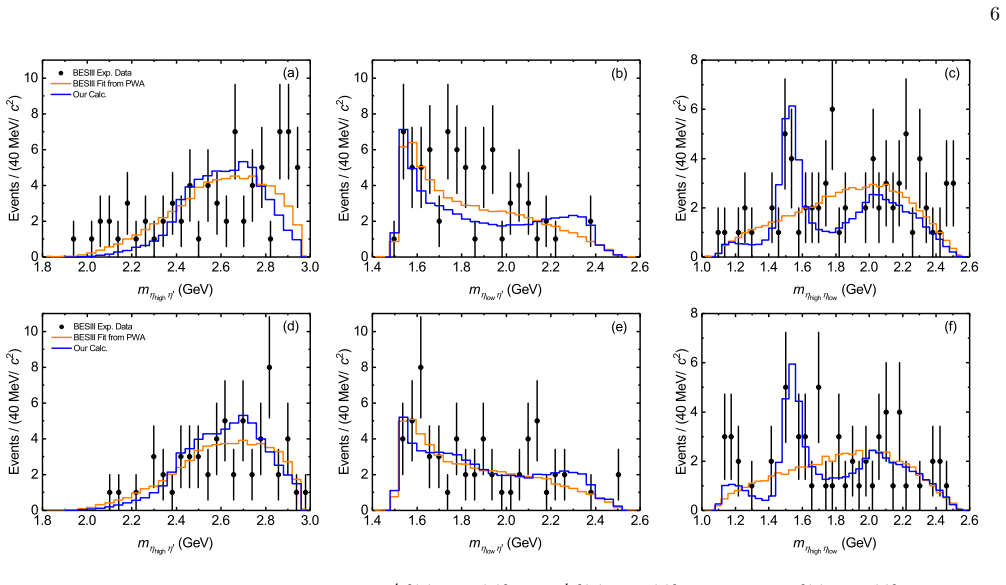
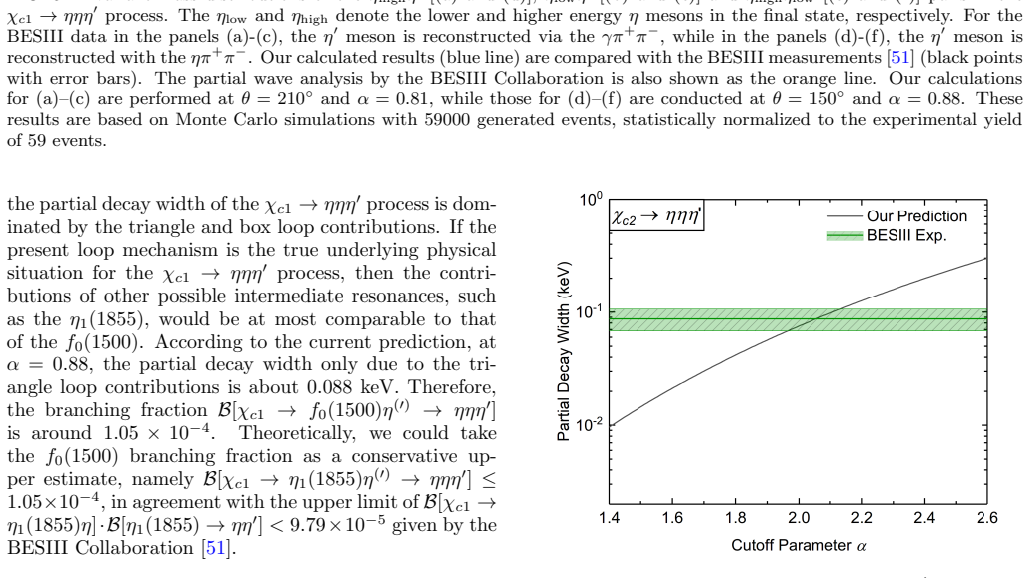
In the effective Lagrangian approach the processes χcJ → ηηη' proceed primarily through triangle and box loops with charmed mesons and f0(1500), which reproduce the experimental branching fractions and yield invariant mass spectra consistent with BESIII data, indicating that the non-observation of η1(1855) is due to the dominance of these loop contributions.
What carries the argument
Triangle and box loop diagrams involving charmed mesons and the scalar meson f0(1500) within an effective Lagrangian framework.
Load-bearing premise
The decay χc1 → ηηη' is dominated by the triangle and box loop contributions involving charmed mesons and f0(1500), with parameters chosen to reproduce the observed rates.
What would settle it
A high-statistics measurement that reveals a clear resonant peak for η1(1855) in the ηη' invariant mass spectrum of χc1 → ηηη' or shows branching fractions that deviate substantially from the loop predictions.
Figures



read the original abstract
Recently, the BESIII Collaboration reported the first observation of the decays $\chi_{cJ} \to \eta \eta \eta^\prime$ in order to search for the $1^{-+}$ exotic state $\eta_1(1855)$. A partial wave analysis of the $\eta \eta^\prime$ invariant mass spectrum shows no significant signal for the $\eta_1(1855)$. In this work, we, using an effective Lagrangian approach, investigate the processes $\chi_{cJ} \to \eta \eta \eta^\prime$ via the box and triangle loops involving charmed mesons and the scalar meson $f_0(1500)$. Our calculations reproduce well the experimental branching fractions of $\chi_{cJ} \to \eta \eta \eta^\prime$. Furthermore, we present the predictions of the relevant invariant mass spectra of $\eta \eta^\prime$ and $\eta \eta$ produced in the $\chi_{c1}$ decay, which seem overall consistent with the BESIII measurements. In the present model, the decay $\chi_{c1} \to \eta \eta \eta^\prime$ is dominated by the triangle and box loop contributions. The consistency between our theoretical results and the BESIII measurements sheds light on the underlying decay mechanism of the $\chi_{cJ}$ decaying into light mesons and might be helpful to understand the absence of the $\eta_1(1855)$ signal in the decay channels $\chi_{cJ} \to \eta \eta \eta^\prime$.
Editorial analysis
A structured set of objections, weighed in public.
Referee Report
Summary. The manuscript employs an effective Lagrangian framework to analyze the decays χ_cJ → ηηη' through triangle and box loop diagrams involving intermediate charmed mesons (D(*)) and the f0(1500) scalar. It reports that the computed branching fractions match BESIII measurements, presents predicted ηη' and ηη invariant-mass distributions for the χ_c1 channel that appear consistent with data, and concludes that these loop mechanisms dominate, thereby explaining the non-observation of the η1(1855) exotic state.
Significance. If the central results hold after addressing parameter dependence, the work would strengthen the case for intermediate charmed-meson loops as a key mechanism in charmonium decays to light mesons and offer a dynamical account for the absence of η1(1855) signals. The explicit spectral predictions add testable content beyond integrated rates and could inform future partial-wave analyses.
major comments (2)
- [Abstract and numerical results] Abstract and numerical results section: the reproduction of branching fractions is achieved by adjusting loop coupling constants and cutoff parameters (as implied by the model description and the statement that parameters are chosen to match observed rates). This tuning renders the subsequent agreement of the ηη' and ηη spectra a consistency check on normalized amplitudes rather than an independent test of the assumed dominance of the triangle and box diagrams.
- [Discussion of decay mechanism] Discussion of decay mechanism: the assertion that χ_c1 → ηηη' 'is dominated by the triangle and box loop contributions' follows directly from the parameter fit to integrated rates; no external constraints (e.g., from other charmonium decays or lattice inputs) or comparison to alternative mechanisms are invoked to establish this dominance independently of the fit.
minor comments (2)
- Explicit functional forms of the form factors and cutoff regularization schemes used in the loop integrals should be provided, together with the numerical values of all fitted parameters, to allow reproducibility.
- The manuscript would benefit from a brief comparison table of the fitted branching fractions versus experimental central values and uncertainties.
Simulated Author's Rebuttal
We thank the referee for the detailed and constructive report. The comments correctly identify that our branching-fraction reproduction relies on parameter adjustment and that dominance is asserted within the model. We address each point below, clarifying the predictive content of the spectra and adding discussion of alternative mechanisms. Revisions have been made to improve precision without altering the central results.
read point-by-point responses
-
Referee: [Abstract and numerical results] Abstract and numerical results section: the reproduction of branching fractions is achieved by adjusting loop coupling constants and cutoff parameters (as implied by the model description and the statement that parameters are chosen to match observed rates). This tuning renders the subsequent agreement of the ηη' and ηη spectra a consistency check on normalized amplitudes rather than an independent test of the assumed dominance of the triangle and box diagrams.
Authors: We agree that the overall normalization is fixed by reproducing the measured branching fractions, as is standard in effective-Lagrangian loop calculations. However, once the couplings and cutoff are set, the shapes of the ηη' and ηη invariant-mass distributions are genuine predictions arising from the loop integrals, propagators, and form factors; no additional parameters are adjusted to fit the spectra. We have revised the abstract and the numerical-results section to state explicitly that the differential distributions constitute an independent test of the dynamical mechanism, while the integrated rates serve only for normalization. revision: yes
-
Referee: [Discussion of decay mechanism] Discussion of decay mechanism: the assertion that χ_c1 → ηηη' 'is dominated by the triangle and box loop contributions' follows directly from the parameter fit to integrated rates; no external constraints (e.g., from other charmonium decays or lattice inputs) or comparison to alternative mechanisms are invoked to establish this dominance independently of the fit.
Authors: The referee is correct that dominance is concluded inside the present framework after the fit. We have added a paragraph in the discussion section that (i) recalls the suppression of direct tree-level amplitudes by OZI and isospin selection rules, (ii) notes that similar loop mechanisms successfully describe other χ_cJ → light-meson channels in the literature, and (iii) acknowledges that a quantitative comparison with lattice-QCD inputs lies beyond the scope of this work. These additions make the basis for the dominance statement more transparent. revision: yes
Circularity Check
Branching fractions reproduced via tuned loop parameters; spectra then presented as predictions using the same fitted amplitudes
specific steps
-
fitted input called prediction
[Abstract]
"Our calculations reproduce well the experimental branching fractions of χ_{cJ} → η η η'. Furthermore, we present the predictions of the relevant invariant mass spectra of η η' and η η produced in the χ_{c1} decay, which seem overall consistent with the BESIII measurements."
The branching fractions are the integrated rates over the full phase space. The model parameters (cutoff scales in the loop form factors and the effective f_0(1500) coupling) are chosen so that the calculated rates match experiment. The invariant-mass distributions are then obtained by integrating the same normalized amplitudes over the remaining variables; their agreement with data therefore follows from the kinematic structure of the already-fitted amplitudes rather than constituting an independent prediction.
full rationale
The paper states that its effective-Lagrangian loop model reproduces the measured branching fractions of χ_cJ → ηηη' and then computes the ηη' and ηη invariant-mass spectra, finding them 'overall consistent' with BESIII data. Because the model introduces free parameters (cutoffs in the charmed-meson form factors and the f_0(1500) coupling) that are adjusted to match the integrated rates, the subsequent spectral shapes are determined by the already-normalized amplitudes. This reduces the spectral comparison to a test of kinematic dependence rather than an independent verification of the assumed dominance of the triangle/box diagrams. The derivation chain therefore contains a fitted-input-called-prediction step, warranting a moderate circularity score; the central claim of mechanism dominance is not fully independent of the data used for normalization.
Axiom & Free-Parameter Ledger
free parameters (1)
- loop coupling constants
axioms (1)
- domain assumption Effective Lagrangian approach with charmed-meson loops is valid for these decays
Reference graph
Works this paper leans on
-
[1]
(and references therein and thereto). Experimentally, theπ 1(1400) was mainly observed in theηπdecay chan- nel and has a much lower mass than the lattice predic- tions for light-quark hybrid mesons ranging from 1.6 to ∗ liusd@qfnu.edu.cn † wuqi@htu.edu.cn ‡ gli@qfnu.edu.cn § xiejujun@impcas.ac.cn 2.2 GeV [9–11], while theπ 1(1600) was observed in var- iou...
work page internal anchor Pith review Pith/arXiv arXiv 2015
-
[2]
Theϕis related to the usual octet-singlet mixing angleθ P byϕ=θ P + arctan √
-
[3]
By fitting the DM2 measurements of the branching fractions ofJ/ψ→vector + pseudoscalar [62], the value ofθ P is estimated to be (−19.1±1.4) ◦. With this value ofθ P, we obtain α= cosϕ√ 2 = 0.57, β= sinϕ√ 2 = 0.41, γ=−sinϕ=−0.58, δ= cosϕ= 0.81.(6) The coupling constantsg DD∗P andg D∗D∗P have the fol- lowing relations: gD∗D∗P = gDD∗P √mDmD∗ = 2g fπ ,(7) whe...
-
[4]
andgis a dimensionless coupling constant with the value ofg= 0.57±0.01 extracted from the experimental data ofD ∗+ →D 0π+(D+π0) [4, 55, 63]. For the coupling of the scalarf 0(1500) to the charmed mesons, we adopt the following Lagrangian: [64–67] Lf0 =g f0DDf0DD† −g f0D∗D∗ f0D∗ µD∗µ† ,(8) with the coupling constants being gf0DD mD = gf0D∗D∗ mD∗ =g f0 .(9)...
-
[5]
M. Ablikimet al.(BESIII), Observation of an Isoscalar Resonance with ExoticJ P C = 1 −+ Quantum Num- bers inJ/ψ→γηη ′, Phys. Rev. Lett.129, 192002 (2022), [Erratum: Phys.Rev.Lett. 130, 159901 (2023)], arXiv:2202.00621 [hep-ex]
-
[6]
Ablikimet al.(BESIII), Partial wave analysis of J/ψ→γηη ′, Phys
M. Ablikimet al.(BESIII), Partial wave analysis of j/ψ→γηη ′, Phys. Rev. D106, 072012 (2022), arXiv:2202.00623 [hep-ex]
-
[7]
Maon (BESIII), Observation of isoscalar 1 −+ spin- exotic stateη 1(1855), Nuovo Cim
R. Maon (BESIII), Observation of isoscalar 1 −+ spin- exotic stateη 1(1855), Nuovo Cim. C47, 182 (2024)
2024
-
[8]
Navaset al.(Particle Data Group), Review of particle physics, Phys
S. Navaset al.(Particle Data Group), Review of particle physics, Phys. Rev. D110, 030001 (2024)
2024
-
[9]
D. Barberiset al.(WA102), A Study of theηη ′ and η′η′ channels produced in central p p interactions at 450-GeV/c, Phys. Lett. B471, 429 (2000), arXiv:hep- ex/9911041
-
[10]
Aldeet al., Further study of theX(1910) meson, Sov
D. Aldeet al., Further study of theX(1910) meson, Sov. J. Nucl. Phys.54, 455 (1991)
1910
- [11]
- [12]
- [13]
- [14]
-
[15]
E. Klempt and A. Zaitsev, Glueballs, hybrids, multi- quarks. experimental facts versus qcd inspired concepts, Phys. Rept.454, 1 (2007), arXiv:0708.4016 [hep-ph]
-
[16]
G. M. Beladidzeet al.(VES), Study ofπ −N→ηπ −N andπ −N→η ′π−Nreactions at 37 GeV/c, Phys. Lett. B313, 276 (1993)
1993
-
[17]
Y. A. Khokhlov (VES), Study ofX(1600) 1 −+ hybrid, Nucl. Phys. A663, 596 (2000)
2000
-
[18]
J. Kuhnet al.(E852), Exotic meson production in the f1(1285)π− system observed in the reactionπ −p→ ηπ +π−π− at 18 GeV/c, Phys. Lett. B595, 109 (2004), arXiv:hep-ex/0401004
- [19]
-
[20]
Adolphet al.(COMPASS), Odd and even partial waves ofηπ − andη ′π− inπ −p→η (′)π−pat 191 GeV/c, Phys
C. Adolphet al.(COMPASS), Odd and even partial waves ofηπ − andη ′π− inπ −p→η (′)π−pat 191 GeV/c, Phys. Lett. B740, 303 (2015), [Erratum: Phys.Lett.B 811, 135913 (2020)], arXiv:1408.4286 [hep-ex]
-
[21]
Zaitsev (VES), Study of exotic resonances in diffrac- tive reactions, Nucl
A. Zaitsev (VES), Study of exotic resonances in diffrac- tive reactions, Nucl. Phys. A675, 155C (2000)
2000
-
[22]
Luet al.(E852), Exotic meson decay toωπ 0π−, Phys
M. Luet al.(E852), Exotic meson decay toωπ 0π−, Phys. Rev. Lett.94, 032002 (2005), arXiv:hep-ex/0405044
-
[23]
D. V. Amelinet al., Investigation of hybrid states in the VES experiment at the Institute for High Energy Physics (Protvino), Phys. Atom. Nucl.68, 359 (2005)
2005
-
[24]
C. A. Bakeret al., Confirmation ofa 0(1450) andπ 1(1600) in ¯pp→ωπ +π−π0 at rest, Phys. Lett. B563, 140 (2003)
2003
-
[25]
G. S. Adamset al.(E852), Observation of a newJ P C = 1−+ exotic state in the reactionπ −p→π +π−π−pat 18-GeV/c, Phys. Rev. Lett.81, 5760 (1998)
1998
-
[26]
S. U. Chunget al., Exotic andq¯qresonances in the π+π−π− system produced inπ −pcollisions at 18 GeV/c, Phys. Rev. D65, 072001 (2002)
2002
-
[27]
M. Alekseevet al.(COMPASS), Observation of aJ P C = 1−+ exotic resonance in diffractive dissociation of 190 GeV/c π − intoπ −π−π+, Phys. Rev. Lett.104, 241803 (2010), arXiv:0910.5842 [hep-ex]
-
[28]
Aghasyanet al.(COMPASS), Light isovector reso- nances inπ −p→π −π−π+pat 190 GeV/c, Phys
M. Aghasyanet al.(COMPASS), Light isovector reso- nances inπ −p→π −π−π+pat 190 GeV/c, Phys. Rev. D 98, 092003 (2018), arXiv:1802.05913 [hep-ex]
- [29]
-
[30]
Rodaset al.(JPAC), Determination of the pole posi- tion of the lightest hybrid meson candidate, Phys
A. Rodaset al.(JPAC), Determination of the pole posi- tion of the lightest hybrid meson candidate, Phys. Rev. Lett.122, 042002 (2019), arXiv:1810.04171 [hep-ph]
- [31]
- [32]
- [33]
-
[34]
V. Shastry, C. S. Fischer, and F. Giacosa, The phe- nomenology of the exotic hybrid nonet withπ 1(1600) andη 1(1855), Phys. Lett. B834, 137478 (2022), arXiv:2203.04327 [hep-ph]
- [35]
-
[36]
B. Chen, S.-Q. Luo, and X. Liu, Constructing the jP(C) = 1 −(+) light flavor hybrid nonet with the newly observedη 1(1855), Phys. Rev. D108, 054034 (2023), arXiv:2302.06785 [hep-ph]
-
[37]
V. Shastry and F. Giacosa, Radiative production and decays of the exoticη ′ 1(1855) and its siblings, Nucl. Phys. A1037, 122683 (2023), arXiv:2302.07687 [hep-ph]
- [38]
- [39]
-
[40]
X.-K. Dong, Y.-H. Lin, and B.-S. Zou, Interpretation of theη 1(1855) as aK ¯K1(1400)+ c.c. molecule, Sci. China Phys. Mech. Astron.65, 261011 (2022), arXiv:2202.00863 [hep-ph]
- [41]
-
[42]
X.-Y. Wang, F.-C. Zeng, and X. Liu, Production of the η1(1855) through kaon induced reactions under the as- sumptions that it is a molecular or a hybrid state, Phys. Rev. D106, 036005 (2022), arXiv:2205.09283 [hep-ph]
- [43]
- [44]
-
[45]
Qiao and B.-D
C.-F. Qiao and B.-D. Wan, The natures of recently ob- served statesη 1(1855) andX(2600), Nucl. Part. Phys. Proc.324-329, 76 (2023)
2023
- [46]
- [47]
-
[48]
X.-Y. Zhang, P.-P. Shi, and F.-K. Guo, Produc- tion of 1 −+ exotic charmonium-like states in electron- positron collisions, Phys. Lett. B867, 139603 (2025), arXiv:2503.06259 [hep-ph]
- [49]
-
[50]
K. Xu, Z. Zhao, N. Tagsinsit, A. Kaewsnod, A. Limphi- rat, C. Herold, and Y. Yan, Systematic study of exotic 1−+ tetraquark spectroscopy (2025), arXiv:2511.22111 [hep-ph]
work page internal anchor Pith review Pith/arXiv arXiv 2025
-
[51]
M. Ablikimet al.(BESIII), Search for a 1 −+ molec- 9 ular state viae +e− →γD + s D− s1(2536) +c.c.(2025), arXiv:2503.11015 [hep-ex]
-
[52]
B.-D. Wan, Y. Zhang, J.-H. Zhang, and M.-Y. Yuan, Hidden-charm and -bottom tetraquark states with J P C = 1−+ via QCD sum rules (2025), arXiv:2512.03800 [hep-ph]
work page internal anchor Pith review arXiv 2025
-
[53]
M. Ablikimet al.(BESIII), Search for 1 −+ charmonium- like hybrid viae +e− →γη (′)ηc at center-of-mass energies between 4.258 and 4.681 GeV (2025), arXiv:2504.13539 [hep-ex]
-
[54]
Y. Huang and H. Q. Zhu, Revealing the inner structure of the newly observedη 1(1855) via photoproduction, J. Phys. G50, 095002 (2023), arXiv:2209.02879 [hep-ph]
-
[55]
Ablikimet al.(BESIII), Search forη 1(1855) inχ cJ → ηηη ′ decays (2025), arXiv:2504.19087 [hep-ex]
M. Ablikimet al.(BESIII), Search forη 1(1855) inχ cJ → ηηη ′ decays (2025), arXiv:2504.19087 [hep-ex]
-
[56]
P. Colangelo, F. De Fazio, and T. Pham, Nonfactor- izable contributions in b decays to charmonium: The case ofB − →K −hc, Phys. Rev. D69, 054023 (2004), arXiv:hep-ph/0310084
-
[57]
Phenomenology of Heavy Meson Chiral Lagrangians
R. Casalbuoni, A. Deandrea, N. Di Bartolomeo, R. Gatto, F. Feruglio, and G. Nardulli, Phenomenology of heavy meson chiral lagrangians, Phys. Rept.281, 145 (1997), arXiv:hep-ph/9605342
work page Pith review arXiv 1997
- [58]
- [59]
-
[60]
A. Deandrea, G. Nardulli, and A. D. Polosa,J/ψcou- plings to charmed resonances and toπ, Phys. Rev. D68, 034002 (2003), arXiv:hep-ph/0302273
-
[61]
T. Mehen, Hadronic loops versus factorization in effective field theory calculations of (3872)→χ cJ π0, Phys. Rev. D92, 034019 (2015), arXiv:1503.02719 [hep-ph]
-
[62]
P. Colangelo, F. De Fazio, and T. N. Pham,B − → K −χc0 decay from charmed meson rescattering, Phys. Lett. B542, 71 (2002), arXiv:hep-ph/0207061
- [63]
- [64]
-
[65]
C. Amsler and F. E. Close, Isf 0(1500) a scalar glueball?, Phys. Rev. D53, 295 (1996), arXiv:hep-ph/9507326
-
[66]
Joussetet al.(DM2),J/ψ→vector + pseudoscalar decays and the quark content ofηandη ′, Phys
J. Joussetet al.(DM2),J/ψ→vector + pseudoscalar decays and the quark content ofηandη ′, Phys. Rev. D 41, 1389 (1990)
1990
- [67]
-
[68]
C. Meng and K.-T. Chao, Peak shifts due toB (∗) − B (∗) rescattering in Υ(5S) dipion transitions, Phys. Rev. D 78, 034022 (2008), arXiv:0805.0143 [hep-ph]
- [69]
- [70]
- [71]
- [72]
-
[73]
Q. Wang, X.-H. Liu, and Q. Zhao, Study ofη c andη ′ c decays into vector meson pairs, arXiv:1010.1343 [hep-ph] (2010), arXiv:1010.1343 [hep-ph]
- [74]
-
[75]
H.-Y. Cheng, C.-K. Chua, and A. Soni, Final state inter- actions in hadronicBdecays, Phys. Rev. D71, 014030 (2005), arXiv:hep-ph/0409317
-
[76]
M. Ablikimet al.(BESIII), Measurements of the branch- ing fractions ofχ cJ →ϕϕη, ϕϕη ′ andϕK +K −η(2025), arXiv:2512.14369 [hep-ex]
discussion (0)
Sign in with ORCID, Apple, or X to comment. Anyone can read and Pith papers without signing in.