Recognition: unknown
How complex behavioural contagion can prevent infectious diseases from becoming endemic
Pith reviewed 2026-05-10 16:15 UTC · model grok-4.3
The pith
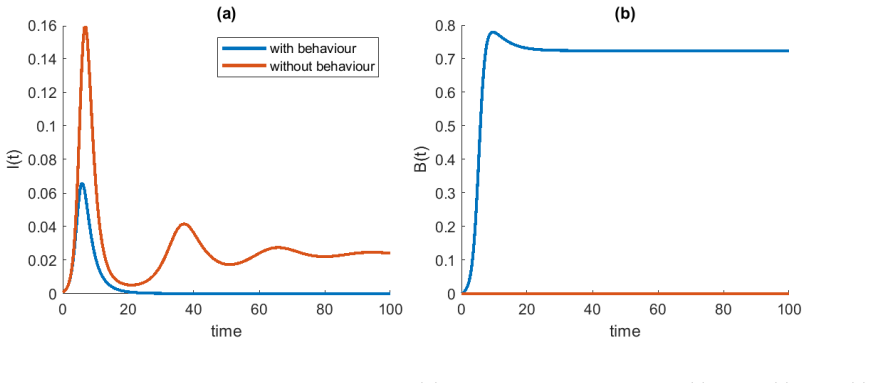
Nonlinear behavioural contagion can cause an epidemic to trigger sustained protective behaviour that eliminates the disease.
A machine-rendered reading of the paper's core claim, the machinery that carries it, and where it could break.
Core claim
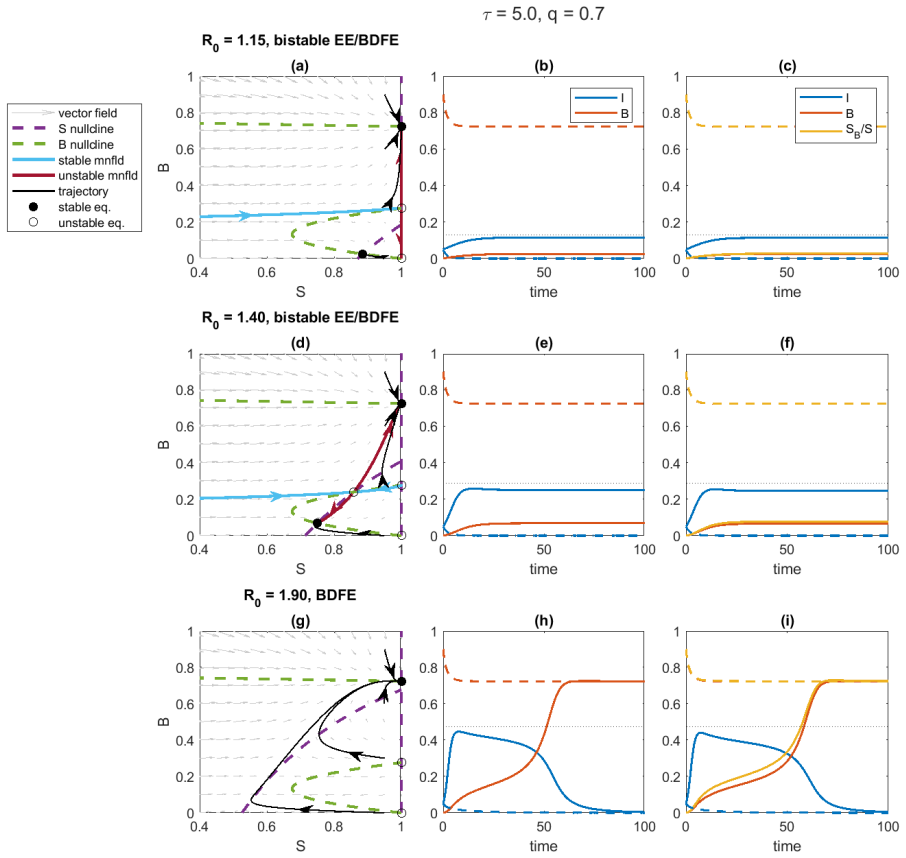
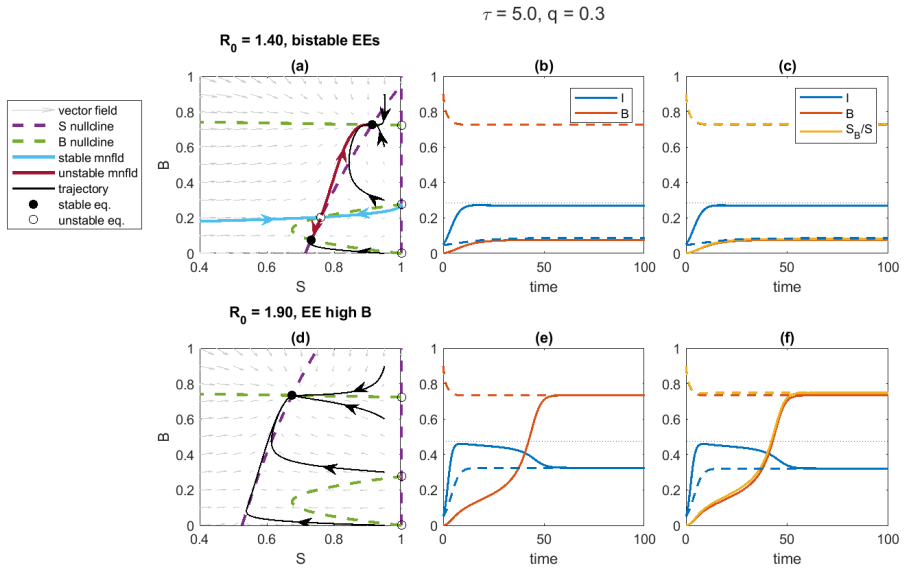
In an SIR-type model extended with complex behavioural contagion, the behaviour uptake rate is a nonlinear function of the number of behaving contacts. This functional form creates regions of parameter space containing multiple stable disease-free equilibria. An epidemic starting from low behaviour levels can therefore induce a transition to the high-behaviour equilibrium, after which the disease is eliminated. The outcome occurs for certain combinations of R0, the strength of the behavioural effect on transmission, and the relative speed of behaviour uptake and abandonment, and it is robust to the presence or absence of temporary post-infection immunity.
What carries the argument
The nonlinear function that sets the rate of behaviour uptake from the number of contacts already practicing the behaviour, which generates multiple stable disease-free equilibria.
If this is right
- Moderate R0 values produce endemic disease while higher R0 values can produce behaviour-driven elimination.
- An epidemic can serve as the perturbation that switches a population from low to high protective behaviour.
- The elimination effect holds whether or not the model includes temporary post-infection immunity.
- The existence of multiple disease-free equilibria requires both the nonlinear uptake function and suitable values of behavioural strength and speed parameters.
Where Pith is reading between the lines
- Public-health planning could explore whether brief, controlled exposure to a pathogen or information campaign might be used to cross the behaviour threshold in low-adoption groups.
- The same bistable structure might appear in models of other socially contagious actions such as vaccine uptake or climate-related behaviour.
- Field studies that simultaneously track incidence and behaviour adoption during outbreaks could directly test for the predicted switch between equilibria.
- Standard policy models that omit nonlinear contagion may systematically underestimate the chance that some outbreaks will self-limit through behaviour change.
Load-bearing premise
The rate at which people adopt protective behaviour must increase nonlinearly with the number of others already doing so, in a way that produces multiple stable states without the disease.
What would settle it
Longitudinal data from a real population showing that, after an outbreak with high R0 and initially low protective behaviour, behaviour remains permanently elevated and disease prevalence reaches zero, while moderate-R0 outbreaks in the same setting become endemic without a sustained behaviour increase.
Figures


read the original abstract
Infectious disease transmission in human populations has a complex two-way interaction with changes in host behaviour. It is increasingly recognised that incorporating adaptive behavioural change into epidemic models is important for improving understanding of infectious disease dynamics and developing policy-relevant modelling tools. An important aspect of behavioural dynamics is social contagion, where people tend to adopt behaviours exhibited by others around them. In a simple behavioural contagion model, the behaviour uptake rate increases linearly with the number of contacts who have adopted a given behaviour. Here, we explore an epidemic model with complex behavioural contagion, where the behaviour uptake rate is a nonlinear function of the number of behaving contacts. We identify key bifurcation parameters of the model, which include the basic reproduction number $R_0$, the strength of the behavioural effect on disease transmission, and the speed of behaviour uptake relative to behaviour abandonment. We show that, in some regions of parameter space, the model has multiple disease-free equilibria. In this situation, the occurrence of an epidemic in a population with an initially low level of behaviour practice can trigger a self-sustaining increase in behaviour, which then causes the disease to be eliminated. In some cases, while moderate values of $R_0$ lead to the disease becoming endemic, higher values of $R_0$ may lead to behaviour-driven disease elimination. We demonstrate that this mechanism of epidemic-triggered uptake of behaviour leading to disease elimination can occur in the presence and absence of temporary post-infection immunity.
Editorial analysis
A structured set of objections, weighed in public.
Referee Report
Summary. The paper develops a compartmental epidemic model incorporating complex behavioural contagion, in which the rate of adopting a protective behaviour is a nonlinear function of the number of contacts already exhibiting the behaviour. The authors perform bifurcation analysis with respect to the basic reproduction number R0, the strength of the behavioural effect on transmission, and the ratio of behaviour uptake to abandonment rates. They report the existence of multiple disease-free equilibria in certain parameter regimes, such that an epidemic starting from low behaviour levels can drive the system across a separatrix to a high-behaviour disease-free equilibrium that eliminates the pathogen. They further claim that, for some parameter values, increasing R0 can shift the long-term outcome from endemicity to elimination via this behavioural mechanism, and that the phenomenon persists both with and without temporary post-infection immunity.
Significance. If the results hold under reasonable variations in model assumptions, the work identifies a concrete mechanism by which nonlinear social contagion can produce counter-intuitive epidemic outcomes, including the possibility that higher transmissibility leads to disease elimination rather than endemicity. This underscores the potential for behavioural dynamics to alter effective reproduction numbers and equilibrium structure in ways not captured by standard models, with implications for both theoretical epidemiology and the design of interventions that leverage social norms.
major comments (2)
- [Model formulation] Model formulation section: The headline result of multiple stable disease-free equilibria whose basins permit an epidemic to trigger self-sustaining behaviour uptake and subsequent elimination depends on the specific nonlinear functional form chosen for the behaviour uptake rate. The manuscript demonstrates the phenomenon for its chosen nonlinearity but does not test whether the bistable region and the R0-dependent elimination regime survive under alternative plausible complex-contagion maps (e.g., Hill functions with different exponents or different saturation thresholds) while keeping the same R0 range and behavioural effect strength. This functional-form sensitivity is load-bearing for the central claim.
- [Bifurcation and equilibrium analysis] Bifurcation and equilibrium analysis: The abstract states that key bifurcation parameters are identified and that multiple DFEs exist in some regions, yet the explicit equilibrium conditions, Jacobian or next-generation matrix derivations, and numerical continuation details required to verify the claimed multiple equilibria and the non-monotonic dependence on R0 are not supplied at a level that permits independent reproduction of the reported regimes.
minor comments (2)
- The distinction between simple (linear) and complex (nonlinear) behavioural contagion could be drawn more sharply in the introduction to clarify the incremental contribution.
- Bifurcation diagrams would benefit from explicit indication of the basins of attraction for each disease-free equilibrium and from clearer annotation of the parameter values at which the qualitative transitions occur.
Simulated Author's Rebuttal
We thank the referee for their thoughtful and constructive comments, which help clarify the robustness and reproducibility of our findings on nonlinear behavioural contagion in epidemic models. We address each major comment point by point below, indicating planned revisions to the manuscript.
read point-by-point responses
-
Referee: [Model formulation] Model formulation section: The headline result of multiple stable disease-free equilibria whose basins permit an epidemic to trigger self-sustaining behaviour uptake and subsequent elimination depends on the specific nonlinear functional form chosen for the behaviour uptake rate. The manuscript demonstrates the phenomenon for its chosen nonlinearity but does not test whether the bistable region and the R0-dependent elimination regime survive under alternative plausible complex-contagion maps (e.g., Hill functions with different exponents or different saturation thresholds) while keeping the same R0 range and behavioural effect strength. This functional-form sensitivity is load-bearing for the central claim.
Authors: We chose the nonlinear uptake function to capture the accelerating, threshold-like nature of complex contagion as described in the social sciences literature. We agree that demonstrating robustness across functional forms strengthens the central claim. In the revised manuscript we will add a new subsection (or supplementary analysis) that numerically explores alternative maps, including Hill functions with exponents 2 and 3 and varied saturation thresholds, while holding R0 and behavioural effect strength fixed. We will report the parameter regimes in which multiple disease-free equilibria and the non-monotonic R0 dependence persist or disappear, thereby addressing the functional-form sensitivity directly. revision: yes
-
Referee: [Bifurcation and equilibrium analysis] Bifurcation and equilibrium analysis: The abstract states that key bifurcation parameters are identified and that multiple DFEs exist in some regions, yet the explicit equilibrium conditions, Jacobian or next-generation matrix derivations, and numerical continuation details required to verify the claimed multiple equilibria and the non-monotonic dependence on R0 are not supplied at a level that permits independent reproduction of the reported regimes.
Authors: We acknowledge that additional explicit derivations will improve independent verification. The revised manuscript will include the algebraic conditions for the disease-free equilibria obtained by setting all time derivatives to zero. We will also present the Jacobian matrix at these equilibria, outline the next-generation matrix construction used to obtain R0, and describe the numerical continuation procedure (including software or algorithm details) employed to trace the bifurcations. Supplementary material will contain the corresponding code or pseudocode so that the reported regimes and the counter-intuitive R0 dependence can be reproduced. revision: yes
Circularity Check
Standard bifurcation analysis of an assumed nonlinear contagion model with no definitional or fitted circularity
full rationale
The paper introduces an explicit compartmental ODE model with a chosen nonlinear function for behavior uptake rate (a modeling assumption, not derived from the target outcome). It then performs standard equilibrium and bifurcation analysis to identify parameter regions with multiple disease-free equilibria. No quantity is defined in terms of itself, no parameter is fitted to the epidemic outcome and then called a prediction, and no load-bearing step reduces to a self-citation chain or imported uniqueness theorem. The central claim (epidemic-triggered behavior shift eliminating disease) is a direct consequence of solving the model equations under the stated assumptions, making the derivation self-contained against external benchmarks.
Axiom & Free-Parameter Ledger
free parameters (3)
- R0
- behavioral effect strength
- uptake versus abandonment speed ratio
axioms (2)
- domain assumption Behavior uptake rate is a nonlinear function of the number of contacts who have adopted the behavior
- standard math Standard mass-action or frequency-dependent transmission in a compartmental epidemic framework
Reference graph
Works this paper leans on
-
[1]
Changes in social contacts in England during the COVID-19 pandemic between March 2020 and March 2021 as measured by the CoMix survey: A repeated cross-sectional study
Gimma A, Munday JD, Wong KLM, Coletti P, van Zandvoort K, Prem K, et al. Changes in social contacts in England during the COVID-19 pandemic between March 2020 and March 2021 as measured by the CoMix survey: A repeated cross-sectional study. PLoS Medicine. 2022;19(3):e1003907
2020
-
[2]
Temporal trends in test- seeking behaviour during the COVID-19 pandemic
Eales O, Teo M, Price DJ, Hao T, Ryan GE, Senior KL, et al. Temporal trends in test- seeking behaviour during the COVID-19 pandemic. Mathematics in Medical and Life Sciences. 2025;2(1):2521858
2025
-
[3]
Factors influencing the wearing of facemasks to prevent the se- vere acute respiratory syndrome among adult Chinese in Hong Kong
Tang CSk, Wong Cy. Factors influencing the wearing of facemasks to prevent the se- vere acute respiratory syndrome among adult Chinese in Hong Kong. Preventive Medicine. 2004;39(6):1187-93
2004
-
[4]
Understanding health behaviour changes in response to outbreaks: Findings from a longitudinal study of a large epidemic of mosquito- borne disease
Raude J, McColl K, Flamand C, Apostolidis T. Understanding health behaviour changes in response to outbreaks: Findings from a longitudinal study of a large epidemic of mosquito- borne disease. Social Science and Medicine. 2019;230:184-93
2019
-
[5]
Sexually transmitted infection prevention behaviours: health impact, prevalence, correlates, and interventions
de Wit JBF, Adam PCG, den Daas C, Jonas K. Sexually transmitted infection prevention behaviours: health impact, prevalence, correlates, and interventions. Psychology and Health. 2023;38(6):675-700
2023
-
[6]
Modelling: understanding pandemics and how to control them
Marion G, Hadley L, Isham V, Mollison D, Panovska-Griffiths J, Pellis L, et al. Modelling: understanding pandemics and how to control them. Epidemics. 2022;39:100588
2022
-
[7]
Integrating human behaviour and epidemiological modelling: unlocking the remaining challenges
Hill EM, Ryan M, Haw D, Lynch MP, McCabe R, Milne AE, et al. Integrating human behaviour and epidemiological modelling: unlocking the remaining challenges. Mathematics in Medical and Life Sciences. 2024;1(1):2429479
2024
-
[8]
Modelling the influence of human behaviour on the spread of infectious diseases: a review
Funk S, Salath´ e M, Jansen VA. Modelling the influence of human behaviour on the spread of infectious diseases: a review. Journal of the Royal Society Interface. 2010;7(50):1247-56
2010
-
[9]
A review and agenda for integrated disease models including social and behavioural factors
Bedson J, Skrip LA, Pedi D, Abramowitz S, Carter S, Jalloh MF, et al. A review and agenda for integrated disease models including social and behavioural factors. Nature Human Behaviour. 2021;5(7):834-46
2021
-
[10]
The Economics of Infectious Diseases
Auld MC, Fenichel EP, Toxvaerd F. The Economics of Infectious Diseases. Journal of Economic Literature. 2025;63:1281-330
2025
-
[11]
The spread of awareness and its impact on epidemic outbreaks
Funk S, Gilad E, Watkins C, Jansen VAA. The spread of awareness and its impact on epidemic outbreaks. Proceedings of the National Academy of Sciences. 2009;106(16):6872-7
2009
-
[12]
Impact of opinion dynamics on recurrent pandemic waves: balancing risk aversion and peer pressure
Chang SL, Nguyen QD, Suster CJE, Jamerlan MC, Rockett RJ, Sintchenko V, et al. Impact of opinion dynamics on recurrent pandemic waves: balancing risk aversion and peer pressure. Interface Focus. 2025;15(4):20240038
2025
-
[13]
A behaviour and disease transmission model: incorporating the Health Belief Model for human behaviour into a simple transmission model
Ryan M, Brindal E, Roberts M, Hickson RI. A behaviour and disease transmission model: incorporating the Health Belief Model for human behaviour into a simple transmission model. Journal of the Royal Society Interface. 2024;21(215):20240038. 17
2024
-
[14]
Why people use health services
Rosenstock IM. Why people use health services. Milbank Memorial Fund Quarterly. 1966;44(3):94-127
1966
-
[15]
The health belief model and sick role behavior
Becker MH. The health belief model and sick role behavior. Health Education Monographs. 1974;2(4):409-19
1974
-
[16]
Complex contagions and the weakness of long ties
Centola D, Macy M. Complex contagions and the weakness of long ties. American Journal of Sociology. 2007;113(3):702-34
2007
-
[17]
The spread of behavior in an online social network experiment
Centola D. The spread of behavior in an online social network experiment. Science. 2010;329(5996):1194-7
2010
-
[18]
Evidence for complex contagion models of social contagion from ob- servational data
Sprague DA, House T. Evidence for complex contagion models of social contagion from ob- servational data. PLoS One. 2017;12(7):e0180802
2017
-
[19]
A behaviour and disease model of testing and isolation
Ryan M, Hickson RI, Hill EM, House T, Isham V, Zhang D, et al. A behaviour and disease model of testing and isolation. Mathematics in Medical and Life Sciences. 2026;3:10.1080/29937574.2026.2627906
-
[20]
Github repository: Behaviour and disease SIS model; 2026
Plank MJ, McCaw J. Github repository: Behaviour and disease SIS model; 2026. Available from:https://github.com/michaelplanknz/behaviour_and_disease_SIS_model
2026
-
[21]
Wearing face masks to protect oneself and/or others: counter-intuitive results from a simple epidemic model accounting for selfish and altruistic human behavior
Martin H, Castella F, Hamelin F. Wearing face masks to protect oneself and/or others: counter-intuitive results from a simple epidemic model accounting for selfish and altruistic human behavior. Journal of Theoretical Biology. 2026:112395
2026
-
[22]
The potential stickiness of pandemic-induced behavior changes in the United States
Salon D, Conway MW, Capasso da Silva D, Chauhan RS, Derrible S, Mohammadian A, et al. The potential stickiness of pandemic-induced behavior changes in the United States. Proceed- ings of the National Academy of Sciences. 2021;118(27):e2106499118
2021
-
[23]
Boundaries of solidarity: a meta-ethnography of mask use during past epidemics to inform SARS-CoV-2 suppression
Tsang PM, Prost A. Boundaries of solidarity: a meta-ethnography of mask use during past epidemics to inform SARS-CoV-2 suppression. BMJ Global Health. 2021;6(1)
2021
-
[24]
The impact of social ties and SARS memory on the public aware- ness of 2019 novel coronavirus (SARS-CoV-2) outbreak
Chen H, Paris C, Reeson A. The impact of social ties and SARS memory on the public aware- ness of 2019 novel coronavirus (SARS-CoV-2) outbreak. Scientific Reports. 2020;10(1):18241
2019
-
[25]
Impacts of SARS on health-seeking behaviors in general population in Hong Kong
Lau JTF, Yang X, Tsui HY, Kim JH. Impacts of SARS on health-seeking behaviors in general population in Hong Kong. Preventive Medicine. 2005;41(2):454-62
2005
-
[26]
Psychosocial and behavioral interventions
Vermund SH, Geller AB, Crowley JS, Committee on Prevention and Control of Sexually Trans- mitted Infections in the United States, Board on Population Health and Public Health Practice; Health and Medicine Division, National Academies of Sciences, Engineering, and Medicine. Psychosocial and behavioral interventions. In: Sexually Transmitted Infections: Ado...
2021
-
[27]
Social stress drives the multi-wave dynamics of COVID-19 outbreaks
Kastalskiy IA, Pankratova EV, Mirkes EM, Kazantsev VB, Gorban AN. Social stress drives the multi-wave dynamics of COVID-19 outbreaks. Scientific Reports. 2021;11(1):22497. 18 How complex behavioural contagion can prevent infec- tious diseases from becoming endemic: Supplementary Material S1 Transmission-modulated SIS model reduction S1.1 Model reduction T...
2021
discussion (0)
Sign in with ORCID, Apple, or X to comment. Anyone can read and Pith papers without signing in.