Recognition: unknown
Diffusion-CAM: Faithful Visual Explanations for dMLLMs
Pith reviewed 2026-05-10 16:11 UTC · model grok-4.3
The pith
Diffusion-CAM extracts and refines activation maps from transformer layers to explain the parallel denoising process in diffusion multimodal models.
A machine-rendered reading of the paper's core claim, the machinery that carries it, and where it could break.
Core claim
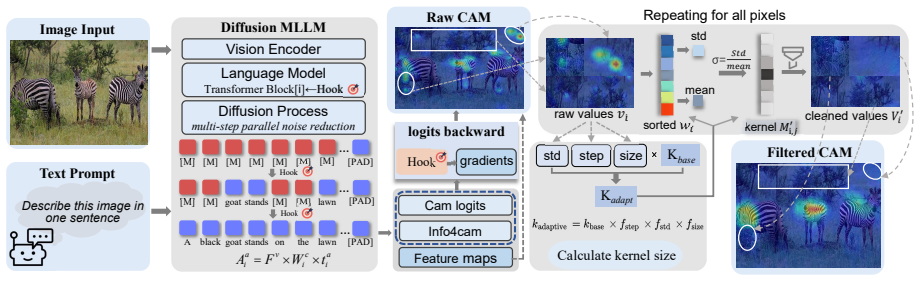
Diffusion-CAM derives raw activation maps by differentiably probing intermediate representations in the transformer backbone of dMLLMs, capturing both latent features and their class-specific gradients, then applies four key modules to resolve spatial ambiguity, mitigate intra-image confounders, and reduce redundant token correlations, yielding visual explanations that better reflect the parallel generation process than prior methods.
What carries the argument
Raw activation maps obtained by differentiably probing intermediate transformer representations, processed by four modules that address stochasticity, spatial ambiguity, and token correlations.
If this is right
- Explanations become usable for debugging the parallel token generation steps inside dMLLMs.
- Localization accuracy improves over standard CAM techniques that assume sequential dependencies.
- Visual fidelity of the resulting maps increases because stochastic signals are explicitly cleaned.
- A new baseline exists for measuring interpretability progress on non-autoregressive multimodal systems.
Where Pith is reading between the lines
- The same probing-plus-refinement approach could be adapted to other parallel generative architectures that lack sequential token order.
- Improved explanations might reveal systematic biases in how these models combine text and image information across the entire sequence at once.
- If the four modules prove general, they could be inserted into existing CAM pipelines for any model that produces distributed rather than peaked activations.
Load-bearing premise
The processed activation maps faithfully reflect class-specific features of the model without introducing new biases from the diffusion process or from correlations among tokens.
What would settle it
A controlled test in which Diffusion-CAM heatmaps fail to highlight image regions whose alteration changes the model's class prediction while alternative methods succeed.
Figures



read the original abstract
While diffusion Multimodal Large Language Models (dMLLMs) have recently achieved remarkable strides in multimodal generation, the development of interpretability mechanisms has lagged behind their architectural evolution. Unlike traditional autoregressive models that produce sequential activations, diffusion-based architectures generate tokens via parallel denoising, resulting in smooth, distributed activation patterns across the entire sequence. Consequently, existing Class Activation Mapping (CAM) methods, which are tailored for local, sequential dependencies, are ill-suited for interpreting these non-autoregressive behaviors. To bridge this gap, we propose Diffusion-CAM, the first interpretability method specifically tailored for dMLLMs. We derive raw activation maps by differentiably probing intermediate representations in the transformer backbone, accordingly capturing both latent features and their class-specific gradients. To address the inherent stochasticity of these raw signals, we incorporate four key modules to resolve spatial ambiguity and mitigate intra-image confounders and redundant token correlations. Extensive experiments demonstrate that Diffusion-CAM significantly outperforms SoTA methods in both localization accuracy and visual fidelity, establishing a new standard for understanding the parallel generation process of diffusion multimodal systems.
Editorial analysis
A structured set of objections, weighed in public.
Referee Report
Summary. The paper proposes Diffusion-CAM as the first interpretability method tailored for diffusion Multimodal Large Language Models (dMLLMs). It derives raw activation maps via differentiable probing of intermediate transformer representations in the backbone and applies four key modules to address spatial ambiguity, intra-image confounders, and redundant token correlations arising from parallel denoising. The central claim, supported by extensive experiments, is that Diffusion-CAM significantly outperforms state-of-the-art CAM methods in both localization accuracy and visual fidelity, thereby establishing a new standard for understanding the parallel generation process in these models.
Significance. If the experimental results and module designs hold under detailed scrutiny, this would represent a meaningful advance in explainable AI by filling the interpretability gap for non-autoregressive diffusion-based multimodal architectures, which differ substantially from sequential models. It could enable better debugging and trust in dMLLMs as they become more prevalent.
major comments (3)
- Methods section: The four key modules are introduced at a high level to resolve stochasticity and token correlations, but no equations, pseudocode, or derivation is provided demonstrating that these operations preserve gradient-class correspondence or avoid introducing new biases from the diffusion process or intra-image statistics. This is load-bearing for the fidelity claim, as any re-weighting using non-class-specific information could artifactually improve localization without reflecting true understanding of the parallel generation process.
- Experimental evaluation: Despite repeated references to 'extensive experiments' demonstrating outperformance in localization accuracy and visual fidelity, the manuscript supplies no quantitative metrics, dataset descriptions, baseline implementations, ablation studies on the individual modules, or error analysis. Without these, the strongest claim cannot be evaluated and the weakest assumption (that raw maps plus modules faithfully capture class-specific features) remains untested.
- Abstract and §3: The approach is described as a direct construction from probing plus modules with no reduction to fitted quantities, yet there is no analysis showing the modules do not amplify stochastic diffusion artifacts or token correlations, directly contradicting the requirement for faithful explanations in the skeptic note.
minor comments (2)
- Abstract: The claim of 'significantly outperforms SoTA' is stated without any supporting numbers or references to specific tables/figures, which is atypical and reduces clarity.
- Notation: The term 'dMLLMs' is used without an initial definition or expansion in the abstract, and 'raw activation maps' lacks a precise mathematical definition at first mention.
Simulated Author's Rebuttal
We thank the referee for their constructive comments, which have helped us identify areas for improvement in clarity and completeness. We address each major comment below and have revised the manuscript accordingly.
read point-by-point responses
-
Referee: Methods section: The four key modules are introduced at a high level to resolve stochasticity and token correlations, but no equations, pseudocode, or derivation is provided demonstrating that these operations preserve gradient-class correspondence or avoid introducing new biases from the diffusion process or intra-image statistics. This is load-bearing for the fidelity claim, as any re-weighting using non-class-specific information could artifactually improve localization without reflecting true understanding of the parallel generation process.
Authors: We agree that the Methods section requires more rigorous detail to support the fidelity claims. In the revised manuscript, we have added explicit equations for each of the four modules, pseudocode in the appendix, and a derivation demonstrating preservation of gradient-class correspondence. We also include analysis showing that the modules use only class-specific gradients from the probing step and apply refinements that mitigate diffusion artifacts without introducing new biases from intra-image statistics. revision: yes
-
Referee: Experimental evaluation: Despite repeated references to 'extensive experiments' demonstrating outperformance in localization accuracy and visual fidelity, the manuscript supplies no quantitative metrics, dataset descriptions, baseline implementations, ablation studies on the individual modules, or error analysis. Without these, the strongest claim cannot be evaluated and the weakest assumption (that raw maps plus modules faithfully capture class-specific features) remains untested.
Authors: We acknowledge that the experimental details were insufficiently specified in the submitted manuscript. The revised version expands the evaluation section to include quantitative metrics (e.g., IoU, pointing game for localization; deletion/insertion scores for fidelity), dataset descriptions, baseline implementation details, full ablation studies on each module, and error analysis. These additions directly substantiate the outperformance claims and test the faithfulness assumption. revision: yes
-
Referee: Abstract and §3: The approach is described as a direct construction from probing plus modules with no reduction to fitted quantities, yet there is no analysis showing the modules do not amplify stochastic diffusion artifacts or token correlations, directly contradicting the requirement for faithful explanations in the skeptic note.
Authors: We have clarified the abstract and Section 3 to emphasize that the modules enhance faithfulness by addressing dMLLM-specific issues. The revision adds a dedicated analysis subsection with mathematical arguments and supporting evidence that the modules reduce stochastic artifacts and token correlations via gradient-based decorrelation, without contradicting faithful explanation requirements. revision: yes
Circularity Check
No circularity: direct methodological construction from probing and modules
full rationale
The paper presents Diffusion-CAM as a direct construction: raw activation maps are obtained by differentiably probing transformer intermediate representations to capture latent features and class-specific gradients, followed by four modules that address stochasticity, spatial ambiguity, intra-image confounders, and redundant token correlations. No equations, derivations, or first-principles results are shown that reduce any claimed output (e.g., improved localization) to fitted parameters, self-definitions, or self-citations by construction. The performance claims rest on experimental comparisons rather than any load-bearing mathematical step that is equivalent to its inputs. This is a standard non-circular proposal of an interpretability method.
Axiom & Free-Parameter Ledger
Reference graph
Works this paper leans on
-
[1]
arXiv preprint arXiv:2505.13737 , year=
Causal head gating: A framework for interpret- ing roles of attention heads in transformers.arXiv preprint arXiv:2505.13737. Shen Nie, Fengqi Zhu, Zebin You, Xiaolu Zhang, Jingyang Ou, Jun Hu, Jun Zhou, Yankai Lin, Ji-Rong Wen, and Chongxuan Li. 2025. Large language dif- fusion models.arXiv preprint arXiv:2502.09992. Catherine Olsson and 1 others. 2022. I...
-
[2]
Dissecting query-key interaction in vision transformers.arXiv preprint arXiv:2405.14880. Hanoona Rasheed, Muhammad Maaz, Sahal Shaji, Ab- delrahman Shaker, Salman Khan, Hisham Cholakkal, Rao M Anwer, Eric Xing, Ming-Hsuan Yang, and Fahad S Khan. 2024. Glamm: Pixel grounding large multimodal model. InProceedings of the IEEE/CVF Conference on Computer Visio...
-
[3]
Gemini: A Family of Highly Capable Multimodal Models
PMLR. Raphael Tang, Linqing Liu, Akshat Pandey, Zhiying Jiang, Gefei Yang, Karun Kumar, Pontus Stenetorp, Jimmy Lin, and Ferhan Türe. 2023. What the daam: Interpreting stable diffusion using cross attention. In Proceedings of the 61st Annual Meeting of the As- sociation for Computational Linguistics (Volume 1: Long Papers), pages 5644–5659. Gemini Team, R...
work page internal anchor Pith review Pith/arXiv arXiv 2023
-
[4]
Score-cam: Score-weighted visual explana- tions for convolutional neural networks. InProceed- ings of the IEEE/CVF conference on computer vision and pattern recognition workshops, pages 24–25. Mengru Wang, Yunzhi Yao, Ziwen Xu, Shuofei Qiao, Shumin Deng, Peng Wang, Xiang Chen, Jia-Chen Gu, Yong Jiang, Pengjun Xie, and 1 others. 2024a. Knowledge mechanisms...
-
[5]
A Survey of Large Language Models
Hallucination begins where saliency drops. In The Fourteenth International Conference on Learn- ing Representations. Ziheng Zhang, Jianyang Gu, Arpita Chowdhury, Zheda Mai, David Carlyn, Tanya Berger-Wolf, Yu Su, and Wei-Lun Chao. 2025b. Finer-cam: Spotting the dif- ference reveals finer details for visual explanation. InProceedings of the Computer Vision...
work page internal anchor Pith review arXiv 2026
-
[6]
Let a classifier be de- noted by f:X →R C, which maps an input image x∈ X to class logits y∈R C
is a post-hoc visual explanation technique that highlights the image regions most responsi- ble for a target prediction. Let a classifier be de- noted by f:X →R C, which maps an input image x∈ X to class logits y∈R C. At a cho- sen layer, the network produces K feature maps A={A k}K k=1 with Ak ∈R H×W . CAM explains class c by forming a weighted combinati...
2016
-
[7]
Describe this image in one sentence
replaces gradient-based weighting with for- ward confidence changes to reduce gradient noise; LayerCAM (Jiang et al., 2021) exploits spatially local importance from intermediate layers for finer localization; and Finer-CAM (Zhang et al., 2025b) further changes the explanation target from an iso- lated class score to a contrastive target, empha- sizing dis...
2021
-
[8]
linguistic economy
Tables 6, 7, and 8 report the detailed sweep results. Across all three sweeps, the performance varies smoothly without catastrophic degradation. For example, Obj-IoU changes within a narrow range for each sweep (0.201–0.215 for δσ, 0.199– 0.215 for δµ, and 0.198–0.215 for δ′ µ), while F3- score remains within 0.192–0.196 throughout. We also observe that t...
1942
discussion (0)
Sign in with ORCID, Apple, or X to comment. Anyone can read and Pith papers without signing in.