Recognition: no theorem link
From Planning to Revision: How AI Writing Support at Different Stages Alters Ownership
Pith reviewed 2026-05-10 16:12 UTC · model grok-4.3
The pith
AI support for drafting reduces writers' sense of ownership more than support for planning or revising.
A machine-rendered reading of the paper's core claim, the machinery that carries it, and where it could break.
Core claim
While any AI assistance decreased ownership, planning support only minimally decreased ownership, while drafting support saw the largest decrease. This variation maps onto the amount of text and ideas contributed by AI, where more text and ideas from AI decreased ownership. Notably, an AI-generated draft based on participants' own outline resulted in significantly more AI-contributed ideas than AI support for planning. At the same time, more AI contributions improved essay quality.
What carries the argument
Writing-stage-specific AI assistance, measured by self-reported ownership and quantified counts of AI-contributed text and ideas.
If this is right
- Greater AI text and idea contribution improves measurable essay quality.
- An AI draft built on a user's outline still supplies more ideas than AI planning support alone.
- Stage of assistance should be considered when designing AI writing tools to manage ownership effects.
- Educators and writers may need stage-aware guidelines for when AI help is introduced.
Where Pith is reading between the lines
- Designers could limit AI idea generation in early stages to reduce ownership loss while retaining quality gains.
- Longer-term studies could test whether reduced ownership affects continued writing practice or attribution norms.
- The findings suggest testing stage-specific defaults in consumer AI writing products.
Load-bearing premise
That the three writing stages can be cleanly separated in the experimental conditions without carryover effects and that self-reported ownership scores capture the relevant psychological experience.
What would settle it
A replication that holds the amount of AI-contributed text and ideas constant across stages and finds no difference in ownership scores.
Figures


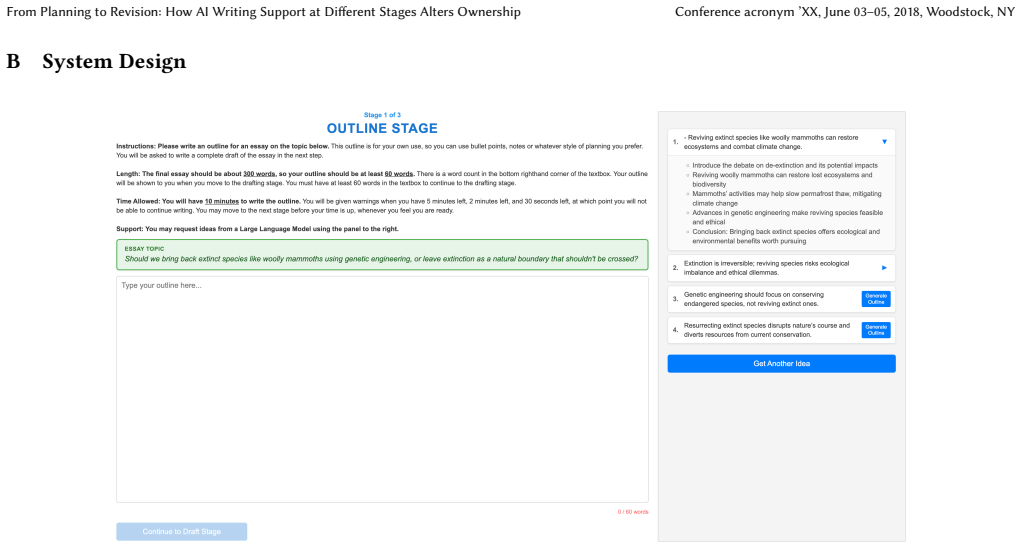


read the original abstract
Although AI assistance can improve writing quality, it can also decrease feelings of ownership. Ownership in writing has important implications for attribution, rights, norms, and cognitive engagement, and designers of AI support systems may want to consider how system features may impact ownership. We investigate how the stage at which AI support for writing is provided (planning, drafting, or revising) changes ownership. In a study of short essay writing (between subjects, n = 253) we find that while any AI assistance decreased ownership, planning support only minimally decreased ownership, while drafting support saw the largest decrease. This variation maps onto the amount of text and ideas contributed by AI, where more text and ideas from AI decreased ownership. Notably, an AI-generated draft based on participants' own outline resulted in significantly more AI-contributed ideas than AI support for planning. At the same time, more AI contributions improved essay quality. We propose that writers, educators, and designers consider writing stage when introducing AI assistance.
Editorial analysis
A structured set of objections, weighed in public.
Referee Report
Summary. The paper reports results from a between-subjects user study (n=253) on short-essay writing that examines how providing AI assistance at different stages (planning, drafting, or revising) affects writers' sense of ownership. The central empirical claim is that any AI assistance reduces ownership relative to a no-AI baseline, with planning-stage support producing only minimal reduction while drafting-stage support produces the largest reduction; this pattern is attributed to measurable differences in the volume of text and ideas contributed by the AI. The study additionally reports that greater AI contributions improve essay quality and that an AI-generated draft based on a participant's own outline yields more AI-contributed ideas than planning support alone.
Significance. If the reported stage-specific effects and their mapping to contribution volume hold after fuller methodological disclosure, the work offers a useful empirical contribution to HCI research on AI-augmented creative tasks. It supplies concrete guidance for tool designers and educators on choosing intervention timing to balance quality gains against ownership loss, and it strengthens the evidence base linking objective contribution metrics to subjective psychological outcomes in writing.
major comments (2)
- [Methods] Methods section: the abstract and study description omit the precise ownership measurement instrument (number and wording of items, scale anchors, reliability statistics), the exact statistical tests and effect-size reporting for the stage comparisons, and the participant exclusion criteria that produced the final n=253. These omissions are load-bearing because the central claim rests on detecting differential ownership reductions that are then mapped to AI contribution volume.
- [Results] Results and Discussion: the claim that an AI-generated draft from participants' own outlines produced significantly more AI-contributed ideas than planning support requires explicit reporting of the relevant means, standard deviations, and inferential statistics (including any correction for multiple comparisons) to allow readers to judge whether the difference is robust enough to support the proposed mechanism.
minor comments (2)
- [Abstract] Abstract: the phrasing 'planning support only minimally decreased ownership' would be clearer if accompanied by the actual mean difference or effect size relative to the no-AI baseline.
- [Methods] The manuscript would benefit from a brief table or figure summarizing the four experimental conditions, the exact AI prompts or interfaces used at each stage, and the measured outcome variables.
Simulated Author's Rebuttal
We thank the referee for the careful review and for identifying areas where additional methodological and statistical detail will strengthen the manuscript. We agree that fuller disclosure is warranted for the central claims and will incorporate the requested information in the revised version.
read point-by-point responses
-
Referee: [Methods] Methods section: the abstract and study description omit the precise ownership measurement instrument (number and wording of items, scale anchors, reliability statistics), the exact statistical tests and effect-size reporting for the stage comparisons, and the participant exclusion criteria that produced the final n=253. These omissions are load-bearing because the central claim rests on detecting differential ownership reductions that are then mapped to AI contribution volume.
Authors: We agree that these details are necessary for reproducibility and to allow readers to evaluate the ownership findings. In the revised manuscript we will expand the Methods section to report: (1) the full ownership instrument, including the exact number of items, wording, scale anchors (e.g., 1–7 Likert), and reliability (Cronbach’s α); (2) the precise statistical tests (ANOVA or planned contrasts) and effect sizes (η² or Cohen’s d) for all stage comparisons; and (3) the initial sample size, exclusion criteria, and how the final n=253 was obtained. These additions will directly support the mapping from contribution volume to ownership. revision: yes
-
Referee: [Results] Results and Discussion: the claim that an AI-generated draft from participants' own outlines produced significantly more AI-contributed ideas than planning support requires explicit reporting of the relevant means, standard deviations, and inferential statistics (including any correction for multiple comparisons) to allow readers to judge whether the difference is robust enough to support the proposed mechanism.
Authors: We acknowledge that the current text states the significant difference without the supporting statistics. In the revised Results section we will add the relevant descriptive statistics (means and SDs for AI-contributed ideas in the outline-based draft vs. planning conditions), the inferential test (t-test or ANOVA), exact p-value, effect size, and any multiple-comparison correction applied. This will allow readers to assess the robustness of the evidence for the proposed mechanism. revision: yes
Circularity Check
Empirical user study with no derivations or self-referential elements
full rationale
The paper reports a between-subjects experiment (n=253) measuring ownership, AI text/idea contributions, and essay quality across planning, drafting, and revising conditions. All central claims are direct statistical comparisons of collected participant data; there are no equations, fitted parameters, predictions derived from inputs, uniqueness theorems, or self-citations that bear the load of any result. The mapping from AI contribution volume to ownership is an observed correlation in the data, not a constructed equivalence or renamed prior result.
Axiom & Free-Parameter Ledger
axioms (1)
- domain assumption Between-subjects design isolates effects of AI support stage without carryover
Reference graph
Works this paper leans on
-
[1]
T. M. Amabile. 1983. The social psychology of creativity: A componential con- ceptualization.Journal of Personality and Social Psychology45 (1983), 357–376. https://api.semanticscholar.org/CorpusID:145719543
1983
-
[2]
Barrett R Anderson, Jash Hemant Shah, and Max Kreminski. 2024. Homogeniza- tion Effects of Large Language Models on Human Creative Ideation. InCreativity and Cognition. ACM, Chicago IL USA, 413–425. doi:10.1145/3635636.3656204
-
[3]
Virginia Braun and Victoria Clarke. 2012. Thematic Analysis. InAPA Handbook of Research Methods in Psychology, Vol 2: Research Designs: Quantitative, Qualitative, Neuropsychological, and Biological., Harris Cooper, Paul M. Camic, Debra L. Long, A. T. Panter, David Rindskopf, and Kenneth J. Sher (Eds.). American Psychological Association, Washington, 57–71...
-
[4]
Daniel Buschek. 2024. Collage Is the New Writing: Exploring the Fragmentation of Text and User Interfaces in AI Tools. InDesigning Interactive Systems Conference. ACM, Copenhagen Denmark, 2719–2737. doi:10.1145/3643834.3660681
-
[5]
John T. Cacioppo and Richard E. Petty. 1982. The Need for Cognition.Journal of Personality and Social Psychology42, 1 (Jan. 1982), 116–131. doi:10.1037/0022- 3514.42.1.116
-
[6]
Alex Calderwood, John Joon Young Chung, Yuqian Sun, Melissa Roem- mele, and Max Kreminski. 2025. Phraselette: A Poet’s Procedural Palette. arXiv:2503.06335 [cs] doi:10.48550/arXiv.2503.06335
-
[7]
Dashiel Carrera, Zixin Zhao, Ashish Ajin Thomas, and Daniel Wigdor. 2025. Nabokov’s Cards: An AI Assisted Prewriting System to Support Bottom-Up Creative Writing. InProceedings of the 2025 Conference on Creativity and Cognition. ACM, Virtual United Kingdom, 546–559. doi:10.1145/3698061.3726916
-
[8]
UC Berkeley Student Learning Center. [n. d.]. A Process Approach to Writing Re- search Papers. https://slc.berkeley.edu/writing-worksheets-and-other-writing- resources/process-approach-writing-research-papers. Accessed: 20 August 2025
2025
-
[9]
Lee, Gagan Bansal, Yuan Cao, Shuyuan Zhang, Justin Lu, Jackie Tsay, Yinan Wang, Andrew M
Mia Xu Chen, Benjamin N. Lee, Gagan Bansal, Yuan Cao, Shuyuan Zhang, Justin Lu, Jackie Tsay, Yinan Wang, Andrew M. Dai, Zhifeng Chen, Timothy Sohn, and Yonghui Wu. 2019. Gmail Smart Compose: Real-Time Assisted Writing. InProceedings of the 25th ACM SIGKDD International Conference on Knowledge Discovery & Data Mining. ACM, Anchorage AK USA, 2287–2295. doi:...
-
[10]
Elizabeth Clark, Anne Spencer Ross, Chenhao Tan, Yangfeng Ji, and Noah A. Smith. 2018. Creative Writing with a Machine in the Loop: Case Studies on Slogans and Stories. In23rd International Conference on Intelligent User Interfaces. ACM, Tokyo Japan, 329–340. doi:10.1145/3172944.3172983
-
[11]
Fabrizio Dell’Acqua, Edward McFowland, Ethan R. Mollick, Hila Lifshitz-Assaf, Katherine Kellogg, Saran Rajendran, Lisa Krayer, François Candelon, and Karim R. Lakhani. 2023. Navigating the Jagged Technological Frontier: Field Experimental Evidence of the Effects of AI on Knowledge Worker Productivity and Quality. SSRN Electronic Journal(2023). doi:10.2139...
-
[12]
InProceedings of the 2024 CHI Conference on Human Factors in Computing Systems
Paramveer S. Dhillon, Somayeh Molaei, Jiaqi Li, Maximilian Golub, Shaochun Zheng, and Lionel Peter Robert. 2024. Shaping Human-AI Collaboration: Varied Scaffolding Levels in Co-writing with Language Models. InProceedings of the CHI Conference on Human Factors in Computing Systems. ACM, Honolulu HI USA, 1–18. doi:10.1145/3613904.3642134
-
[13]
Anil R. Doshi and Oliver P. Hauser. 2024. Generative AI Enhances Individual Cre- ativity but Reduces the Collective Diversity of Novel Content.Science Advances 10, 28 (July 2024). doi:10.1126/sciadv.adn5290
-
[14]
Fiona Draxler, Anna Werner, Florian Lehmann, Matthias Hoppe, Albrecht Schmidt, Daniel Buschek, and Robin Welsch. 2024. The AI Ghostwriter Effect: When Users Do Not Perceive Ownership of AI-Generated Text but Self-Declare as Authors.ACM Transactions on Computer-Human Interaction31, 2 (April 2024), 1–40. doi:10.1145/3637875
-
[15]
EBSCO. [n. d.]. Writing process (planning, drafting, revising, editing, publish- ing). https://www.ebsco.com/research-starters/literature-and-writing/writing- process-planning-drafting-revising-editing. Accessed: 20 August 2025
2025
-
[16]
Elkhatat, Khaled Elsaid, and Saeed Almeer
Ahmed M. Elkhatat, Khaled Elsaid, and Saeed Almeer. 2023. Evaluating the Efficacy of AI Content Detection Tools in Differentiating between Human and AI-generated Text.International Journal for Educational Integrity19, 1 (Sept. 2023), 17. doi:10.1007/s40979-023-00140-5
-
[17]
Bradley Emi and Max Spero. 2024. Technical Report on the Pangram AI-Generated Text Classifier. arXiv:2402.14873 [cs] doi:10.48550/arXiv.2402.14873
-
[18]
Janet Emig. 1977. Writing as a Mode of Learning.College Composition and Communication28, 2 (May 1977), 122–128. doi:10.58680/ccc197716382
-
[19]
Linda Flower and John R Hayes. 1981. A Cognitive Process Theory of Writing. College Composition and Communication32, 4 (1981), 365–387. jstor:356600
1981
-
[20]
Kansas University: Wingspan: Center for Learning and Writing Support. [n. d.]. The Writing Process. https://writing.ku.edu/writing-process. Accessed: 20 August 2025
2025
-
[21]
Interaction Design Foundation. 2025. What is Design Thinking (DT)? https: //www.interaction-design.org/literature/topics/design-thinking. Accessed: 20 August 2025
2025
-
[22]
Katy Ilonka Gero and Lydia B. Chilton. 2019. Metaphoria: An Algorithmic Companion for Metaphor Creation. InProceedings of the 2019 CHI Conference on Human Factors in Computing Systems. ACM, Glasgow Scotland Uk, 1–12. doi:10.1145/3290605.3300526
-
[23]
Katy Ilonka Gero, Vivian Liu, and Lydia Chilton. 2022. Sparks: Inspiration for Sci- ence Writing Using Language Models. InDesigning Interactive Systems Conference. ACM, Virtual Event Australia, 1002–1019. doi:10.1145/3532106.3533533
- [24]
-
[25]
InProceedings of the 2024 CHI Conference on Human Factors in Computing Systems
Katy Ilonka Gero, Chelse Swoopes, Ziwei Gu, Jonathan K. Kummerfeld, and Elena L. Glassman. 2024. Supporting Sensemaking of Large Language Model Outputs at Scale. InProceedings of the CHI Conference on Human Factors in Computing Systems. ACM, Honolulu HI USA, 1–21. doi:10.1145/3613904.3642139
-
[26]
Georg Wilhelm Friedrich Hegel, T. M. Knox, and J. Sibree. 2015.The Philosophy of Right. Hackett Publishing, Chicago
2015
-
[27]
Shelton, Fanny Chevalier, Kari Kraus, and Niklas Elmqvist
Md Naimul Hoque, Tasfia Mashiat, Bhavya Ghai, Cecilia D. Shelton, Fanny Cheva- lier, Kari Kraus, and Niklas Elmqvist. 2024. The HaLLMark Effect: Supporting Provenance and Transparent Use of Large Language Models in Writing with In- teractive Visualization. InProceedings of the CHI Conference on Human Factors in Computing Systems. ACM, Honolulu HI USA, 1–1...
-
[28]
Xi Hu, Yiwen Xing, Xudong Cai, Yihang Zhao, Michael Cook, Rita Borgo, and Timothy Neate. 2025. Designing Interactions with Generative AI for Art and Creativity: A Systematic Review and Taxonomy. InProceedings of the 2025 ACM Designing Interactive Systems Conference. ACM, Madeira Portugal, 1126–1155. doi:10.1145/3715336.3735843
-
[29]
IELTS. [n. d.]. Writing Task 1 Band Descriptors. https://takeielts.britishcouncil. org/sites/default/files/ielts_writing_band_descriptors.pdf. Accessed: 20 August 2025
2025
-
[30]
John Hayes. 2000. A New Framework for Understanding Cognition and Affect in Writing. InThe Science of Writing. 6–44
2000
- [31]
-
[32]
If the Machine Is As Good As Me, Then What Use Am I?
Charlotte Kobiella, Yarhy Said Flores López, Franz Waltenberger, Fiona Draxler, and Albrecht Schmidt. 2024. "If the Machine Is As Good As Me, Then What Use Am I?" – How the Use of ChatGPT Changes Young Professionals’ Perception of Productivity and Accomplishment. InProceedings of the CHI Conference on Human Factors in Computing Systems. ACM, Honolulu HI U...
-
[33]
Nataliya Kosmyna, Eugene Hauptmann, Ye Tong Yuan, and Jessica Situ. [n. d.]. Your Brain on ChatGPT: Accumulation of Cognitive Debt When Using an AI Assistant for Essay Writing Task. ([n. d.])
-
[34]
Philippe Laban, Jesse Vig, Marti Hearst, Caiming Xiong, and Chien-Sheng Wu
-
[35]
Beyond the Chat: Executable and Verifiable Text-Editing with LLMs. In Proceedings of the 37th Annual ACM Symposium on User Interface Software and Technology. ACM, Pittsburgh PA USA, 1–23. doi:10.1145/3654777.3676419
-
[36]
In Proceedings of the 2024 CHI Conference on Human Factors in Computing Systems (CHI ’24)
Mina Lee, Katy Ilonka Gero, John Joon Young Chung, Simon Buckingham Shum, Vipul Raheja, Hua Shen, Subhashini Venugopalan, Thiemo Wambsganss, David Zhou, Emad A. Alghamdi, Tal August, Avinash Bhat, Madiha Zahrah Choksi, Senjuti Dutta, Jin L.C. Guo, Md Naimul Hoque, Yewon Kim, Simon Knight, Seyed Parsa Neshaei, Antonette Shibani, Disha Shrivastava, Lila Shr...
-
[37]
Mina Lee, Percy Liang, and Qian Yang. 2022. CoAuthor: Designing a Human-AI Collaborative Writing Dataset for Exploring Language Model Capabilities. In CHI Conference on Human Factors in Computing Systems. ACM, New Orleans LA USA, 1–19. doi:10.1145/3491102.3502030
-
[38]
Zhuoyan Li, Chen Liang, Jing Peng, and Ming Yin. 2024. The Value, Benefits, and Concerns of Generative AI-Powered Assistance in Writing. arXiv:2403.12004 [cs] doi:10.48550/arXiv.2403.12004
-
[39]
Weixin Liang, Yaohui Zhang, Mihai Codreanu, Jiayu Wang, Hancheng Cao, and James Zou. 2025. The Widespread Adoption of Large Language Model-Assisted Writing Across Society. arXiv:2502.09747 [cs] doi:10.48550/arXiv.2502.09747
-
[40]
1689.Second Treatise of Government
John Locke. 1689.Second Treatise of Government. The Project Gutenberg eBook. https://www.gutenberg.org/files/7370/7370-h/7370-h.htm
-
[41]
Tao Long, Katy Ilonka Gero, and Lydia B Chilton. 2024. Not Just Novelty: A Lon- gitudinal Study on Utility and Customization of an AI Workflow. InProceedings of the 2024 ACM Designing Interactive Systems Conference(Copenhagen, Denmark) (DIS ’24). Association for Computing Machinery, New York, NY, USA, 782–803. doi:10.1145/3643834.3661587
-
[42]
Damien Masson, Young-Ho Kim, and Fanny Chevalier. 2025. Textoshop: Interac- tions Inspired by Drawing Software to Facilitate Text Editing. InProceedings of the 2025 CHI Conference on Human Factors in Computing Systems. ACM, Yokohama Japan, 1–14. doi:10.1145/3706598.3713862
-
[43]
Damien Masson, Sylvain Malacria, Géry Casiez, and Daniel Vogel. 2024. Direct- GPT: A Direct Manipulation Interface to Interact with Large Language Models. InProceedings of the CHI Conference on Human Factors in Computing Systems. ACM, Honolulu HI USA, 1–16. doi:10.1145/3613904.3642462
-
[44]
Sheshera Mysore, Debarati Das, Hancheng Cao, and Bahareh Sarrafzadeh. 2025. Prototypical Human-AI Collaboration Behaviors from LLM-Assisted Writing in the Wild. arXiv:2505.16023 [cs] doi:10.48550/arXiv.2505.16023
-
[45]
doi:10.1016/j.jcps.2011.08.002 Notion Labs, Inc
Michael I. Norton, Daniel Mochon, and Dan Ariely. 2012. The IKEA Effect: When Labor Leads to Love.Journal of Consumer Psychology22, 3 (July 2012), 453–460. doi:10.1016/j.jcps.2011.08.002
-
[46]
Shakked Noy and Whitney Zhang. 2023. Experimental Evidence on the Produc- tivity Effects of Generative Artificial Intelligence.Science381, 6654 (July 2023), 187–192. doi:10.1126/science.adh2586 From Planning to Revision: How AI Writing Support at Different Stages Alters Ownership Conference acronym ’XX, June 03–05, 2018, Woodstock, NY
-
[47]
Pierce, Tatiana Kostova, and Kurt T
Jon L. Pierce, Tatiana Kostova, and Kurt T. Dirks. 2003. The State of Psychological Ownership: Integrating and Extending a Century of Research.Review of General Psychology7, 1 (March 2003), 84–107. doi:10.1037/1089-2680.7.1.84
-
[48]
Peinuan Qin, Chi-Lan Yang, Jingshu Li, Jing Wen, and Yi-Chieh Lee. 2025. Timing Matters: How Using LLMs at Different Timings Influences Writers’ Perceptions and Ideation Outcomes in AI-Assisted Ideation. InProceedings of the 2025 CHI Conference on Human Factors in Computing Systems. ACM, Yokohama Japan, 1–16. doi:10.1145/3706598.3713146
-
[49]
Mohi Reza, Jeb Thomas-Mitchell, Peter Dushniku, Nathan Laundry, Joseph Jay Williams, and Anastasia Kuzminykh. 2025. Co-Writing with AI, on Human Terms: Aligning Research with User Demands Across the Writing Process.Proceedings of the ACM on Human-Computer Interaction9, 7 (Oct. 2025), 1–37. doi:10.1145/ 3757566
2025
-
[50]
Language in Action
Carly Schnitzler. 2026. Amplifying “Language in Action”: A Process-Oriented Approach to Teaching Writing with LLMs in Personal Narrative.Pedagogy26, 1 (2026)
2026
-
[51]
Chenglei Si, Tatsunori Hashimoto, and Diyi Yang. 2025. The Ideation-Execution Gap: Execution Outcomes of LLM-Generated versus Human Research Ideas. arXiv:2506.20803 [cs] doi:10.48550/arXiv.2506.20803
-
[52]
Siddiqui, Nikki Nasseri, Adam Coscia, Roy Pea, and Hari Subramonyam
Momin N. Siddiqui, Nikki Nasseri, Adam Coscia, Roy Pea, and Hari Subramonyam
-
[53]
arXiv:2509.23505 [cs] doi:10.48550/ arXiv.2509.23505
DraftMarks: Enhancing Transparency in Human-AI Co-Writing Through Interactive Skeuomorphic Process Traces. arXiv:2509.23505 [cs] doi:10.48550/ arXiv.2509.23505
-
[54]
Nancy Sommers. 1980. Revision Strategies of Student Writers and Experienced Adult Writers.College Composition and Communication31, 4 (Dec. 1980), 378–388. jstor:356588
1980
-
[55]
MIT Comparative Media Studies. [n. d.]. Resources for Writers: The Writing Process. https://cmsw.mit.edu/writing-and-communication-center/resources/ writers/writing-process/. Accessed: 20 August 2025
2025
-
[56]
Sangho Suh, Meng Chen, Bryan Min, Toby Jia-Jun Li, and Haijun Xia. 2024. Luminate: Structured Generation and Exploration of Design Space with Large Language Models for Human-AI Co-Creation. InProceedings of the CHI Conference on Human Factors in Computing Systems. 1–26. arXiv:2310.12953 [cs] doi:10.1145/ 3613904.3642400
-
[57]
Luoxi Tang, Tharunya Sundar, Shuai Yang, Ankita Patra, Manohar Chippada, Giqi Zhao, Yi Li, Riteng Zhang, Tunan Zhao, Ting Yang, Yuqiao Meng, Weicheng Ma, and Zhaohan Xi. 2025. Are LLMs Ready for English Standardized Tests? A Benchmarking and Elicitation Perspective. arXiv:2505.17056 [cs] doi:10.48550/ arXiv.2505.17056
work page internal anchor Pith review Pith/arXiv arXiv 2025
-
[58]
Frederic Traylor. 2025. The Threat of AI Chatbot Responses to Crowdsourced Open-Ended Survey Questions.Energy Research & Social Science119 (Jan. 2025), 103857. doi:10.1016/j.erss.2024.103857
-
[59]
Khonzoda Umarova, Talia Wise, Zhuoer Lyu, Mina Lee, and Qian Yang. 2025. How Problematic Writer-AI Interactions (Rather than Problematic AI) Hinder Writers’ Idea Generation. arXiv:2503.11915 [cs] doi:10.48550/arXiv.2503.11915
-
[60]
Rama Adithya Varanasi, Batia Mishan Wiesenfeld, and Oded Nov. 2025. AI Rivalry as a Craft: How Resisting and Embracing Generative AI Are Reshaping the Writing Profession. InProceedings of the 2025 CHI Conference on Human Factors in Computing Systems (CHI ’25). Association for Computing Machinery, New York, NY, USA, 1–19. doi:10.1145/3706598.3714035
-
[61]
Jeremy Waldron. 2023. Property and Ownership. InThe Stanford Encyclopedia of Philosophy(Fall 2023 ed.), Edward N. Zalta and Uri Nodelman (Eds.). Metaphysics Research Lab, Stanford University
2023
-
[62]
Catherine Yeh, Gonzalo Ramos, Rachel Ng, Andy Huntington, and Richard Banks
-
[63]
GhostWriter: Augmenting Collaborative Human-AI Writing Experiences Through Personalization and Agency. arXiv:2402.08855 [cs] doi:10.48550/arXiv. 2402.08855
work page internal anchor Pith review doi:10.48550/arxiv
-
[64]
David Zhou and Sarah Sterman. 2023. Creative struggle: Arguing for the value of difficulty in supporting ownership and self-expression in creative writing. In The Second Workshop on Intelligent and Interactive Writing Assistants (In2Writing). In2Writing New York, NY, USA, 1–3
2023
-
[65]
Barry J. Zimmerman. 2002. Becoming a Self-Regulated Learner: An Overview. Theory Into Practice41, 2 (May 2002), 64–70. doi:10.1207/s15430421tip4102_2 Conference acronym ’XX, June 03–05, 2018, Woodstock, NY Katy Ilonka Gero, Tao Long, Carly Schnitzler, and Paramveer S. Dhillon A Essay Writing Prompts ID n (%) Essay Prompt a1 58 (23%) Should public schools ...
-
[67]
double quotes
Quote the problematic phrase EXACTLY as it appears in the text (keep it under 10 words), using "double quotes"
-
[68]
Very briefly explain the problem in 5-10 words
-
[69]
problematic text
Suggest a concise fix. The Fix must be a direct replacement for the quoted text, with no instructions, options, or meta-comments. If the fix is to delete the text, return an empty string.↩→ Format as: ### Issue 1 > "problematic text" > > **Issue**: Brief explanation > > **Fix**: "corrected version" Be extremely concise. Only identify actual errors. The qu...
2018
-
[71]
double quotes
Quote the unclear phrase EXACTLY as it appears in the text (keep it under 10 words), using "double quotes"
-
[72]
Very briefly explain the clarity issue in 5-10 words
-
[73]
unclear text
Suggest a clearer alternative. The Fix must be a direct replacement for the quoted text, with no instructions, options, or meta-comments. If the fix is to delete the text, return an empty string.↩→ Format as: ### Issue 1 > "unclear text" > > **Issue**: Brief explanation > > **Fix**: "clearer version" Be extremely concise. Focus only on clarity issues. The...
2018
-
[74]
Number the issue (Issue 1, Issue 2, etc.)
-
[75]
double quotes
Quote the relevant text that indicates approximately where the problem is (keep it under 15 words), using "double quotes". Quote a phrase EXACTLY as it appears in the text - copy and paste the exact words, do not paraphrase or modify. ↩→ ↩→
-
[76]
Very briefly describe the argument weakness
-
[77]
Provide a specific, actionable suggestion with concrete examples or specific steps
-
[78]
COMPLETE_SENTENCE
If your suggestion involves adding new content, provide: - **Addition label**: a short (2-6 words) summary for a button label, e.g.,'add examples and case studies','add limitations', or'add concrete examples'.↩→ - **Addition text**: the exact text to add (1-3 sentences). - **Insertion point**: a clear description of where to insert it. Use one of these fo...
2018
-
[79]
Quality of argument - how well the student develops and supports their ideas
-
[80]
Coherence and cohesion - how logically the essay flows and how ideas are connected
-
[81]
Lexical resource and grammar - vocabulary range, accuracy, and grammar use. Rubric (truncated to stay within context length): {rubric_text} Here are 30 graded examples for reference: {examples} Now grade the following essay: {essay_text} Assign scores that reflect the standards from the examples. Align with the reference grader
-
[82]
Avoid giving "safe" midrange scores unless they truly match the examples
Quality of argument: Look for weak reasoning, insufficient support, or underdeveloped ideas. Avoid giving "safe" midrange scores unless they truly match the examples
discussion (0)
Sign in with ORCID, Apple, or X to comment. Anyone can read and Pith papers without signing in.