Recognition: unknown
Parameterized Algorithms and Complexity for Function Merging with Branch Reordering
Pith reviewed 2026-05-10 16:10 UTC · model grok-4.3
The pith
Function merging with branch reordering is fixed-parameter tractable when parameterized by branching factor and nesting depth.
A machine-rendered reading of the paper's core claim, the machinery that carries it, and where it could break.
Core claim
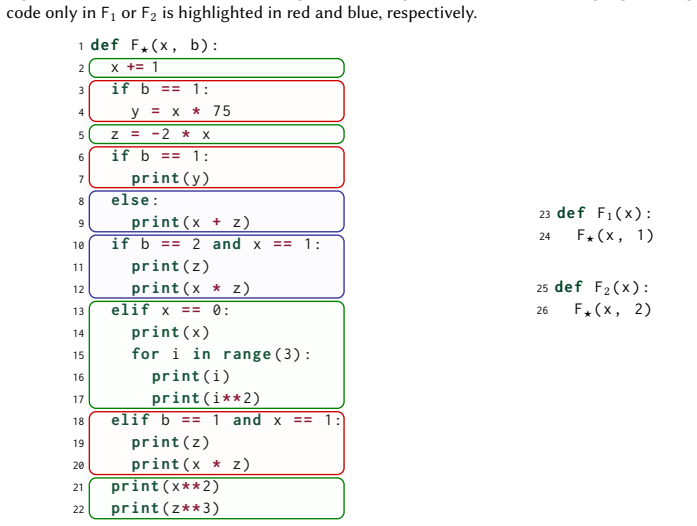
The input consists of two functions F1 and F2, each with size ni, branching factor bi, and nesting depth di. The task is to reorder branches within each function so that the resulting linearizations maximize sequence alignment score. The problem is fixed-parameter tractable in the four parameters b1, d1, b2, d2 via a 2^{O(bd)} n^2 algorithm, remains FPT when one nesting depth is unbounded via a 2^{O(b d2)} n^7 algorithm, and is NP-hard even when d1, b2, d2 are fixed constants.
What carries the argument
The pair of parameters consisting of branching factor b (maximum out-degree in the control-flow graph) and nesting depth d (maximum nesting level of branches), which together bound the number of distinct linearizations of each function.
If this is right
- When functions have small branching and nesting, compilers can compute optimal merges in time practical for code-size reduction.
- Tractability holds even if one input function has deep nesting, provided the other has bounded branching.
- The hardness result shows that constant nesting depth and branching in one function plus constant branching in the other is already intractable.
- The approach extends sequence-alignment methods by explicitly accounting for control-flow reordering.
Where Pith is reading between the lines
- The same parameterization could be applied to merging more than two functions or to other code-reordering tasks such as instruction scheduling.
- Practical implementations could combine the FPT algorithms with heuristics when bd grows moderately large.
- The results suggest studying whether additional natural parameters such as the number of live variables further reduce the exponent.
Load-bearing premise
Reordering the branches inside each function produces a semantically equivalent program whose observable behavior is unchanged.
What would settle it
An explicit pair of small functions with bounded bd whose optimal merge cannot be found by any algorithm running in time 2^{o(bd)} poly(n), or a concrete example where branch reordering changes observable program output.
Figures



read the original abstract
Binary size reduction is an increasingly important optimization objective for compilers. One emerging technique is function merging, where multiple similar functions are merged into one, thereby eliminating redundancy. The SOTA approach to perform the merging is based on sequence alignment, where functions are viewed as linear sequences of instructions that are then matched in a way maximizing their alignment. In this paper, we consider a significantly generalized formulation of the problem by allowing reordering of branches within each function, subsequently allowing for more flexible matching and better merging. We show that this makes the problem NP-hard, and thus we study it through the lens of parameterized algorithms and complexity, where we identify certain parameters of the input that govern its complexity. We look at two natural parameters: the branching factor and nesting depth of input functions. Concretely, our input consists of two functions $F_1, F_2,$ where each $F_i$ has size $n_i,$ branching factor $b_i,$ and nesting depth $d_i.$ Our task is to reorder the branches of $F_1$ and $F_2$ in a way that yields linearizations achieving the maximum sequence alignment. Let $n=\max(n_1, n_2),$ and define $b, d$ similarly. Our results are as follows: - A simple algorithm running in time $2^{O(bd)} n^2,$ establishing that the problem is fixed-parameter tractable (FPT) with respect to all four parameters $b_1,d_1, b_2, d_2.$ - An algorithm running in time $2^{O(bd_2)} n^7,$ showing that even when one of the functions has an unbounded nesting depth, the problem remains in FPT. - A hardness result showing that the problem is NP-hard even when constrained to constant $d_1, b_2, d_2.$ To the best of our knowledge, this is the first systematic study of function merging with branch reordering from an algorithmic or complexity-theoretic perspective.
Editorial analysis
A structured set of objections, weighed in public.
Referee Report
Summary. The manuscript generalizes the function merging problem to allow reordering of branches within each of two input functions F1 and F2 (with sizes n1, n2, branching factors b1, b2, and nesting depths d1, d2) in order to maximize the score of a subsequent sequence alignment. It presents an FPT algorithm running in time 2^{O(bd)} n^2 (where b and d are the maxima of the respective parameters), a second algorithm running in time 2^{O(b d2)} n^7 that remains FPT even when d1 is unbounded, and an NP-hardness result that holds even when d1, b2, and d2 are fixed constants.
Significance. If the stated running times and hardness reduction are correct, the work supplies the first parameterized-complexity treatment of branch-reordering function merging. The parameters b_i and d_i are natural, small in practice, and directly bound the state space of any dynamic program over reorderings; the explicit FPT bounds and the separation between the fully bounded case and the one-sided unbounded-depth case therefore give concrete guidance on when the optimization is tractable. The hardness result usefully delineates the boundary of tractability.
minor comments (3)
- The abstract states that n = max(n1, n2) and b, d are defined similarly, but the manuscript should explicitly confirm whether the O(bd) term uses the maxima or the sums of the individual parameters, as this affects the precise FPT claim.
- The NP-hardness statement leaves b1 unbounded; the manuscript should add a sentence clarifying that this is the intended source of hardness and that the reduction does not rely on large b1.
- Notation for the two functions and their linearizations after reordering should be introduced once in a dedicated preliminary section and used consistently thereafter.
Simulated Author's Rebuttal
We thank the referee for the positive evaluation of our manuscript and the recommendation for minor revision. The report provides a clear summary of our contributions but does not list any specific major comments requiring response. We are pleased that the parameterized complexity results, including the FPT algorithms and the hardness result, are viewed as providing useful guidance on the tractability of function merging with branch reordering.
Circularity Check
No significant circularity
full rationale
The paper's core results consist of explicit algorithmic constructions (a DP-based FPT algorithm running in 2^{O(bd)} n^2 time and a variant in 2^{O(b d2)} n^7) together with a standard NP-hardness reduction for the remaining parameter. These are derived directly from the definitions of branching factor b_i and nesting depth d_i as natural bounds on the state space of reorderings and alignments; no quantities are defined in terms of themselves, no fitted parameters are relabeled as predictions, and no load-bearing claims rest on self-citations or imported uniqueness theorems. The semantic assumption that branch reordering preserves observable behavior is stated as part of the problem formulation rather than derived from the algorithms themselves. The derivation chain is therefore self-contained and non-circular.
Axiom & Free-Parameter Ledger
axioms (1)
- standard math Standard definitions and results from parameterized complexity theory (FPT membership via explicit algorithms, NP-hardness via reduction).
Reference graph
Works this paper leans on
-
[1]
Amir Abboud, Arturs Backurs, and Virginia Vassilevska Williams. 2015. Tight Hardness Results for LCS and Other Sequence Similarity Measures. InFOCS. IEEE Computer Society, 59–78
2015
-
[2]
Frances E. Allen. 1970. Control flow analysis. InSymposium on Compiler Optimization. ACM, 1–19
1970
-
[3]
Karl Bringmann and Marvin Künnemann. 2015. Quadratic Conditional Lower Bounds for String Problems and Dynamic Time Warping. InFOCS. IEEE Computer Society, 79–97
2015
-
[4]
Milind Chabbi, Jin Lin, and Raj Barik. 2021. An Experience with Code-Size Optimization for Production iOS Mobile Applications. InCGO. IEEE, 363–377
2021
-
[5]
Cormen, Charles E
Thomas H. Cormen, Charles E. Leiserson, Ronald L. Rivest, and Clifford Stein. 2009.Introduction to Algorithms, 3rd Edition. MIT Press
2009
-
[6]
Bruno Coutinho, Diogo Sampaio, Fernando Magno Quintão Pereira, and Wagner Meira Jr. 2011. Divergence Analysis and Optimizations. InPACT. IEEE Computer Society, 320–329
2011
-
[7]
Fomin, Lukasz Kowalik, Daniel Lokshtanov, Dániel Marx, Marcin Pilipczuk, Michal Pilipczuk, and Saket Saurabh
Marek Cygan, Fedor V. Fomin, Lukasz Kowalik, Daniel Lokshtanov, Dániel Marx, Marcin Pilipczuk, Michal Pilipczuk, and Saket Saurabh. 2015.Parameterized Algorithms. Springer
2015
-
[8]
Downey and Michael R
Rodney G. Downey and Michael R. Fellows. 1999.Parameterized Complexity. Springer
1999
-
[9]
Enming Fan, Xiaofeng Guan, Fan Hu, Heng Shi, Hao Zhou, and Jianguo Yao. 2025. Postiz: Extending Post-increment Addressing for Loop Optimization and Code Size Reduction. InCGO. ACM, 600–613
2025
-
[10]
M. R. Garey and David S. Johnson. 1979.Computers and Intractability: A Guide to the Theory of NP-Completeness. W. H. Freeman
1979
-
[11]
Tianao Ge, Zewei Mo, Kan Wu, Xianwei Zhang, and Yutong Lu. 2022. RollBin: reducing code-size via loop rerolling at binary level. InLCTES. ACM, 99–110
2022
-
[12]
2025.Android Developers - Reduce your app size
Google. 2025.Android Developers - Reduce your app size. Technical Report. https://developer.android.com/topic/ performance/reduce-apk-size
2025
-
[13]
Ellis Hoag, Kyungwoo Lee, Julián Mestre, Sergey Pupyrev, and Yongkang Zhu. 2024. Reordering Functions in Mobiles Apps for Reduced Size and Faster Start-Up.ACM Trans. Embed. Comput. Syst.23, 4 (2024), 54:1–54:54
2024
-
[14]
2004.An introduction to bioinformatics algorithms
Neil C Jones and Pavel A Pevzner. 2004.An introduction to bioinformatics algorithms. MIT press
2004
-
[15]
Kyungwoo Lee, Ellis Hoag, and Nikolai Tillmann. 2022. Efficient profile-guided size optimization for native mobile applications. InCC. ACM, 243–253
2022
-
[16]
Kyungwoo Lee, Manman Ren, and Ellis Hoag. 2024. Optimistic and Scalable Global Function Merging. InLCTES. ACM, 46–57
2024
-
[17]
Kyungwoo Lee, Manman Ren, and Shane Nay. 2022. Scalable size inliner for mobile applications (WIP). InLCTES. ACM, 116–120
2022
-
[18]
Gai Liu, Umar Farooq, Chengyan Zhao, Xia Liu, and Nian Sun. 2023. Linker Code Size Optimization for Native Mobile Applications. InCC. ACM, 168–179
2023
-
[19]
Reps, Stefan Schwoon, Somesh Jha, and David Melski
Thomas W. Reps, Stefan Schwoon, Somesh Jha, and David Melski. 2005. Weighted pushdown systems and their application to interprocedural dataflow analysis.Sci. Comput. Program.58, 1-2 (2005), 206–263
2005
-
[20]
Rodrigo C. O. Rocha, Pavlos Petoumenos, Björn Franke, Pramod Bhatotia, and Michael F. P. O’Boyle. 2022. Loop Rolling for Code Size Reduction. InCGO. IEEE, 217–229
2022
-
[21]
Rodrigo C. O. Rocha, Pavlos Petoumenos, Zheng Wang, Murray Cole, Kim M. Hazelwood, and Hugh Leather. 2021. HyFM: function merging for free. InLCTES. ACM, 110–121
2021
-
[22]
Rodrigo C. O. Rocha, Pavlos Petoumenos, Zheng Wang, Murray Cole, and Hugh Leather. 2019. Function Merging by Sequence Alignment. InCGO. IEEE, 149–163
2019
-
[23]
Rodrigo C. O. Rocha, Pavlos Petoumenos, Zheng Wang, Murray Cole, and Hugh Leather. 2020. Effective function merging in the SSA form. InPLDI. ACM, 854–868
2020
-
[24]
Rodrigo C. O. Rocha, Charitha Saumya, Kirshanthan Sundararajah, Pavlos Petoumenos, Milind Kulkarni, and Michael F. P. O’Boyle. 2023. HyBF: A Hybrid Branch Fusion Strategy for Code Size Reduction. InCC. ACM, 156–167
2023
-
[25]
Yuta Saito, Kazunori Sakamoto, Hironori Washizaki, and Yoshiaki Fukazawa. 2025. Multiple Function Merging for Code Size Reduction.ACM Trans. Archit. Code Optim.22, 1 (2025), 7:1–7:26
2025
-
[26]
Anuj Sehgal, Vladislav Perelman, Siarhei Kuryla, and Jürgen Schönwälder. 2012. Management of resource constrained devices in the internet of things.IEEE Commun. Mag.50, 12 (2012), 144–149
2012
-
[27]
Sean Stirling, Rodrigo C. O. Rocha, Kim M. Hazelwood, Hugh Leather, Michael F. P. O’Boyle, and Pavlos Petoumenos
-
[28]
F3M: Fast Focused Function Merging. InCGO. IEEE, 242–253. Proc. ACM Program. Lang., Vol. 10, No. PLDI, Article 204. Publication date: June 2026. 204:24 Goharshady et al
2026
-
[29]
Tobias J. K. Edler von Koch, Björn Franke, Pranav Bhandarkar, and Anshuman Dasgupta. 2014. Exploiting function similarity for code size reduction. InLCTES. ACM, 85–94. A Appendix A.1 Proof of Lemma 3.2 Lemma 3.2.Given two programs 𝑃1, 𝑃2 ∈Prog(Σ) and a scoring function 𝛿, Algorithm 2 returns FMBR(𝑃 1, 𝑃2, 𝛿). Proof. We first give a quick refresher on the ...
2014
discussion (0)
Sign in with ORCID, Apple, or X to comment. Anyone can read and Pith papers without signing in.