Recognition: unknown
Optimizing Riesz means of Robin Laplace operators on cuboids in a semiclassical limit
Pith reviewed 2026-05-10 15:48 UTC · model grok-4.3
The pith
The transition point for maximizers of Riesz means on Robin cuboids differs from where the second asymptotic term changes sign.
A machine-rendered reading of the paper's core claim, the machinery that carries it, and where it could break.
Core claim
In the semiclassical limit, sequences of cuboids maximizing the Riesz means of the Robin Laplacian either converge to the unit cube or possess no convergent subsequences, depending on the ratio between the Robin parameter and the square root of the spectral parameter; this transition ratio may differ from the point where the second term of the two-term asymptotic expansion changes sign.
What carries the argument
Two-term spectral asymptotics for the Riesz means of the Robin Laplacian on cuboids, combined with uniform inequalities that hold uniformly for all cuboids of fixed measure.
Load-bearing premise
The two-term spectral asymptotics and uniform inequalities for the Riesz means remain sufficiently accurate and uniform across varying cuboid shapes to control the location of the maximizers in the semiclassical limit.
What would settle it
For a ratio lying strictly between the sign-change point of the second asymptotic term and the claimed transition point, compute or approximate the Riesz means for cuboid sequences with aspect ratios approaching the boundary of the convergent regime and check whether those cuboids achieve the maximum value.
Figures
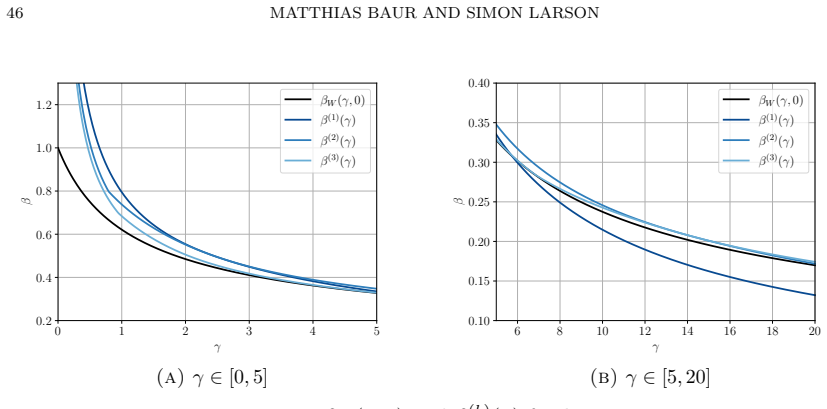

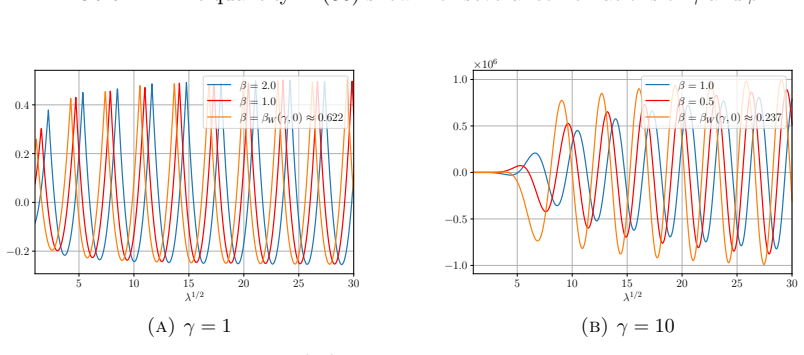
read the original abstract
We study asymptotic shape optimization for Riesz means of Robin Laplacian eigenvalues among cuboids of fixed measure. Our focus is the regime where the Robin parameter is proportional to the square root of the spectral parameter defining the Riesz means. Here, a transition emerges based on the precise ratio between the two parameters: as the spectral parameter tends to infinity, sequences of maximizers shift from converging to the unit cube to lacking convergent subsequences entirely. Key tools include two-term spectral asymptotics and uniform inequalities for the Riesz means. Notably, the transition point governing the behavior of optimizers may differ from the point at which the second asymptotic term changes sign. This shows that heuristics based solely on asymptotics for a fixed domain fail to accurately predict the asymptotic behavior of maximizers.
Editorial analysis
A structured set of objections, weighed in public.
Referee Report
Summary. The paper examines asymptotic shape optimization of Riesz means of Robin Laplacian eigenvalues on cuboids of fixed volume in the semiclassical regime where the Robin parameter scales proportionally to the square root of the spectral parameter. It identifies a transition in the ratio of these parameters separating two regimes: sequences of maximizers that converge to the unit cube versus sequences with no convergent subsequences. The argument relies on two-term spectral asymptotics for the Riesz means together with uniform inequalities that are claimed to hold across all aspect ratios; the authors note that the optimizer transition occurs at a different ratio than the sign-change of the second asymptotic term, showing that fixed-domain heuristics are insufficient.
Significance. If the uniformity statements hold, the result supplies a concrete instance in which the asymptotic location of optimizers for a spectral functional cannot be read off from the sign of the second term in the expansion on a fixed domain. This clarifies the limitations of naive asymptotic heuristics in shape optimization and contributes a rigorous example to the literature on semiclassical Robin problems. The explicit separation between the two transition points is a strength of the analysis.
major comments (2)
- [§3] §3 (two-term asymptotics) and the statement of the uniform remainder: the claimed uniformity of the error term in the Riesz-mean expansion must be independent of the aspect ratios of the cuboid. When one or more side lengths tend to zero while the volume is held fixed, the Robin boundary corrections on the short faces produce eigenvalue shifts of the same order as the second asymptotic term; the paper must supply explicit constants in the o(1) remainder that do not deteriorate with eccentricity, otherwise the comparison that locates the optimizer transition can change sign before the nominal threshold.
- [Proof of main transition theorem] Proof of the main transition theorem (presumably Theorem 1.3 or equivalent): the argument that the optimizer transition differs from the sign-change point of the second term rests on the uniform inequalities being strong enough to control the difference between Riesz means on the cube and on anisotropic cuboids. If the implicit constants in those inequalities grow with the aspect ratio, the separation between the two critical ratios may collapse or reverse; an explicit quantitative estimate showing that the remainder is smaller than the gap between the two candidate thresholds is required.
minor comments (2)
- [Introduction] Notation for the Riesz means and the semiclassical parameter should be introduced once and used consistently; currently the scaling relation between the Robin parameter and the spectral parameter is stated in the abstract but reappears with slightly different symbols in the body.
- [Main results] The statement that 'sequences of maximizers lack convergent subsequences' would benefit from a brief clarification of the topology in which non-compactness is measured (e.g., in the space of cuboids up to scaling).
Simulated Author's Rebuttal
We thank the referee for the thorough review and for emphasizing the need for explicit uniformity in the error terms. The comments highlight important points about the robustness of our asymptotic comparisons, which we address below by committing to additional explicit estimates in the revision.
read point-by-point responses
-
Referee: [§3] §3 (two-term asymptotics) and the statement of the uniform remainder: the claimed uniformity of the error term in the Riesz-mean expansion must be independent of the aspect ratios of the cuboid. When one or more side lengths tend to zero while the volume is held fixed, the Robin boundary corrections on the short faces produce eigenvalue shifts of the same order as the second asymptotic term; the paper must supply explicit constants in the o(1) remainder that do not deteriorate with eccentricity, otherwise the comparison that locates the optimizer transition can change sign before the nominal threshold.
Authors: We agree that explicit control on the constants is necessary for the argument to be fully rigorous. In Section 3 the two-term expansion is derived from the semiclassical trace formula adapted to the Robin setting with the given scaling; the remainder arises from the standard Weyl remainder plus boundary corrections that remain o(1) uniformly because the Robin parameter is proportional to the square root of the spectral parameter. Nevertheless, the referee is correct that the dependence on eccentricity must be made fully explicit. In the revised manuscript we will insert a new lemma (or expanded remark) that supplies an explicit bound on the o(1) term whose constant depends only on the fixed volume and the proportionality constant in the Robin scaling, remaining bounded as any side length tends to zero. This will ensure the sign comparisons used later are unaffected. revision: yes
-
Referee: [Proof of main transition theorem] Proof of the main transition theorem (presumably Theorem 1.3 or equivalent): the argument that the optimizer transition differs from the sign-change point of the second term rests on the uniform inequalities being strong enough to control the difference between Riesz means on the cube and on anisotropic cuboids. If the implicit constants in those inequalities grow with the aspect ratio, the separation between the two critical ratios may collapse or reverse; an explicit quantitative estimate showing that the remainder is smaller than the gap between the two candidate thresholds is required.
Authors: The separation between the sign-change ratio of the second term and the optimizer-transition ratio is indeed the central claim, and it rests on the uniform inequalities being quantitatively strong enough. We will add, in the proof of the main theorem, an explicit estimate that bounds the total error (asymptotic remainder plus the difference between the cube and any other cuboid of the same volume) by a multiple of the positive gap between the two critical ratios, with the multiple independent of aspect ratio. This quantitative comparison will be inserted directly after the statement of the uniform inequalities, confirming that the transition point remains strictly larger than the sign-change point for all sufficiently large spectral parameters. revision: yes
Circularity Check
No circularity: derivation rests on external two-term asymptotics and uniform remainder estimates
full rationale
The paper's central claims concern the location of maximizers for Riesz means of Robin Laplacians on cuboids and the distinction between optimizer transition and sign-change of the second asymptotic term. These rest on cited two-term spectral asymptotics plus uniform inequalities for the Riesz means, which are treated as external tools rather than derived or fitted within the optimization itself. No step equates a prediction to a fitted input by construction, renames a known result as new unification, or reduces the transition-point result to a self-citation chain whose validity depends on the present work. The abstract explicitly contrasts the optimizer behavior with fixed-domain heuristics, confirming the argument is not self-definitional. Minor self-citations, if present for background asymptotics, are not load-bearing for the main comparison and do not force the claimed separation between transition points.
Axiom & Free-Parameter Ledger
axioms (2)
- domain assumption Two-term spectral asymptotics hold uniformly for Robin Laplacians on cuboids in the semiclassical limit
- domain assumption Uniform inequalities for the Riesz means are valid across the family of cuboids
Reference graph
Works this paper leans on
-
[1]
P. R. S. Antunes and P. Freitas,Optimal spectral rectangles and lattice ellipses. Proc. R. Soc. Lond. Ser. A Math. Phys. Eng. Sci.469(2013), no. 2150
2013
-
[2]
P. R. S. Antunes and P. Freitas,Optimization of Eigenvalues of the Dirichlet Laplacian with a Surface Area Restriction. Appl. Math. Optim.73(2016), no. 2, 313–328
2016
-
[3]
P. R. S. Antunes, P. Freitas, and J. Kennedy,Asymptotic behaviour and numerical approximation of optimal eigenvalues of the Robin Laplacian. ESAIM Control Optim. Calc. Var.19(2013), no. 2, 438–459
2013
-
[4]
Aizenman and E
M. Aizenman and E. H. Lieb,On semiclassical bounds for eigenvalues of Schr ¨odinger operators. Phys. Lett. A66(1978), no. 6, 427–429
1978
-
[5]
F. A. Berezin,Covariant and contravariant symbols of operators. Izv. Akad. Nauk SSSR Ser. Mat.36(1972), 1134–1167
1972
-
[6]
van den Berg,On the minimization of Dirichlet eigenvalues
M. van den Berg,On the minimization of Dirichlet eigenvalues. Bull. Lond. Math. Soc. 47(2015), no. 1, 143–155
2015
-
[7]
van den Berg, D
M. van den Berg, D. Bucur, and K. Gittins,Maximising Neumann eigenvalues on rectangles. Bull. Lond. Math. Soc.48(2016), no. 5, 877–894
2016
-
[8]
van den Berg and K
M. van den Berg and K. Gittins,Minimising Dirichlet eigenvalues on cuboids of unit measure. Mathematika63(2017), 468–482
2017
-
[9]
Bucur and P
D. Bucur and P. Freitas,Asymptotic behaviour of optimal spectral planar domains with fixed perimeter. J. Math. Phys.54(2013), no. 5, 053504
2013
-
[10]
Buoso and P
D. Buoso and P. Freitas,Extremal eigenvalues of the Dirichlet biharmonic operator on rectangles. Proc. Amer. Math. Soc.148(2020), no. 3, 1109–1120
2020
-
[11]
E. A. Carlen, R. L. Frank, and S. Larson,A Jensen inequality for partial traces and applications to partially semiclassical limits. Lett. Math. Phys.115(2025), no. 3, paper no. 52
2025
-
[12]
Farrington,On the isoperimetric and isodiametric inequalities and the minimisation of eigenvalues of the Laplacian
S. Farrington,On the isoperimetric and isodiametric inequalities and the minimisation of eigenvalues of the Laplacian. J. Geom. Anal.35(2025), no. 2, paper no. 62
2025
-
[13]
R. L. Frank, A. Laptev, and T. Weidl,Schr ¨odinger Operators: Eigenvalues and Lieb– Thirring Inequalities. Cambridge Studies in Advanced Mathematics, Cambridge Uni- versity Press, Cambridge, 2023
2023
-
[14]
R. L. Frank and L. Geisinger,Semi-classical analysis of the Laplace operator with Robin boundary conditions. Bull. Math. Sci.2(2012), no. 2, 281–319. OPTIMIZING RIESZ MEANS OF ROBIN LAPLACE OPERATORS 49
2012
-
[15]
R. L. Frank and S. Larson,Two-term spectral asymptotics for the Dirichlet Laplacian in a Lipschitz domain. J. Reine Angew. Math.766(2020), 195–228
2020
-
[16]
R. L. Frank and S. Larson,Riesz means asymptotics for Dirichlet and Neumann Lapla- cians on Lipschitz domains. Invent. Math.241(2025), 999–1079
2025
-
[17]
R. L. Frank and S. Larson,Semiclassical inequalities for Dirichlet and Neumann Lapla- cians on convex domains. Comm. Pure Appl. Math.79(2026), no. 3, 762-822
2026
-
[18]
Freitas,Asymptotic behaviour of extremal averages of Laplacian eigenvalues
P. Freitas,Asymptotic behaviour of extremal averages of Laplacian eigenvalues. J. Stat. Phys.167(2017), no. 6, 1511–1518
2017
-
[19]
Freitas, J
P. Freitas, J. Lagac´ e, and J. Payette,Optimal unions of scaled copies of domains and P´ olya’s conjecture. Ark. Mat.59(2021), no. 1, 11–51
2021
-
[20]
Freitas and J
P. Freitas and J. Kennedy,Extremal Domains and P´ olya-type Inequalities for the Robin Laplacian on Rectangles and Unions of Rectangles. Int. Math. Res. Not. IMRN (2021), no. 18, 13730-13782
2021
-
[21]
Gittins and S
K. Gittins and S. Larson,Asymptotic behaviour of cuboids optimising Laplacian eigen- values. Integral Equations Operator Theory89(2017), no. 5, 607–629
2017
-
[22]
Henrot,Extremum problems for Eigenvalues of Elliptic Operators
A. Henrot,Extremum problems for Eigenvalues of Elliptic Operators. Frontiers in Math- ematics. Birkh¨auser Verlag, Basel (2006)
2006
-
[23]
Henrot (ed.),Shape optimization and spectral theory
A. Henrot (ed.),Shape optimization and spectral theory. De Gruyter Open, Warsaw, 2017
2017
-
[24]
Ivrii,The second term of the spectral asymptotics for a Laplace-Beltrami operator on manifolds with boundary
V. Ivrii,The second term of the spectral asymptotics for a Laplace-Beltrami operator on manifolds with boundary. Funktsional. Anal. i Prilozhen.14(1980), no. 2, 25–34
1980
-
[25]
Kr ¨oger,Upper bounds for the Neumann eigenvalues on a bounded domain in Eu- clidean space, J
P. Kr ¨oger,Upper bounds for the Neumann eigenvalues on a bounded domain in Eu- clidean space, J. Funct. Anal.106(1992), no. 2, 353–357
1992
-
[26]
Lagac´ e,Eigenvalue optimisation on flat tori and lattice points in anisotropically expanding domains
J. Lagac´ e,Eigenvalue optimisation on flat tori and lattice points in anisotropically expanding domains. Canad. J. Math.72(2020), no. 4, 967–987
2020
-
[27]
Larson,Asymptotic shape optimization for Riesz means of the Dirichlet Laplacian over convex domains
S. Larson,Asymptotic shape optimization for Riesz means of the Dirichlet Laplacian over convex domains. J. Spectr. Theory9(2019), no. 3, 857–895. Erratum in J. Spectr. Theory11(2021), no. 4
2019
-
[28]
Larson,Maximizing Riesz means of anisotropic harmonic oscillators
S. Larson,Maximizing Riesz means of anisotropic harmonic oscillators. Ark. Mat.57 (2019), no. 1, 129–155
2019
-
[29]
Larson and R
S. Larson and R. L. Frank,Spectral Asymptotics for Robin Laplacians on Lipschitz Sets. Funct. Anal. Appl.59(2025), no. 3, 277–296
2025
-
[30]
Li and S
P. Li and S. T. Yau,On the Schr ¨odinger equation and the eigenvalue problem. Comm. Math. Phys.88(1983), no. 3, 309–318
1983
-
[31]
P´ olya,Mathematics and plausible reasoning Vol II
G. P´ olya,Mathematics and plausible reasoning Vol II. Patterns of plausible inference. Princeton University Press, Princeton, NJ, (1954)
1954
-
[32]
P´ olya,On the eigenvalues of vibrating membranes
G. P´ olya,On the eigenvalues of vibrating membranes. Proc. London Math. Soc. (3)11 (1961), no. 1, 419–433. 33.NIST Digital Library of Mathematical Functions. http://dlmf.nist.gov/, Release 1.2.1, F. W. J. Olver, A. B. Olde Daalhuis, D. W. Lozier, B. I. Schneider, R. F. Boisvert, C. W. Clark, B. R. Miller, B. V. Saunders, H. S. Cohl, and M. A. McClain (ed...
1961
discussion (0)
Sign in with ORCID, Apple, or X to comment. Anyone can read and Pith papers without signing in.