Recognition: unknown
Naka-GS: A Bionics-inspired Dual-Branch Naka Correction and Progressive Point Pruning for Low-Light 3DGS
Pith reviewed 2026-05-10 15:09 UTC · model grok-4.3
The pith
NAKA-GS combines a Naka-guided dual-branch network for color correction with distance-adaptive point pruning to improve photometric quality and geometric initialization in low-light 3D Gaussian Splatting.
A machine-rendered reading of the paper's core claim, the machinery that carries it, and where it could break.
Core claim
The central claim is that a Naka-guided chroma-correction network, built from physics-prior low-light enhancement, dual-branch inputs, frequency-decoupled correction, and mask-guided optimization, followed by a Point Preprocessing Module performing coordinate alignment, voxel pooling, and distance-adaptive progressive pruning, produces cleaner inputs and better Gaussian initializations that together raise restoration quality, training stability, and optimization efficiency for low-light 3D reconstruction without heavy inference overhead.
What carries the argument
The Naka-guided chroma-correction network with dual-branch input modeling and frequency-decoupled correction, paired with the Point Preprocessing Module that performs coordinate alignment, voxel pooling, and distance-adaptive progressive pruning.
If this is right
- Low-light images gain reduced chromatic artifacts and sharper edge structures before reconstruction.
- The initial point cloud contains fewer noisy or redundant points while preserving key scene geometry.
- 3D Gaussian Splatting training runs with greater stability and faster convergence.
- Overall scene restoration quality rises relative to standard baselines.
- The added modules impose negligible extra cost during inference.
Where Pith is reading between the lines
- The same early correction and pruning steps could be inserted into other 3D reconstruction pipelines that start from noisy or degraded images.
- By cleaning initialization data, the approach may lower the amount of regularization needed later in optimization.
- Strong results on challenge data imply the method could support practical tasks such as nighttime mapping or robotics where lighting varies.
Load-bearing premise
The Naka-guided chroma-correction network and Point Preprocessing Module will suppress bright-region chromatic artifacts and edge errors while removing noisy points without losing representative structures or adding noticeable computation.
What would settle it
Reconstructed 3D models that still show persistent color distortions in bright areas or that lose fine structural details after the pruning step would show the corrections and preprocessing do not deliver the claimed improvements.
Figures


read the original abstract
Low-light conditions severely hinder 3D restoration and reconstruction by degrading image visibility, introducing color distortions, and contaminating geometric priors for downstream optimization. We present NAKA-GS, a bionics-inspired framework for low-light 3D Gaussian Splatting that jointly improves photometric restoration and geometric initialization. Our method starts with a Naka-guided chroma-correction network, which combines physics-prior low-light enhancement, dual-branch input modeling, frequency-decoupled correction, and mask-guided optimization to suppress bright-region chromatic artifacts and edge-structure errors. The enhanced images are then fed into a feed-forward multi-view reconstruction model to produce dense scene priors. To further improve Gaussian initialization, we introduce a lightweight Point Preprocessing Module (PPM) that performs coordinate alignment, voxel pooling, and distance-adaptive progressive pruning to remove noisy and redundant points while preserving representative structures. Without introducing heavy inference overhead, NAKA-GS improves restoration quality, training stability, and optimization efficiency for low-light 3D reconstruction. The proposed method was presented in the NTIRE 3D Restoration and Reconstruction (3DRR) Challenge, and outperformed the baseline methods by a large margin. The code is available at https://github.com/RunyuZhu/Naka-GS
Editorial analysis
A structured set of objections, weighed in public.
Referee Report
Summary. The paper presents NAKA-GS, a bionics-inspired framework for low-light 3D Gaussian Splatting. It proposes a Naka-guided chroma-correction network combining physics-prior low-light enhancement, dual-branch input modeling, frequency-decoupled correction, and mask-guided optimization to suppress chromatic artifacts and edge errors. Enhanced images feed a feed-forward multi-view reconstruction model for dense scene priors. A lightweight Point Preprocessing Module (PPM) performs coordinate alignment, voxel pooling, and distance-adaptive progressive pruning to remove noisy/redundant points while preserving structures. The method claims improved restoration quality, training stability, and optimization efficiency without heavy inference overhead. It was presented in the NTIRE 3DRR Challenge where it outperformed baselines by a large margin; code is released.
Significance. If the empirical gains hold under rigorous validation, the work offers a practical, modular pipeline that jointly tackles photometric degradation and geometric initialization in low-light 3DGS. The explicit combination of a physics-informed correction stage with an efficient preprocessing module for point clouds is a clear strength, as is the public code release and challenge participation. These elements could support downstream applications in robotics and AR under challenging illumination.
minor comments (3)
- §3.2: The description of the frequency-decoupled correction branch would benefit from an explicit equation or diagram showing how high- and low-frequency components are separated and recombined, as the current prose leaves the exact filtering operation ambiguous.
- Table 2: The NTIRE challenge results table reports large margins but does not include standard deviations or the number of runs; adding these would strengthen the stability claim.
- §4.3: The ablation on PPM components (alignment, pooling, pruning) is presented sequentially; a single joint ablation table would make the contribution of each submodule clearer.
Simulated Author's Rebuttal
We thank the referee for the positive summary, significance assessment, and recommendation of minor revision. The report does not contain any specific major comments to address.
Circularity Check
No significant circularity detected
full rationale
The paper describes an empirical pipeline consisting of a Naka-guided dual-branch chroma-correction network and a Point Preprocessing Module (PPM) with coordinate alignment, voxel pooling, and progressive pruning. No equations, derivations, or fitted-parameter predictions are presented that reduce by construction to the inputs. Claims of improved restoration quality and efficiency rest on the independent design of these modules and their reported performance in the NTIRE challenge, without self-referential definitions or load-bearing self-citations that collapse the argument.
Axiom & Free-Parameter Ledger
axioms (1)
- domain assumption Existing physics-prior low-light enhancement and 3D Gaussian Splatting techniques provide valid starting points for the proposed corrections.
Forward citations
Cited by 8 Pith papers
-
Dehaze-then-Splat: Generative Dehazing with Physics-Informed 3D Gaussian Splatting for Smoke-Free Novel View Synthesis
Dehaze-then-Splat uses per-frame generative dehazing followed by physics-regularized 3D Gaussian Splatting to achieve 20.98 dB PSNR and 0.683 SSIM on the Akikaze scene, a 1.5 dB gain over baseline by mitigating cross-...
-
3D Smoke Scene Reconstruction Guided by Vision Priors from Multimodal Large Language Models
A framework that combines MLLM-based image enhancement with a medium-aware 3D Gaussian Splatting model to reconstruct and render smoke scenes.
-
CLIP-Guided Data Augmentation for Night-Time Image Dehazing
CLIP-guided selection of external data plus staged NAFNet training and inference fusion provides an effective pipeline for nighttime image dehazing in the NTIRE 2026 challenge.
-
Training-Free Model Ensemble for Single-Image Super-Resolution via Strong-Branch Compensation
A dual-branch training-free ensemble fuses a hybrid attention network with a Mamba-based model via weighted combination to enhance super-resolution PSNR on DIV2K x4.
-
Dual-Branch Remote Sensing Infrared Image Super-Resolution
Dual-branch fusion of HAT-L and MambaIRv2-L with eight-way ensemble and equal-weight averaging outperforms single branches on PSNR, SSIM, and challenge score for infrared super-resolution.
-
SmokeGS-R: Physics-Guided Pseudo-Clean 3DGS for Real-World Multi-View Smoke Restoration
SmokeGS-R uses refined dark channel prior for pseudo-clean supervision to train 3DGS geometry, followed by ensemble-based appearance harmonization, achieving PSNR 15.21 and outperforming baselines on smoke restoration...
-
Beyond Model Design: Data-Centric Training and Self-Ensemble for Gaussian Color Image Denoising
Expanding training data diversity, adopting two-stage optimization, and applying geometric self-ensemble raises Restormer performance on Gaussian color denoising at sigma=50 by 3.366 dB PSNR on the NTIRE 2026 validation set.
-
NTIRE 2026 3D Restoration and Reconstruction in Real-world Adverse Conditions: RealX3D Challenge Results
The NTIRE 2026 challenge reports measurable progress in 3D reconstruction pipelines that handle real-world low-light and smoke degradation via the RealX3D benchmark.
Reference graph
Works this paper leans on
-
[1]
Brain-like retinex: A bio- logically plausible retinex algorithm for low light image en- hancement.Pattern Recognition, 136:109195, 2023
Rongtai Cai and Zekun Chen. Brain-like retinex: A bio- logically plausible retinex algorithm for low light image en- hancement.Pattern Recognition, 136:109195, 2023. 3
2023
-
[2]
Retinexformer: One-stage retinex- based transformer for low-light image enhancement
Yuanhao Cai, Hao Bian, Jing Lin, Haoqian Wang, Radu Tim- ofte, and Yulun Zhang. Retinexformer: One-stage retinex- based transformer for low-light image enhancement. InPro- ceedings of the IEEE/CVF international conference on com- puter vision, pages 12504–12513, 2023. 3 8
2023
-
[3]
Aleth-nerf: Illumination adaptive nerf with concealing field assumption
Ziteng Cui, Lin Gu, Xiao Sun, Xianzheng Ma, Yu Qiao, and Tatsuya Harada. Aleth-nerf: Illumination adaptive nerf with concealing field assumption. InProceedings of the AAAI Conference on Artificial Intelligence, pages 1435– 1444, 2024. 2, 7, 8
2024
-
[4]
Luminance-gs: Adapting 3d gaussian splatting to chal- lenging lighting conditions with view-adaptive curve adjustment
Ziteng Cui, Xuangeng Chu, and Tatsuya Harada. Luminance-gs: Adapting 3d gaussian splatting to chal- lenging lighting conditions with view-adaptive curve adjustment. InProceedings of the IEEE/CVF International Conference on Computer Vision, pages 26472–26482, 2025. 3, 8
2025
-
[5]
Ziteng Cui, Shuhong Liu, Xiaoyu Dong, Xuangeng Chu, Lin Gu, Ming-Hsuan Yang, and Tatsuya Harada. Unifying color and lightness correction with view-adaptive curve ad- justment for robust 3d novel view synthesis.arXiv preprint arXiv:2602.18322, 2026. 3
-
[6]
Lighting every dark- ness with 3dgs: Fast training and real-time rendering for hdr view synthesis.Advances in Neural Information Processing Systems, 37:80191–80219, 2024
Xin Jin, Pengyi Jiao, Zheng-Peng Duan, Xingchao Yang, Chongyi Li, Chun-Le Guo, and Bo Ren. Lighting every dark- ness with 3dgs: Fast training and real-time rendering for hdr view synthesis.Advances in Neural Information Processing Systems, 37:80191–80219, 2024. 3
2024
-
[7]
3d gaussian splatting for real-time radiance field rendering.ACM Transactions on Graphics, 42 (4):139–1, 2023
Bernhard Kerbl, Georgios Kopanas, Thomas Leimk ¨uhler, and George Drettakis. 3d gaussian splatting for real-time radiance field rendering.ACM Transactions on Graphics, 42 (4):139–1, 2023. 1, 2, 8
2023
-
[8]
Lightness and retinex theory.Journal of the Optical society of America, 61(1):1– 11, 1971
Edwin H Land and John J McCann. Lightness and retinex theory.Journal of the Optical society of America, 61(1):1– 11, 1971. 3
1971
-
[9]
From chaos to clarity: 3dgs in the dark.Advances in Neural Infor- mation Processing Systems, 37:94971–94992, 2024
Zhihao Li, Yufei Wang, Alex Kot, and Bihan Wen. From chaos to clarity: 3dgs in the dark.Advances in Neural Infor- mation Processing Systems, 37:94971–94992, 2024. 3
2024
-
[10]
Retinex-inspired unrolling with cooperative prior architecture search for low-light image enhancement
Risheng Liu, Long Ma, Jiaao Zhang, Xin Fan, and Zhongx- uan Luo. Retinex-inspired unrolling with cooperative prior architecture search for low-light image enhancement. InPro- ceedings of the IEEE/CVF conference on computer vision and pattern recognition, pages 10561–10570, 2021. 3
2021
-
[11]
Shuhong Liu, Chenyu Bao, Ziteng Cui, Yun Liu, Xuangeng Chu, Lin Gu, Marcos V Conde, Ryo Umagami, Tomohiro Hashimoto, Zijian Hu, et al. Realx3d: A physically-degraded 3d benchmark for multi-view visual restoration and recon- struction.arXiv preprint arXiv:2512.23437, 2025. 7
-
[12]
I2-nerf: Learning neural radiance fields un- der physically-grounded media interactions
Shuhong Liu, Lin Gu, Ziteng Cui, Xuangeng Chu, and Tat- suya Harada. I2-nerf: Learning neural radiance fields un- der physically-grounded media interactions. InAdvances in Neural Information Processing Systems (NeurIPS), 2025. 8
2025
-
[13]
Shuhong Liu, Chenyu Bao, Ziteng Cui, Xuangeng Chu, Bin Ren, Lin Gu, Xiang Chen, Mingrui Li, Long Ma, Mar- cos V . Conde, Radu Timofte, Yun Liu, Ryo Umagami, Tomo- hiro Hashimoto, Zijian Hu, Yuan Gan, Tianhan Xu, Yusuke Kurose, Tatsuya Harada, Junwei Yuan, Gengjia Chang, Xin- ing Ge, Mache You, Qida Cao, Zeliang Li, Xinyuan Hu, Hongde Gu, Changyue Shi, Jia...
2026
-
[14]
Nerf: Representing scenes as neural radiance fields for view syn- thesis.Communications of the ACM, 65(1):99–106, 2021
Ben Mildenhall, Pratul P Srinivasan, Matthew Tancik, Jonathan T Barron, Ravi Ramamoorthi, and Ren Ng. Nerf: Representing scenes as neural radiance fields for view syn- thesis.Communications of the ACM, 65(1):99–106, 2021. 2
2021
-
[15]
S-potentials from colour units in the retina of fish (cyprinidae).The Journal of physi- ology, 185(3):536–555, 1966
KI Naka and William AH Rushton. S-potentials from colour units in the retina of fish (cyprinidae).The Journal of physi- ology, 185(3):536–555, 1966. 3
1966
-
[16]
Zefan Qu, Ke Xu, Gerhard Petrus Hancke, and Rynson WH Lau. Lush-nerf: Lighting up and sharpening nerfs for low- light scenes.arXiv preprint arXiv:2411.06757, 2024. 2
-
[17]
Ll-gaussian: Low-light scene reconstruc- tion and enhancement via gaussian splatting for novel view synthesis
Hao Sun, Fenggen Yu, Huiyao Xu, Tao Zhang, and Changqing Zou. Ll-gaussian: Low-light scene reconstruc- tion and enhancement via gaussian splatting for novel view synthesis. InProceedings of the 33rd ACM International Conference on Multimedia, pages 4261–4270, 2025. 2, 3
2025
-
[18]
Vggt: Vi- sual geometry grounded transformer
Jianyuan Wang, Minghao Chen, Nikita Karaev, Andrea Vedaldi, Christian Rupprecht, and David Novotny. Vggt: Vi- sual geometry grounded transformer. InProceedings of the Computer Vision and Pattern Recognition Conference, pages 5294–5306, 2025. 7
2025
-
[19]
Zero-reference low-light enhancement via physical quadru- ple priors
Wenjing Wang, Huan Yang, Jianlong Fu, and Jiaying Liu. Zero-reference low-light enhancement via physical quadru- ple priors. InProceedings of the IEEE/CVF conference on computer vision and pattern recognition, pages 26057– 26066, 2024. 3
2024
-
[20]
Deep Retinex Decomposition for Low-Light Enhancement
Chen Wei, Wenjing Wang, Wenhan Yang, and Jiaying Liu. Deep retinex decomposition for low-light enhancement. arXiv preprint arXiv:1808.04560, 2018. 3
work page Pith review arXiv 2018
-
[21]
Uretinex-net: Retinex-based deep unfolding network for low-light image enhancement
Wenhui Wu, Jian Weng, Pingping Zhang, Xu Wang, Wen- han Yang, and Jianmin Jiang. Uretinex-net: Retinex-based deep unfolding network for low-light image enhancement. InProceedings of the IEEE/CVF conference on computer vi- sion and pattern recognition, pages 5901–5910, 2022. 3
2022
-
[22]
Gaussian in the dark: Real-time view synthe- sis from inconsistent dark images using gaussian splatting
Sheng Ye, Zhen-Hui Dong, Yubin Hu, Yu-Hui Wen, and Yong-Jin Liu. Gaussian in the dark: Real-time view synthe- sis from inconsistent dark images using gaussian splatting. InComputer Graphics Forum, page e15213. Wiley Online Library, 2024. 2
2024
-
[23]
Lo-gaussian: Gaussian splatting for low- light and overexposure scenes through simulated filter.Eu- 9 rographics Association: Eindhoven, The Netherlands, 2024
Jingjiao You, Yuanyang Zhang, Tianchen Zhou, Yecheng Zhao, and Li Yao. Lo-gaussian: Gaussian splatting for low- light and overexposure scenes through simulated filter.Eu- 9 rographics Association: Eindhoven, The Netherlands, 2024. 2
2024
-
[24]
Darkgs: Learning neural illumination and 3d gaussians relighting for robotic exploration in the dark
Tianyi Zhang, Kaining Huang, Weiming Zhi, and Matthew Johnson-Roberson. Darkgs: Learning neural illumination and 3d gaussians relighting for robotic exploration in the dark. In2024 IEEE/RSJ International Conference on Intelli- gent Robots and Systems (IROS), pages 12864–12871. IEEE,
-
[25]
Lita-gs: Illumination- agnostic novel view synthesis via reference-free 3d gaus- sian splatting and physical priors
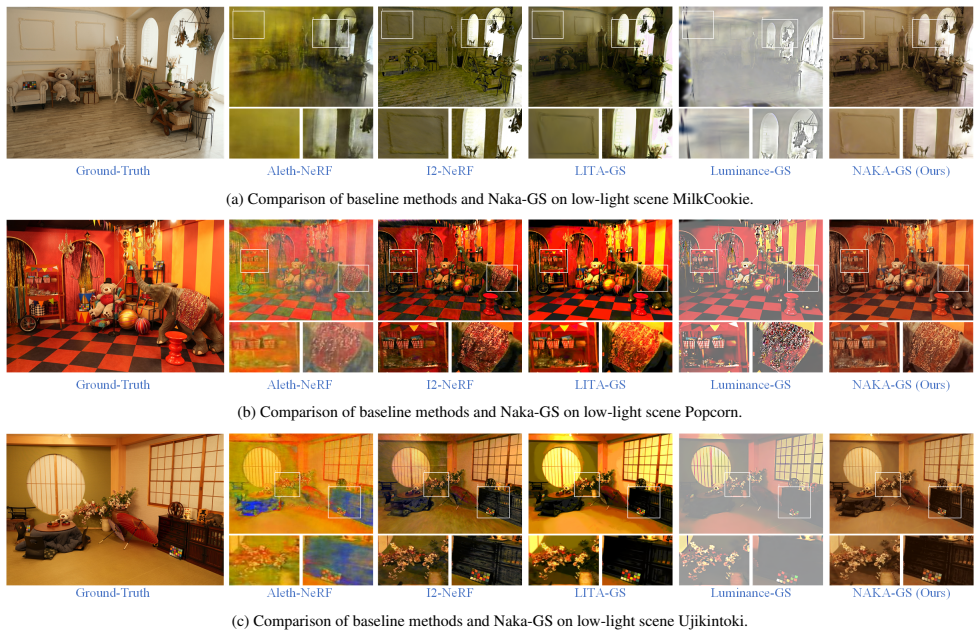
Han Zhou, Wei Dong, and Jun Chen. Lita-gs: Illumination- agnostic novel view synthesis via reference-free 3d gaus- sian splatting and physical priors. InProceedings of the IEEE/CVF International Conference on Computer Vision, pages 21580–21589, 2025. 3, 8 10 (a) Comparison of baseline methods and Naka-GS on low-light scene BlueHawaii. (b) Comparison of ba...
2025
discussion (0)
Sign in with ORCID, Apple, or X to comment. Anyone can read and Pith papers without signing in.