Recognition: unknown
The Neurobiological Craving Signature (NCS) predicts social craving and responds to social isolation
Pith reviewed 2026-05-10 16:08 UTC · model grok-4.3
The pith
A brain signature for drug and food craving also predicts social craving and rises after social isolation.
A machine-rendered reading of the paper's core claim, the machinery that carries it, and where it could break.
Core claim
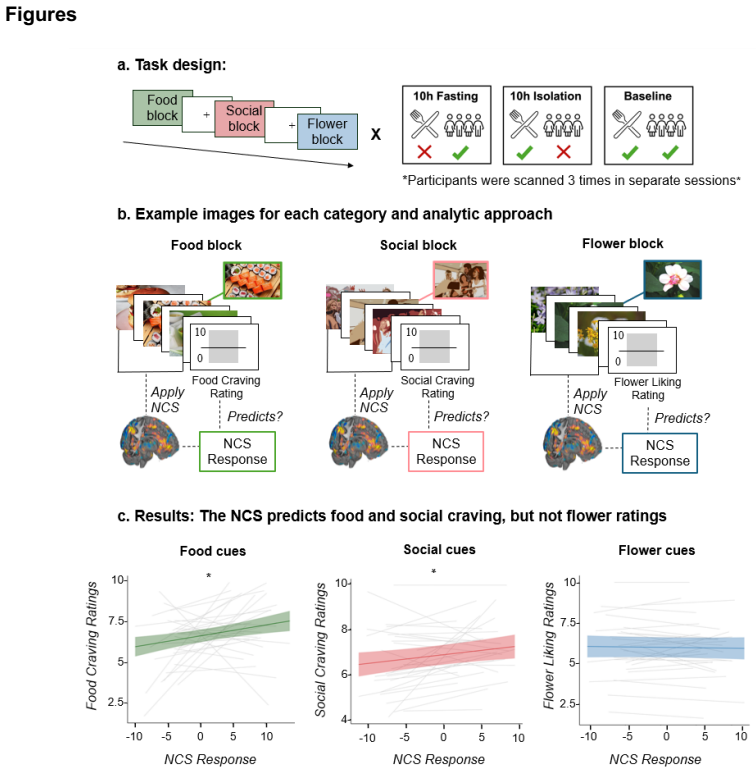
The Neurobiological Craving Signature (NCS) significantly predicted self-reported craving for food and social cues but not flower cues. NCS responses to food were higher after fasting compared to baseline, and higher for social cues after social isolation compared to baseline, demonstrating its responsiveness to both food and social deprivation. These findings resonate with recent work showing shared brainstem circuits for hunger and social isolation, and indicate shared whole-brain circuits for social, food, and drug craving.
What carries the argument
The Neurobiological Craving Signature (NCS), a multivariate fMRI pattern that decodes craving intensity from whole-brain activity patterns.
If this is right
- The NCS can serve as a common measure of craving intensity across food, drug, and social domains.
- Social isolation produces brain responses comparable to those from food deprivation.
- Shared circuits may link social deprivation to changes in eating or substance use.
- The NCS provides a tool for testing craving and deprivation effects across different primary rewards.
Where Pith is reading between the lines
- The signature could be used to track whether interventions that reduce loneliness also lower neural craving signals.
- Treatments targeting food or drug craving circuits might show measurable effects on social craving as well.
- Repeated application of the NCS could reveal whether chronic isolation changes baseline craving sensitivity to other rewards.
Load-bearing premise
The NCS developed for drug and food craving can be directly applied to social craving without being confounded by differences in visual processing, emotional valence, or general motivation between the cue types.
What would settle it
Finding no significant correlation between NCS scores and self-reported social craving ratings, or no selective increase in NCS response after social isolation, would falsify the central claim.
Figures

read the original abstract
Humans are inherently social and seek connection with others for survival. Recent studies suggest that acute social isolation leads to craving for social interactions, but the brain mechanisms of social craving and their relationship to brain networks underlying drug and food craving remain incompletely understood. Here we harnessed an existing dataset and tested whether the Neurobiological Craving Signature (NCS)-a recently developed fMRI-based brain-signature of drug and food craving-also predicts social craving. During fMRI, participants rated their craving for images of food, social interactions, and flowers in three different sessions: after 10h of fasting from food, 10h of social isolation, or neither (baseline; order of sessions counterbalanced). The NCS significantly predicted self-reported craving for food and social cues but not flower cues. Further, NCS responses to food were higher after fasting compared to baseline, and higher for social cues after social isolation compared to baseline, demonstrating its responsiveness to both food and social deprivation. These findings resonate with recent work showing shared brainstem circuits for hunger and social isolation, and indicate shared whole-brain circuits for social, food, and drug craving. They open new avenues for testing the NCS across different primary rewards, for assessing the consequences of their deprivation, and for examining how social deprivation-such as loneliness and isolation-interacts with overeating and drug use.
Editorial analysis
A structured set of objections, weighed in public.
Referee Report
Summary. The manuscript applies the Neurobiological Craving Signature (NCS), a multivariate fMRI pattern previously developed for drug and food craving, to an existing dataset in which participants viewed images of food, social interactions, and flowers during fMRI sessions after 10 h fasting, 10 h social isolation, or baseline (counterbalanced order). It reports that NCS expression significantly predicts self-reported craving ratings for food and social cues (but not flower cues) and shows elevated responses to food cues after fasting and to social cues after isolation, interpreted as evidence for shared whole-brain circuits supporting craving across these domains.
Significance. If the statistical and control issues are resolved, the work would be significant for demonstrating that a pre-validated craving signature generalizes to social interaction cues and is modulated by social deprivation. This supports the hypothesis of overlapping neurobiological mechanisms for primary rewards and deprivations, with implications for research on loneliness, its interaction with overeating or substance use, and potential clinical applications of the NCS. The within-subject design and reuse of an existing dataset are methodological strengths.
major comments (2)
- [Methods (cue stimuli and fMRI preprocessing subsections)] Methods (cue stimuli and fMRI preprocessing subsections): The paper does not describe matching the food, social, and flower image sets on low-level visual statistics (luminance, contrast, spatial frequency) or higher-level properties (emotional arousal, complexity, social relevance), nor does it report regressing these factors from the BOLD time series before computing NCS expression. This is load-bearing for the central generalization claim, as differential NCS prediction for social versus flower cues could arise from non-specific cue properties rather than shared craving circuitry.
- [Results section and Abstract] Results section and Abstract: The key claims of significant NCS prediction for food/social craving and condition-specific elevation lack reported sample size, exact statistical tests (correlation coefficients, t- or F-values, degrees of freedom), effect sizes, confidence intervals, or multiple-comparison corrections. Without these, the reliability and magnitude of the reported effects cannot be evaluated, undermining assessment of the responsiveness to social isolation.
minor comments (2)
- [Abstract] The abstract refers to 'an existing dataset' without citing its source publication or providing basic demographics; this information should be added for reproducibility.
- [Discussion] The discussion references shared brainstem circuits but does not quantitatively compare the current whole-brain NCS results to those prior brainstem findings.
Simulated Author's Rebuttal
We thank the referee for their constructive and detailed review, which has identified important areas for improving the methodological transparency and statistical rigor of our manuscript. We address each major comment point by point below, outlining the revisions we plan to implement.
read point-by-point responses
-
Referee: Methods (cue stimuli and fMRI preprocessing subsections): The paper does not describe matching the food, social, and flower image sets on low-level visual statistics (luminance, contrast, spatial frequency) or higher-level properties (emotional arousal, complexity, social relevance), nor does it report regressing these factors from the BOLD time series before computing NCS expression. This is load-bearing for the central generalization claim, as differential NCS prediction for social versus flower cues could arise from non-specific cue properties rather than shared craving circuitry.
Authors: We agree that explicit reporting of stimulus matching and potential regression of low-level features is necessary to strengthen the generalization claim. The stimuli were selected from the validated set used in the original published dataset, with some balancing of visual and affective properties attempted during stimulus creation, but these details were not fully described or analyzed in our submission. In revision, we will expand the Methods section to report all available stimulus properties (luminance, contrast, spatial frequency, emotional arousal, and complexity) from the source study. We will also re-analyze the data by regressing out low-level visual features from the BOLD time series prior to NCS computation and report whether the key predictive and condition-specific effects remain significant. Any limitations due to incomplete matching data will be explicitly discussed. revision: yes
-
Referee: Results section and Abstract: The key claims of significant NCS prediction for food/social craving and condition-specific elevation lack reported sample size, exact statistical tests (correlation coefficients, t- or F-values, degrees of freedom), effect sizes, confidence intervals, or multiple-comparison corrections. Without these, the reliability and magnitude of the reported effects cannot be evaluated, undermining assessment of the responsiveness to social isolation.
Authors: We concur that complete statistical reporting is essential for evaluating the findings. The original submission omitted these details primarily for brevity. We will revise the Results section to include the sample size, exact test statistics (correlation coefficients, t- or F-values with degrees of freedom), effect sizes, 95% confidence intervals, and the multiple-comparison correction procedure applied (e.g., FDR across cue types). These elements will also be summarized concisely in the Abstract. This will enable readers to fully assess the magnitude and reliability of the NCS effects for social craving and isolation responsiveness. revision: yes
Circularity Check
No significant circularity; NCS applied as fixed prior signature to independent new data
full rationale
The paper applies a pre-existing Neurobiological Craving Signature (NCS) developed in prior literature to new fMRI sessions involving social isolation, fasting, and baseline conditions with food, social, and flower cues. The central claims consist of empirical correlations between the fixed NCS expression values and self-reported craving ratings, plus condition-specific elevations, all tested on held-out data types and sessions. No equations, fitted parameters from this dataset, or self-definitional steps are present that would make any prediction equivalent to the inputs by construction. The NCS reference is a standard citation to prior work and does not reduce the current generalization test to a tautology; the results remain falsifiable via the new experimental manipulations and cue types.
Axiom & Free-Parameter Ledger
axioms (2)
- domain assumption Multivariate brain signatures trained on one reward type can generalize to predict craving for other rewards
- domain assumption Self-reported craving ratings validly reflect underlying subjective experience
Reference graph
Works this paper leans on
-
[1]
L. Koban, T. D. Wager, H. Kober, A neuromarker for drug and food craving distinguishes drug users from non-users. Nat Neurosci 26, 316–325 (2023). 26. P. Bach, et al., Effects of social exclusion and physical pain in chronic opioid maintenance treatment: fMRI correlates. European Neuropsychopharmacology 29, 291–305 (2019). 27. P. Maurage, et al., Disrupte...
-
[2]
W. Zheng, et al., Effect of Natural Rewards on Substance Use Disorder: An Incentive Sensitization Perspective. Biological Psychiatry 99, 436–445 (2026). 51. F. Rocha-Almeida, A. R. Conde-Moro, A. Fernández-Ruiz, J. M. Delgado-García, A. Gruart, Cortical and subcortical activities during food rewards versus social interaction in rats. Sci Rep 15, 4389 (202...
-
[3]
Addiction and Brain Reward and Antireward Pathways
S. Song, A. Zilverstand, W. Gui, X. Pan, X. Zhou, Reducing craving and consumption in individuals with drug addiction, obesity or overeating through neuromodulation intervention: a systematic review and meta-analysis of its follow-up effects. Addiction 117, 1242–1255 (2022). 74. M. Xiao, Y. Luo, H. Chen, Social support influences effective neural connecti...
2022
discussion (0)
Sign in with ORCID, Apple, or X to comment. Anyone can read and Pith papers without signing in.