Gradient extremals, talwegs, valleys, and directional alignment for generic gradient descent
Pith reviewed 2026-05-10 15:18 UTC · model grok-4.3
The pith
Gradient descent trajectories align directionally with gradient extremals and talwegs, with rates governed by the Hessian's spectral gap or smallest eigenvalue.
A machine-rendered reading of the paper's core claim, the machinery that carries it, and where it could break.
Core claim
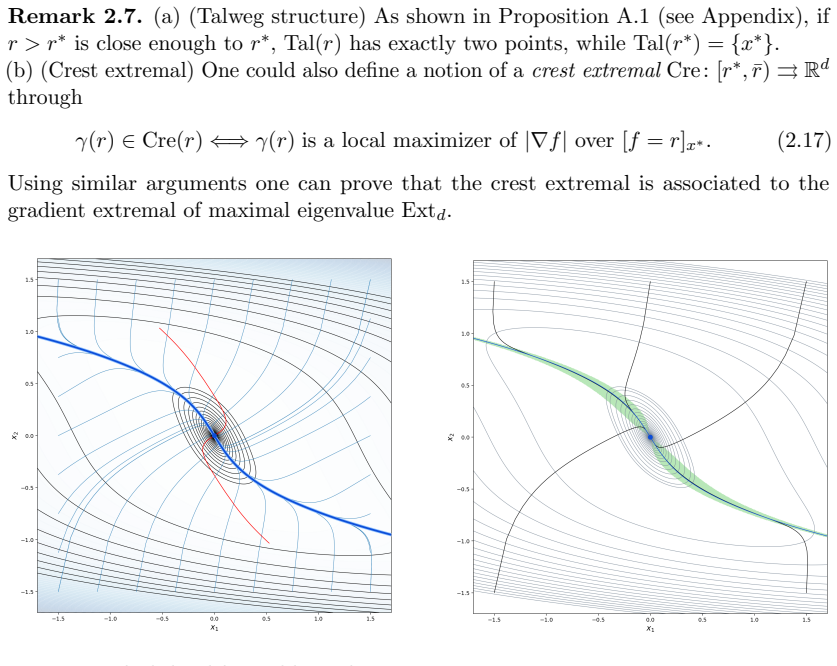
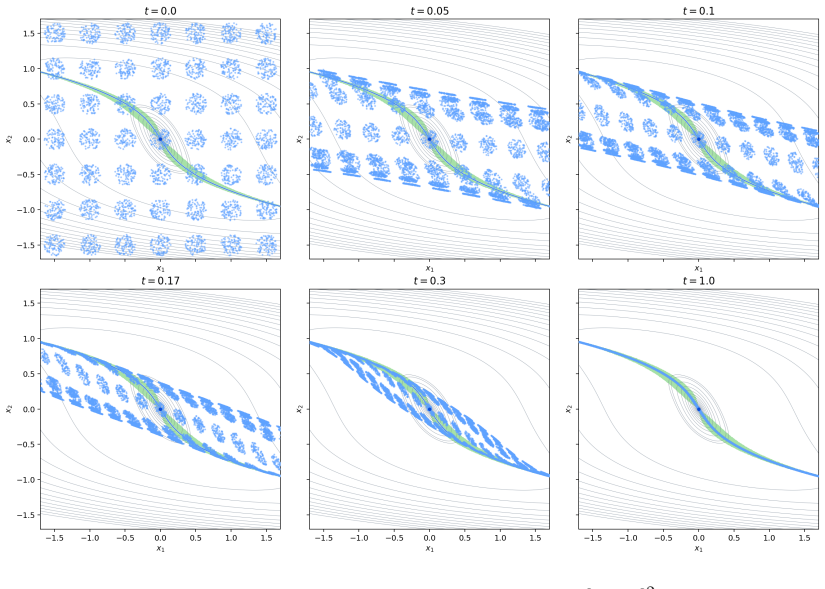
Gradient extremals unify valleys and talwegs in the generic case as loci along which the gradient is an eigenvector of the Hessian. Trajectories of the gradient flow and its discrete counterpart align directionally with the tangent spaces to gradient extremals and generically to the talweg. Under non-resonance assumptions, alignment rates are governed either by the first spectral gap or by the smallest eigenvalue of the Hessian at the limit point, and nonlinearities together with the step length may distort these rates. The images of sets of initial conditions concentrate inside valleys and asymptotically around talwegs.
What carries the argument
Gradient extremals, defined as the loci where the gradient is an eigenvector of the Hessian, which serve as the unifying geometric objects for analyzing directional alignment and volume concentration in gradient trajectories.
Load-bearing premise
The analysis requires the function to be generic and to satisfy non-resonance assumptions to obtain the stated alignment rates and volume concentration.
What would settle it
A numerical experiment on a low-dimensional non-quadratic non-resonant function where a gradient descent trajectory fails to align its direction with the talweg at a rate matching the first spectral gap or minimal Hessian eigenvalue would falsify the alignment claim.
Figures
read the original abstract
Gradient extremals are loci along which the gradient is an eigenvector of the Hessian. These objects provide a natural geometric framework connecting several notions, notably valleys and talwegs, which we analyze from a variational viewpoint in the generic case. We then show that trajectories of the gradient flow and of its discrete counterpart exhibit directional alignment with the tangent spaces to gradient extremals, and generically to the talweg. Under non-resonance assumptions, and in contrast with the quadratic case, alignment rates are governed either by the first spectral gap or by the smallest eigenvalue of the Hessian at the limit point. Nonlinearities and the step length may both distort these rates in a complex manner. We further prove a volume concentration phenomenon emphasizing the structuring role of gradient extremals: for large times, the images of sets of initial conditions concentrate inside valleys and asymptotically around talwegs.
Editorial analysis
A structured set of objections, weighed in public.
Referee Report
Summary. The manuscript defines gradient extremals as the loci where the gradient of a C^2 function is an eigenvector of its Hessian. It develops a variational characterization of valleys and talwegs in the generic case, then proves that both the continuous gradient flow and its discrete gradient-descent counterpart exhibit directional alignment with the tangent spaces to gradient extremals (and generically to the talweg). Under non-resonance assumptions, the alignment rates are governed by the first spectral gap or the smallest Hessian eigenvalue at the limit point, in contrast to the quadratic case; nonlinearities and step-size effects are shown to distort these rates. A volume-concentration result is established showing that images of sets of initial conditions concentrate inside valleys and asymptotically around talwegs for large times.
Significance. If the derivations hold, the paper supplies a geometric and dynamical-systems framework that explains the structuring role of gradient extremals in generic landscapes, furnishing explicit alignment rates and a concentration phenomenon that go beyond the quadratic setting. The emphasis on genericity and the contrast with quadratic behavior are potentially useful for analyzing non-convex optimization trajectories.
major comments (2)
- [Abstract / rate-derivation section] The non-resonance assumptions invoked for the alignment-rate statements (abstract and the section deriving the rates) are not given an explicit definition (e.g., absence of integer linear relations among eigenvalue ratios that would produce resonant terms in the variational equations along the extremal). Without this, it is impossible to verify the claimed genericity in the measure-theoretic or Baire-category sense on the space of C^2 functions, which is load-bearing for the rate and concentration claims.
- [Concentration theorem] The volume-concentration theorem relies on the alignment results; if the non-resonance condition excludes a non-negligible set, the concentration statement loses its generic character. The manuscript should supply a precise statement of the condition together with a proof that it holds outside a set of measure zero.
minor comments (2)
- [Definitions] Notation for the talweg and valley sets should be introduced with a clear diagram or local coordinate chart to aid readability.
- [Alignment-rate discussion] The abstract states that nonlinearities distort rates 'in a complex manner'; an explicit remainder estimate or leading-order expansion would strengthen the presentation.
Simulated Author's Rebuttal
We thank the referee for the careful reading and constructive suggestions. The comments highlight the need for greater precision in defining the non-resonance condition and establishing its genericity, which we will address directly in the revision.
read point-by-point responses
-
Referee: [Abstract / rate-derivation section] The non-resonance assumptions invoked for the alignment-rate statements (abstract and the section deriving the rates) are not given an explicit definition (e.g., absence of integer linear relations among eigenvalue ratios that would produce resonant terms in the variational equations along the extremal). Without this, it is impossible to verify the claimed genericity in the measure-theoretic or Baire-category sense on the space of C^2 functions, which is load-bearing for the rate and concentration claims.
Authors: We agree that an explicit definition is required. In the revised manuscript we will insert a precise definition of the non-resonance condition: the absence of nontrivial integer relations among the ratios of distinct eigenvalues of the Hessian along the gradient extremal that would generate resonant forcing terms in the variational equations. We will also add a short argument, based on the fact that such relations define a countable union of codimension-one submanifolds in the space of eigenvalue tuples, showing that the condition holds on a residual set in the Baire-category topology on C^2 functions. revision: yes
-
Referee: [Concentration theorem] The volume-concentration theorem relies on the alignment results; if the non-resonance condition excludes a non-negligible set, the concentration statement loses its generic character. The manuscript should supply a precise statement of the condition together with a proof that it holds outside a set of measure zero.
Authors: We accept that the generic character of the concentration result must be justified explicitly. The revision will restate the concentration theorem under the now-defined non-resonance condition and include a proof that the exceptional set has measure zero (and is meager) by applying a transversality argument to the map that sends a C^2 function to its eigenvalue-ratio functions along gradient extremals; the resonant loci are lower-dimensional and therefore negligible in the appropriate function-space measure. revision: yes
Circularity Check
No circularity: derivation rests on independent dynamical-systems analysis
full rationale
The paper defines gradient extremals variationally as loci where the gradient is an eigenvector of the Hessian, then proves directional alignment of gradient-flow and discrete GD trajectories with the tangent spaces to these objects (and generically to the talweg) under stated generic and non-resonance assumptions. Alignment rates are expressed in terms of the first spectral gap or the smallest Hessian eigenvalue at the limit point; volume concentration is shown for large times. None of these steps reduce by construction to a fitted parameter, a self-citation chain, or a renaming of the input data. The non-resonance conditions are external hypotheses invoked to control rates, not tautological definitions. The derivation chain is therefore self-contained against external benchmarks and receives score 0.
Axiom & Free-Parameter Ledger
axioms (3)
- domain assumption The objective function is at least twice continuously differentiable so that the Hessian exists and the gradient flow is well-defined.
- domain assumption The function satisfies generic-case assumptions that avoid degeneracies in the spectrum or critical-point structure.
- ad hoc to paper Non-resonance conditions hold between eigenvalues of the Hessian at the limit point.
invented entities (1)
-
Gradient extremals
no independent evidence
Reference graph
Works this paper leans on
-
[1]
G. Allaire and S. M. Kaber. Numerical Linear Algebra, volume 55 of Texts Appl. Math. Springer, New York, 2008. Translated from the 2002 French original by K. Trabelsi
work page 2008
-
[2]
F. Bach. Learning Theory from First Principles . MIT Press, 2024
work page 2024
- [3]
- [4]
-
[5]
M.J. Boussinesq. Sur une propri´ et´ e’ remarquable des points o` u les lignes de plus grande pente d ’ ¨Aˆ oune surface ont leurs plans osculateurs verticaux, et sur la diff´ erence qui existe g´ en´ eralement, ` a la surface de la terre, entre les lignes de faˆ ıte ou de thalweg et celles le long desquelles la pente du sol est un minimum. C. R. H. Acad....
-
[6]
A. Cayley. On contour and slope lines. London Edinburgh Dublin Philos. Mag. J. Sci. Ser. 4 , 18:264–268, 1859
- [7]
-
[8]
D. D’Acunto and K. Kurdyka. Explicit bounds for the Lojasiewicz exponent in the gradient inequality for polynomials. Ann. Polon. Math. , 87(1):51–61, 2005
work page 2005
-
[9]
M. de Saint-Venant. Surfaces ` a plus grande pente constitut´ ees sur des lignes courbes. Extraits des Proce` s-Verbaux des S´ eances de la Soci´ et´ e Philomathique de Paris, Ser. 5, 17:24–30, 1852
-
[10]
A. V. Fiacco and G. P. McCormick. Nonlinear Programming, volume 4 of Classics Appl. Math. SIAM, Philadelphia, PA, 2 edition, 1990. Sequential unconstrained minimization techniques
work page 1990
-
[11]
I. M. Gelfand and M. L. Tsetlin. On the principle of nonlocal search in automatic optimization systems. Dokl. Akad. Nauk SSSR , 137:295–298, 1961. In Russian
work page 1961
-
[12]
M. Golubitsky and V. Guillemin. Stable mappings and their singularities , volume Vol. 14 of Graduate Texts in Mathematics . Springer-Verlag, New York-Heidelberg, 1973. 30
work page 1973
-
[13]
X. Goudou and J. Munier. The gradient and heavy ball with friction dynamical systems: the quasiconvex case. Math. Program., 116(1–2):173–191, 2009
work page 2009
-
[14]
P. Hartman. On local homeomorphisms of Euclidean spaces. Bol. Soc. Mat. Mexicana, 5:220–241, 1960
work page 1960
-
[15]
P. Hartman. Ordinary Differential Equations, volume 38 of Classics Appl. Math. SIAM, Philadelphia, PA, 2002. Corrected reprint of the second (1982) edition
work page 2002
-
[16]
K. Kurdyka. On gradients of functions definable in o-minimal structures. Ann. Inst. Fourier, 48(3):769–783, 1998
work page 1998
-
[17]
K. Kurdyka, T. Mostowski, and A. Parusi´ nski. Proof of the gradient conjecture of R. Thom. Ann. of Math. , 152(3):763–792, 2000
work page 2000
-
[18]
J. D. Lee, M. Simchowitz, M. I. Jordan, and B. Recht. Gradient descent only converges to minimizers. In V. Feldman, A. Rakhlin, and O. Shamir, editors, Proc. 29th Annual Conf. Learn. Theory , volume 49 of Proc. Mach. Learn. Res., pages 1246–1257. PMLR, 2016
work page 2016
-
[19]
S. Lojasiewicz. Une propri´ et´ e topologique des sous-ensembles analytiques r´ eels. In Les ´Equations aux D´ eriv´ ees Partielles, pages 87–89. ´Editions du Centre National de la Recherche Scientifique, Paris, 1963
work page 1963
-
[20]
S. Lojasiewicz. Sur les trajectoires du gradient d’une fonction analytique. Semin. Geom., 1983(1984):115–117, 1982
work page 1983
-
[21]
J.C. Maxwell. On hills and dales. London Edinburgh Dublin Philos. Mag. J. Sci. Ser. 4, 40:421–’ ¨A` ı427, 1870
- [22]
-
[23]
F. Santambrogio. Optimal transport for applied mathematicians , vol- ume 87 of Progress in Nonlinear Differential Equations and their Applications . Birkh¨ auser/Springer, Cham, 2015. Calculus of variations, PDEs, and modeling
work page 2015
-
[24]
H. B. Schlegel. Following gradient extremal paths.Theoret. Chim. Acta, 83(1):15–20, 1992
work page 1992
- [25]
-
[26]
R. Thom. Sur une partition en cellules associ´ ee ` a une fonction sur une vari´ et´ e.C. R. Acad. Sci. Paris , 228(12):973–975, 1949
work page 1949
-
[27]
M. Viana and J. M. Espinar. Differential Equations—A Dynamical Systems Approach to Theory and Practice , volume 212 of Grad. Stud. Math. Amer. Math. Soc., Providence, RI, 2021. 31
work page 2021
discussion (0)
Sign in with ORCID, Apple, or X to comment. Anyone can read and Pith papers without signing in.