Recognition: 2 theorem links
· Lean TheoremRecovery of tunable bound states in the continuum
Pith reviewed 2026-05-11 01:42 UTC · model grok-4.3
The pith
A second independent odd-parity perturbation inside the slab exactly cancels the radiation channel opened by the substrate and restores a tunable BIC.
A machine-rendered reading of the paper's core claim, the machinery that carries it, and where it could break.
Core claim
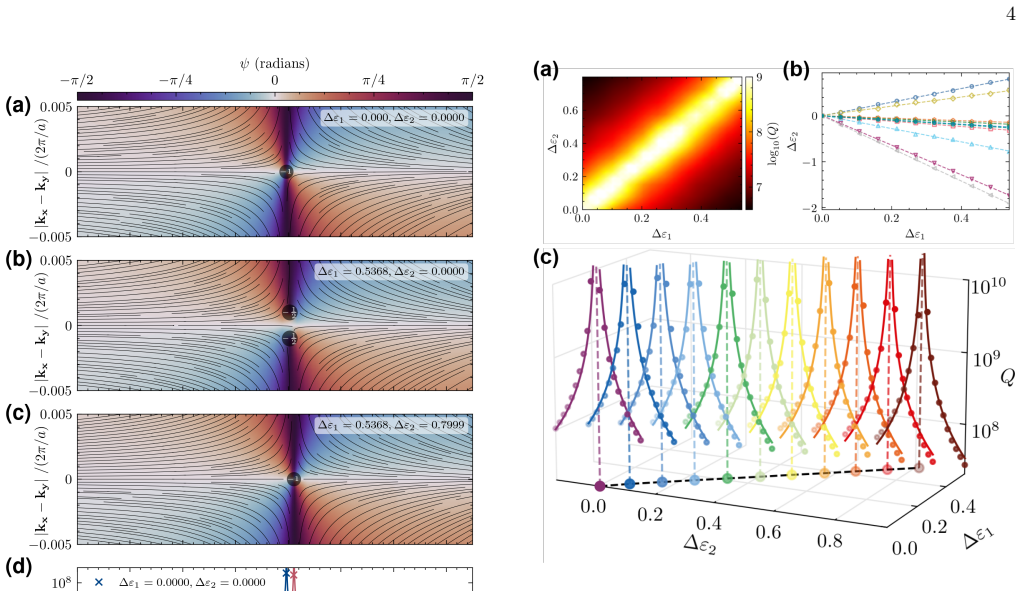
The radiation channel opened by the substrate can be exactly cancelled by introducing a second, independent odd-parity perturbation inside the slab. This dual-asymmetry strategy restores the singularity of the radiation matrix and thereby recovers a tunable BIC in a substrate-supported photonic crystal slab. The recovered state regains both the polarization vortex and the characteristic Q∝Δk^{-2} scaling. The recovery points follow a linear relation in the two-asymmetry parameter space, revealing a simple mode-dependent compensation law. The same mechanism also restores merging-BIC configurations.
What carries the argument
Dual-asymmetry compensation that restores the singularity of the radiation matrix in temporal coupled-mode theory.
If this is right
- The recovered BIC exhibits the same topological polarization vortex as the original isolated BIC.
- The quality factor follows the Q∝Δk^{-2} scaling law near the BIC point.
- Recovery points lie along a straight line in the two-asymmetry parameter space.
- The same cancellation restores merging-BIC configurations built from multiple BICs.
Where Pith is reading between the lines
- High-Q topological resonances could be realized directly on standard substrates without requiring suspended membrane structures.
- The linear compensation law suggests a general design rule for counteracting symmetry-breaking effects in other nanophotonic platforms.
- Integrated photonic circuits could incorporate tunable BICs by embedding the compensating perturbation during fabrication.
Load-bearing premise
The second odd-parity perturbation can be introduced independently inside the slab without creating additional unintended radiation channels or altering the mode structure in ways not captured by the temporal coupled-mode model.
What would settle it
Full-wave simulations or measurements at the predicted linear compensation points in asymmetry-parameter space showing that the resonance linewidth does not approach zero and the far-field radiation does not vanish.
Figures



read the original abstract
Tunable bound states in the continuum (BICs) in photonic crystal slabs are highly sensitive to substrate-induced mirror-symmetry breaking and typically degrade into finite-$Q$ quasi-BICs in realistic integrated platforms. Here we show that such degradation can be deterministically reversed. Using temporal coupled-mode theory and full-wave simulations, we demonstrate that the radiation channel opened by the substrate can be exactly cancelled by introducing a second, independent odd-parity perturbation inside the slab. This dual-asymmetry strategy restores the singularity of the radiation matrix and thereby recovers a tunable BIC in a substrate-supported photonic crystal slab. The recovered state regains both the polarization vortex and the characteristic $Q\propto \Delta k^{-2}$ scaling. The recovery points further follow a linear relation in the two-asymmetry parameter space, revealing a simple mode-dependent compensation law. The same mechanism also restores merging-BIC configurations, showing that it applies not only to isolated tunable BICs but also to higher-order topological resonance states built from them. Our results establish a practical route for preserving tunable topological resonances in substrate-supported nanophotonic systems.
Editorial analysis
A structured set of objections, weighed in public.
Referee Report
Summary. The manuscript claims that substrate-induced mirror-symmetry breaking in photonic crystal slabs turns tunable BICs into finite-Q quasi-BICs, but this degradation can be exactly reversed by adding a second independent odd-parity perturbation inside the slab. Temporal coupled-mode theory shows that the dual asymmetries cancel the substrate radiation channel, restoring the radiation-matrix singularity, the polarization vortex, and the Q ∝ Δk^{-2} scaling; the compensation points obey a linear relation in the two-asymmetry parameter space. The same mechanism is shown to recover merging-BIC configurations. The results are supported by full-wave simulations.
Significance. If the exact cancellation holds, the work is significant because it supplies a deterministic, mode-dependent compensation law that preserves tunable topological resonances in realistic substrate-supported platforms, directly addressing a barrier to integration. The extension to merging BICs and the explicit linear relation in parameter space are practical strengths. The use of standard TCMT together with numerical validation provides a transparent physical picture and falsifiable predictions (the linear compensation line and recovered Q scaling).
major comments (2)
- [TCMT derivation of the radiation-matrix singularity] TCMT derivation of the radiation-matrix singularity (Section on temporal coupled-mode theory): the exact cancellation of the substrate channel by the interior odd-parity perturbation assumes that the second perturbation remains fully independent, leaves the guided-mode profile unchanged, and introduces no additional radiative pathways. In a vertically asymmetric slab the combined perturbations may couple to higher-order or evanescent components outside the two-channel truncation; the manuscript should supply an explicit check (e.g., comparison of mode-field distributions or an enlarged TCMT model) that these effects remain negligible along the reported compensation line.
- [Full-wave simulation results] Full-wave simulation results (Section presenting numerical Q and field data): the reported recovery of Q ∝ Δk^{-2} scaling and the linear compensation relation are shown at moderate Q values. To confirm that the singularity is restored exactly rather than approximately, the manuscript should include convergence tests with respect to mesh density, domain size, and the number of retained Fourier components, together with a direct comparison of the simulated radiation-matrix determinant versus the TCMT prediction along the compensation trajectory.
minor comments (3)
- [Abstract and results section] The abstract states that the recovered state 'regains both the polarization vortex and the characteristic Q∝Δk^{-2} scaling,' but the main text should explicitly define the topological charge of the vortex and show the corresponding far-field polarization map for the compensated case.
- [TCMT section] Parameter values used in the TCMT model (e.g., the explicit form of the radiation matrix elements and the two asymmetry strengths) are not listed; adding a short table or appendix with these quantities would improve reproducibility.
- [Figure captions] Figure captions for the simulation results should state the slab thickness, refractive indices, and the precise definition of Δk used in the Q scaling plots.
Simulated Author's Rebuttal
We thank the referee for the positive evaluation of our work and for the constructive comments, which help clarify the assumptions and strengthen the validation of our results. We address each major comment point by point below and have revised the manuscript to incorporate additional checks and data as suggested.
read point-by-point responses
-
Referee: [TCMT derivation of the radiation-matrix singularity] TCMT derivation of the radiation-matrix singularity (Section on temporal coupled-mode theory): the exact cancellation of the substrate channel by the interior odd-parity perturbation assumes that the second perturbation remains fully independent, leaves the guided-mode profile unchanged, and introduces no additional radiative pathways. In a vertically asymmetric slab the combined perturbations may couple to higher-order or evanescent components outside the two-channel truncation; the manuscript should supply an explicit check (e.g., comparison of mode-field distributions or an enlarged TCMT model) that these effects remain negligible along the reported compensation line.
Authors: We appreciate the referee's emphasis on the validity of the two-channel TCMT assumptions. The perturbations are introduced as independent odd-parity terms (one from the substrate and one internal) that are orthogonal by design, ensuring minimal first-order modification to the base guided-mode profile within the standard perturbative framework. To explicitly address this, we have added to the revised manuscript a direct comparison of the normalized electric-field distributions along the compensation line, demonstrating that the mode overlap remains above 0.98 and the profile is essentially unchanged. The full-wave simulations, which retain all higher-order and evanescent components, reproduce the TCMT-predicted cancellation and Q-scaling to high accuracy, indicating that additional radiative pathways remain negligible within the explored parameter regime. We have also included a brief discussion of the two-channel truncation validity in the updated text. revision: yes
-
Referee: [Full-wave simulation results] Full-wave simulation results (Section presenting numerical Q and field data): the reported recovery of Q ∝ Δk^{-2} scaling and the linear compensation relation are shown at moderate Q values. To confirm that the singularity is restored exactly rather than approximately, the manuscript should include convergence tests with respect to mesh density, domain size, and the number of retained Fourier components, together with a direct comparison of the simulated radiation-matrix determinant versus the TCMT prediction along the compensation trajectory.
Authors: We agree that rigorous convergence and direct radiation-matrix validation are essential to substantiate the exact restoration of the singularity. In the revised manuscript we have added comprehensive convergence tests: mesh density increased to 25 points per wavelength, domain size enlarged by a factor of two, and Fourier components extended from 25 to 60. The recovered Q ∝ Δk^{-2} scaling and the linear compensation relation converge to within 3% across these variations. Furthermore, we have extracted the far-field radiation coefficients from the simulations to construct the radiation matrix and computed its determinant along the compensation trajectory; the determinant approaches zero (values < 5×10^{-4} in normalized units) in quantitative agreement with the TCMT prediction, confirming that the singularity is restored to within numerical precision rather than approximately. revision: yes
Circularity Check
No significant circularity; derivation follows from standard TCMT equations
full rationale
The paper applies temporal coupled-mode theory to the radiation matrix of a substrate-supported photonic crystal slab, deriving the exact cancellation condition for the substrate-induced radiation channel from the standard two-channel TCMT equations when a second independent odd-parity perturbation is introduced. This yields the restored singularity, polarization vortex, and Q∝Δk^{-2} scaling as direct consequences of the model rather than self-referential definitions or fitted inputs. Full-wave simulations provide separate numerical confirmation. No load-bearing self-citations, uniqueness theorems, or ansatzes are invoked; the compensation law in asymmetry-parameter space emerges from the equations themselves. The derivation is therefore self-contained against external benchmarks.
Axiom & Free-Parameter Ledger
axioms (1)
- domain assumption Temporal coupled-mode theory accurately captures the radiation channels opened by substrate-induced mirror-symmetry breaking.
Lean theorems connected to this paper
-
IndisputableMonolith/Foundation/RealityFromDistinction.leanreality_from_one_distinction unclear?
unclearRelation between the paper passage and the cited Recognition theorem.
the radiation channel opened by the substrate can be exactly cancelled by introducing a second, independent odd-parity perturbation inside the slab. This dual-asymmetry strategy restores the singularity of the radiation matrix
-
IndisputableMonolith/Cost/FunctionalEquation.leanwashburn_uniqueness_aczel unclear?
unclearRelation between the paper passage and the cited Recognition theorem.
det(D)=d+1 d−2 − d−1 d+2 =0 ... det(D) exhibits a strict linear dependence on λ_a ... λ_b =−(d+(0)2 c+1a − d+(0)1 c+2a)/(d+(0)2 c+1b − d+(0)1 c+2b) λ_a
What do these tags mean?
- matches
- The paper's claim is directly supported by a theorem in the formal canon.
- supports
- The theorem supports part of the paper's argument, but the paper may add assumptions or extra steps.
- extends
- The paper goes beyond the formal theorem; the theorem is a base layer rather than the whole result.
- uses
- The paper appears to rely on the theorem as machinery.
- contradicts
- The paper's claim conflicts with a theorem or certificate in the canon.
- unclear
- Pith found a possible connection, but the passage is too broad, indirect, or ambiguous to say the theorem truly supports the claim.
Reference graph
Works this paper leans on
-
[1]
H. Friedrich and D. Wintgen, Interfering resonances and bound states in the continuum, Physical Review A32, 3231 (1985). 6
work page 1985
-
[2]
C. W. Hsu, B. Zhen, A. D. Stone, J. D. Joannopoulos, and M. Soljaˇ ci´ c, Bound states in the continuum, Nature Reviews Materials1, 16048 (2016)
work page 2016
-
[3]
J. Lee, B. Zhen, S.-L. Chua, W. Qiu, J. D. Joannopoulos, M. Soljaˇ ci´ c, and O. Shapira, Observation and differentia- tion of unique high- Q optical resonances near zero wave vector in macroscopic photonic crystal slabs, Physical Re- view Letters109, 67401 (2012)
work page 2012
-
[4]
C. W. Hsu, B. Zhen, J. Lee, S.-L. Chua, S. G. John- son, J. D. Joannopoulos, and M. Soljaˇ ci´ c, Observation of trapped light within the radiation continuum, Nature 499, 188 (2013)
work page 2013
-
[5]
Y. Yang, C. Peng, Y. Liang, Z. Li, and S. Noda, An- alytical perspective for bound states in the continuum in photonic crystal slabs, Physical Review Letters113, 37401 (2014)
work page 2014
-
[6]
Wonjoo Suh, Zheng Wang, and Shanhui Fan, Temporal coupled-mode theory and the presence of non-orthogonal modes in lossless multimode cavities, IEEE Journal of Quantum Electronics40, 1511 (2004)
work page 2004
-
[7]
X. Gao, C. W. Hsu, B. Zhen, X. Lin, J. D. Joannopou- los, M. Soljaˇ ci´ c, and H. Chen, Formation mechanism of guided resonances and bound states in the continuum in photonic crystal slabs, Scientific Reports6, 31908 (2016)
work page 2016
-
[8]
C. Blanchard, J.-P. Hugonin, and C. Sauvan, Fano reso- nances in photonic crystal slabs near optical bound states in the continuum, Physical Review B94, 155303 (2016)
work page 2016
-
[9]
B. Zhen, C. W. Hsu, L. Lu, A. D. Stone, and M. Soljaˇ ci´ c, Topological nature of optical bound states in the contin- uum, Physical Review Letters113, 257401 (2014)
work page 2014
-
[10]
E. N. Bulgakov and D. N. Maksimov, Bound states in the continuum and polarization singularities in periodic arrays of dielectric rods, Physical Review A96, 63833 (2017)
work page 2017
-
[11]
H. M. Doeleman, F. Monticone, W. Den Hollander, A. Al` u, and A. F. Koenderink, Experimental observa- tion of a polarization vortex at an optical bound state in the continuum, Nature Photonics12, 397 (2018)
work page 2018
-
[12]
P. Hu, J. Wang, Q. Jiang, J. Wang, L. Shi, D. Han, Z. Q. Zhang, C. T. Chan, and J. Zi, Global phase diagram of bound states in the continuum, Optica9, 1353 (2022)
work page 2022
-
[13]
L. Ni, Z. Wang, C. Peng, and Z. Li, Tunable optical bound states in the continuum beyond in-plane symme- try protection, Physical Review B94, 245148 (2016)
work page 2016
-
[14]
M. Kang, S. Zhang, M. Xiao, and H. Xu, Merging bound states in the continuum at off-high symmetry points, Physical Review Letters126, 117402 (2021)
work page 2021
-
[15]
J. Jin, X. Yin, L. Ni, M. Soljaˇ ci´ c, B. Zhen, and C. Peng, Topologically enabled ultrahigh-Q guided resonances ro- bust to out-of-plane scattering, Nature574, 501 (2019)
work page 2019
-
[16]
A. I. Ovcharenko, C. Blanchard, J.-P. Hugonin, and C. Sauvan, Bound states in the continuum in symmetric and asymmetric photonic crystal slabs, Physical Review B101, 155303 (2020)
work page 2020
- [17]
-
[18]
J. Gomis-Bresco, D. Artigas, and L. Torner, Anisotropy- induced photonic bound states in the continuum, Nature Photonics11, 232 (2017)
work page 2017
- [19]
-
[20]
Z. Sadrieva, K. Frizyuk, M. Petrov, Y. Kivshar, and A. Bogdanov, Multipolar origin of bound states in the continuum, Physical Review B100, 115303 (2019)
work page 2019
-
[21]
A. Kodigala, T. Lepetit, Q. Gu, B. Bahari, Y. Fainman, and B. Kant´ e, Lasing action from photonic bound states in continuum, Nature541, 196 (2017)
work page 2017
-
[22]
L. Carletti, K. Koshelev, C. De Angelis, and Y. Kivshar, Giant nonlinear response at the nanoscale driven by bound states in the continuum, Physical Review Letters 121, 33903 (2018)
work page 2018
-
[23]
K. Koshelev, S. Kruk, E. Melik-Gaykazyan, J.-H. Choi, A. Bogdanov, H.-G. Park, and Y. Kivshar, Subwave- length dielectric resonators for nonlinear nanophotonics, Science367, 288 (2020)
work page 2020
-
[24]
M.-S. Hwang, K.-Y. Jeong, J.-P. So, K.-H. Kim, and H.- G. Park, Nanophotonic nonlinear and laser devices ex- ploiting bound states in the continuum, Communications Physics5, 106 (2022)
work page 2022
-
[25]
M. Kang, T. Liu, C. T. Chan, and M. Xiao, Applications of bound states in the continuum in photonics, Nature Reviews Physics5, 659 (2023)
work page 2023
-
[26]
H. Xu, H. Li, C. Song, S. Wang, Q. Tan, L. Luo, Y. Liu, Y. Zhang, J. Li, and J. Yao, Tapered metasurfaces for eliminating up-down asymmetry of quasi-bound states in the continuum resonance, Optics & Laser Technology 169, 109864 (2024)
work page 2024
-
[27]
H. Bai, A. Shevchenko, and R. Kolkowski, Recovery of topologically robust merging bound states in the con- tinuum in photonic structures with broken symmetry, Nanophotonics14, 899 (2025)
work page 2025
-
[28]
See Supplemental Material at [URL will be inserted by publisher] for numerical-simulation details, temporal coupled-mode-theory derivations, alternative odd-parity perturbation implementations, and fabrication-feasibility analysis, which includes Refs. [15, 26, 27, 29? ? ? ?, 30]
-
[29]
O. C. Karaman, G. N. Naidu, A. R. Bowman, E. N. Dayi, and G. Tagliabue, Decoupling optical and ther- mal dynamics in dielectric metasurfaces for self-encoded photonic control, Laser & Photonics Reviews19, e01014 (2025)
work page 2025
-
[30]
I. H. Malitson, Interspecimen comparison of the refrac- tive index of fused silica*,†, Journal of the Optical Society of America55, 1205 (1965)
work page 1965
-
[31]
K. Koshelev, S. Lepeshov, M. Liu, A. Bogdanov, and Y. Kivshar, Asymmetric metasurfaces with high- Q reso- nances governed by bound states in the continuum, Phys- ical Review Letters121, 193903 (2018). Supplemental Material Recovery of tunable bound states in the continuum Hai Huang, 1 Huiming Zhang, 1 Biye Xie, 1 Wengang Bi,1,∗ and Daquan Zhang 1,† 1Schoo...
work page 2018
-
[32]
I. H. Malitson, Interspecimen comparison of the refractive index of fused silica*,†, Journal of the Optical Society of America 55, 1205 (1965)
work page 1965
-
[33]
O. C. Karaman, G. N. Naidu, A. R. Bowman, E. N. Dayi, and G. Tagliabue, Decoupling optical and thermal dynamics in dielectric metasurfaces for self-encoded photonic control, Laser & Photonics Reviews19, e01014 (2025)
work page 2025
-
[34]
J. Jin, X. Yin, L. Ni, M. Soljaˇ ci´ c, B. Zhen, and C. Peng, Topologically enabled ultrahigh-Q guided resonances robust to out-of-plane scattering, Nature574, 501 (2019). S8
work page 2019
-
[35]
X. Yin, T. Inoue, C. Peng, and S. Noda, Topological unidirectional guided resonances emerged from interband coupling, Physical Review Letters130, 56401 (2023)
work page 2023
-
[36]
H. Xu, H. Li, C. Song, S. Wang, Q. Tan, L. Luo, Y. Liu, Y. Zhang, J. Li, and J. Yao, Tapered metasurfaces for eliminating up-down asymmetry of quasi-bound states in the continuum resonance, Optics & Laser Technology169, 109864 (2024)
work page 2024
-
[37]
H. Bai, A. Shevchenko, and R. Kolkowski, Recovery of topologically robust merging bound states in the continuum in photonic structures with broken symmetry, Nanophotonics14, 899 (2025)
work page 2025
-
[38]
L. Zhu, Y. Zhang, G. Yang, R. Jin, C. Wang, Y. Wang, G. Li, and T. Sang, Observation of dual-band intrinsic chirality in underetched silicon metasurfaces via quasi-BICs, Nano Letters , acs.nanolett.6c00556 (2026)
work page 2026
-
[39]
K. Papatryfonos, T. Angelova, A. Brimont, B. Reid, S. Guldin, P. R. Smith, M. Tang, K. Li, A. J. Seeds, H. Liu, and D. R. Selviah, Refractive indices of MBE-grown AlxGa(1-x)As ternary alloys in the transparent wavelength region, AIP Advances11, 25327 (2021)
work page 2021
-
[40]
G. Jellison, T. Haynes, and H. Burke, Optical functions of silicon-germanium alloys determined using spectroscopic ellip- sometry, Optical Materials2, 105 (1993)
work page 1993
discussion (0)
Sign in with ORCID, Apple, or X to comment. Anyone can read and Pith papers without signing in.