Recognition: unknown
Seg2Change: Adapting Open-Vocabulary Semantic Segmentation Model for Remote Sensing Change Detection
Pith reviewed 2026-05-10 15:21 UTC · model grok-4.3
The pith
A simple adapter turns open-vocabulary semantic segmentation models into open-vocabulary change detectors for remote sensing imagery.
A machine-rendered reading of the paper's core claim, the machinery that carries it, and where it could break.
Core claim
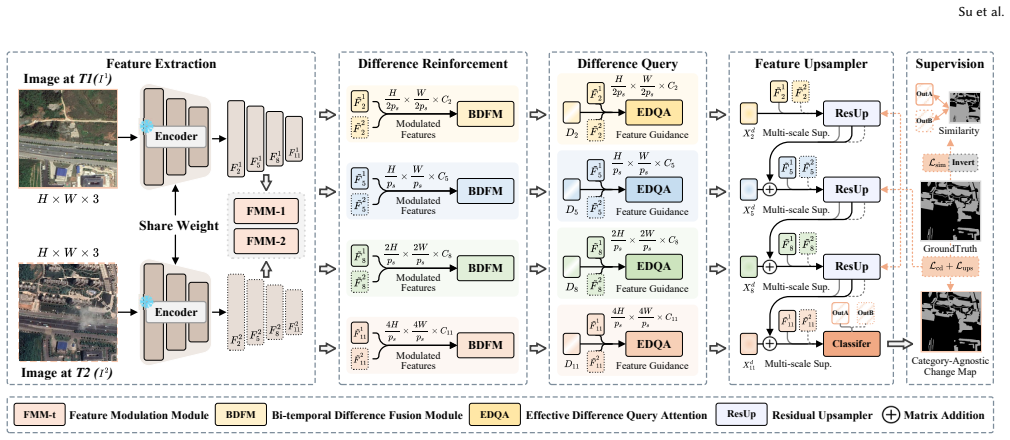
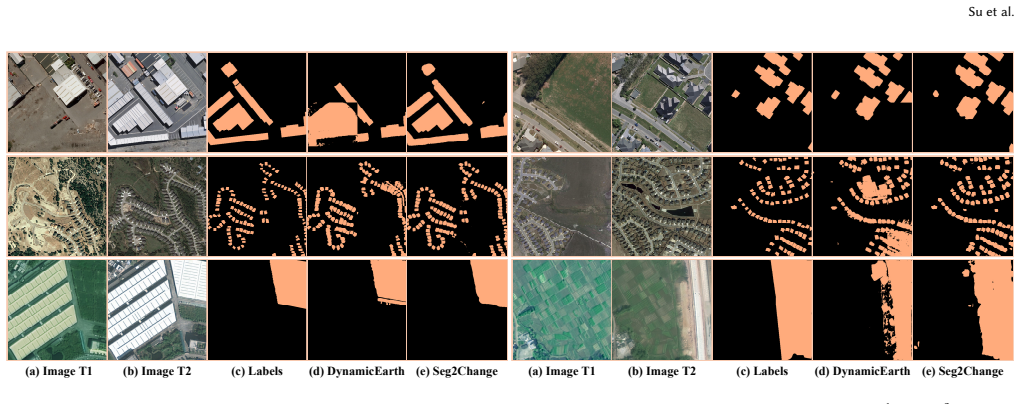
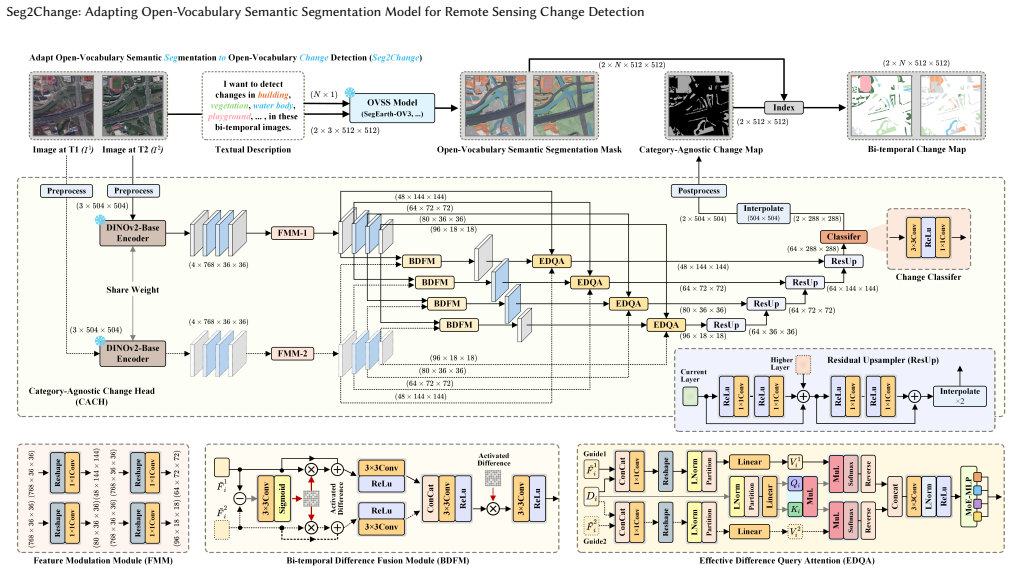
We construct the category-agnostic change detection dataset CA-CDD and introduce a category-agnostic change head that detects arbitrary category transitions and indexes them to specific classes. Based on these elements we present Seg2Change, an adapter that converts pre-trained open-vocabulary semantic segmentation models into open-vocabulary change detection models. The resulting framework reaches state-of-the-art results on OVCD benchmarks.
What carries the argument
The category-agnostic change head, which attaches to a pre-trained open-vocabulary segmentation backbone, detects transitions between arbitrary categories and maps them to language-specified classes.
If this is right
- Open-vocabulary change detection becomes feasible without retraining entire models or restricting outputs to a fixed label set.
- Changes involving categories absent from the original training data can still be detected and named using language descriptions.
- The adapter approach yields measurable gains on established benchmarks such as WHU-CD and SECOND.
- Existing open-vocabulary segmentation models can be reused for change detection with only the addition of the new head and dataset.
Where Pith is reading between the lines
- Similar lightweight adapters could allow the same segmentation models to handle other remote sensing tasks such as object counting or anomaly localization.
- The method opens the possibility of querying change maps with natural language descriptions rather than predefined class lists.
- If domain shift proves larger than expected, targeted fine-tuning of only the change head might still preserve most of the open-vocabulary capability.
- The framework could reduce reliance on large-scale, fully labeled change detection datasets by leveraging segmentation models already trained on diverse imagery.
Load-bearing premise
A category-agnostic change head attached to pre-trained open-vocabulary segmentation models will generalize to real-world remote sensing change detection without major domain shift or loss of open-vocabulary ability.
What would settle it
Training Seg2Change on a new remote sensing dataset with many unseen categories and observing that it fails to outperform closed-set change detectors on those categories would falsify the central claim.
Figures







read the original abstract
Change detection is a fundamental task in remote sensing, aiming to quantify the impacts of human activities and ecological dynamics on land-cover changes. Existing change detection methods are limited to predefined classes in training datasets, which constrains their scalability in real-world scenarios. In recent years, numerous advanced open-vocabulary semantic segmentation models have emerged for remote sensing imagery. However, there is still a lack of an effective framework for directly applying these models to open-vocabulary change detection (OVCD), a novel task that integrates vision and language to detect changes across arbitrary categories. To address these challenges, we first construct a category-agnostic change detection dataset, termed CA-CDD. Further, we design a category-agnostic change head to detect the transitions of arbitrary categories and index them to specific classes. Based on them, we propose Seg2Change, an adapter designed to adapt open-vocabulary semantic segmentation models to change detection task. Without bells and whistles, this simple yet effective framework achieves state-of-the-art OVCD performance (+9.52 IoU on WHU-CD and +5.50 mIoU on SECOND). Our code is released at https://github.com/yogurts-sy/Seg2Change.
Editorial analysis
A structured set of objections, weighed in public.
Referee Report
Summary. The paper introduces Seg2Change, an adapter framework that repurposes pre-trained open-vocabulary semantic segmentation (OVSS) models for open-vocabulary change detection (OVCD) in remote sensing. It constructs a new category-agnostic change detection dataset (CA-CDD) and attaches a category-agnostic change head to detect and index arbitrary-class transitions. The central empirical claim is that this simple design yields SOTA OVCD results (+9.52 IoU on WHU-CD, +5.50 mIoU on SECOND) without bells and whistles, with code released.
Significance. If the reported gains are robust, the work supplies a practical route to scalable, class-agnostic change detection that overcomes the closed-set limitation of prior remote-sensing CD methods. The new CA-CDD dataset and public code release are concrete assets that lower the barrier for follow-on research. The significance is reduced, however, by the untested assumption that a lightweight change head can fully compensate for domain shift between natural-image OVSS pre-training and aerial/satellite imagery while preserving open-vocabulary indexing.
major comments (2)
- [Experiments] Experiments section (results on WHU-CD and SECOND): the reported +9.52 IoU and +5.50 mIoU gains are presented without error bars, statistical significance tests, or explicit confirmation that data splits and category sampling were fixed before seeing results. This directly affects the strength of the SOTA claim and the assertion that the gains arise from the proposed adapter rather than dataset-specific tuning.
- [Method] Method section, category-agnostic change head design: the central claim that the head enables reliable open-vocabulary indexing on remote-sensing data rests on the untested assumption that it can compensate for spectral/textural/scale domain shift from natural-image pre-training. No ablation or diagnostic is shown that measures preservation of class-agnostic feature alignment (e.g., zero-shot transfer accuracy on held-out remote-sensing categories before and after head attachment).
minor comments (2)
- [Abstract] Abstract: the phrase 'without bells and whistles' is repeated but the precise training protocol for the change head (frozen vs. lightly tuned backbone, loss formulation, number of epochs) is not summarized, making it hard for readers to reproduce the claimed simplicity.
- [Introduction] The paper should add a short related-work paragraph contrasting the new CA-CDD construction with existing change-detection benchmarks to clarify its novelty.
Simulated Author's Rebuttal
Thank you for the detailed review and valuable feedback on our manuscript. We appreciate the recognition of the significance of Seg2Change and the CA-CDD dataset. We address each of the major comments below and outline the revisions we will make to strengthen the paper.
read point-by-point responses
-
Referee: [Experiments] Experiments section (results on WHU-CD and SECOND): the reported +9.52 IoU and +5.50 mIoU gains are presented without error bars, statistical significance tests, or explicit confirmation that data splits and category sampling were fixed before seeing results. This directly affects the strength of the SOTA claim and the assertion that the gains arise from the proposed adapter rather than dataset-specific tuning.
Authors: We agree that the absence of error bars, standard deviations, and statistical significance tests limits the robustness of the SOTA claims. In the revised manuscript we will report results averaged over at least three independent runs with different random seeds, including mean and standard deviation for IoU on WHU-CD and mIoU on SECOND. We will also add paired statistical tests (e.g., t-test) against the strongest baselines. We confirm that the official data splits of WHU-CD and SECOND were used without modification and that the category definitions and sampling strategy for CA-CDD were fixed before any training or evaluation; we will state this explicitly in the experiments section. revision: yes
-
Referee: [Method] Method section, category-agnostic change head design: the central claim that the head enables reliable open-vocabulary indexing on remote-sensing data rests on the untested assumption that it can compensate for spectral/textural/scale domain shift from natural-image pre-training. No ablation or diagnostic is shown that measures preservation of class-agnostic feature alignment (e.g., zero-shot transfer accuracy on held-out remote-sensing categories before and after head attachment).
Authors: We acknowledge that the manuscript does not contain a direct diagnostic measuring whether the change head preserves the open-vocabulary alignment of the pre-trained OVSS features under remote-sensing domain shift. We will add an ablation that evaluates zero-shot semantic segmentation accuracy on held-out remote-sensing categories (drawn from a withheld portion of CA-CDD) both before and after attaching the category-agnostic change head. This will quantify any degradation in class-agnostic feature alignment and support the claim that the head enables change detection without destroying the inherited open-vocabulary indexing capability. revision: yes
Circularity Check
No significant circularity; new dataset and adapter provide independent empirical content
full rationale
The paper's central claims rest on constructing a new category-agnostic dataset (CA-CDD) and designing a new change head/adapter (Seg2Change) that is then evaluated on standard external benchmarks (WHU-CD, SECOND). No equations or steps reduce by construction to fitted parameters on the test data, self-cited uniqueness theorems, or renamed prior results. The derivation chain is self-contained via novel components and reported performance gains.
Axiom & Free-Parameter Ledger
axioms (1)
- domain assumption Pre-trained open-vocabulary segmentation models produce reliable per-pixel embeddings that can be compared across time for change detection.
invented entities (1)
-
Category-agnostic change head
no independent evidence
Reference graph
Works this paper leans on
-
[1]
Jean-Baptiste Alayrac, Jeff Donahue, Pauline Luc, Antoine Miech, Iain Barr, Yana Hasson, Karel Lenc, Arthur Mensch, Katherine Millican, Malcolm Reynolds, Roman Ring, Eliza Rutherford, Serkan Cabi, Tengda Han, Zhitao Gong, Sina Samangooei, Marianne Monteiro, Jacob L Menick, Sebastian Borgeaud, Andy Brock, Aida Nematzadeh, Sahand Sharifzadeh, Mikoł aj Bińko...
2022
-
[2]
Wele Gedara Chaminda Bandara and Vishal M. Patel. 2022. A Transformer-Based Siamese Network for Change Detection. InIGARSS 2022 - 2022 IEEE International Geoscience and Remote Sensing Symposium. 207–210. doi:10.1109/IGARSS46834. 2022.9883686
-
[3]
Luca Bergamasco, Sudipan Saha, Francesca Bovolo, and Lorenzo Bruzzone. 2022. Unsupervised change detection using convolutional-autoencoder multiresolution features.IEEE Transactions on Geoscience and Remote Sensing60 (2022), 1–19
2022
-
[4]
Francesca Bovolo and Lorenzo Bruzzone. 2007. A Theoretical Framework for Unsupervised Change Detection Based on Change Vector Analysis in the Polar Domain.IEEE Transactions on Geoscience and Remote Sensing45, 1 (2007), 218–236. doi:10.1109/TGRS.2006.885408
-
[5]
Francesca Bovolo, Lorenzo Bruzzone, and Mattia Marconcini. 2008. A Novel Approach to Unsupervised Change Detection Based on a Semisupervised SVM and a Similarity Measure.IEEE Transactions on Geoscience and Remote Sensing 46, 7 (2008), 2070–2082. doi:10.1109/TGRS.2008.916643
-
[6]
Lorenzo Bruzzone and Diego F Prieto. 2002. Automatic analysis of the difference image for unsupervised change detection.IEEE Transactions on Geoscience and Remote sensing38, 3 (2002), 1171–1182
2002
-
[7]
F. P. Kressler C. A. Mucher, K. T. Steinnocher and C. Heunks. 2000. Land cover characterization and change detection for environmental monitoring of pan- Europe.International Journal of Remote Sensing21, 6-7 (2000), 1159–1181. doi:10. 1080/014311600210128
2000
-
[8]
Nicolas Carion, Laura Gustafson, Yuan-Ting Hu, Shoubhik Debnath, Ronghang Hu, Didac Suris, Chaitanya Ryali, Kalyan Vasudev Alwala, Haitham Khedr, An- drew Huang, Jie Lei, Tengyu Ma, Baishan Guo, Arpit Kalla, Markus Marks, Joseph Greer, Meng Wang, Peize Sun, Roman Rädle, Triantafyllos Afouras, Effrosyni Mavroudi, Katherine Xu, Tsung-Han Wu, Yu Zhou, Lilian...
work page internal anchor Pith review Pith/arXiv arXiv 2025
-
[10]
Turgay Celik. 2009. Unsupervised Change Detection in Satellite Images Using Principal Component Analysis and 𝑘-Means Clustering.IEEE Geoscience and Remote Sensing Letters6, 4 (2009), 772–776. doi:10.1109/LGRS.2009.2025059
-
[11]
Hao Chen, Zipeng Qi, and Zhenwei Shi. 2022. Remote Sensing Image Change Detection With Transformers.IEEE Transactions on Geoscience and Remote Sensing60 (2022), 1–14. doi:10.1109/TGRS.2021.3095166
-
[12]
Hao Chen and Zhenwei Shi. 2020. A Spatial-Temporal Attention-Based Method and a New Dataset for Remote Sensing Image Change Detection.Remote Sensing 12, 10 (2020)
2020
-
[13]
Hongruixuan Chen, Jian Song, Chen Wu, Bo Du, and Naoto Yokoya. 2023. Ex- change means change: An unsupervised single-temporal change detection frame- work based on intra- and inter-image patch exchange.ISPRS Journal of Pho- togrammetry and Remote Sensing206 (2023), 87–105. doi:10.1016/j.isprsjprs.2023. 11.004
-
[14]
Hongruixuan Chen, Naoto Yokoya, and Marco Chini. 2023. Fourier domain structural relationship analysis for unsupervised multimodal change detection. ISPRS Journal of Photogrammetry and Remote Sensing198 (2023), 99–114. doi:10. 1016/j.isprsjprs.2023.03.004
2023
- [15]
-
[16]
Schwing, Alexander Kirillov, and Rohit Girdhar
Bowen Cheng, Ishan Misra, Alexander G. Schwing, Alexander Kirillov, and Rohit Girdhar. 2022. Masked-attention Mask Transformer for Universal Image Segmentation.CVPR
2022
-
[17]
J. S. Deng, K. Wang, Y. H. Deng, and G. J. Qi. 2008. PCA-based land-use change detection and analysis using multitemporal and multisensor satel- lite data.International Journal of Remote Sensing29, 16 (2008), 4823–4838. doi:10.1080/01431160801950162
-
[18]
Peijun Du, Xin Wang, Dongmei Chen, Sicong Liu, Cong Lin, and Yaping Meng
-
[19]
doi:10.1016/j.isprsjprs.2020.01.026
An improved change detection approach using tri-temporal logic-verified change vector analysis.ISPRS Journal of Photogrammetry and Remote Sensing 161 (2020), 278–293. doi:10.1016/j.isprsjprs.2020.01.026
-
[20]
Yuchao Feng, Jiawei Jiang, Honghui Xu, and Jianwei Zheng. 2023. Change De- tection on Remote Sensing Images using Dual-branch Multi-level Inter-temporal Network.IEEE Transactions on Geoscience and Remote Sensing(2023), 1–1. doi:10.1109/TGRS.2023.3241257
-
[21]
Feng Gao, Xiao Wang, Yunhao Gao, Junyu Dong, and Shengke Wang. 2019. Sea Ice Change Detection in SAR Images Based on Convolutional-Wavelet Neural Networks.IEEE Geoscience and Remote Sensing Letters16, 8 (2019), 1240–1244
2019
-
[22]
Jose L. Gil-Yepes, Luis A. Ruiz, Jorge A. Recio, Ángel Balaguer-Beser, and Tx- omin Hermosilla. 2016. Description and validation of a new set of object- based temporal geostatistical features for land-use/land-cover change detec- tion.ISPRS Journal of Photogrammetry and Remote Sensing121 (2016), 77–91. doi:10.1016/j.isprsjprs.2016.08.010
-
[23]
Schumann, Paul D
Laura Giustarini, Renaud Hostache, Patrick Matgen, Guy J.-P. Schumann, Paul D. Bates, and David C. Mason. 2013. A Change Detection Approach to Flood Mapping in Urban Areas Using TerraSAR-X.IEEE Transactions on Geoscience and Remote Sensing51, 4 (2013), 2417–2430
2013
-
[24]
Chengxi Han, Chen Wu, Haonan Guo, Meiqi Hu, Jiepan Li, and Hongruixuan Chen. 2023. Change Guiding Network: Incorporating Change Prior to Guide Change Detection in Remote Sensing Imagery.IEEE Journal of Selected Topics in Applied Earth Observations and Remote Sensing16 (2023), 8395–8407. doi:10. 1109/JSTARS.2023.3310208
-
[25]
Kaiming He, Xiangyu Zhang, Shaoqing Ren, and Jian Sun. 2015. Deep Residual Learning for Image Recognition. arXiv:1512.03385 [cs.CV] https://arxiv.org/abs/ 1512.03385
work page internal anchor Pith review arXiv 2015
-
[26]
Kaiming He, Xiangyu Zhang, Shaoqing Ren, and Jian Sun. 2016. Deep Residual Learning for Image Recognition. InProc. IEEE/CVF Conf. Comput. Vis. Pattern Recognit. (CVPR). 770–778
2016
-
[27]
Thorsten Hoberg, Franz Rottensteiner, Raul Queiroz Feitosa, and Christian Heipke. 2015. Conditional Random Fields for Multitemporal and Multiscale Classification of Optical Satellite Imagery.IEEE Transactions on Geoscience and Remote Sensing53, 2 (2015), 659–673. doi:10.1109/TGRS.2014.2326886
-
[28]
Masroor Hussain, Dongmei Chen, Angela Cheng, Hui Wei, and David Stanley
-
[29]
doi:10.1016/j.isprsjprs.2013.03.006
Change detection from remotely sensed images: From pixel-based to object-based approaches.ISPRS Journal of Photogrammetry and Remote Sensing 80 (2013), 91–106. doi:10.1016/j.isprsjprs.2013.03.006
-
[30]
Shunping Ji, Shiqing Wei, and Meng Lu. 2019. Fully Convolutional Networks for Multisource Building Extraction From an Open Aerial and Satellite Imagery Data Set.IEEE Transactions on Geoscience and Remote Sensing57, 1 (2019), 574–586
2019
-
[31]
Chao Jia, Yinfei Yang, Ye Xia, Yi-Ting Chen, Zarana Parekh, Hieu Pham, Quoc Le, Yun-Hsuan Sung, Zhen Li, and Tom Duerig. 2021. Scaling Up Visual and Vision-Language Representation Learning With Noisy Text Supervision. InProc. Int. Conf. Machine Learning. (ICML), Vol. 139. 4904–4916
2021
-
[32]
Kaixuan Jiang and Chen Wu. 2025. LGCANet: Local–Global and Change-Aware Network via Segment Anything Model for Remote Sensing Images Change Detection.IEEE Transactions on Geoscience and Remote Sensing63 (2025), 1–13. doi:10.1109/TGRS.2025.3582784
-
[33]
Yufeng Jiang and Yiqing Shen. 2024. M4oE: A Foundation Model for Medical Multimodal Image Segmentation with Mixture of Experts . Inproceedings of Medical Image Computing and Computer Assisted Intervention – MICCAI 2024, Vol. LNCS 15012. Springer Nature Switzerland
2024
-
[34]
T. Kasetkasem and P.K. Varshney. 2002. An image change detection algorithm based on Markov random field models.IEEE Transactions on Geoscience and Remote Sensing40, 8 (2002), 1815–1823. doi:10.1109/TGRS.2002.802498
-
[35]
Alexander Kirillov, Eric Mintun, Nikhila Ravi, Hanzi Mao, Chloe Rolland, Laura Gustafson, Tete Xiao, Spencer Whitehead, Alexander C. Berg, Wan-Yen Lo, Piotr Dollár, and Ross Girshick. 2023. Segment Anything.arXiv:2304.02643(2023)
work page internal anchor Pith review arXiv 2023
-
[36]
Alex Krizhevsky, Ilya Sutskever, and Geoffrey E Hinton. 2012. ImageNet Clas- sification with Deep Convolutional Neural Networks. InProc. Adv. Neural Inf. Process. Syst. (NIPS), Vol. 25
2012
- [38]
-
[39]
Junnan Li, Dongxu Li, Caiming Xiong, and Steven Hoi. 2022. BLIP: Bootstrapping Language-Image Pre-training for Unified Vision-Language Understanding and Generation. InICML
2022
- [40]
-
[41]
Kaiyu Li, Xiangyong Cao, Yupeng Deng, Jiayi Song, Junmin Liu, Deyu Meng, and Zhi Wang. 2024. SemiCD-VL: Visual-language model guidance makes better semi-supervised change detector.IEEE Transactions on Geoscience and Remote Sensing(2024)
2024
-
[42]
Kaiyu Li, Ruixun Liu, Xiangyong Cao, Xueru Bai, Feng Zhou, Deyu Meng, and Zhi Wang. 2025. Segearth-ov: Towards training-free open-vocabulary segmentation Seg2Change: Adapting Open-Vocabulary Semantic Segmentation Model for Remote Sensing Change Detection for remote sensing images. InProceedings of the Computer Vision and Pattern Recognition Conference. 10...
2025
-
[43]
Kaiyu Li, Shengqi Zhang, Yupeng Deng, Zhi Wang, Deyu Meng, and Xiangyong Cao. 2025. SegEarth-OV3: Exploring SAM 3 for Open-Vocabulary Semantic Segmentation in Remote Sensing Images.arXiv preprint arXiv:2512.08730(2025)
work page internal anchor Pith review Pith/arXiv arXiv 2025
-
[44]
Zhiwei Li, Huanfeng Shen, Qing Cheng, Yuhao Liu, Shucheng You, and Zongyi He. 2019. Deep learning based cloud detection for medium and high resolution remote sensing images of different sensors.ISPRS Journal of Photogrammetry and Remote Sensing150 (2019), 197–212
2019
-
[46]
Zhenglai Li, Chang Tang, Lizhe Wang, and Albert Y. Zomaya. 2022. Remote Sensing Change Detection via Temporal Feature Interaction and Guided Re- finement.IEEE Transactions on Geoscience and Remote Sensing60 (2022), 1–11. doi:10.1109/TGRS.2022.3199502
-
[47]
Fan Liu, Delong Chen, Zhangqingyun Guan, Xiaocong Zhou, Jiale Zhu, Qiaolin Ye, Liyong Fu, and Jun Zhou. 2024. Remoteclip: A vision language foundation model for remote sensing.IEEE Transactions on Geoscience and Remote Sensing 62 (2024), 1–16
2024
-
[48]
Mengxi Liu, Zhuoqun Chai, Haojun Deng, and Rong Liu. 2022. A CNN- Transformer Network With Multiscale Context Aggregation for Fine-Grained Cropland Change Detection.IEEE J. Sel. Topics Appl. Earth Observ. Remote Sens. 15 (2022), 4297–4306. doi:10.1109/JSTARS.2022.3177235
-
[49]
Shilong Liu, Zhaoyang Zeng, Tianhe Ren, Feng Li, Hao Zhang, Jie Yang, Chun- yuan Li, Jianwei Yang, Hang Su, Jun Zhu, et al. 2023. Grounding dino: Marrying dino with grounded pre-training for open-set object detection.arXiv preprint arXiv:2303.05499(2023)
work page Pith review arXiv 2023
-
[50]
Ze Liu, Yutong Lin, Yue Cao, Han Hu, Yixuan Wei, Zheng Zhang, Stephen Lin, and Baining Guo. 2021. Swin Transformer: Hierarchical Vision Transformer using Shifted Windows . In2021 IEEE/CVF International Conference on Computer Vision (ICCV). IEEE Computer Society, Los Alamitos, CA, USA, 9992–10002. doi:10.1109/ICCV48922.2021.00986
- [51]
-
[52]
Prabuddh Kumar Mishra, Aman Rai, and Suresh Chand Rai. 2020. Land use and land cover change detection using geospatial techniques in the Sikkim Himalaya, India.The Egyptian Journal of Remote Sensing and Space Science23, 2 (2020), 133–143
2020
-
[53]
Nielsen, Knut Conradsen, and James J
Allan A. Nielsen, Knut Conradsen, and James J. Simpson. 1998. Multivariate Al- teration Detection (MAD) and MAF Postprocessing in Multispectral, Bitemporal Image Data: New Approaches to Change Detection Studies.Remote Sensing of Environment64, 1 (1998), 1–19. doi:10.1016/S0034-4257(97)00162-4
-
[54]
Maxime Oquab, Timothée Darcet, Théo Moutakanni, Huy Vo, Marc Szafraniec, Vasil Khalidov, Pierre Fernandez, Daniel Haziza, Francisco Massa, Alaaeldin El- Nouby, et al. 2023. Dinov2: Learning robust visual features without supervision. ArXivabs/2304.07193 (2023)
work page internal anchor Pith review Pith/arXiv arXiv 2023
-
[55]
Nobuyuki Otsu. 1979. A Threshold Selection Method from Gray-Level His- tograms.IEEE Transactions on Systems, Man, and Cybernetics9, 1 (1979), 62–66
1979
-
[56]
Eleonora Jonasova Parelius. 2023. A Review of Deep-Learning Methods for Change Detection in Multispectral Remote Sensing Images.Remote Sensing15, 8 (2023). doi:10.3390/rs15082092
-
[57]
Alec Radford, Jong Wook Kim, Chris Hallacy, Aditya Ramesh, Gabriel Goh, Sand- hini Agarwal, Girish Sastry, Amanda Askell, Pamela Mishkin, Jack Clark, et al
-
[58]
Learning transferable visual models from natural language supervision. In Proc. Int. Conf. Machine Learning. (ICML). 8748–8763
-
[59]
R.J. Radke, S. Andra, O. Al-Kofahi, and B. Roysam. 2005. Image change detection algorithms: a systematic survey.IEEE Transactions on Image Processing14, 3 (2005), 294–307. doi:10.1109/TIP.2004.838698
-
[60]
Nikhila Ravi, Valentin Gabeur, Yuan-Ting Hu, Ronghang Hu, Chaitanya Ryali, Tengyu Ma, Haitham Khedr, Roman Rädle, Chloe Rolland, Laura Gustafson, Eric Mintun, Junting Pan, Kalyan Vasudev Alwala, Nicolas Carion, Chao-Yuan Wu, Ross Girshick, Piotr Dollár, and Christoph Feichtenhofer. 2024. SAM 2: Segment Anything in Images and Videos.arXiv preprint arXiv:24...
work page internal anchor Pith review Pith/arXiv arXiv 2024
-
[61]
Evan Shelhamer, Jonathan Long, and Trevor Darrell. 2017. Fully Convolutional Networks for Semantic Segmentation.IEEE Transactions on Pattern Analysis and Machine Intelligence39, 4 (2017), 640–651
2017
-
[62]
Yunhang Shen, Chaoyou Fu, Peixian Chen, Mengdan Zhang, Ke Li, Xing Sun, Yunsheng Wu, Shaohui Lin, and Rongrong Ji. 2024. Aligning and Prompting Everything All at Once for Universal Visual Perception.CVPR
2024
-
[63]
Qian Shi, Mengxi Liu, Shengchen Li, Xiaoping Liu, Fei Wang, and Liangpei Zhang
-
[64]
A Deeply Supervised Attention Metric-Based Network and an Open Aerial Image Dataset for Remote Sensing Change Detection.IEEE Transactions on Geoscience and Remote Sensing(2021), 1–16. doi:10.1109/TGRS.2021.3085870
-
[65]
Wenzhong Shi, Min Zhang, Rui Zhang, Shanxiong Chen, and Zhao Zhan. 2020. Change Detection Based on Artificial Intelligence: State-of-the-Art and Chal- lenges.Remote Sensing12, 10 (2020). doi:10.3390/rs12101688
-
[66]
Richards
Chunqiao Song, Bo Huang, Linghong Ke, and Keith S. Richards. 2014. Remote sensing of alpine lake water environment changes on the Tibetan Plateau and surroundings: A review.ISPRS Journal of Photogrammetry and Remote Sensing 92 (2014), 26–37
2014
-
[67]
Xiaoliang Tan, Guanzhou Chen, Tong Wang, Jiaqi Wang, and Xiaodong Zhang
-
[68]
Segment change model (scm) for unsupervised change detection in vhr remote sensing images: a case study of buildings. InProc. IEEE Int. Geoscience And Remote Sensing Sym. (IGARSS). 8577–8580
-
[69]
Xiaoliang Tan, Guanzhou Chen, Xiaodong Zhang, Tong Wang, Jiaqi Wang, Kui Wang, and Tingxuan Miao. 2025. TripleS: Mitigating multi-task learning conflicts for semantic change detection in high-resolution remote sensing imagery.ISPRS Journal of Photogrammetry and Remote Sensing230 (2025), 374–401. doi:10.1016/ j.isprsjprs.2025.09.019
2025
-
[70]
Xiaoliang Tan, Guanzhou Chen, Xiaodong Zhang, Tong Wang, Jiaqi Wang, Kui Wang, and Tingxuan Miao. 2025. TripleS: Mitigating multi-task learning conflicts for semantic change detection in high-resolution remote sensing imagery.ISPRS Journal of Photogrammetry and Remote Sensing230 (2025), 374–401
2025
-
[71]
Xu Tang, Tianxiang Zhang, Jingjing Ma, Xiangrong Zhang, Fang Liu, and Licheng Jiao. 2023. WNet: W-Shaped Hierarchical Network for Remote-Sensing Image Change Detection.IEEE Transactions on Geoscience and Remote Sensing61 (2023), 1–14. doi:10.1109/TGRS.2023.3296383
-
[72]
Chen Wu, Bo Du, and Liangpei Zhang. 2014. Slow Feature Analysis for Change Detection in Multispectral Imagery.IEEE Transactions on Geoscience and Remote Sensing52, 5 (2014), 2858–2874. doi:10.1109/TGRS.2013.2266673
-
[73]
George Xian, Collin Homer, and Joyce Fry. 2009. Updating the 2001 National Land Cover Database land cover classification to 2006 by using Landsat imagery change detection methods.Remote Sensing of Environment113, 6 (2009), 1133–
2009
-
[74]
doi:10.1016/j.rse.2009.02.004
-
[75]
Xu, Wenhan Lu, Zebo Li, Pranav Khaitan, and Valeriya Zaytseva
Joseph Z. Xu, Wenhan Lu, Zebo Li, Pranav Khaitan, and Valeriya Zaytseva. 2019. Building Damage Detection in Satellite Imagery Using Convolutional Neural Networks.ArXivabs/1910.06444 (2019)
- [76]
-
[77]
Lihe Yang, Zhen Zhao, and Hengshuang Zhao. 2025. UniMatch V2: Pushing the Limit of Semi-Supervised Semantic Segmentation.TPAMI(2025)
2025
-
[79]
Zilu Ying, Zijun Tan, Yikui Zhai, Xudong Jia, Wenba Li, Junying Zeng, Angelo Genovese, Vincenzo Piuri, and Fabio Scotti. 2024. DGMA2-Net: A Difference- Guided Multiscale Aggregation Attention Network for Remote Sensing Change Detection.IEEE Transactions on Geoscience and Remote Sensing62 (2024), 1–16. doi:10.1109/TGRS.2024.3390206
-
[80]
Panli Yuan, Qingzhan Zhao, Xingbiao Zhao, Xuewen Wang, Xuefeng Long, and Yuchen Zheng. 2022. A transformer-based Siamese network and an open optical dataset for semantic change detection of remote sensing images.International Journal of Digital Earth15, 1 (2022), 1506–1525. doi:10.1080/17538947.2022. 2111470
-
[82]
Tao Zhan, Qiushi Tian, Yuanyuan Zhu, Jie Lan, Qianlong Dang, and Maoguo Gong. 2025. Difference-Aware Multiscale Feature Aggregation Network for Building Change Detection.IEEE Transactions on Geoscience and Remote Sensing 63 (2025), 1–15. doi:10.1109/TGRS.2025.3560977
-
[83]
Chenxiao Zhang, Peng Yue, Deodato Tapete, Liangcun Jiang, Boyi Shangguan, Li Huang, and Guangchao Liu. 2020. A deeply supervised image fusion network for change detection in high resolution bi-temporal remote sensing images.ISPRS Journal of Photogrammetry and Remote Sensing166 (2020), 183–200
2020
- [84]
-
[85]
Zhuo Zheng, Yanfei Zhong, Liangpei Zhang, and Stefano Ermon. 2024. Segment any change.Proc. Adv. Neural Inf. Process. Syst. (NIPS)37 (2024), 81204–81224
2024
discussion (0)
Sign in with ORCID, Apple, or X to comment. Anyone can read and Pith papers without signing in.