Recognition: unknown
Decoupled Similarity for Task-Aware Token Pruning in Large Vision-Language Models
Pith reviewed 2026-05-10 15:08 UTC · model grok-4.3
The pith
A decoupled similarity between visual features and text tokens allows pruning most visual tokens in large vision-language models while retaining nearly all performance.
A machine-rendered reading of the paper's core claim, the machinery that carries it, and where it could break.
Core claim
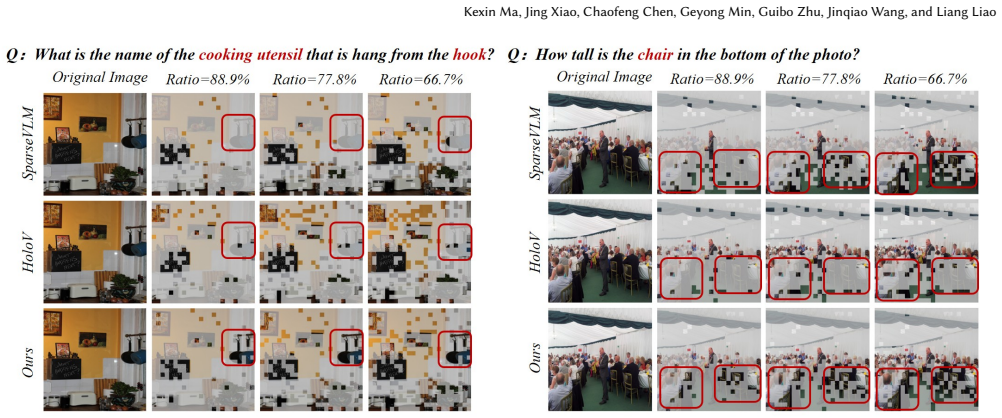
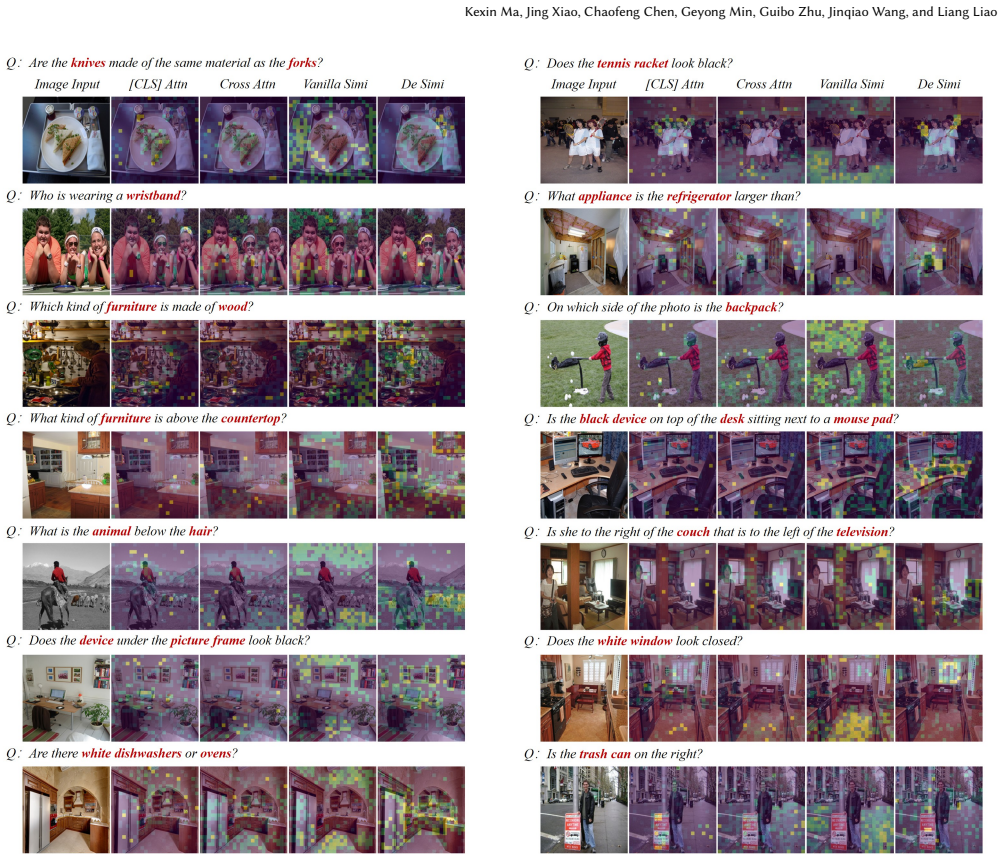
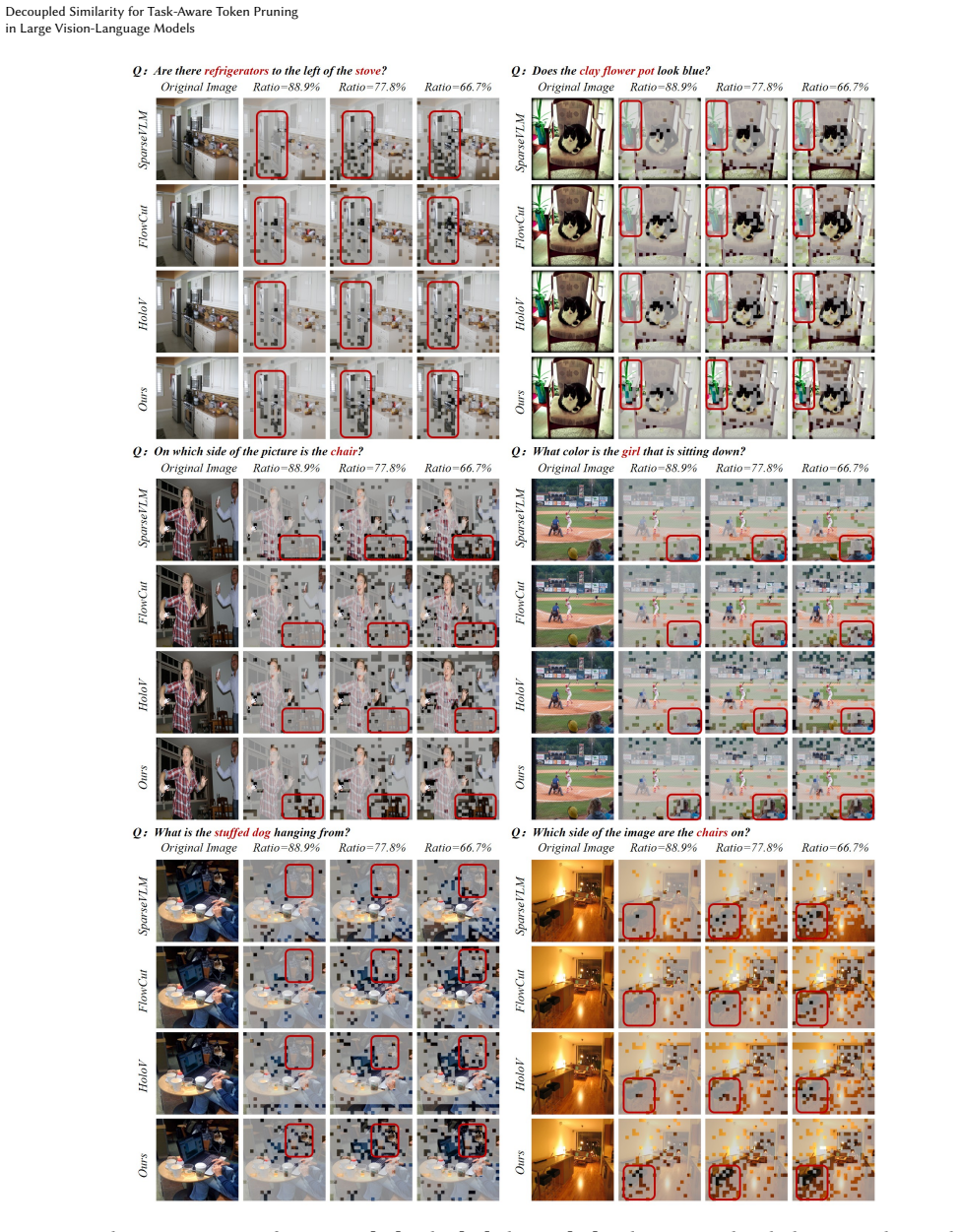
DeSAP introduces a decoupled similarity to capture explicit task-related cross-modal relevance between visual features and text tokens, then integrates it with visual saliency signals from attention inside the visual encoder to produce robust pruning decisions even at high ratios.
What carries the argument
Decoupled similarity measure that separates visual and textual contributions to quantify fine-grained task relevance, fused with visual attention saliency for pruning decisions.
If this is right
- On LLaVA-1.5-7B, computation drops by a factor of 10 and prefill speeds up by 2.3 times while accuracy stays at 98.1% of the original.
- The same pruning approach works across multiple LVLM architectures and benchmarks without retraining.
- Pruning decisions become more stable because they draw from both task-specific and appearance-based cues.
- Only 11.1% of visual tokens need to be kept to achieve near-original results.
Where Pith is reading between the lines
- The same decoupling idea could be applied to prune tokens in video or multi-image inputs where temporal or spatial redundancy is high.
- Combining DeSAP with post-training quantization might compound the efficiency gains without further accuracy loss.
- The method could be adapted for on-device deployment where memory bandwidth is the main bottleneck.
Load-bearing premise
The decoupled similarity plus visual attention combination will continue to identify the right tokens reliably even when the pruning ratio becomes very high.
What would settle it
Run DeSAP on LLaVA-1.5-7B at the 11.1% token retention ratio and measure whether accuracy falls below 98.1% of the unpruned baseline.
Figures



read the original abstract
Token pruning has emerged as an effective approach to reduce the substantial computational overhead of Large Vision-Language Models (LVLMs) by discarding less informative visual tokens while preserving performance. However, existing methods typically rely on individual attention sources from different LVLM components, resulting in incomplete and suboptimal pruning decisions due to biased attention distributions. To address this problem, we propose DeSAP, a novel Decoupled Similarity-Aware Pruning method for precise, task-aware token pruning within the visual encoder. Specifically, DeSAP introduces a decoupled similarity to capture fine-grained cross-modal relevance between visual features and text tokens, providing explicit task-related guidance for pruning. By integrating decoupled similarity with visual saliency signals derived from visual attention, DeSAP performs token pruning under the guidance of both task-related and visual cues, enabling robust pruning even under aggressive pruning ratios. Extensive experiments across diverse benchmarks and architectures show that DeSAP consistently outperforms SOTA methods in both accuracy and efficiency. On LLaVA-1.5-7B, DeSAP achieves a 10 times FLOPs reduction and a 2.3 times prefill speedup by retaining only 11.1% of visual tokens, while maintaining 98.1% of the original performance.
Editorial analysis
A structured set of objections, weighed in public.
Referee Report
Summary. The paper proposes DeSAP, a Decoupled Similarity-Aware Pruning method for task-aware token pruning in Large Vision-Language Models. It introduces a decoupled similarity measure to capture fine-grained cross-modal relevance between visual features and text tokens, which is combined with visual saliency signals from attention to perform pruning inside the visual encoder. Experiments across benchmarks and architectures show consistent outperformance over prior methods; on LLaVA-1.5-7B the method retains 11.1% of visual tokens while achieving a 10× FLOPs reduction, 2.3× prefill speedup, and 98.1% of original performance.
Significance. If the decoupled similarity can be realized with negligible overhead and without relying on post-projection LLM text features, the approach would meaningfully advance efficient inference for LVLMs by mitigating biased single-source attention pruning. The reported speedups at aggressive ratios, if net of all costs, would be a notable practical contribution.
major comments (2)
- [Abstract / Method] Abstract and Method: The 10× FLOPs reduction and 2.3× prefill speedup claims rest on the assumption that computing the decoupled similarity incurs no material extra cost. In LLaVA-style pipelines, text embeddings become available only after visual projection; any implementation that uses an auxiliary projection head or pre-LLM text features must be shown (via explicit FLOPs breakdown) not to offset the reported net gains, otherwise the central efficiency result is conditional on an unverified architectural choice.
- [Experiments] Experiments: The 98.1% performance retention at 11.1% token retention is presented without error bars, standard deviations, or multiple-run statistics. Given that pruning decisions are deterministic only if the similarity computation is fully specified, the absence of variance measures weakens confidence that the result generalizes across random seeds or slight prompt variations.
minor comments (1)
- [Abstract] The abstract states results on 'diverse benchmarks and architectures' but does not enumerate them; listing the specific datasets and model variants in the abstract would improve immediate readability.
Simulated Author's Rebuttal
We thank the referee for the constructive and detailed feedback. We address each major comment below and will revise the manuscript to incorporate clarifications and additional analyses that strengthen the efficiency and robustness claims.
read point-by-point responses
-
Referee: [Abstract / Method] The 10× FLOPs reduction and 2.3× prefill speedup claims rest on the assumption that computing the decoupled similarity incurs no material extra cost. In LLaVA-style pipelines, text embeddings become available only after visual projection; any implementation that uses an auxiliary projection head or pre-LLM text features must be shown (via explicit FLOPs breakdown) not to offset the reported net gains.
Authors: We appreciate the referee's emphasis on verifying net efficiency. In DeSAP, the decoupled similarity is computed using text embeddings extracted directly from the language model's embedding layer prior to visual projection and cross-attention. No auxiliary projection head is introduced, and the operation is a lightweight matrix multiplication between the visual feature matrix (size N_v × D) and text embedding matrix (N_t × D), incurring O(N_v · N_t · D) cost that is negligible relative to the pruned visual encoder FLOPs. We will add an explicit FLOPs breakdown table (including this term) to the revised Experiments and Method sections, confirming that the net reduction remains ~10× and prefill speedup ~2.3× after overhead. revision: yes
-
Referee: [Experiments] The 98.1% performance retention at 11.1% token retention is presented without error bars, standard deviations, or multiple-run statistics. Given that pruning decisions are deterministic only if the similarity computation is fully specified, the absence of variance measures weakens confidence that the result generalizes across random seeds or slight prompt variations.
Authors: We agree that variance reporting improves confidence. DeSAP's pruning is fully deterministic: both the decoupled similarity (cosine or dot-product between fixed visual and text features) and visual saliency (from attention maps) contain no randomness. To address the concern, we will rerun the main benchmarks over 3 random seeds for data ordering and report mean ± std, and we will add a small ablation on prompt paraphrasing for a subset of tasks. These statistics and stability results will be included in the revised Experiments section. revision: yes
Circularity Check
No circularity: DeSAP introduces an independent decoupled similarity computation for pruning.
full rationale
The abstract and available description present DeSAP as a novel method that computes decoupled similarity to capture cross-modal relevance and integrates it with visual saliency signals. No equations, fitting procedures, or self-citations are shown that would reduce any prediction or central claim to its own inputs by construction. The pruning decisions are described as arising from explicit task-related guidance rather than re-expression of fitted quantities or prior author results. The derivation chain is therefore self-contained.
Axiom & Free-Parameter Ledger
Reference graph
Works this paper leans on
-
[1]
Josh Achiam, Steven Adler, Sandhini Agarwal, et al. 2023. Gpt-4 technical report. arXiv preprint arXiv:2303.08774(2023)
work page internal anchor Pith review Pith/arXiv arXiv 2023
-
[2]
Kazi Hasan Ibn Arif, JinYi Yoon, Dimitrios S Nikolopoulos, et al. 2024. HiRED: Attention-Guided Token Dropping for Efficient Inference of High-Resolution Vision-Language Models in Resource-Constrained Environments.CoRR(2024)
2024
-
[3]
Shuai Bai, Keqin Chen, Xuejing Liu, et al. 2025. Qwen2.5-VL Technical Report. arXiv:2502.13923 [cs.CV] https://arxiv.org/abs/2502.13923
work page internal anchor Pith review Pith/arXiv arXiv 2025
-
[4]
Daniel Bolya, Cheng-Yang Fu, Xiaoliang Dai, et al. 2022. Token merging: Your vit but faster.arXiv preprint arXiv:2210.09461(2022)
work page internal anchor Pith review arXiv 2022
-
[5]
Gianni Brauwers and Flavius Frasincar. 2021. A general survey on attention mechanisms in deep learning.IEEE transactions on knowledge and data engineer- ing35, 4 (2021), 3279–3298
2021
-
[6]
Fu Chaoyou, Chen Peixian, Shen Yunhang, et al. 2023. Mme: A comprehensive evaluation benchmark for multimodal large language models.arXiv preprint arXiv:2306.133943 (2023)
work page internal anchor Pith review arXiv 2023
-
[7]
David Chen and William B Dolan. 2011. Collecting highly parallel data for paraphrase evaluation. InProceedings of the 49th annual meeting of the association for computational linguistics: human language technologies. 190–200
2011
-
[8]
Junjie Chen, Xuyang Liu, Zichen Wen, et al. 2025. Variation-aware Vision Token Dropping for Faster Large Vision-Language Models
2025
-
[9]
Liang Chen, Haozhe Zhao, Tianyu Liu, et al. 2024. An image is worth 1/2 tokens after layer 2: Plug-and-play inference acceleration for large vision-language models. InECCV. Springer, 19–35
2024
-
[10]
Yi Chen, Jian Xu, Xu-Yao Zhang, Wen-Zhuo Liu, Yang-Yang Liu, and Cheng- Lin Liu. 2025. Recoverable compression: A multimodal vision token recovery mechanism guided by text information. InProceedings of the AAAI Conference on Artificial Intelligence, Vol. 39. 2293–2301
2025
-
[11]
Hyung Won Chung, Le Hou, Shayne Longpre, et al. 2024. Scaling instruction- finetuned language models.Journal of Machine Learning Research25, 70 (2024), 1–53
2024
-
[12]
Wenliang Dai, Junnan Li, Dongxu Li, et al. 2023. Instructblip: Towards general- purpose vision-language models with instruction tuning.Advances in Neural Information Processing Systems36 (2023), 49250–49267
2023
-
[13]
Timothée Darcet, Maxime Oquab, Julien Mairal, and Piotr Bojanowski. 2024. Vision Transformers Need Registers. InInternational Conference on Learning Representations, B. Kim, Y. Yue, S. Chaudhuri, K. Fragkiadaki, M. Khan, and Y. Sun (Eds.), Vol. 2024. 2632–2652
2024
-
[14]
Alexey Dosovitskiy, Lucas Beyer, Alexander Kolesnikov, et al. 2021. An Image is Worth 16x16 Words: Transformers for Image Recognition at Scale. InInternational Conference on Learning Representations
2021
-
[15]
Yash Goyal, Tejas Khot, Douglas Summers-Stay, Dhruv Batra, and Devi Parikh
-
[16]
Making the v in vqa matter: Elevating the role of image understanding in visual question answering. InCVPR. 6904–6913
-
[17]
Jiaxian Guo, Junnan Li, Dongxu Li, et al. 2023. From images to textual prompts: Zero-shot visual question answering with frozen large language models. InCVPR. 10867–10877
2023
-
[18]
Danna Gurari, Qing Li, Abigale J Stangl, et al . 2018. Vizwiz grand challenge: Answering visual questions from blind people. InCVPR. 3608–3617
2018
-
[19]
Drew A Hudson and Christopher D Manning. 2019. Gqa: A new dataset for real-world visual reasoning and compositional question answering. InCVPR. 6700–6709
2019
-
[20]
Bin Kang, Bin Chen, Junjie Wang, Yulin Li, Junzhi Zhao, Junle Wang, and Zhuotao Tian. 2025. CalibCLIP: Contextual Calibration of Dominant Semantics for Text- Driven Image Retrieval. InProceedings of the 33rd ACM International Conference on Multimedia
2025
-
[21]
Jiayi Kuang, Ying Shen, Jingyou Xie, et al. 2025. Natural language understanding and inference with mllm in visual question answering: A survey.Comput. Surveys 57, 8 (2025), 1–36
2025
-
[22]
Mengcheng Lan, Chaofeng Chen, Yiping Ke, et al. 2024. Clearclip: Decomposing clip representations for dense vision-language inference. InECCV. Springer, 143–160
2024
-
[23]
Yifan Li, Yifan Du, Kun Zhou, et al. 2023. Evaluating object hallucination in large vision-language models.arXiv preprint arXiv:2305.10355(2023)
work page internal anchor Pith review arXiv 2023
- [24]
-
[25]
Yanwei Li, Chengyao Wang, and Jiaya Jia. 2024. Llama-vid: An image is worth 2 tokens in large language models. InECCV. Springer, 323–340
2024
-
[26]
Yanwei Li, Yuechen Zhang, Chengyao Wang, et al. 2025. Mini-gemini: Mining the potential of multi-modality vision language models.IEEE Transactions on Pattern Analysis and Machine Intelligence(2025)
2025
-
[27]
Bin Lin, Yang Ye, Bin Zhu, et al . 2024. Video-llava: Learning united visual representation by alignment before projection. (2024), 5971–5984
2024
-
[28]
Haotian Liu, Chunyuan Li, Yuheng Li, and Yong Jae Lee. 2024. Improved baselines with visual instruction tuning. InCVPR. 26296–26306
2024
-
[29]
Haotian Liu, Chunyuan Li, Yuheng Li, Bo Li, Yuanhan Zhang, Sheng Shen, and Yong Jae Lee. 2024. LLaVA-NeXT: Improved reasoning, OCR, and world knowledge. (January 2024). https://llava-vl.github.io/blog/2024-01-30-llava- next/
2024
-
[30]
Yuan Liu, Haodong Duan, Yuanhan Zhang, et al. 2024. Mmbench: Is your multi- modal model an all-around player?. InECCV. Springer, 216–233
2024
-
[31]
Pan Lu, Swaroop Mishra, Tanglin Xia, et al. 2022. Learn to explain: Multimodal reasoning via thought chains for science question answering.Advances in Neural Information Processing Systems35 (2022), 2507–2521
2022
-
[32]
Yuzhang Shang, Mu Cai, Bingxin Xu, Yong Jae Lee, and Yan Yan. 2025. Llava- prumerge: Adaptive token reduction for efficient large multimodal models. In CVPR. 22857–22867
2025
-
[33]
Amanpreet Singh, Vivek Natarajan, Meet Shah, et al. 2019. Towards vqa models that can read. InCVPR. 8317–8326
2019
- [34]
-
[35]
Yunlong Tang, Jing Bi, Siting Xu, et al. 2025. Video understanding with large language models: A survey.IEEE Transactions on Circuits and Systems for Video Technology(2025)
2025
- [36]
-
[37]
Ashish Vaswani, Noam Shazeer, Niki Parmar, Jakob Uszkoreit, et al. 2017. At- tention is all you need.Advances in Neural Information Processing Systems30 (2017)
2017
-
[38]
Haicheng Wang, Zhemeng Yu, Gabriele Spadaro, et al. 2025. Folder: Accelerating multi-modal large language models with enhanced performance. (2025), 23614– 23625
2025
- [39]
-
[40]
Zichen Wen, Yifeng Gao, Weijia Li, et al. 2025. Token Pruning in Multimodal Large Language Models: Are We Solving the Right Problem?. InAnnual Meeting of the Association for Computational Linguistics
2025
- [41]
-
[42]
Important Tokens
Zichen Wen, Yifeng Gao, Shaobo Wang, et al. 2025. Stop Looking for “Important Tokens” in Multimodal Language Models: Duplication Matters More. (2025), 9972–9991
2025
- [43]
-
[44]
Jun Xu, Tao Mei, Ting Yao, and Yong Rui. 2016. Msr-vtt: A large video description dataset for bridging video and language. InCVPR. 5288–5296
2016
-
[45]
Senqiao Yang, Yukang Chen, Zhuotao Tian, et al . 2025. Visionzip: Longer is better but not necessary in vision language models. InCVPR. 19792–19802
2025
- [46]
-
[47]
Ce Zhang, Kaixin Ma, Tianqing Fang, et al. [n. d.]. VScan: A Two-Stage Visual Token Reduction Framework for Accelerating Large Vision-Language Models. InES-FoMo III: 3rd Workshop on Efficient Systems for Foundation Models
- [48]
-
[49]
Xin Zou, Di Lu, Yizhou Wang, et al . 2025. Don’t Just Chase" Highlighted To- kens" in MLLMs: Revisiting Visual Holistic Context Retention.arXiv preprint arXiv:2510.02912(2025)
-
[50]
Xiaohan Zou, Changqiao Wu, Lele Cheng, and Zhongyuan Wang. 2022. Token- flow: Rethinking fine-grained cross-modal alignment in vision-language retrieval. arXiv preprint arXiv:2209.13822(2022). Kexin Ma, Jing Xiao, Chaofeng Chen, Geyong Min, Guibo Zhu, Jinqiao Wang, and Liang Liao Appendix In the Appendix, we provide additional details and experimental res...
-
[51]
As shown in Table 7, our method consistently maintains competitive performance across multiple video under- standing benchmarks while retaining only 50% of the visual token budget
and FastV [9]. As shown in Table 7, our method consistently maintains competitive performance across multiple video under- standing benchmarks while retaining only 50% of the visual token budget. Notably, it outperforms all compared methods and pre- serves nearly 100% of the original model performance, or even surpasses it on MSVD-QA [7] benchmarks. A.2 Q...
discussion (0)
Sign in with ORCID, Apple, or X to comment. Anyone can read and Pith papers without signing in.