Recognition: unknown
GeV gamma-ray emission in the field of the shell-type supernova remnant Vela Jr revisited
Pith reviewed 2026-05-10 15:25 UTC · model grok-4.3
The pith
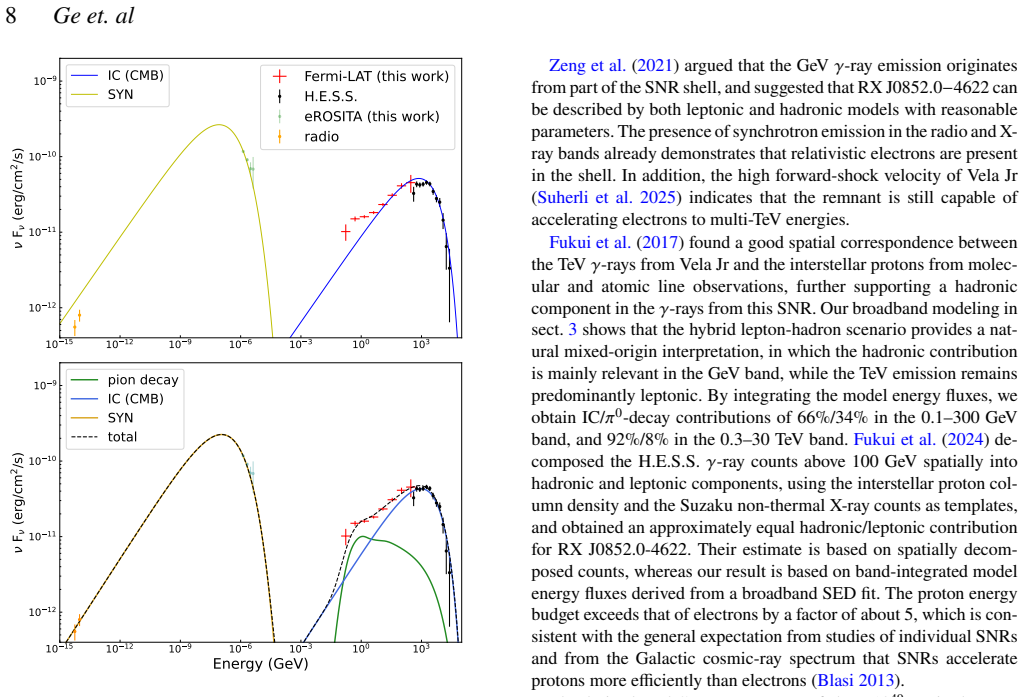
Analysis of 15 years of Fermi data shows a hybrid lepton-hadron model fits the gamma-ray emission from Vela Jr better than a pure leptonic model.
A machine-rendered reading of the paper's core claim, the machinery that carries it, and where it could break.
Core claim
Using 15 yr of Fermi Large Area Telescope data, the GeV gamma-ray emission from RX J0852.0-4622 is best described by the masked H.E.S.S. shell template, showing negligible contribution from the embedded pulsar wind nebula. The 0.1-500 GeV spectrum is a hard power law with photon index 1.77 that connects smoothly to the TeV spectrum. Independent eROSITA X-ray data supply new constraints on synchrotron emission. Both pure leptonic and hybrid lepton-hadron models reproduce the broadband spectral energy distribution, yet the hybrid model provides a better statistical fit, supporting a mixed-origin picture in which the hadronic contribution is mainly relevant in the GeV band while the TeV regime,
What carries the argument
Quantitative comparison of pure leptonic versus hybrid lepton-hadron models applied to the multi-wavelength spectral energy distribution, anchored by the masked H.E.S.S. shell morphology template.
If this is right
- The pulsar wind nebula contributes negligibly to the GeV flux.
- Hadronic processes supply the dominant GeV gamma-ray component.
- Leptonic processes remain the primary driver of the TeV emission.
- New eROSITA X-ray data tighten constraints on the synchrotron-emitting electron population.
Where Pith is reading between the lines
- Similar hybrid modeling may be needed for other shell-type SNRs where GeV and TeV spectra do not align under a single mechanism.
- Deeper GeV imaging could test whether faint PWN leakage appears at lower energies.
- The result underscores the value of joint X-ray, GeV, and TeV datasets for separating proton and electron acceleration channels in the same remnant.
Load-bearing premise
The masked H.E.S.S. shell template is an unbiased representation of the true GeV-emitting volume with negligible residual background or point-source contamination.
What would settle it
A new Fermi-LAT analysis or morphological template that shows the hybrid model no longer yields a statistically superior fit statistic, or that the GeV morphology deviates from the masked H.E.S.S. shell, would refute the mixed-origin conclusion.
Figures


read the original abstract
We present an updated analysis of the gigaelectronvolt (GeV) gamma-ray emission from the shell-type supernova remnant (SNR) RX J0852.0-4622 (Vela Jr) using 15 yr of Fermi Large Area Telescope (Fermi-LAT) data. We quantitatively model the GeV morphology and find that it is best described by the masked H.E.S.S. shell template, indicating that the embedded pulsar wind nebula (PWN) contributes little to the GeV flux. The 0.1-500 GeV spectrum is well fitted by a hard power law with a photon index of $1.77 \pm 0.03$ and connects smoothly to the teraelectronvolt (TeV) spectrum, confirming previous results with improved precision. We further construct an independent eROSITA shell template and derive the 1-5 keV X-ray spectral energy distribution (SED) of the whole remnant, which provides new constraints on the synchrotron emission. We model the multi-wavelength (MWL) SED with a pure leptonic model and a hybrid lepton-hadron model. While the pure leptonic model reproduces the overall broadband shape, the hybrid model provides a better statistical description of the same dataset, supporting a mixed-origin picture in which the hadronic contribution is mainly relevant in the GeV band and the TeV emission remains predominantly leptonic.
Editorial analysis
A structured set of objections, weighed in public.
Referee Report
Summary. The paper presents an updated Fermi-LAT analysis of GeV emission from SNR Vela Jr (RX J0852.0-4622) using 15 years of data. It quantitatively shows that the morphology is best described by a masked H.E.S.S. shell template (indicating negligible PWN contribution), reports a hard power-law spectrum with index 1.77 ± 0.03 that connects smoothly to the TeV band, derives a new 1-5 keV X-ray SED from an independent eROSITA shell template, and models the MWL SED with both pure leptonic and hybrid lepton-hadron scenarios, claiming the hybrid model provides a better statistical description supporting a mixed-origin picture (hadronic mainly in GeV, leptonic in TeV).
Significance. If the hybrid-model preference is shown to be robust after penalizing for extra parameters, the result would strengthen evidence for mixed leptonic-hadronic gamma-ray emission in shell-type SNRs, with direct implications for distinguishing cosmic-ray acceleration channels. The longer Fermi-LAT baseline, independent X-ray template, and quantitative morphology test add useful constraints even if the model-comparison step requires refinement.
major comments (2)
- [MWL SED modeling and abstract] In the MWL SED modeling section (and the abstract statement that the hybrid model 'provides a better statistical description'): no Δχ², likelihood-ratio test statistic, p-value, or penalized information criterion (AIC/BIC) is reported. Because the hybrid model necessarily introduces at least one additional free parameter (hadronic normalization, and likely a second such as proton index or cutoff), an unpenalized improvement in raw likelihood does not establish that the hadronic component is required; this is load-bearing for the central 'mixed-origin picture' claim.
- [Morphology modeling section] In the morphology analysis: the quantitative preference for the masked H.E.S.S. shell template assumes this template is an unbiased representation of the true GeV-emitting volume. No assessment is provided of residual background, point-source contamination, or masking artifacts after template application; this directly affects the conclusion of negligible PWN contribution at GeV energies.
minor comments (2)
- [Abstract and §3-4] The abstract and results text should explicitly state the background-modeling approach, the precise energy range and binning used for the Fermi-LAT spectrum, and the exact statistical metric (with value) used to compare the two SED models.
- [Spectral analysis and SED sections] Systematic uncertainties on the photon index, flux normalizations, and template normalizations are not discussed; adding a brief dedicated paragraph or table would improve transparency.
Simulated Author's Rebuttal
We thank the referee for their thorough review and constructive comments on our manuscript. We address each major comment point by point below. Revisions have been made to strengthen the statistical rigor and address potential systematics as suggested.
read point-by-point responses
-
Referee: [MWL SED modeling and abstract] In the MWL SED modeling section (and the abstract statement that the hybrid model 'provides a better statistical description'): no Δχ², likelihood-ratio test statistic, p-value, or penalized information criterion (AIC/BIC) is reported. Because the hybrid model necessarily introduces at least one additional free parameter (hadronic normalization, and likely a second such as proton index or cutoff), an unpenalized improvement in raw likelihood does not establish that the hadronic component is required; this is load-bearing for the central 'mixed-origin picture' claim.
Authors: We agree that an unpenalized comparison is insufficient and that a penalized criterion such as AIC is required to support the preference for the hybrid model. In the revised manuscript we have added AIC values for both models in the MWL SED section, along with the likelihood-ratio test statistic and associated p-value. The hybrid model remains preferred after the penalty for the extra hadronic normalization parameter. The abstract has been updated to state that the hybrid model provides a statistically preferred description according to the AIC. These additions directly address the concern and reinforce the mixed-origin interpretation with proper model selection. revision: yes
-
Referee: [Morphology modeling section] In the morphology analysis: the quantitative preference for the masked H.E.S.S. shell template assumes this template is an unbiased representation of the true GeV-emitting volume. No assessment is provided of residual background, point-source contamination, or masking artifacts after template application; this directly affects the conclusion of negligible PWN contribution at GeV energies.
Authors: We acknowledge the need for explicit checks on template fidelity. In the revised morphology section we now present residual maps after fitting the masked H.E.S.S. shell template, which show no significant structured residuals or background artifacts above the noise level within the ROI. We have also added a dedicated test in which an additional point-source component is included at the PWN position; its best-fit flux is consistent with zero, confirming negligible PWN contribution at GeV energies. These quantitative assessments address the potential for masking artifacts and contamination. revision: yes
Circularity Check
No significant circularity; derivation uses independent external templates and standard emission models
full rationale
The paper fits Fermi-LAT counts to masked H.E.S.S. and independently constructed eROSITA templates to determine morphology and spectrum, then applies conventional leptonic and hybrid (lepton-hadron) emission formulas to the resulting MWL SED. The statement that the hybrid model gives a better statistical description does not reduce to a self-definitional loop, a fitted parameter renamed as a prediction, or a load-bearing self-citation chain; the templates and formulas are external to the target claim. No ansatz is smuggled via citation and no uniqueness theorem is invoked. The derivation chain remains self-contained against the external data and standard physics.
Axiom & Free-Parameter Ledger
free parameters (2)
- Photon index =
1.77
- SED model normalizations and cut-off energies
axioms (2)
- domain assumption The masked H.E.S.S. TeV shell template accurately traces the GeV-emitting region
- domain assumption Standard leptonic and hadronic radiation processes dominate the observed emission
Reference graph
Works this paper leans on
-
[1]
, " * write output.state after.block = add.period write newline
ENTRY address archiveprefix author booktitle chapter edition editor howpublished institution eprint journal key month note number organization pages publisher school series title type volume year label extra.label sort.label short.list INTEGERS output.state before.all mid.sentence after.sentence after.block FUNCTION init.state.consts #0 'before.all := #1 ...
-
[2]
write newline
" write newline "" before.all 'output.state := FUNCTION n.dashify 't := "" t empty not t #1 #1 substring "-" = t #1 #2 substring "--" = not "--" * t #2 global.max substring 't := t #1 #1 substring "-" = "-" * t #2 global.max substring 't := while if t #1 #1 substring * t #2 global.max substring 't := if while FUNCTION word.in bbl.in " " * FUNCTION format....
-
[3]
write newline
" write newline "" before.all 'output.state := FUNCTION fin.entry write newline FUNCTION new.block output.state before.all = 'skip after.block 'output.state := if FUNCTION new.sentence output.state after.block = 'skip output.state before.all = 'skip after.sentence 'output.state := if if FUNCTION not #0 #1 if FUNCTION and 'skip pop #0 if FUNCTION or pop #1...
-
[4]
Abdo A. A., et al., 2009, @doi [ ] 10.1088/0004-637X/706/1/L1 , https://ui.adsabs.harvard.edu/abs/2009ApJ...706L...1A 706, L1
-
[5]
Abdollahi S., et al., 2022, @doi [ ] 10.3847/1538-4365/ac6751 , https://ui.adsabs.harvard.edu/abs/2022ApJS..260...53A 260, 53
-
[6]
Acero F., Gallant Y., Ballet J., Renaud M., Terrier R., 2013, @doi [ ] 10.1051/0004-6361/201220799 , https://ui.adsabs.harvard.edu/abs/2013A&A...551A...7A 551, A7
-
[7]
Ackermann M., et al., 2017, @doi [ ] 10.3847/1538-4357/aa775a , https://ui.adsabs.harvard.edu/abs/2017ApJ...843..139A 843, 139
-
[8]
Aharonian F., et al., 2005, @doi [ ] 10.1051/0004-6361:200500130 , https://ui.adsabs.harvard.edu/abs/2005A&A...437L...7A 437, L7
-
[9]
Aharonian F., et al., 2007, @doi [ ] 10.1086/512603 , https://ui.adsabs.harvard.edu/abs/2007ApJ...661..236A 661, 236
-
[10]
Aharonian F., et al., 2026, @doi [ ] 10.1051/0004-6361/202558346 , https://ui.adsabs.harvard.edu/abs/2026A&A...708A...6A 708, A6
-
[11]
Akaike H., 1974, IEEE Transactions on Automatic Control, https://ui.adsabs.harvard.edu/abs/1974ITAC...19..716A 19, 716
1974
-
[12]
E., Chow K., DeLaney T., Filipovi \'c M
Allen G. E., Chow K., DeLaney T., Filipovi \'c M. D., Houck J. C., Pannuti T. G., Stage M. D., 2015, @doi [ ] 10.1088/0004-637X/798/2/82 , https://ui.adsabs.harvard.edu/abs/2015ApJ...798...82A 798, 82
-
[13]
Aschenbach B., 1998, @doi [ ] 10.1038/24103 , https://ui.adsabs.harvard.edu/abs/1998Natur.396..141A 396, 141
-
[14]
Aschenbach B., Iyudin A. F., Sch \"o nfelder V., 1999, @doi [ ] 10.48550/arXiv.astro-ph/9909415 , https://ui.adsabs.harvard.edu/abs/1999A&A...350..997A 350, 997
work page internal anchor Pith review doi:10.48550/arxiv.astro-ph/9909415 1999
-
[15]
Atwood W. B., et al., 2009, @doi [ ] 10.1088/0004-637X/697/2/1071 , https://ui.adsabs.harvard.edu/abs/2009ApJ...697.1071A 697, 1071
-
[16]
I., Leer E., Skadron G., 1977, in International Cosmic Ray Conference
Axford W. I., Leer E., Skadron G., 1977, in International Cosmic Ray Conference. p. 132
1977
-
[17]
H., Lott, B., & collaboration, T
Ballet J., Bruel P., Burnett T. H., Lott B., The Fermi-LAT collaboration 2023, @doi [arXiv e-prints] 10.48550/arXiv.2307.12546 , https://ui.adsabs.harvard.edu/abs/2023arXiv230712546B p. arXiv:2307.12546
-
[18]
Bamba A., Yamazaki R., Yoshida T., Terasawa T., Koyama K., 2005, @doi [ ] 10.1086/427620 , https://ui.adsabs.harvard.edu/abs/2005ApJ...621..793B 621, 793
-
[19]
Bell A. R., 1978, @doi [ ] 10.1093/mnras/182.2.147 , https://ui.adsabs.harvard.edu/abs/1978MNRAS.182..147B 182, 147
-
[20]
Blandford R., Eichler D., 1987, @doi [ ] 10.1016/0370-1573(87)90134-7 , https://ui.adsabs.harvard.edu/abs/1987PhR...154....1B 154, 1
-
[21]
Blandford R. D., Ostriker J. P., 1978, @doi [ ] 10.1086/182658 , https://ui.adsabs.harvard.edu/abs/1978ApJ...221L..29B 221, L29
-
[22]
Blasi P., 2013, @doi [ ] 10.1007/s00159-013-0070-7 , https://ui.adsabs.harvard.edu/abs/2013A&ARv..21...70B 21, 70
-
[23]
and Wolfire, Mark and Leroy, Adam K
Bolatto A. D., Wolfire M., Leroy A. K., 2013, @doi [ ] 10.1146/annurev-astro-082812-140944 , https://ui.adsabs.harvard.edu/abs/2013ARA&A..51..207B 51, 207
work page Pith review doi:10.1146/annurev-astro-082812-140944 2013
-
[24]
Bruel P., 2021, @doi [ ] 10.1051/0004-6361/202141553 , https://ui.adsabs.harvard.edu/abs/2021A&A...656A..81B 656, A81
-
[25]
Bruel P., Burnett T. H., Digel S. W., Johannesson G., Omodei N., Wood M., 2018, @doi [arXiv e-prints] 10.48550/arXiv.1810.11394 , https://ui.adsabs.harvard.edu/abs/2018arXiv181011394B p. arXiv:1810.11394
-
[26]
Camilloni F., Becker W., Predehl P., Dennerl K., Freyberg M., Mayer M. G. F., Sasaki M., 2023, @doi [ ] 10.1051/0004-6361/202245475 , https://ui.adsabs.harvard.edu/abs/2023A&A...673A..45C 673, A45
-
[27]
Condon B., Lemoine-Goumard M., Acero F., Katagiri H., 2017, @doi [ ] 10.3847/1538-4357/aa9be8 , https://ui.adsabs.harvard.edu/abs/2017ApJ...851..100C 851, 100
-
[28]
Dame T. M., Hartmann D., Thaddeus P., 2001, @doi [ ] 10.1086/318388 , https://ui.adsabs.harvard.edu/abs/2001ApJ...547..792D 547, 792
-
[29]
Duncan A. R., Green D. A., 2000, @doi [ ] 10.48550/arXiv.astro-ph/0009289 , https://ui.adsabs.harvard.edu/abs/2000A&A...364..732D 364, 732
work page internal anchor Pith review doi:10.48550/arxiv.astro-ph/0009289 2000
-
[30]
Enomoto R., et al., 2006, @doi [ ] 10.1086/508531 , https://ui.adsabs.harvard.edu/abs/2006ApJ...652.1268E 652, 1268
-
[31]
Fukui Y., et al., 2012, @doi [ ] 10.1088/0004-637X/746/1/82 , https://ui.adsabs.harvard.edu/abs/2012ApJ...746...82F 746, 82
-
[32]
Fukui Y., et al., 2017, @doi [ ] 10.3847/1538-4357/aa9219 , https://ui.adsabs.harvard.edu/abs/2017ApJ...850...71F 850, 71
-
[33]
Fukui Y., Aruga M., Sano H., Hayakawa T., Inoue T., Rowell G., Einecke S., Tachihara K., 2024, @doi [ ] 10.3847/1538-4357/ad0da3 , https://ui.adsabs.harvard.edu/abs/2024ApJ...961..162F 961, 162
-
[34]
Guo X.-L., Xin Y.-L., Liao N.-H., Yuan Q., Gao W.-H., Fan Y.-Z., 2018, @doi [ ] 10.3847/1538-4357/aaa3f8 , https://ui.adsabs.harvard.edu/abs/2018ApJ...853....2G 853, 2
-
[35]
H. E. S. S. Collaboration et al., 2018a, @doi [ ] 10.1051/0004-6361/201629377 , https://ui.adsabs.harvard.edu/abs/2018A&A...612A...2H 612, A2
-
[36]
H. E. S. S. Collaboration et al., 2018b, @doi [ ] 10.1051/0004-6361/201526545 , https://ui.adsabs.harvard.edu/abs/2018A&A...612A...4H 612, A4
-
[37]
H. E. S. S. Collaboration et al., 2018c, @doi [ ] 10.1051/0004-6361/201629790 , https://ui.adsabs.harvard.edu/abs/2018A&A...612A...6H 612, A6
-
[38]
H. E. S. S. Collaboration et al., 2018d, @doi [ ] 10.1051/0004-6361/201630002 , https://ui.adsabs.harvard.edu/abs/2018A&A...612A...7H 612, A7
-
[39]
H. E. S. S. Collaboration et al., 2018e, @doi [ ] 10.1051/0004-6361/201730737 , https://ui.adsabs.harvard.edu/abs/2018A&A...612A...8H 612, A8
-
[40]
HI4PI Collaboration et al., 2016, @doi [ ] 10.1051/0004-6361/201629178 , https://ui.adsabs.harvard.edu/abs/2016A&A...594A.116H 594, A116
-
[41]
Hewitt J. W., Lemoine-Goumard M., 2015, @doi [Comptes Rendus Physique] 10.1016/j.crhy.2015.08.015 , https://ui.adsabs.harvard.edu/abs/2015CRPhy..16..674H 16, 674
-
[42]
Inoue T., Yamazaki R., Inutsuka S.-i., Fukui Y., 2012, @doi [ ] 10.1088/0004-637X/744/1/71 , https://ui.adsabs.harvard.edu/abs/2012ApJ...744...71I 744, 71
-
[43]
Iyudin A. F., et al., 1998, @doi [ ] 10.1038/24106 , https://ui.adsabs.harvard.edu/abs/1998Natur.396..142I 396, 142
-
[44]
Iyudin A. F., Aschenbach B., Becker W., Dennerl K., Haberl F., 2005, @doi [ ] 10.1051/0004-6361:20041779 , https://ui.adsabs.harvard.edu/abs/2005A&A...429..225I 429, 225
-
[46]
Kargaltsev O., Pavlov G. G., Sanwal D., Garmire G. P., 2002b, @doi [ ] 10.1086/343852 , https://ui.adsabs.harvard.edu/abs/2002ApJ...580.1060K 580, 1060
-
[47]
Katagiri H., et al., 2005, @doi [ ] 10.1086/427980 , https://ui.adsabs.harvard.edu/abs/2005ApJ...619L.163K 619, L163
-
[48]
Katsuda S., Tsunemi H., Mori K., 2008, @doi [ ] 10.1086/588499 , https://ui.adsabs.harvard.edu/abs/2008ApJ...678L..35K 678, L35
-
[49]
Khangulyan D., Aharonian F. A., Kelner S. R., 2014, @doi [ ] 10.1088/0004-637X/783/2/100 , https://ui.adsabs.harvard.edu/abs/2014ApJ...783..100K 783, 100
-
[50]
Kishishita T., Hiraga J., Uchiyama Y., 2013, @doi [ ] 10.1051/0004-6361/201220525 , https://ui.adsabs.harvard.edu/abs/2013A&A...551A.132K 551, A132
-
[51]
Kramer M., et al., 2003, @doi [ ] 10.1046/j.1365-8711.2003.06637.x , https://ui.adsabs.harvard.edu/abs/2003MNRAS.342.1299K 342, 1299
-
[52]
F., 1977, Akademiia Nauk SSSR Doklady, https://ui.adsabs.harvard.edu/abs/1977DoSSR.234.1306K 234, 1306
Krymskii G. F., 1977, Akademiia Nauk SSSR Doklady, https://ui.adsabs.harvard.edu/abs/1977DoSSR.234.1306K 234, 1306
1977
-
[53]
Lebrun F., et al., 1983, @doi [ ] 10.1086/161440 , https://ui.adsabs.harvard.edu/abs/1983ApJ...274..231L 274, 231
-
[54]
Lee S.-H., Slane P. O., Ellison D. C., Nagataki S., Patnaude D. J., 2013, @doi [ ] 10.1088/0004-637X/767/1/20 , https://ui.adsabs.harvard.edu/abs/2013ApJ...767...20L 767, 20
-
[55]
Maxted N. I., et al., 2018, @doi [ ] 10.3847/1538-4357/aae082 , https://ui.adsabs.harvard.edu/abs/2018ApJ...866...76M 866, 76
-
[56]
Mayer M. G. F., Becker W., Predehl P., Sasaki M., 2023, @doi [ ] 10.1051/0004-6361/202346691 , https://ui.adsabs.harvard.edu/abs/2023A&A...676A..68M 676, A68
-
[57]
Merloni A., et al., 2024, @doi [ ] 10.1051/0004-6361/202347165 , https://ui.adsabs.harvard.edu/abs/2024A&A...682A..34M 682, A34
work page internal anchor Pith review doi:10.1051/0004-6361/202347165 2024
-
[58]
Pannuti T. G., Allen G. E., Filipovi \'c M. D., De Horta A., Stupar M., Agrawal R., 2010, @doi [ ] 10.1088/0004-637X/721/2/1492 , https://ui.adsabs.harvard.edu/abs/2010ApJ...721.1492P 721, 1492
-
[59]
G., Sanwal D., K z ltan B., Garmire G
Pavlov G. G., Sanwal D., K z ltan B., Garmire G. P., 2001, @doi [ ] 10.1086/323975 , https://ui.adsabs.harvard.edu/abs/2001ApJ...559L.131P 559, L131
-
[60]
Petrosian V., Liu S., 2004, @doi [ ] 10.1086/421486 , https://ui.adsabs.harvard.edu/abs/2004ApJ...610..550P 610, 550
-
[61]
U., Tr \"u mper J., Yorke H., eds, Roentgenstrahlung from the Universe
Pfeffermann E., Aschenbach B., 1996, in Zimmermann H. U., Tr \"u mper J., Yorke H., eds, Roentgenstrahlung from the Universe. pp 267--268
1996
-
[62]
Porter T. A., Moskalenko I. V., Strong A. W., 2006, @doi [ ] 10.1086/507770 , https://ui.adsabs.harvard.edu/abs/2006ApJ...648L..29P 648, L29
-
[63]
Slane P., Hughes J. P., Edgar R. J., Plucinsky P. P., Miyata E., Tsunemi H., Aschenbach B., 2001, @doi [ ] 10.1086/319033 , https://ui.adsabs.harvard.edu/abs/2001ApJ...548..814S 548, 814
-
[64]
Suherli J., et al., 2025, @doi [arXiv e-prints] 10.48550/arXiv.2512.04956 , https://ui.adsabs.harvard.edu/abs/2025arXiv251204956S p. arXiv:2512.04956
-
[65]
Takeda S., Bamba A., Terada Y., Tashiro M. S., Katsuda S., Yamazaki R., Ohira Y., Iwakiri W., 2016, @doi [ ] 10.1093/pasj/psw036 , https://ui.adsabs.harvard.edu/abs/2016PASJ...68S..10T 68, S10
-
[66]
Tanaka T., et al., 2011, @doi [ ] 10.1088/2041-8205/740/2/L51 , https://ui.adsabs.harvard.edu/abs/2011ApJ...740L..51T 740, L51
-
[67]
Tsunemi H., Miyata E., Aschenbach B., Hiraga J., Akutsu D., 2000, @doi [ ] 10.1093/pasj/52.5.887 , https://ui.adsabs.harvard.edu/abs/2000PASJ...52..887T 52, 887
-
[68]
Xing Y., Wang Z., Zhang X., Chen Y., 2016, @doi [ ] 10.3847/0004-637X/823/1/44 , https://ui.adsabs.harvard.edu/abs/2016ApJ...823...44X 823, 44
-
[69]
Yuan Q., Liu S., Fan Z., Bi X., Fryer C. L., 2011, @doi [ ] 10.1088/0004-637X/735/2/120 , https://ui.adsabs.harvard.edu/abs/2011ApJ...735..120Y 735, 120
- [70]
-
[71]
Zeng H., Xin Y., Zhang S., Liu S., 2021, @doi [ ] 10.3847/1538-4357/abe37e , https://ui.adsabs.harvard.edu/abs/2021ApJ...910...78Z 910, 78
discussion (0)
Sign in with ORCID, Apple, or X to comment. Anyone can read and Pith papers without signing in.