Recognition: unknown
A Falsifiable Timing Test for the Double-White-Dwarf Model of Long-Period Transients
Pith reviewed 2026-05-10 15:13 UTC · model grok-4.3
The pith
The double-white-dwarf model for long-period transients predicts a joint drift in burst and modulation periods that reaches tens of seconds within one year.
A machine-rendered reading of the paper's core claim, the machinery that carries it, and where it could break.
Core claim
If the burst period is the orbital clock and the long-period modulation is a spin-orbit beat, then the modulation period is not a free timescale. Instead it must evolve jointly with the orbital clock and the spin clock through gravitational-wave losses, magnetic dissipation, and tidal interaction. For CHIME/ILT J1634+44-like parameters, the beat clock drift reaches |P_b dot| ~ 10^{-10} s s^{-1}, implying an observed-minus-calculated drift of tens of seconds in one year.
What carries the argument
The spin-orbit beat period, whose evolution is locked to the orbital and spin periods by the same angular-momentum-loss channels that drive the binary.
If this is right
- Joint monitoring of the short period, long modulation, and both derivatives can confirm or rule out the ultra-compact binary channel for this and similar sources.
- The same coupled evolution applies to any other long-period transient whose periods are interpreted as orbital and beat clocks, yielding source-specific drift predictions.
- The test requires only radio timing data and does not depend on the details of the radio emission mechanism.
- Absence of the predicted drift would require either a different origin or additional physics that decouples the modulation timescale from the orbital and spin clocks.
Where Pith is reading between the lines
- Detection of the predicted drift would identify a new population of ultra-compact binaries whose orbital evolution is already measurable from the ground.
- Non-detection would favor alternative models such as isolated neutron-star processes or precession without requiring a companion.
- The required timing precision is within reach of existing wide-field radio arrays, making the test immediately executable.
- If confirmed, the sources would constitute nearby, high-frequency gravitational-wave emitters whose inspiral rates could be cross-checked with future space-based detectors.
Load-bearing premise
The 841 s and 4206 s periods correspond exactly to the orbital period and the spin-orbit beat in a double white dwarf system whose evolution is dominated by gravitational waves, magnetic dissipation, and tides with no other dominant effects.
What would settle it
A one-year campaign of precise timing that measures either no observed-minus-calculated drift in the 4206 s modulation or a drift whose magnitude or sign differs substantially from the predicted tens of seconds.
Figures


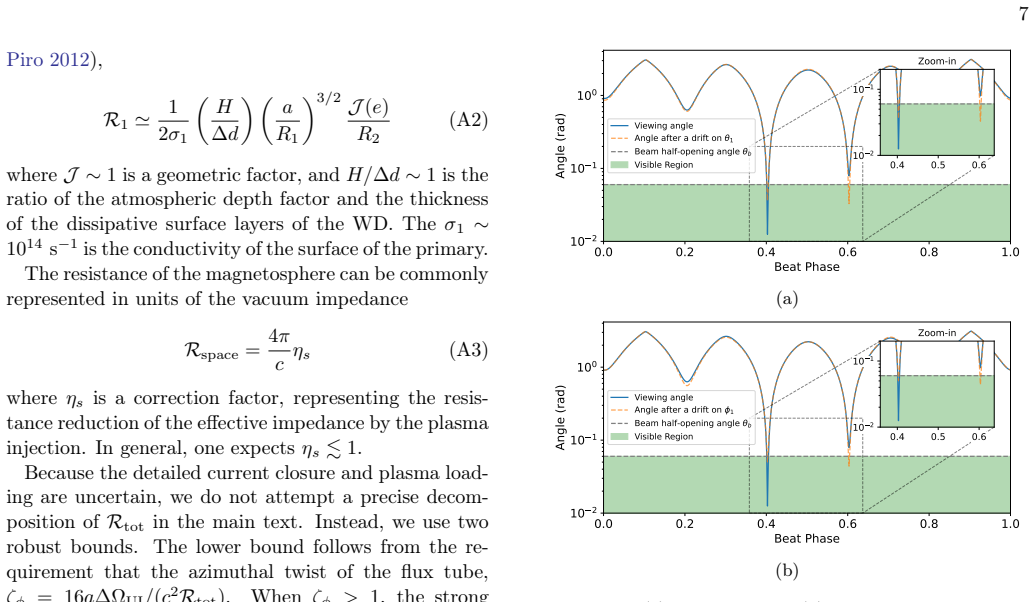
read the original abstract
Long-period transients (LPTs) are a newly identified class of radio sources with burst recurrence times from minutes to hours, and their diversity suggests multiple physical origins. CHIME/ILT J1634+44, with a short period of 841 s, a long-period modulation of 4206 s, and a significant negative period derivative, strongly suggests a binary origin. For such a short-period source, Roche-lobe constraints strongly favor an ultra-compact companion, motivating a double-white-dwarf (WD--WD) interpretation. In this Letter, we show that the WD--WD channel makes a sharp timing prediction: if the burst period is the orbital clock and the long-period modulation is a spin-orbit beat, then the modulation period is not a free timescale. Instead it must evolve jointly with the orbital clock and the spin clock through gravitational-wave losses, magnetic dissipation, and tidal interaction. For CHIME/ILT J1634+44-like parameters, we find that the beat clock drift $|\dot P_b|\sim 10^{-10} \text{ s s}^{-1}$, implying an observed-minus-calculated drift of tens of seconds in one year. Joint measurements of the burst period, modulation period, and their derivatives provide a minimal and falsifiable timing test of an ultra-compact binary origin.
Editorial analysis
A structured set of objections, weighed in public.
Referee Report
Summary. The paper claims that long-period transients such as CHIME/ILT J1634+44 can be explained by an ultra-compact double white dwarf binary in which the 841 s recurrence time is the orbital period and the 4206 s modulation is the spin-orbit beat. Under this identification, standard gravitational-wave-driven orbital decay (Peters quadrupole formula), magnetic dissipation, and tidal coupling imply that the beat period must evolve jointly with the orbital and spin periods, yielding a beat-period derivative |P_b dot| ~ 10^{-10} s s^{-1} and an observable O-C drift of tens of seconds within one year. This supplies a minimal, falsifiable timing test of the DWD channel that does not introduce new free parameters.
Significance. If the central prediction is confirmed by future timing observations, the work supplies a sharp, observationally accessible discriminant between the ultra-compact binary model and alternative origins for LPTs. The prediction rests on conventional binary-evolution physics applied to the observed periods rather than on fitted parameters, giving it independent grounding and making it a useful addition to the literature on these newly discovered sources.
minor comments (2)
- The abstract states the final numerical result but does not indicate the relative sizes of the gravitational-wave, magnetic, and tidal contributions; a single sentence or parenthetical reference to the dominant term would improve immediate readability.
- Notation for the beat period (P_b) and its derivative should be introduced explicitly in the first paragraph of the main text rather than assumed from the abstract.
Simulated Author's Rebuttal
We thank the referee for their positive assessment of the manuscript and for recommending minor revision. No specific major comments were raised in the report.
Circularity Check
No significant circularity identified
full rationale
The paper's derivation applies standard external binary-evolution physics (Peters quadrupole formula for gravitational-wave orbital decay, conventional magnetic spin-down, and tidal coupling) to the conditional assumption that the observed 841 s and 4206 s periods are the orbital period and spin-orbit beat, respectively. This produces a derived numerical value for the beat-period derivative as a consequence of those inputs plus independent formulas, rather than re-expressing the input periods by construction or fitting a parameter to the target observable. No self-definitional steps, fitted inputs renamed as predictions, load-bearing self-citations, or smuggled ansatzes appear in the chain. The result remains a sharp, externally falsifiable prediction under the stated model.
Axiom & Free-Parameter Ledger
axioms (3)
- domain assumption The 841 s period is the orbital period of an ultra-compact binary
- domain assumption The 4206 s modulation is the spin-orbit beat period
- domain assumption Orbital and spin evolution are driven by gravitational-wave losses, magnetic dissipation, and tidal interaction
Reference graph
Works this paper leans on
-
[1]
Laser Interferometer Space Antenna
Amaro-Seoane, P., Audley, H., Babak, S., et al. 2017, Laser Interferometer Space Antenna, arXiv, doi: 10.48550/arXiv.1702.00786
work page internal anchor Pith review Pith/arXiv arXiv doi:10.48550/arxiv.1702.00786 2017
-
[2]
Anumarlapudi, A., Kaplan, D. L., Rea, N., et al. 2025, Monthly Notices of the Royal Astronomical Society, 542, 1208, doi: 10.1093/mnras/staf1227
-
[3]
Bloot, S., Vedantham, H. K., Bassa, C. G., et al. 2025, Astronomy & Astrophysics, 699, A341, doi: 10.1051/0004-6361/202555131
-
[4]
Caleb, M., Lenc, E., Kaplan, D. L., et al. 2024, Nature Astronomy, 8, 1159, doi: 10.1038/s41550-024-02277-w de Ruiter, I., Rajwade, K. M., Bassa, C. G., et al. 2025, Nature Astronomy, 9, 672, doi: 10.1038/s41550-025-02491-0
-
[5]
Dong, F. A., Shin, K., Law, C., et al. 2025, The Astrophysical Journal Letters, 988, L29, doi: 10.3847/2041-8213/adeaab
-
[6]
Walsworth, R. L. 2025, Physical Review D, 111, 044023, doi: 10.1103/PhysRevD.111.044023
-
[7]
2024, The Astrophysical Journal, 967, 24, doi: 10.3847/1538-4357/ad3aef
Fan, Y.-N., Xu, K., & Chen, W.-C. 2024, The Astrophysical Journal, 967, 24, doi: 10.3847/1538-4357/ad3aef
-
[8]
2026, Monthly Notices of the Royal Astronomical Society, 546, doi: 10.1093/mnras/stag146
Ferrario, L. 2026, Monthly Notices of the Royal Astronomical Society, 546, doi: 10.1093/mnras/stag146
-
[9]
2024, Physical Review D, 110, doi: 10.1103/PhysRevD.110.083009
Fiacco, G. 2024, Physical Review D, 110, doi: 10.1103/PhysRevD.110.083009
-
[10]
C., Trotta , R., Berkes , P., Starkman , G
Fuller, J., & Lai, D. 2012, Monthly Notices of the Royal Astronomical Society, 421, 426, doi: 10.1111/j.1365-2966.2011.20320.x
-
[11]
T., Mellema, G., Pen, U.-L., et al
Hobbs, G. B., Edwards, R. T., & Manchester, R. N. 2006, Monthly Notices of the Royal Astronomical Society, 369, 655, doi: 10.1111/j.1365-2966.2006.10302.x
-
[12]
National Science Review4(5), 685–686 (2017) https: //doi.org/10.1093/nsr/nwx116
Hu, W.-R., & Wu, Y.-L. 2017, National Science Review, 4, 685, doi: 10.1093/nsr/nwx116
-
[13]
2022, Nature, 601, 526, doi: 10.1038/s41586-021-04272-x
Hurley-Walker, N., Zhang, X., Bahramian, A., et al. 2022, Nature, 601, 526, doi: 10.1038/s41586-021-04272-x
-
[14]
Hurley-Walker, N., Rea, N., McSweeney, S. J., et al. 2023, Nature, 619, 487, doi: 10.1038/s41586-023-06202-5
-
[15]
Hurley-Walker, N., McSweeney, S. J., Bahramian, A., et al. 2024, The Astrophysical Journal Letters, 976, L21, doi: 10.3847/2041-8213/ad890e
-
[16]
Hyman, S. D., Lazio, T. J. W., Kassim, N. E., et al. 2005, Nature, 434, 50, doi: 10.1038/nature03400 9
-
[17]
2023, Journal of Astrophysics and Astronomy, 44, 1, doi: 10.1007/s12036-022-09899-4
Konar, S. 2023, Journal of Astrophysics and Astronomy, 44, 1, doi: 10.1007/s12036-022-09899-4
-
[18]
2012, ApJL, 757, L3, doi: 10.1088/2041-8205/757/1/L3 Lemaˆ ıtre, G
Lai, D. 2012, The Astrophysical Journal, 757, L3, doi: 10.1088/2041-8205/757/1/L3
-
[19]
Lee, Y. W. J., Caleb, M., Murphy, T., et al. 2025, Nature Astronomy, 9, 393, doi: 10.1038/s41550-024-02452-z
-
[20]
Lommen, A. N., & Demorest, P. 2013, Classical and Quantum Gravity, 30, 224001, doi: 10.1088/0264-9381/30/22/224001
-
[21]
R., & Kramer, M
Lorimer, D. R., & Kramer, M. 2012, Handbook of Pulsar Astronomy
2012
-
[22]
Classical and Quantum Gravity33(3), 035010 (2016) https://doi.org/ 10.1088/0264-9381/33/3/035010
Luo, J., Chen, L.-S., Duan, H.-Z., et al. 2016, Classical and Quantum Gravity, 33, 035010, doi: 10.1088/0264-9381/33/3/035010
-
[23]
Luo, J., Ransom, S., Demorest, P., et al. 2021, The Astrophysical Journal, 911, 45, doi: 10.3847/1538-4357/abe62f
-
[24]
Marsh, T. R., Nelemans, G., & Steeghs, D. 2004, Monthly Notices of the Royal Astronomical Society, 350, 113, doi: 10.1111/j.1365-2966.2004.07564.x
-
[25]
J., Hurley-Walker, N., Horváth, C., et al
McSweeney, S. J., Hurley-Walker, N., Horváth, C., et al. 2025, Monthly Notices of the Royal Astronomical Society, 542, 203, doi: 10.1093/mnras/staf1203
-
[26]
2013, Nature, 501, 517, doi: 10.1038/nature12470
Papitto, A., Ferrigno, C., Bozzo, E., et al. 2013, Nature, 501, 517, doi: 10.1038/nature12470
-
[27]
Peters, P. C. 1964, Physical Review, 136, B1224, doi: 10.1103/PhysRev.136.B1224
-
[28]
Piro, A. L. 2012, The Astrophysical Journal, 755, 80, doi: 10.1088/0004-637X/755/1/80
-
[29]
Pritchard, J., Murphy, T., Dobie, D., et al. 2026, Discovery of a 36-Minute Long-Period Transient ASKAP J142431.2-612611, arXiv, doi: 10.48550/arXiv.2603.07857
-
[30]
2025, The Astrophysical Journal, 981, 34, doi: 10.3847/1538-4357/adb1b5
Qu, Y., & Zhang, B. 2025, The Astrophysical Journal, 981, 34, doi: 10.3847/1538-4357/adb1b5
-
[31]
2026, Long Period Transients (LPTs): A Comprehensive Review, arXiv, doi: 10.48550/arXiv.2601.10393
Rea, N., Hurley-Walker, N., & Caleb, M. 2026, Long Period Transients (LPTs): A Comprehensive Review, arXiv, doi: 10.48550/arXiv.2601.10393
-
[32]
2024, The Astrophysical Journal, 961, 214, doi: 10.3847/1538-4357/ad165d
Rea, N., Hurley-Walker, N., Pardo-Araujo, C., et al. 2024, The Astrophysical Journal, 961, 214, doi: 10.3847/1538-4357/ad165d
-
[33]
Robson, T., Cornish, N. J., & Liu, C. 2019, Classical and Quantum Gravity, 36, 105011, doi: 10.1088/1361-6382/ab1101
-
[34]
2022, The Astrophysical Journal, 934, 184, doi: 10.3847/1538-4357/ac7cec
Ronchi, M., Rea, N., Graber, V., & Hurley-Walker, N. 2022, The Astrophysical Journal, 934, 184, doi: 10.3847/1538-4357/ac7cec
-
[35]
Suvorov, A. G., Dehman, C., & Pons, J. A. 2025, The Astrophysical Journal, 991, 134, doi: 10.3847/1538-4357/adfc55
-
[36]
Wang, Z., Rea, N., Bao, T., et al. 2025, Nature, 642, 583, doi: 10.1038/s41586-025-09077-w
-
[37]
Wu, K., Cropper, M., Ramsay, G., & Sekiguchi, K. 2002, Monthly Notices of the Royal Astronomical Society, 331, 221, doi: 10.1046/j.1365-8711.2002.05190.x
-
[38]
2024, The Astrophysical Journal, 970, 2, doi: 10.3847/1538-4357/ad5319
Xu, K., Yang, H.-R., Jiang, L., et al. 2024, The Astrophysical Journal, 970, 2, doi: 10.3847/1538-4357/ad5319
-
[39]
2026, The Astrophysical Journal, 997, 124, doi: 10.3847/1538-4357/ae2864
Yang, Y.-P. 2026, The Astrophysical Journal, 997, 124, doi: 10.3847/1538-4357/ae2864
discussion (0)
Sign in with ORCID, Apple, or X to comment. Anyone can read and Pith papers without signing in.