Recognition: unknown
HydroFirn: A numerical model for large-scale multidimensional firn hydrology
Pith reviewed 2026-05-10 16:30 UTC · model grok-4.3
The pith
A new multidimensional model for firn hydrology shows that lateral heterogeneities control melt percolation depths and ice layer formation on the Greenland Ice Sheet.
A machine-rendered reading of the paper's core claim, the machinery that carries it, and where it could break.
Core claim
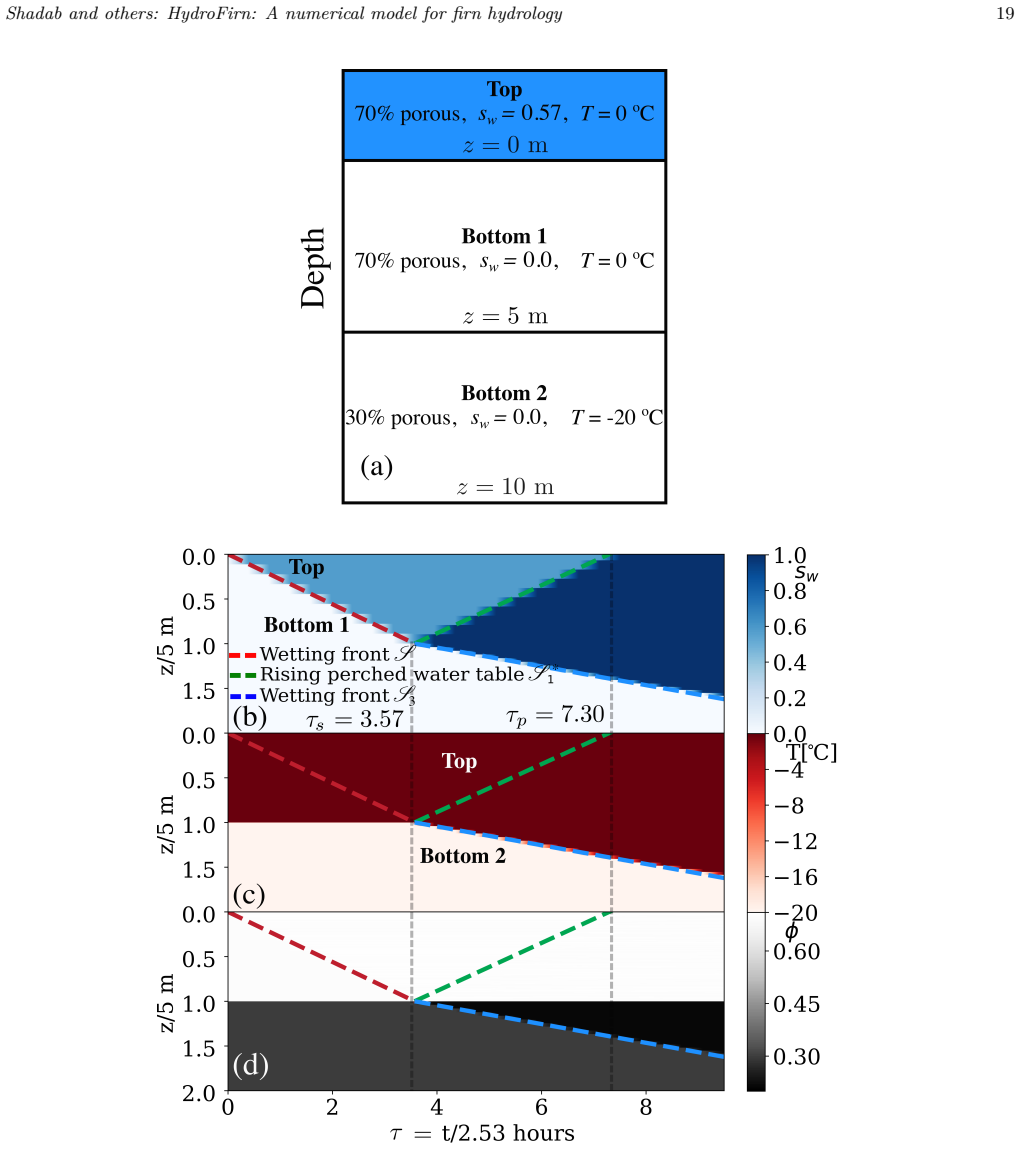
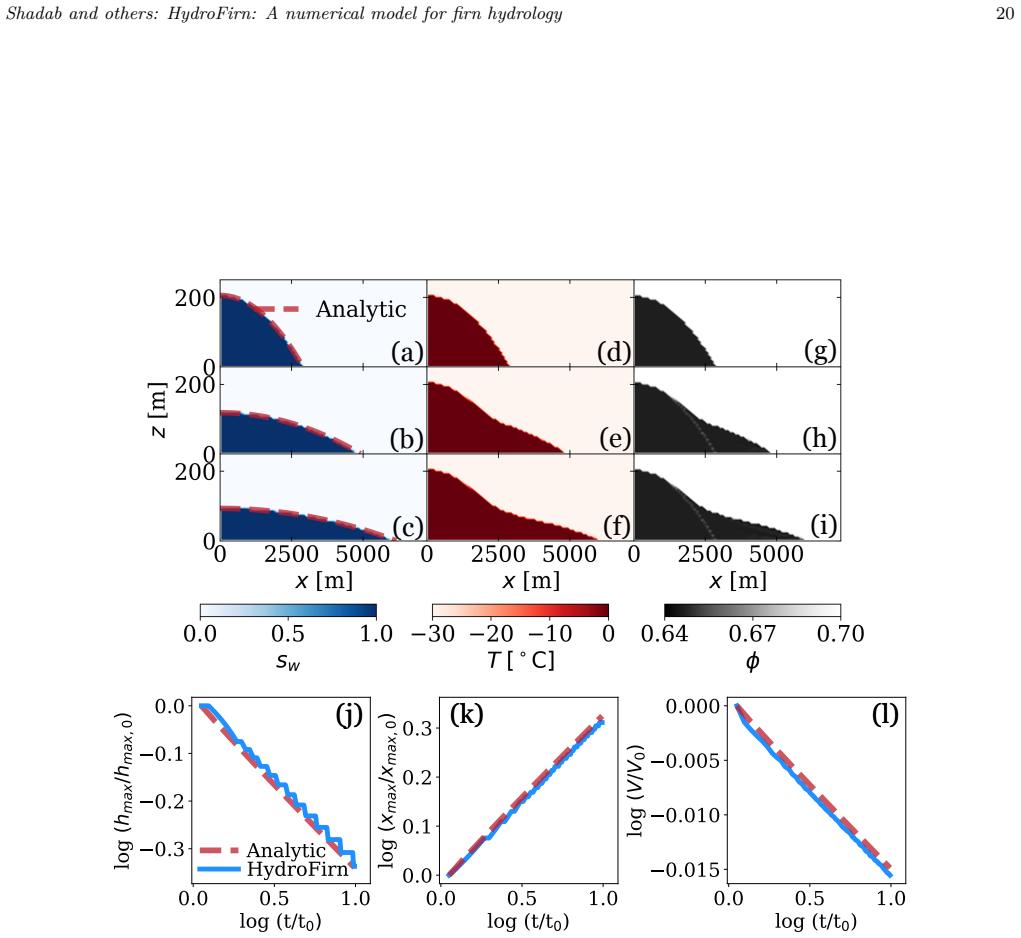
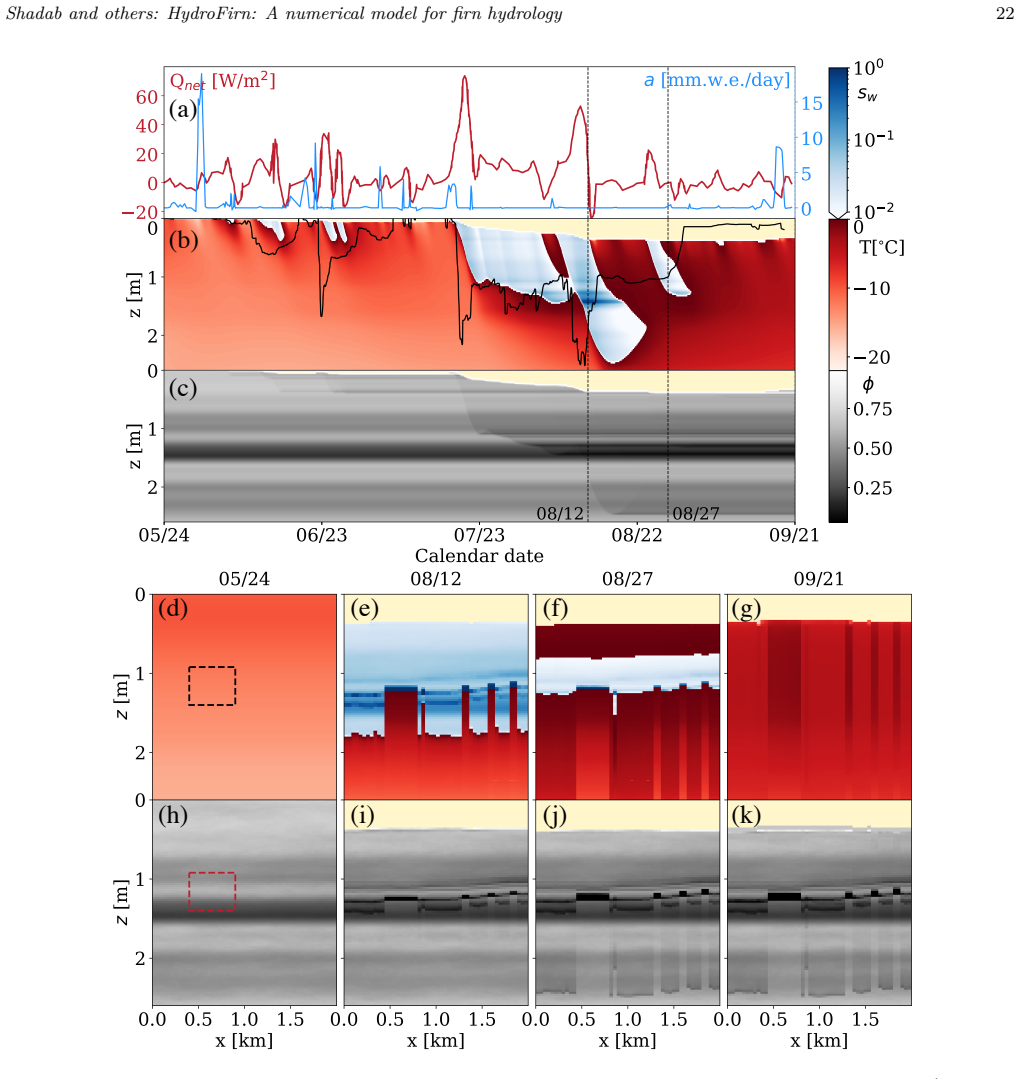
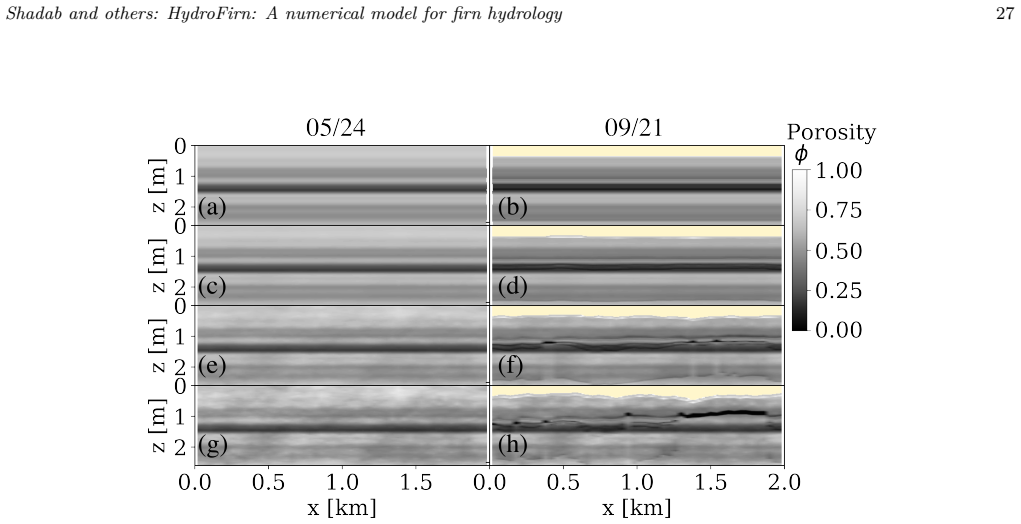
HydroFirn is a multidimensional, multiphase, thermomechanical model for firn subsurface hydrology that solves an additional pressure equation exclusively in saturated regions. This algorithm enables efficient handling of large domains, spatially varying boundary conditions, and the spontaneous growth of fully impermeable ice layers. The model reproduces analytic solutions for one- and two-dimensional test problems that couple unsaturated-saturated flow, heat transport, and phase change. When driven with southwest Greenland observations, the results demonstrate that lateral heterogeneities exert a first-order control on the depth reached by percolating meltwater and on the locations where ice
What carries the argument
The novel algorithm that solves an extra pressure equation only inside saturated zones, thereby capturing the transition to impermeable ice layers and avoiding numerical artifacts across the entire unsaturated-saturated domain.
If this is right
- Lateral heterogeneities must be included to predict realistic melt percolation depths and ice-layer distributions.
- The model supplies physics-based constraints that can tighten firn-densification calculations used in surface-mass-balance estimates.
- Uncertainty in converting satellite altimetry elevation changes into mass changes can be reduced once multidimensional flow is accounted for.
- Freshwater fluxes from the ice sheet to the ocean under future warming scenarios become more accurately quantifiable.
- The same framework can be applied to other ice-sheet regions where horizontal variability in firn properties is observed.
Where Pith is reading between the lines
- Embedding this multidimensional solver into existing large-scale ice-sheet models would allow consistent treatment of firn hydrology at continental scales.
- The efficiency gained from the saturated-only pressure solve could be transferred to other porous-media problems that involve phase-change fronts, such as permafrost thaw or soil freezing.
- Targeted field campaigns that measure both vertical and horizontal firn properties at the same sites would provide stronger tests of the heterogeneity effect identified here.
Load-bearing premise
The assumption that restricting the extra pressure solve to saturated regions alone is sufficient to represent the full physics of the unsaturated-saturated transition and dynamic ice-layer formation without artifacts or hidden tuning parameters.
What would settle it
A mismatch between the model's predicted depths and lateral positions of ice layers and independent, high-resolution radar or borehole measurements collected across a wider set of Greenland transects would falsify the claim that lateral heterogeneities dominate percolation patterns.
Figures






read the original abstract
Observations show the multidimensional dynamics of meltwater and distribution of ice layers in the firn on the Greenland Ice Sheet. However, state-of-the-art large-scale models for firn hydrology are essentially one-dimensional, limiting their ability to explain observed datasets and contributing to uncertainty in surface mass balance and sea-level rise estimates. Here, we present a large-scale, multidimensional, multiphase, and thermomechanical model for the subsurface hydrology of firn. The model is highly efficient due to a novel algorithm in which an extra equation for pressure is solved only in saturated regions. Furthermore, the model can apply spatially heterogeneous boundary conditions to the unsaturated-saturated domain and allows for the dynamic formation of fully impermeable ice layers. The numerical results show excellent comparisons against analytic solutions to one- and two-dimensional problems that involve coupled unsaturated-saturated flows, thermodynamics, and phase change. We further apply the model to investigate field data from southwest Greenland and find that lateral heterogeneities strongly influence the depth of melt percolation and ice layer formation. Improved understanding of these local, multidimensional processes will provide physics-based constraints on firn densification, reduce uncertainty in converting altimetric elevation change to mass change, and improve estimates of freshwater fluxes to the ocean under a warming climate.
Editorial analysis
A structured set of objections, weighed in public.
Referee Report
Summary. The manuscript presents HydroFirn, a large-scale multidimensional multiphase thermomechanical model for firn hydrology. It introduces a novel efficient algorithm that solves an extra pressure equation only in saturated regions, supports spatially heterogeneous boundary conditions on the unsaturated-saturated domain, and permits dynamic formation of fully impermeable ice layers. The model is validated against analytic solutions for one- and two-dimensional problems involving coupled unsaturated-saturated flows, thermodynamics, and phase change, and is applied to southwest Greenland field data to conclude that lateral heterogeneities strongly influence melt percolation depth and ice layer formation.
Significance. If the central numerical scheme is shown to be free of artifacts at moving interfaces, the work would advance firn modeling beyond current one-dimensional approaches by capturing observed multidimensional processes. This could reduce uncertainties in surface mass balance, altimetry-to-mass conversion, and ocean freshwater fluxes. The efficiency of the saturated-only pressure solver and the ability to handle dynamic impermeability are potentially valuable for large-scale applications, though their robustness requires explicit demonstration.
major comments (2)
- [Abstract and validation section] Abstract and validation section: The claim of 'excellent comparisons' against analytic solutions for coupled unsaturated-saturated flows, thermodynamics, and phase change provides no quantitative error metrics, mesh convergence details, or description of whether the tests include dynamic formation of fully impermeable ice layers or moving unsaturated-saturated interfaces. This is load-bearing for the novel algorithm and the Greenland application conclusions on lateral heterogeneities and ice layer formation.
- [Greenland application section] Greenland application section: The finding that lateral heterogeneities strongly influence percolation depth and ice layer formation depends on the unverified assumption that the saturated-only pressure solver accurately represents the physics of the unsaturated-saturated transition and dynamic impermeable layer formation without introducing numerical artifacts or requiring unstated parameter tuning.
Simulated Author's Rebuttal
We thank the referee for their constructive review and positive assessment of the work's potential significance. We address each major comment below and will revise the manuscript to incorporate additional quantitative details and clarifications as outlined.
read point-by-point responses
-
Referee: [Abstract and validation section] Abstract and validation section: The claim of 'excellent comparisons' against analytic solutions for coupled unsaturated-saturated flows, thermodynamics, and phase change provides no quantitative error metrics, mesh convergence details, or description of whether the tests include dynamic formation of fully impermeable ice layers or moving unsaturated-saturated interfaces. This is load-bearing for the novel algorithm and the Greenland application conclusions on lateral heterogeneities and ice layer formation.
Authors: We agree that quantitative error metrics, mesh convergence studies, and explicit descriptions of the test configurations will strengthen the validation. In the revised manuscript we will add L2 and maximum error norms for all analytic comparisons, along with tables reporting convergence rates under successive mesh refinement. We will also expand the validation section to state that the two-dimensional tests explicitly include dynamic phase change (leading to fully impermeable ice layers) and moving unsaturated-saturated interfaces, as these features are inherent to the coupled flow-thermodynamics problems solved. These additions will be reflected in an updated abstract as well. revision: yes
-
Referee: [Greenland application section] Greenland application section: The finding that lateral heterogeneities strongly influence percolation depth and ice layer formation depends on the unverified assumption that the saturated-only pressure solver accurately represents the physics of the unsaturated-saturated transition and dynamic impermeable layer formation without introducing numerical artifacts or requiring unstated parameter tuning.
Authors: We acknowledge the importance of demonstrating that the saturated-only pressure solver introduces no artifacts at moving interfaces. The existing validation cases already exercise the solver under conditions with moving interfaces and dynamic impermeable-layer formation, and the comparisons to analytic solutions show close agreement without visible artifacts. To make this explicit, we will add a dedicated paragraph and supplementary figure in the revised validation section that quantifies interface sharpness, mass-conservation errors, and solution sensitivity across the unsaturated-saturated transition. All parameters used in the Greenland simulations will be listed in a table to eliminate any ambiguity about tuning. These revisions will directly support the robustness of the lateral-heterogeneity conclusions. revision: yes
Circularity Check
No significant circularity; derivation is self-contained forward model
full rationale
The paper presents a physics-based numerical model for multidimensional firn hydrology, deriving equations from standard multiphase flow, thermodynamics, and phase-change principles. Validation relies on comparisons to independent analytic solutions for coupled unsaturated-saturated flows, not on fitted parameters or self-referential definitions. The novel saturated-only pressure solver is introduced as an efficiency algorithm without reducing to tautological inputs or self-citations. Application to Greenland field data is a forward simulation exercise. No load-bearing steps match the enumerated circularity patterns; the central claims remain independent of the model's own outputs.
Axiom & Free-Parameter Ledger
Reference graph
Works this paper leans on
-
[1]
, " * write output.state after.block = add.period write newline
ENTRY address author booktitle chapter doi edition editor eid howpublished institution isbn issn journal key month note number organization pages publisher school series title type volume year label extra.label sort.label short.list INTEGERS output.state before.all mid.sentence after.sentence after.block FUNCTION init.state.consts #0 'before.all := #1 'mi...
-
[2]
write newline
" write newline "" before.all 'output.state := FUNCTION n.dashify 't := "" t empty not t #1 #1 substring "-" = t #1 #2 substring "--" = not "--" * t #2 global.max substring 't := t #1 #1 substring "-" = "-" * t #2 global.max substring 't := while if t #1 #1 substring * t #2 global.max substring 't := if while FUNCTION word.in bbl.in capitalize " " * FUNCT...
-
[3]
Routledge, New York, ISBN 9780203749449 ( 10.1201/9780203749449 )
Alexiades V and Solomon A (1993) Mathematical Modeling of Melting and Freezing Processes . Routledge, New York, ISBN 9780203749449 ( 10.1201/9780203749449 )
-
[4]
Remote sensing of environment, 210, 297--306
Alley K, Scambos T, Miller J, Long D and MacFerrin M (2018) Quantifying vulnerability of antarctic ice shelves to hydrofracture using microwave scattering properties. Remote sensing of environment, 210, 297--306
2018
-
[5]
Journal of Glaciology, 58(209), 441--457
Aschwanden A, Bueler E, Khroulev C and Blatter H (2012) An enthalpy formulation for glaciers and ice sheets. Journal of Glaciology, 58(209), 441--457
2012
-
[6]
Bartelt P and Lehning M (2002) A physical SNOWPACK model for the Swiss avalanche warning . Cold Regions Science and Technology, 35(3), 123--145, ISSN 0165232X ( 10.1016/S0165-232X(02)00074-5 )
-
[7]
Courier Corporation
Bear J (2013) Dynamics of Fluids in Porous Media. Courier Corporation
2013
-
[8]
Nature Climate Change, 8(12), 1044--1052
Bell RE, Banwell AF, Trusel LD and Kingslake J (2018) Antarctic surface hydrology and impacts on ice-sheet mass balance. Nature Climate Change, 8(12), 1044--1052
2018
-
[9]
Cambridge University Press
Blunt MJ (2017) Multiphase Flow in Permeable Media: A Pore-scale Perspective. Cambridge University Press
2017
-
[10]
Brooks R and Corey A (1964) Hydraulic properties of porous media - hydrology paper no. 3. Civil Engineering Department, Colorado State University, Fort Collins, CO
1964
-
[11]
In SPE Annual Technical Conference and Exhibition?, SPE--10157, SPE ( 10.2118/10157-MS )
Carlson FM (1981) Simulation of relative permeability hysteresis to the nonwetting phase. In SPE Annual Technical Conference and Exhibition?, SPE--10157, SPE ( 10.2118/10157-MS )
-
[12]
Carman PC (1937) Fluid flow through granular beds. Trans. Inst. Chem. Eng., 15, 150--166
1937
-
[13]
Earth and Planetary Science Letters, 563(116886), ISSN 0012821X ( 10.1016/j.epsl.2021.116886 )
Carnahan E, Wolfenbarger N, Jordan J and Hesse M (2021) New insights into temperature-dependent ice properties and their effect on ice shell convection for icy ocean worlds . Earth and Planetary Science Letters, 563(116886), ISSN 0012821X ( 10.1016/j.epsl.2021.116886 )
-
[14]
The Cryosphere Discussions, 1--22
Chan K, Grima C, Rutishauser A, Young DA, Culberg R and Blankenship DD (2022) Spatial characterization of near-surface structure and meltwater runoff conditions across devon ice cap from dual-frequency radar reflectivity. The Cryosphere Discussions, 1--22
2022
-
[15]
theory and comparison to observations from beneath the west antarctic ice sheet
Christoffersen P and Tulaczyk S (2003) Response of subglacial sediments to basal freeze-on 1. theory and comparison to observations from beneath the west antarctic ice sheet. Journal of Geophysical Research: Solid Earth, 108(B4)
2003
-
[16]
Water Resources Research, 53(1), 909--922, ISSN 0043-1397 ( 10.1002/2016WR019672 )
Clark M, Nijssen B and Luce C (2017) An analytical test case for snow models . Water Resources Research, 53(1), 909--922, ISSN 0043-1397 ( 10.1002/2016WR019672 )
-
[17]
Journal of Glaciology, 11(63), 369--385 ( 10.3189/S0022143000022346 )
Colbeck S (1972) A theory of water percolation in snow. Journal of Glaciology, 11(63), 369--385 ( 10.3189/S0022143000022346 )
-
[18]
Water Resources Research, 10(1), 119--123 ( 10.1029/WR010i001p00119 )
Colbeck S (1974) Water flow through snow overlying an impermeable boundary. Water Resources Research, 10(1), 119--123 ( 10.1029/WR010i001p00119 )
-
[19]
Advances in hydroscience, 11, 165--206
Colbeck S (1978) The physical aspects of water flow through snow. Advances in hydroscience, 11, 165--206
1978
-
[20]
Water Resources Research, 12(3), 523--527 ( 10.1029/WR012i003p00523 )
Colbeck SC (1976) An analysis of water flow in dry snow. Water Resources Research, 12(3), 523--527 ( 10.1029/WR012i003p00523 )
-
[21]
Annals of glaciology, 26, 64--68
Col \'e ou C and Lesaffre B (1998) Irreducible water saturation in snow: experimental results in a cold laboratory. Annals of glaciology, 26, 64--68
1998
-
[22]
Academic Press
Cuffey KM and Paterson WSB (2010) The Physics of Glaciers. Academic Press
2010
-
[23]
Nature communications, 12(1), 1--9
Culberg R, Schroeder DM and Chu W (2021) Extreme melt season ice layers reduce firn permeability across greenland. Nature communications, 12(1), 1--9
2021
-
[24]
The Cryosphere, 9(3), 1203--1211, ISSN 1994-0424 ( 10.5194/tc-9-1203-2015 )
de la Pe \ n a S, Howat IM, Nienow PW, van den Broeke MR, Mosley-Thompson E, Price SF, Mair D, No \" e l B and Sole AJ (2015) Changes in the firn structure of the western Greenland Ice Sheet caused by recent warming . The Cryosphere, 9(3), 1203--1211, ISSN 1994-0424 ( 10.5194/tc-9-1203-2015 )
-
[25]
Nature Reviews Earth & Environment, 1--21
Firn Symposium Team (2024) Firn on ice sheets. Nature Reviews Earth & Environment, 1--21
2024
-
[26]
Gascon G, Sharp M, Burgess D, Bezeau P and Bush ABG (2013) Changes in accumulation-area firn stratigraphy and meltwater flow during a period of climate warming: Devon Ice Cap, Nunavut, Canada . Journal of Geophysical Research: Earth Surface, 118(4), 2380--2391, ISSN 21699003 ( 10.1002/2013JF002838 )
-
[27]
Nature, 491(7423), 240--243
Harper J, Humphrey N, Pfeffer WT, Brown J and Fettweis X (2012) Greenland ice-sheet contribution to sea-level rise buffered by meltwater storage in firn. Nature, 491(7423), 240--243
2012
-
[28]
The Cryosphere, 12(6), 1851--1866 ( 10.5194/tc-12-1851-2018 )
Heilig A, Eisen O, MacFerrin M, Tedesco M and Fettweis X (2018) Seasonal monitoring of melt and accumulation within the deep percolation zone of the greenland ice sheet and comparison with simulations of regional climate modeling. The Cryosphere, 12(6), 1851--1866 ( 10.5194/tc-12-1851-2018 )
-
[29]
Hirashima H, Yamaguchi S and Katsushima T (2014) A multi-dimensional water transport model to reproduce preferential flow in the snowpack . Cold Regions Science and Technology, 108, 80--90, ISSN 0165232X ( 10.1016/j.coldregions.2014.09.004 )
-
[30]
Journal of Geophysical Research: Earth Surface, 127(10), e2022JF006753
Horlings AN, Christianson K and Mi \`e ge C (2022) Expansion of firn aquifers in southeast greenland. Journal of Geophysical Research: Earth Surface, 127(10), e2022JF006753
2022
-
[31]
Journal of Glaciology, 67(265), 952--960, ISSN 0022-1430 ( 10.1017/jog.2021.44 )
Humphrey N, Harper J and Meierbachtol T (2021) Physical limits to meltwater penetration in firn . Journal of Glaciology, 67(265), 952--960, ISSN 0022-1430 ( 10.1017/jog.2021.44 )
-
[32]
Water Resources Research, 26(5), 1001--1012, ISSN 19447973 ( 10.1029/WR026i005p01001 )
Illangasekare T, Walter R, Meier M and Pfeffer WT (1990) Modeling of meltwater infiltration in subfreezing snow . Water Resources Research, 26(5), 1001--1012, ISSN 19447973 ( 10.1029/WR026i005p01001 )
-
[33]
Annals of Glaciology, 27, 105--109
Jiahong W, Jiancheng K, Jiankang H, Zichu X, Leibao L and Dali W (1998) Glaciological studies on the king george island ice cap, south shetland islands, antarctica. Annals of Glaciology, 27, 105--109
1998
-
[34]
Technical report, U.S
Jordan R (1991) A One-Dimensional Temperature Model for a Snow Cover . Technical report, U.S. Army Corps of Engineers, Cold Regions Research and Engineering Laboratory, Special Report 91-16
1991
-
[35]
Jullien N, Tedstone AJ, Machguth H, Karlsson NB and Helm V (2023) Greenland ice sheet ice slab expansion and thickening. Geophysical Research Letters, 50(10), e2022GL100911 ( https://doi.org/10.1029/2022GL100911 ), e2022GL100911 2022GL100911
-
[36]
Antarctic Science, 18(2), 271--278
Kaczmarska M, Isaksson E, Karl \"o f L, Brandt O, Winther JG, Van De Wal RS, Van Den Broeke M and Johnsen SJ (2006) Ice core melt features in relation to antarctic coastal climate. Antarctic Science, 18(2), 271--278
2006
-
[37]
Philosophical magazine, 23(181), 153--165
Knight CA (1971) Experiments on the contact angle of water on ice. Philosophical magazine, 23(181), 153--165
1971
-
[38]
Royal Academy of Science, Vienna, Proc
Kozeny J (1927) Uber kapillare leitung der wasser in boden. Royal Academy of Science, Vienna, Proc. Class I, 136, 271--306
1927
-
[39]
Annals of Glaciology, 56(70), 1--8, ISSN 02603055 ( 10.3189/2015AoG70A994 )
Kuipers Munneke P, Ligtenberg SR, Suder EA and Van Den Broeke MR (2015) A model study of the response of dry and wet firn to climate change . Annals of Glaciology, 56(70), 1--8, ISSN 02603055 ( 10.3189/2015AoG70A994 )
-
[40]
o rhold M, M \
Laepple T, H \"o rhold M, M \"u nch T, Freitag J, Wegner A and Kipfstuhl S (2016) Layering of surface snow and firn at kohnen station, antarctica: Noise or seasonal signal? Journal of Geophysical Research: Earth Surface, 121(10), 1849--1860
2016
-
[41]
Water Resources Research, 56(9), e2020WR027466
Leroux NR, Marsh CB and Pomeroy JW (2020) Simulation of preferential flow in snow with a 2-d non-equilibrium richards model and evaluation against laboratory data. Water Resources Research, 56(9), e2020WR027466
2020
-
[42]
Cambridge University Press
Lie KA (2019) An introduction to reservoir simulation using MATLAB/GNU Octave: User guide for the MATLAB Reservoir Simulation Toolbox (MRST). Cambridge University Press
2019
-
[43]
The Cryosphere, 5(4), 809--819, ISSN 1994-0424 ( 10.5194/tc-5-809-2011 )
Ligtenberg S, Helsen M and van den Broeke M (2011) An improved semi-empirical model for the densification of Antarctic firn . The Cryosphere, 5(4), 809--819, ISSN 1994-0424 ( 10.5194/tc-5-809-2011 )
-
[44]
Nature, 573(7774), 403--407
MacFerrin M, Machguth H, As Dv, Charalampidis C, Stevens C, Heilig A, Vandecrux B, Langen P, Mottram R, Fettweis X and others (2019) Rapid expansion of greenland’s low-permeability ice slabs. Nature, 573(7774), 403--407
2019
-
[45]
Machguth H, MacFerrin M, van As D, Box JE, Charalampidis C, Colgan W, Fausto RS, Meijer HAJ, Mosley-Thompson E and van de Wal RSW (2016) Greenland meltwater storage in firn limited by near-surface ice formation . Nature Clim. Change, advance on(January), 1--6, ISSN 1758-6798 ( 10.1038/nclimate2899 )
-
[46]
Observations in the Canadian Arctic
Marsh P and Woo M (1984) Wetting front advance and freezing of meltwater within a snow cover: 1. Observations in the Canadian Arctic . Water Resources Research, 20(12), 1853--1864, ISSN 0043-1397 ( 10.1029/WR020i012p01853 )
-
[47]
Journal of Geophysical Research: Earth Surface, 128(2), e2022JF006752
McDowell IE, Keegan KM, Wever N, Osterberg EC, Hawley RL and Marshall HP (2023) Firn core evidence of two-way feedback mechanisms between meltwater infiltration and firn microstructure from the western percolation zone of the greenland ice sheet. Journal of Geophysical Research: Earth Surface, 128(2), e2022JF006752
2023
-
[48]
The Cryosphere, 11(6), 2799--2813
Meyer CR and Hewitt IJ (2017) A continuum model for meltwater flow through compacting snow. The Cryosphere, 11(6), 2799--2813
2017
-
[49]
Proceedings of the national academy of sciences, 116(19), 9239--9244
Mouginot J, Rignot E, Bj rk AA, Van den Broeke M, Millan R, Morlighem M, No \"e l B, Scheuchl B and Wood M (2019) Forty-six years of greenland ice sheet mass balance from 1972 to 2018. Proceedings of the national academy of sciences, 116(19), 9239--9244
2019
-
[50]
Water Resources Research, e2022WR034035
Moure A, Jones N, Pawlak J, Meyer C and Fu X (2023) A thermodynamic nonequilibrium model for preferential infiltration and refreezing of melt in snow. Water Resources Research, e2022WR034035
2023
-
[51]
Nature Communications, 8(1), 1--8, ISSN 20411723 ( 10.1038/ncomms14730 )
No \" e l B, Van De Berg WJ, Lhermitte S, Wouters B, Machguth H, Howat I, Citterio M, Moholdt G, Lenaerts JT and Van Den Broeke MR (2017) A tipping point in refreezing accelerates mass loss of Greenland's glaciers and ice caps . Nature Communications, 8(1), 1--8, ISSN 20411723 ( 10.1038/ncomms14730 )
-
[52]
Annals of Glaciology, 26, 83--91, ISSN 0260-3055 ( 10.3189/1998AoG26-1-83-91 )
Pfeffer WT and Humphrey NF (1998) Formation of ice layers by infiltration and refreezing of meltwater . Annals of Glaciology, 26, 83--91, ISSN 0260-3055 ( 10.3189/1998AoG26-1-83-91 )
-
[53]
Journal of Geophysical Research, 96(C12), ISSN 01480227 ( 10.1029/91jc02502 )
Pfeffer WT, Meier MF and Illangasekare TH (1991) Retention of Greenland runoff by refreezing: implications for projected future sea level change . Journal of Geophysical Research, 96(C12), ISSN 01480227 ( 10.1029/91jc02502 )
-
[54]
Geophysical Research Letters, 43(24), 12--502
Rutishauser A, Grima C, Sharp M, Blankenship DD, Young DA, Cawkwell F and Dowdeswell JA (2016) Characterizing near-surface firn using the scattered signal component of the glacier surface return from airborne radio-echo sounding. Geophysical Research Letters, 43(24), 12--502
2016
-
[55]
Geophysical Research Letters, 47(15), e2020GL089211 ( 10.1029/2020GL089211 )
Samimi S, Marshall SJ and MacFerrin M (2020) Meltwater penetration through temperate ice layers in the percolation zone at dye-2, greenland ice sheet. Geophysical Research Letters, 47(15), e2020GL089211 ( 10.1029/2020GL089211 )
-
[56]
Journal of Geophysical Research: Earth Surface, 126(10), e2021JF006295 ( 10.1029/2021JF006295 )
Samimi S, Marshall SJ, Vandecrux B and MacFerrin M (2021) Time-domain reflectometry measurements and modeling of firn meltwater infiltration at dye-2, greenland. Journal of Geophysical Research: Earth Surface, 126(10), e2021JF006295 ( 10.1029/2021JF006295 )
-
[57]
Water Resources Research, e2022WR032963 ( 10.1029/2022WR032963 )
Shadab MA and Hesse MA (2022) Analysis of gravity-driven infiltration with the development of a saturated region. Water Resources Research, e2022WR032963 ( 10.1029/2022WR032963 )
-
[58]
Advances in Water Resources, 104736 ( 10.1016/j.advwatres.2024.104736 )
Shadab MA and Hesse MA (2024) A hyperbolic-elliptic pde model and conservative numerical method for gravity-dominated variably-saturated groundwater flow. Advances in Water Resources, 104736 ( 10.1016/j.advwatres.2024.104736 )
-
[59]
Geophysical Research Letters, 51(15), e2024GL109893 ( 10.1029/2024GL109893 )
Shadab MA, Adhikari S, Rutishauser A, Grima C and Hesse MA (2024) A mechanism for ice layer formation in glacial firn. Geophysical Research Letters, 51(15), e2024GL109893 ( 10.1029/2024GL109893 )
-
[60]
Journal of Glaciology, 71, e87
Shadab MA, Rutishauser A, Grima C and Hesse MA (2025 a ) A unified kinematic wave theory for melt infiltration into firn. Journal of Glaciology, 71, e87
2025
-
[61]
arXiv preprint arXiv:2510.14268
Shadab MA, Stone HA and Maxwell RM (2025 b ) A vertically integrated model with phase change for aquifers in cold firn. arXiv preprint arXiv:2510.14268
-
[62]
Smith R (1983) Approximate Soil Water Movement by Kinematic Characteristics . Soil Science Society of America Journal, 47(1), 3--8, ISSN 03615995 ( 10.2136/sssaj1983.03615995004700010001x )
-
[63]
The Cryosphere, 11(6), 2507--2526
Steger CR, Reijmer CH and van den Broeke MR (2017 a ) The modelled liquid water balance of the greenland ice sheet. The Cryosphere, 11(6), 2507--2526
2017
-
[64]
Frontiers in Earth Science, 5, 3
Steger CR, Reijmer CH, Van Den Broeke MR, Wever N, Forster RR, Koenig LS, Kuipers Munneke P, Lehning M, Lhermitte S, Ligtenberg SR and others (2017 b ) Firn meltwater retention on the greenland ice sheet: A model comparison. Frontiers in Earth Science, 5, 3
2017
-
[65]
Geoscientific Model Development, 13(9), 4355--4377, ISSN 1991-9603 ( 10.5194/gmd-13-4355-2020 )
Stevens C, Verjans V, Lundin J, Kahle E, Horlings A, Horlings B and Waddington E (2020) The Community Firn Model (CFM) v1.0 . Geoscientific Model Development, 13(9), 4355--4377, ISSN 1991-9603 ( 10.5194/gmd-13-4355-2020 )
-
[66]
Modelling Water Flow in Unsaturated Porous Media: Accounting for Nonlinear Permeability and Material Heterogeneity, 9--47
Szymkiewicz A and Szymkiewicz A (2013) Mathematical models of flow in porous media. Modelling Water Flow in Unsaturated Porous Media: Accounting for Nonlinear Permeability and Material Heterogeneity, 9--47
2013
-
[67]
Nature, 558(7709), 219--222
Team-IMBIE (2018) Mass balance of the antarctic ice sheet from 1992 to 2017. Nature, 558(7709), 219--222
2018
-
[68]
Nature Communications, 16(1), 4494
Tedstone A, Machguth H, Clerx N, Jullien N, Picton H, Ducrey J, van As D, Colosio P, Tedesco M and Lhermitte S (2025) Concurrent superimposed ice formation and meltwater runoff on greenland’s ice slabs. Nature Communications, 16(1), 4494
2025
-
[69]
Trefethen LN and Bau III D (1997) Numerical linear algebra, volume 50. Siam
1997
-
[70]
Geophysical Research Letters, 40(10), 2109--2113, ISSN 00948276 ( 10.1002/grl.50490 )
Van Angelen JH, Lenaerts JT, Van Den Broeke MR, Fettweis X and Van Meijgaard E (2013) Rapid loss of firn pore space accelerates 21st century Greenland mass loss . Geophysical Research Letters, 40(10), 2109--2113, ISSN 00948276 ( 10.1002/grl.50490 )
-
[71]
science, 326(5955), 984--986
Van den Broeke M, Bamber J, Ettema J, Rignot E, Schrama E, van de Berg WJ, van Meijgaard E, Velicogna I and Wouters B (2009) Partitioning recent greenland mass loss. science, 326(5955), 984--986
2009
-
[72]
Journal of Glaciology, 66(258), 591--602
Vandecrux B, Fausto R, Van As D, Colgan W, Langen P, Haubner K, Ingeman-Nielsen T, Heilig A, Stevens C, Macferrin M and others (2020) Firn cold content evolution at nine sites on the greenland ice sheet between 1998 and 2017. Journal of Glaciology, 66(258), 591--602
2020
-
[73]
Geophysical Research Letters, 47(8), ISSN 19448007 ( 10.1029/2020GL087291 )
Velicogna I, Mohajerani Y, Geruo A, Landerer F, Mouginot J, Noel B, Rignot E, Sutterley T, van den Broeke M, van Wessem M and Wiese D (2020) Continuity of Ice Sheet Mass Loss in Greenland and Antarctica From the GRACE and GRACE Follow-On Missions . Geophysical Research Letters, 47(8), ISSN 19448007 ( 10.1029/2020GL087291 )
-
[74]
The Cryosphere, 13(7), 1819--1842, ISSN 1994-0424 ( 10.5194/tc-13-1819-2019 )
Verjans V, Leeson AA, Stevens CM, MacFerrin M, No \" e l B and van den Broeke MR (2019) Development of physically based liquid water schemes for Greenland firn-densification models . The Cryosphere, 13(7), 1819--1842, ISSN 1994-0424 ( 10.5194/tc-13-1819-2019 )
-
[75]
Geoscientific Model Development, 5(3), 773--791, ISSN 1991-9603 ( 10.5194/gmd-5-773-2012 )
Vionnet V, Brun E, Morin S, Boone A, Faroux S, Le Moigne P, Martin E and Willemet JM (2012) The detailed snowpack scheme Crocus and its implementation in SURFEX v7.2 . Geoscientific Model Development, 5(3), 773--791, ISSN 1991-9603 ( 10.5194/gmd-5-773-2012 )
-
[76]
The Cryosphere, 8(1), 257--274, ISSN 1994-0424 ( 10.5194/tc-8-257-2014 )
Wever N, Fierz C, Mitterer C, Hirashima H and Lehning M (2014) Solving Richards Equation for snow improves snowpack meltwater runoff estimations in detailed multi-layer snowpack model . The Cryosphere, 8(1), 257--274, ISSN 1994-0424 ( 10.5194/tc-8-257-2014 )
-
[77]
The Cryosphere, 10(6), 2731--2744
Wever N, W \"u rzer S, Fierz C and Lehning M (2016) Simulating ice layer formation under the presence of preferential flow in layered snowpacks. The Cryosphere, 10(6), 2731--2744
2016
-
[78]
The Cryosphere, 17(7), 2793--2809
Xu H, Medley B, Tsang L, Johnson JT, Jezek KC, Brogioni M and Kaleschke L (2023) Polar firn properties in greenland and antarctica and related effects on microwave brightness temperatures. The Cryosphere, 17(7), 2793--2809
2023
-
[79]
US Army, Corps of Engineers, Cold Regions Research and Engineering Laboratory, 81(10)
Yen YC (1981) Review of thermal properties of snow, ice, and sea ice. US Army, Corps of Engineers, Cold Regions Research and Engineering Laboratory, 81(10)
1981
-
[80]
Nature, 568(7752), 382--386
Zemp M, Huss M, Thibert E, Eckert N, McNabb R, Huber J, Barandun M, Machguth H, Nussbaumer SU, G \"a rtner-Roer I and others (2019) Global glacier mass changes and their contributions to sea-level rise from 1961 to 2016. Nature, 568(7752), 382--386
2019
discussion (0)
Sign in with ORCID, Apple, or X to comment. Anyone can read and Pith papers without signing in.