Recognition: unknown
Multidimensional Profiles of Critical Thinking in Physics Labs: Latent Structure, Instructional Change, and Connections to Physics Identity
Pith reviewed 2026-05-10 15:11 UTC · model grok-4.3
The pith
Latent profiles show two patterns of critical thinking in physics labs that shift with instruction and link to belonging.
A machine-rendered reading of the paper's core claim, the machinery that carries it, and where it could break.
Core claim
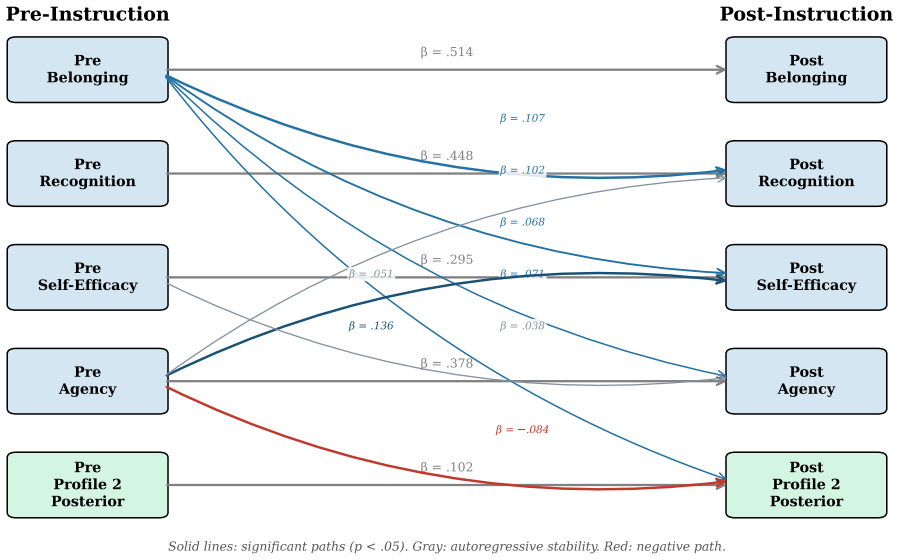
At both pre- and post-instruction, a two-profile solution best fits the data across the three PLIC scales. Profile composition shifts substantially over instruction, with nearly half of students moving from the lower- to the higher-performing profile. Belonging emerges as the principal upstream predictor of recognition, self-efficacy, agency, and higher-knowledge profile membership, while agency and self-efficacy form a reciprocal but asymmetric loop and recognition functions primarily as a downstream construct.
What carries the argument
Latent profile analysis applied simultaneously to the evaluating data, evaluating methods, and proposing next steps scales, combined with cross-lagged panel models that link profile membership to belonging, recognition, self-efficacy, and agency across time points.
If this is right
- If belonging prospectively predicts profile membership, then interventions that strengthen belonging early in a course could increase the share of students reaching the higher critical thinking profile by the end.
- The stronger path from agency to later self-efficacy implies that building agency may produce larger downstream gains in self-efficacy than the reverse direction.
- Small associations between course type and profile membership suggest that profile transitions occur across a range of lab instructional formats.
- Recognition operating mainly as a downstream outcome indicates that gains in critical thinking profiles are more likely to precede than to follow gains in feeling recognized as a physicist.
Where Pith is reading between the lines
- Lab curricula might incorporate targeted belonging-building activities in the first weeks to support both identity development and critical thinking profile gains.
- The same person-centered latent profile approach could be applied to critical thinking inventories in other laboratory disciplines to test whether similar two-profile structures appear.
- Demographic differences in belonging could help explain observed group differences in critical thinking gains if the predictive links hold in more diverse samples.
Load-bearing premise
The two-profile latent structure adequately captures the underlying patterns in the three PLIC scales and the cross-lagged panel models correctly identify temporal precedence without substantial unmeasured confounding.
What would settle it
A replication dataset in which a three-profile solution fits the PLIC responses better than two profiles, or longitudinal measurements showing no significant prospective path from belonging to later higher-profile membership after accounting for baseline levels.
Figures


read the original abstract
The Physics Lab Inventory of Critical Thinking (PLIC) measures three components of students' critical thinking in physics labs: evaluating data, evaluating methods, and proposing next steps. Prior work has analyzed these components in isolation or as a composite score. In this study, we apply latent profile analysis (LPA) to the three PLIC scales using a large, multi-institutional dataset of 5,513 matched pre/post student records to identify characteristic response patterns across the three components simultaneously. At both pre- and post-instruction, a two-profile solution best fit the data. Profile composition shifted substantially over instruction, with 48.4\% of students in the lower-performing profile at pre-test transitioning to the higher-performing profile at post-test, while 43.6\% of students moved in the opposite direction. Course type was statistically associated with profile membership at both timepoints, though the effect was small (Cram\'er's $V \approx 0.10$). To examine the relationship between profile transitions and students' affective development, we estimated cross-lagged panel models (CLPMs) linking profile membership to belonging, recognition, self-efficacy, and agency. Belonging emerged as the principal upstream predictor, prospectively predicting recognition, self-efficacy, agency, and higher-knowledge profile membership. Agency and self-efficacy formed a reciprocal but asymmetric loop, with the path from agency to later self-efficacy being stronger. Recognition functioned primarily as a downstream construct over this timescale. These results provide the first person-centered, multidimensional characterization of PLIC performance and demonstrate that epistemic and identity-related constructs are interlinked in physics lab learning.
Editorial analysis
A structured set of objections, weighed in public.
Referee Report
Summary. The manuscript applies latent profile analysis (LPA) to the three PLIC scales (evaluating data, evaluating methods, proposing next steps) on a multi-institutional sample of 5,513 matched pre/post student records, identifying a two-profile solution at both time points. It reports substantial profile transitions during instruction (48.4% low-to-high, 43.6% high-to-low) and small associations with course type, then estimates cross-lagged panel models (CLPMs) linking profile membership to belonging, recognition, self-efficacy, and agency. The central claims are that belonging is the principal upstream predictor of higher-knowledge profile membership and the other constructs, while agency and self-efficacy form a reciprocal but asymmetric loop and recognition is primarily downstream.
Significance. If the LPA solution and CLPM paths are robust, the work supplies the first person-centered, multidimensional characterization of PLIC performance and demonstrates interconnections between epistemic and identity-related constructs in physics lab learning. The large, multi-institutional sample is a clear strength for generalizability. The combination of LPA with longitudinal CLPM modeling is a methodological advance over prior composite-score or single-scale analyses of the PLIC.
major comments (2)
- [CLPM Methods and Results] The description of the CLPM estimation (in the section on affective-construct linkages) treats the LPA-derived binary profile membership as an observed variable without any indicated correction for classification error (e.g., BCH three-step, MLR with posterior probabilities, or joint latent modeling). Because the central claim that belonging prospectively predicts higher-knowledge profile membership rests on these cross-lagged paths, moderate entropy would bias the coefficients and undermine the upstream-predictor interpretation.
- [LPA Results] No LPA fit indices (BIC, aBIC, BLRT, entropy), missing-data handling, or robustness checks for the two-profile solution are reported in the abstract or the LPA results section. Without these diagnostics, it is impossible to verify that the two-profile model adequately captures the latent structure of the three PLIC scales or that the subsequent CLPM temporal-precedence claims are not sensitive to profile misassignment.
minor comments (1)
- [Abstract] The abstract states that course type is 'statistically associated' with profile membership but does not name the test or report the exact p-value alongside Cramér's V.
Simulated Author's Rebuttal
We thank the referee for their constructive and detailed feedback on our manuscript. Their comments identify key areas for improving the transparency and robustness of our latent profile analysis and cross-lagged panel modeling. We respond to each major comment below and will incorporate the suggested enhancements in the revised version.
read point-by-point responses
-
Referee: The description of the CLPM estimation (in the section on affective-construct linkages) treats the LPA-derived binary profile membership as an observed variable without any indicated correction for classification error (e.g., BCH three-step, MLR with posterior probabilities, or joint latent modeling). Because the central claim that belonging prospectively predicts higher-knowledge profile membership rests on these cross-lagged paths, moderate entropy would bias the coefficients and undermine the upstream-predictor interpretation.
Authors: We agree that classification uncertainty in LPA-derived profiles can bias subsequent regression-based estimates such as those in the CLPM, particularly if entropy is moderate. Our original analysis assigned students to profiles using the highest posterior probability and treated membership as observed. In the revision, we will explicitly report the LPA entropy value and add a sensitivity discussion or analysis (e.g., using posterior probabilities as weights or a BCH-style correction where computationally feasible) to assess the stability of the cross-lagged paths, especially the belonging-to-profile link. revision: yes
-
Referee: No LPA fit indices (BIC, aBIC, BLRT, entropy), missing-data handling, or robustness checks for the two-profile solution are reported in the abstract or the LPA results section. Without these diagnostics, it is impossible to verify that the two-profile model adequately captures the latent structure of the three PLIC scales or that the subsequent CLPM temporal-precedence claims are not sensitive to profile misassignment.
Authors: We acknowledge the need for greater transparency in model selection. Although the abstract notes that a two-profile solution best fit the data, the main text does not present the full set of comparative fit indices, entropy, missing-data procedures, or robustness checks. In the revised manuscript we will expand the LPA results section to include a table of BIC, aBIC, BLRT, and entropy values for one- through four-profile models, describe the use of full-information maximum likelihood for missing data, and report split-sample or bootstrap robustness checks confirming the stability of the two-profile solution. revision: yes
Circularity Check
No significant circularity; LPA-derived profiles and CLPM paths are independent of the target constructs.
full rationale
The derivation proceeds from raw PLIC scale responses via standard LPA to obtain two-profile membership at pre- and post-test, followed by separate CLPM estimation on longitudinal data that includes identity measures (belonging, recognition, self-efficacy, agency) as distinct observed variables. Profile membership is not defined in terms of the identity constructs, nor are the CLPM coefficients obtained by fitting the outcome to itself. No self-citation chain, ansatz smuggling, or renaming of known results is load-bearing for the central claims. The analysis is self-contained against external benchmarks once the LPA and CLPM specifications are accepted; classification-error concerns are methodological rather than circular.
Axiom & Free-Parameter Ledger
free parameters (1)
- number of latent profiles
axioms (2)
- domain assumption Local independence of PLIC indicators conditional on profile membership
- domain assumption Stationarity and correct temporal ordering in the cross-lagged panel model
Reference graph
Works this paper leans on
-
[1]
AAPT Committee on Laboratories. (2014). AAPT recommendations for the undergraduate physics laboratory curriculum. American Association of Physics Teachers
2014
-
[2]
Bandura, A. (1997). Self-efficacy: The exercise of control. Freeman
1997
-
[3]
B., & Johnson, A
Carlone, H. B., & Johnson, A. (2007). Understanding the science experiences of successful women of color: Science identity as an analytic lens. Journal of Research in Science Teaching, 44(8), 1187--1218
2007
-
[4]
Doucette, D., Clark, R., & Singh, C. (2020). Hermione and the secretary: How gendered task division in introductory physics labs can disrupt equitable learning. European Journal of Physics, 41(3), 035702
2020
-
[5]
A., Yale, M
Douglas, K. A., Yale, M. S., Bennett, D. E., Haugan, M. P., & Bryan, L. A. (2014). Evaluation of Colorado Learning Attitudes about Science Survey. Physical Review Special Topics---Physics Education Research, 10(2), 020128
2014
-
[6]
R., Stanley, J
Dounas-Frazer, D. R., Stanley, J. T., & Lewandowski, H. J. (2017). Student ownership of projects in an upper-division optics laboratory course: A multiple case study of successful experiences. Physical Review Physics Education Research, 13(2), 020136
2017
-
[7]
Gr\"un, B., & Leisch, F. (2008). FlexMix version 2: Finite mixtures with concomitant variables and varying and constant parameters. Journal of Statistical Software, 28(4), 1--35
2008
-
[8]
Hammer, D., & Elby, A. (2003). Tapping epistemological resources for learning physics. Journal of the Learning Sciences, 12(1), 53--90
2003
-
[9]
M., & Shanahan, M.-C
Hazari, Z., Sonnert, G., Sadler, P. M., & Shanahan, M.-C. (2010). Connecting high school physics experiences, outcome expectations, physics identity, and physics career choice: A gender study. Journal of Research in Science Teaching, 47(8), 978--1003
2010
-
[10]
G., & Wieman, C
Holmes, N. G., & Wieman, C. E. (2018). Introductory physics labs: We can do better. Physics Today, 71(1), 38--45
2018
-
[11]
G., Olsen, J., Thomas, J
Holmes, N. G., Olsen, J., Thomas, J. L., & Wieman, C. E. (2017). Value added or misattributed? A multi-institution study on the educational benefit of labs for reinforcing physics content. Physical Review Physics Education Research, 13(1), 010129
2017
-
[12]
G., Wieman, C
Holmes, N. G., Wieman, C. E., & Bonn, D. A. (2015). Teaching critical thinking. Proceedings of the National Academy of Sciences, 112(36), 11199--11204
2015
-
[13]
Y., Marshman, E., Schunn, C
Kalender, Z. Y., Marshman, E., Schunn, C. D., Nokes-Malach, T. J., & Singh, C. (2019). Why female science, technology, engineering, and mathematics majors do not identify with physics: They do not think others see them that way. Physical Review Physics Education Research, 15(2), 020148
2019
-
[14]
Y., Marshman, E., Schunn, C
Kalender, Z. Y., Marshman, E., Schunn, C. D., Nokes-Malach, T. J., & Singh, C. (2020). Damage caused by women's lower self-efficacy on physics learning. Physical Review Physics Education Research, 16(1), 010118
2020
-
[15]
Y., Stump, E., Hubenig, L., & Holmes, N
Kalender, Z. Y., Stump, E., Hubenig, L., & Holmes, N. G. (2021). Restructuring physics labs to cultivate sense of student agency. Physical Review Physics Education Research, 17(2), 020128
2021
-
[16]
T., & Rhoades, B
Lanza, S. T., & Rhoades, B. L. (2013). Latent class analysis: An alternative perspective on subgroup analysis in prevention and treatment. Prevention Science, 14(2), 157--168
2013
-
[17]
Lehtinen, A., & Kubsch, M. (2026). Characterizing critical thinkers: Latent profiles of Finnish students' critical thinking in the physics lab. European Journal of Physics, 47(2), 025709
2026
-
[18]
L., Stout, J
Lewis, K. L., Stout, J. G., Finkelstein, N. D., Pollock, S. J., Miyake, A., Cohen, G. L., & Ito, T. A. (2017). Fitting in to move forward: Belonging, gender, and persistence in the physical sciences, technology, engineering, and mathematics (pSTEM). Psychology of Women Quarterly, 41(4), 420--436
2017
-
[19]
Lising, L., & Elby, A. (2005). The impact of epistemology on learning: A case study from introductory physics. American Journal of Physics, 73(4), 372--382
2005
-
[20]
M., & Hazari, Z
Lock, R. M., & Hazari, Z. (2016). Discussing underrepresentation as a means to facilitating female students' physics identity development. Physical Review Physics Education Research, 12(2), 020101
2016
-
[21]
Pirinen, P., Lehtinen, A., & Holmes, N. G. (2023). Impact of traditional physics lab instruction on students' critical thinking skills in a Finnish context. European Journal of Physics, 44(3), 035702
2023
-
[22]
N., Wieman, C
Quinn, K. N., Wieman, C. E., & Holmes, N. G. (2018). Interview validation of the Physics Lab Inventory of Critical Thinking (PLIC). In A. Traxler, Y. Cao, & S. Wolf (Eds.), 2017 Physics Education Research Conference Proceedings (pp.\ 324--327). AAPT
2018
-
[23]
Rainey, K., Dancy, M., Mickelson, R., Stearns, E., & Moller, S. (2018). Race and gender differences in how sense of belonging influences decisions to major in STEM. International Journal of STEM Education, 5(1), 10
2018
-
[24]
Rosseel, Y. (2012). lavaan: An R package for structural equation modeling. Journal of Statistical Software, 48(2), 1--36
2012
-
[25]
M., Stein, M
Smith, E. M., Stein, M. M., Walsh, C., & Holmes, N. G. (2020). Direct measurement of the impact of teaching experimentation in physics labs. Physical Review X, 10(1), 011029
2020
-
[26]
M., Dew, M., Jeon, S., & Holmes, N
Stump, E. M., Dew, M., Jeon, S., & Holmes, N. G. (2023). Taking on a manager role can support women's physics lab identity development. Physical Review Physics Education Research, 19(1), 010107
2023
-
[27]
J., & Holmes, N
Walsh, C., Lewandowski, H. J., & Holmes, N. G. (2022). Skills-focused lab instruction improves critical thinking skills and experimentation views for all students. Physical Review Physics Education Research, 18(1), 010128
2022
-
[28]
N., Wieman, C., & Holmes, N
Walsh, C., Quinn, K. N., Wieman, C., & Holmes, N. G. (2019). Quantifying critical thinking: Development and validation of the physics lab inventory of critical thinking. Physical Review Physics Education Research, 15(1), 010135
2019
-
[29]
E., & Holmes, N
Wieman, C. E., & Holmes, N. G. (2015). Measuring the impact of an instructional laboratory on the learning of introductory physics. American Journal of Physics, 83(11), 972--978
2015
discussion (0)
Sign in with ORCID, Apple, or X to comment. Anyone can read and Pith papers without signing in.