Recognition: unknown
A Regime Shift in Atlantic Surface Currents Reveals a Step-like Decline of the Meridional Overturning Circulation
Pith reviewed 2026-05-10 15:51 UTC · model grok-4.3
The pith
Atlantic surface currents reveal a step-like weakening of the Meridional Overturning Circulation after 2009
A machine-rendered reading of the paper's core claim, the machinery that carries it, and where it could break.
Core claim
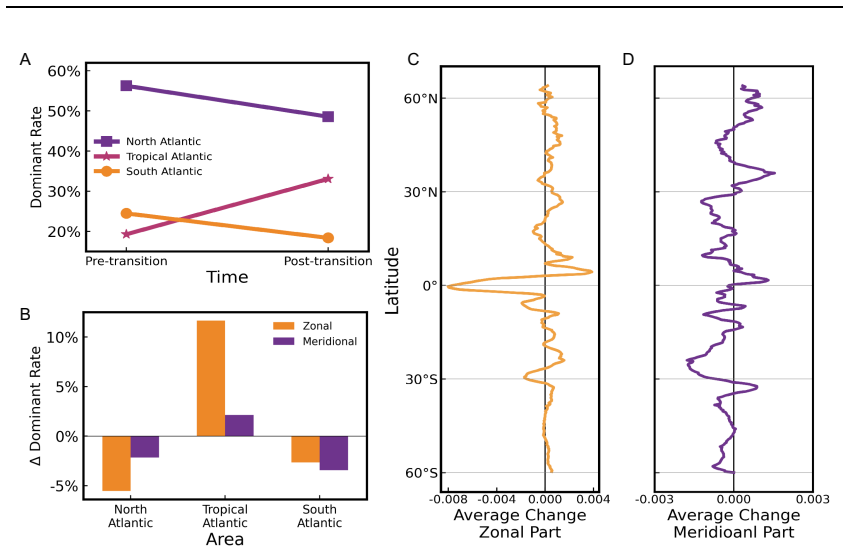
The Atlantic Convergence Divergence Mode (ACDM) experienced a pronounced regime shift in 2009, marked by weakened vertical water exchange and reduced meridional transport. This transition closely coincides with direct RAPID MOCHA AMOC observations and is driven by AMOC-modulated multiscale forcing: a low frequency oceanic thermal reorganization that preconditions the system, and episodic atmospheric shocks that trigger the shift. By identifying the ACDM variability as a sensitive and physically grounded proxy for interannual AMOC fluctuations, the observed 2009 shift signifies a nonlinear, step-like weakening of AMOC that triggered a fundamental basin-scale reorganization of Atlantic surface
What carries the argument
The Atlantic Convergence Divergence Mode (ACDM), a convergence-divergence pattern in the North Atlantic with coherent meridional flows in the South Atlantic, functioning as a proxy for interannual AMOC fluctuations.
If this is right
- The 2009 regime shift indicates a nonlinear, step-like decline in AMOC strength rather than a gradual trend.
- This decline has led to a basin-scale reorganization of Atlantic surface currents.
- The ACDM provides a new way to monitor interannual changes in the AMOC using surface current observations.
- Future projections of AMOC must incorporate the possibility of abrupt transitions driven by multiscale forcing.
Where Pith is reading between the lines
- Satellite observations of surface currents could be used to track AMOC changes more broadly than fixed mooring arrays allow.
- The preconditioning by low-frequency oceanic changes implies that similar regime shifts might occur in other ocean basins under sustained warming.
- Accounting for step-like behavior would change how climate models assess the risk of AMOC collapse in the coming decades.
Load-bearing premise
The Atlantic Convergence Divergence Mode is a sensitive and physically grounded proxy for interannual AMOC fluctuations.
What would settle it
Direct AMOC measurements from the RAPID array that show a smooth gradual decline rather than an abrupt step around 2009 would falsify the interpretation of the regime shift as a nonlinear weakening.
Figures


read the original abstract
The Atlantic surface currents associated with the Atlantic Meridional Overturning Circulation (AMOC) play a central role in regulating Earth's climate, yet their large scale dynamical response to climate variability remains poorly understood. Here we identify a previously unrecognized basin scale phase of Atlantic surface circulation, termed the Atlantic Convergence Divergence Mode (ACDM), characterized by a convergence divergence pattern in the North Atlantic and coherent meridional flows in the South Atlantic. We show that the ACDM experienced a pronounced regime shift in 2009, marked by weakened vertical water exchange and reduced meridional transport. This transition closely coincides with direct RAPID MOCHA AMOC observations and is driven by AMOC modulated multicale forcing: a low frequency oceanic thermal reorganization that preconditions the system, and episodic atmospheric shocks that trigger the shift. By identifying the ACDM variability as a sensitive and physically grounded proxy for interannual AMOC fluctuations, we reveal that the observed 2009 shift signifies a nonlinear, step like weakening of AMOC that triggered a fundamental basin scale reorganization of Atlantic surface currents. Our results offer a dynamical explanation for the AMOC's recent decline and demonstrate its inherently nonlinear nature, highlighting the need to account for step like transitions in assessing its stability and future evolution.
Editorial analysis
A structured set of objections, weighed in public.
Referee Report
Summary. The paper identifies a new basin-scale pattern in Atlantic surface currents termed the Atlantic Convergence Divergence Mode (ACDM), characterized by convergence-divergence in the North Atlantic and meridional flows in the South Atlantic. It reports a pronounced regime shift in the ACDM around 2009, coinciding with the RAPID/MOCHA AMOC transport decline, and attributes the transition to AMOC-modulated multiscale forcing (low-frequency thermal reorganization preconditioning the system plus episodic atmospheric triggers). The authors interpret the ACDM as a sensitive proxy for interannual AMOC fluctuations, concluding that the 2009 event represents a nonlinear, step-like weakening of the AMOC that reorganized Atlantic surface circulation.
Significance. If the ACDM can be shown to function as an independent, mechanistically grounded proxy for AMOC strength with predictive skill outside the 2009 window, the work would strengthen evidence for abrupt transitions in the overturning circulation and provide a dynamical framework for interpreting recent AMOC decline. The explicit linkage of surface-current reorganization to multiscale forcing offers a potentially useful lens for climate-impact studies, though the current grounding rests primarily on temporal coincidence rather than independent validation.
major comments (2)
- [Abstract] Abstract: The central claim that the 2009 ACDM regime shift 'signifies a nonlinear, step like weakening of AMOC' is load-bearing on the assertion that the ACDM is a 'sensitive and physically grounded proxy for interannual AMOC fluctuations.' This rests on temporal coincidence with RAPID observations and a post-hoc multiscale forcing narrative, without reported tests in ocean models, comparisons to independent indices (OSNAP, reanalyses, or paleoproxies), or demonstration that ACDM responds to AMOC changes independently of the surface currents that are themselves part of the AMOC system.
- The definition of the newly introduced ACDM (an invented entity) and its regime-shift detection appear to be derived from the same surface-current data used to infer the AMOC change, creating a risk of circularity. No quantitative separation between the proxy and the target quantity (e.g., via lead-lag analysis or controlled experiments) is described to establish that the 2009 transition is driven by AMOC rather than co-varying with it.
minor comments (2)
- [Abstract] The abstract refers to 'multiscale forcing' and 'low frequency oceanic thermal reorganization' without specifying the exact temporal or spatial scales involved or providing references to prior work on those scales.
- [Abstract] Error bars, uncertainty estimates, and details on data exclusion or preprocessing for the regime-shift identification are not mentioned in the abstract, which reduces the ability to assess robustness of the 2009 transition.
Simulated Author's Rebuttal
We thank the referee for their careful reading and constructive comments on the manuscript. We respond to each major comment below, indicating revisions where we agree changes are needed to strengthen the presentation.
read point-by-point responses
-
Referee: [Abstract] Abstract: The central claim that the 2009 ACDM regime shift 'signifies a nonlinear, step like weakening of AMOC' is load-bearing on the assertion that the ACDM is a 'sensitive and physically grounded proxy for interannual AMOC fluctuations.' This rests on temporal coincidence with RAPID observations and a post-hoc multiscale forcing narrative, without reported tests in ocean models, comparisons to independent indices (OSNAP, reanalyses, or paleoproxies), or demonstration that ACDM responds to AMOC changes independently of the surface currents that are themselves part of the AMOC system.
Authors: The manuscript supports the proxy interpretation through the observed temporal alignment of the ACDM regime shift with the independent RAPID/MOCHA transport record at 26°N together with the physical mechanism of AMOC-modulated multiscale forcing derived from complementary oceanic thermal and atmospheric datasets. The ACDM itself is obtained from basin-scale surface velocity observations (primarily satellite altimetry), which are distinct from the full-depth mooring-based RAPID measurements. We agree that explicit model experiments, OSNAP comparisons, and paleoproxy tests would provide valuable additional support and lie beyond the scope of the present observational analysis. We will revise the abstract to state the evidential basis more precisely and add a dedicated limitations paragraph outlining these points and the scope for future work. revision: yes
-
Referee: The definition of the newly introduced ACDM (an invented entity) and its regime-shift detection appear to be derived from the same surface-current data used to infer the AMOC change, creating a risk of circularity. No quantitative separation between the proxy and the target quantity (e.g., via lead-lag analysis or controlled experiments) is described to establish that the 2009 transition is driven by AMOC rather than co-varying with it.
Authors: We do not view the construction as circular. The ACDM is a statistically defined mode extracted from the full-basin surface current field, while the inference of AMOC weakening rests on the independent RAPID time series rather than on the surface currents themselves. The multiscale forcing analysis uses additional fields to trace the causal pathway from AMOC changes to surface reorganization. We will add lead-lag correlation results between the ACDM index and RAPID transport, together with a brief discussion of how the distinct data sources and physical mechanism separate the proxy from the target quantity, in the revised manuscript. revision: yes
Circularity Check
No significant circularity; derivation relies on independent RAPID coincidence and observational patterns
full rationale
The paper defines the ACDM from observed surface current convergence/divergence fields and documents a 2009 regime shift whose timing aligns with separate RAPID/MOCHA transport records. The claim that ACDM serves as a proxy for AMOC fluctuations is presented as an interpretive conclusion supported by this temporal match and a multiscale forcing narrative, rather than by any equation that reduces the proxy definition or the AMOC attribution to the surface data by construction. No self-citations, fitted parameters renamed as predictions, or uniqueness theorems are invoked in the provided text to close the loop. The central result therefore remains an empirical correlation plus dynamical interpretation without self-referential reduction.
Axiom & Free-Parameter Ledger
invented entities (1)
-
Atlantic Convergence Divergence Mode (ACDM)
no independent evidence
Reference graph
Works this paper leans on
-
[1]
Kuhlbrodt, et al., On the driving processes of the Atlantic meridional overturning circulation
T. Kuhlbrodt, et al., On the driving processes of the Atlantic meridional overturning circulation. Reviews of Geophysics 45, 2004RG000166 (2007). 16. H. Yang, K. Wang, H. Dai, Y. Wang, Q. Li, Wind effect on the Atlantic meridional overturning circulation via sea ice and vertical diffusion. Clim Dyn 46, 3387–3403 (2016). 17. A. Oka, H. Hasumi, N. Suginohar...
2007
-
[2]
H. L. Bryden, H. R. Longworth, S. A. Cunningham, Slowing of the Atlantic meridional overturning circulation at 25° N. Nature 438, 655–657 (2005). 31. J. M. Gregory, et al., A model intercomparison of changes in the Atlantic thermohaline circulation in response to increasing atmospheric CO2 concentration. Geophysical Research Letters 32, 2005GL023209 (2005...
2005
-
[3]
X. Chen, K.-K. Tung, Global surface warming enhanced by weak Atlantic overturning circulation. Nature 559, 387–391 (2018). 46. C. Zhu, Z. Liu, Weakening Atlantic overturning circulation causes South Atlantic salinity pile-up. Nat. Clim. Chang. 10, 998–1003 (2020). 47. K.-Y. Li, W. Liu, Weakened Atlantic Meridional Overturning Circulation causes the histor...
-
[4]
A. V. Fedorov, R. C. Pacanowski, S. G. Philander, G. Boccaletti, The Effect of Salinity on the Wind-Driven Circulation and the Thermal Structure of the Upper Ocean. J. Phys. Oceanogr. 34, 1949–1966 (2004). 60. J. O. Wenegrat, L. N. Thomas, Ekman Transport in Balanced Currents with Curvature. Journal of Physical Oceanography 47, 1189–1203 (2017). 61. M. S....
1949
-
[5]
D. B. Enfield, A. M. Mestas-Nuñez, P. J. Trimble, The Atlantic Multidecadal Oscillation and its relation to rainfall and river flows in the continental U.S. Geophysical Research Letters 28, 2077–2080 (2001). 74. W. Y. Chen, H. Van Den Dool, Sensitivity of Teleconnection Patterns to the Sign of Their Primary Action Center. Mon. Wea. Rev. 131, 2885–2899 (20...
discussion (0)
Sign in with ORCID, Apple, or X to comment. Anyone can read and Pith papers without signing in.