Recognition: unknown
Multi-fluid multi-species models for inverse FIP-effect
Pith reviewed 2026-05-10 15:31 UTC · model grok-4.3
The pith
Upward Alfvén waves produce negative ponderomotive force when magnetic field strength and flux tube expansion overcome multi-fluid damping in 1D solar models.
A machine-rendered reading of the paper's core claim, the machinery that carries it, and where it could break.
Core claim
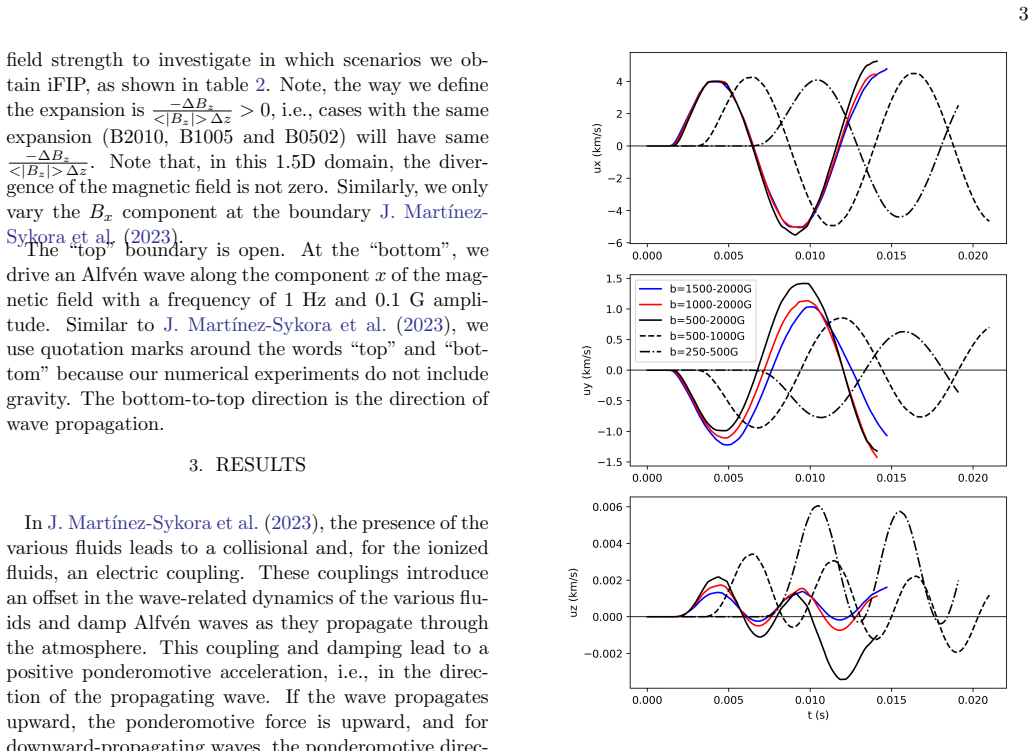
In parametric studies with upward Alfvén waves, the 1D multi-fluid multi-species MHD framework yields a negative ponderomotive force when magnetic field strength and magnetic flux tube expansion with height counteract the dissipation and damping effects from multi-fluid interactions.
What carries the argument
The 1D multi-fluid multi-species MHD model that solves the full MHD equations with multi-fluid and multi-species effects and permits parametric choices for magnetic field strength and flux tube expansion.
If this is right
- Inverse FIP fractionation can occur from upward waves alone once magnetic geometry parameters are adjusted.
- Multi-fluid interactions must be retained in the equations because they control the damping that the field strength and expansion must overcome.
- The sign of the ponderomotive force becomes tunable by varying the rate of flux tube expansion and the background field strength.
- Simplified 1D models suffice to demonstrate the reversal without immediate need for full three-dimensional geometry.
Where Pith is reading between the lines
- Direct measurements of wave amplitudes together with local magnetic field and expansion in inverse-FIP patches would provide a concrete test of the required parameter balance.
- The same framework could be applied to other fractionation anomalies by scanning the same field and expansion parameters.
- If the 1D results survive addition of realistic height-dependent damping profiles, they would narrow the set of viable drivers for observed chemical patterns.
Load-bearing premise
The 1D multi-fluid MHD framework with selected parameters for field strength and expansion fully captures the dominant physics driving inverse FIP fractionation.
What would settle it
If observed inverse FIP regions with independently measured magnetic field strengths and flux tube expansion rates produce no negative force or matching fractionation in the same model, the proposed mechanism would not hold.
Figures

read the original abstract
The inverse First Ionization Potential (FIP) effect is rarely observed in the solar atmosphere, and this anomaly poses a challenging problem in understanding physical processes driving this chemical fractionation. In this work, we investigate various scenarios where the inverse FIP effect could occur using simplified 1D multi-fluid MHD models. The model treats the full MHD equations with multi-fluid and multi-species effects, rather than using wave analysis to derive the ponderomotive force and semi-empirical 1D models. In the parametric study considered here, for upward Alfv\'en waves, one can achieve a negative (opposite) ponderomotive force when the magnetic field strength and the magnetic flux tubes' expansion with height counteract the dissipation and damping effects from multi-fluid interactions.
Editorial analysis
A structured set of objections, weighed in public.
Referee Report
Summary. The manuscript develops simplified 1D multi-fluid multi-species MHD models to investigate scenarios for the inverse FIP effect. Through parametric simulations of upward Alfvén waves, it shows that a negative (opposite) ponderomotive force becomes possible when the magnetic field strength and the expansion of magnetic flux tubes with height are chosen to counteract the dissipation and damping effects arising from multi-fluid interactions.
Significance. If the reported sign change in the ponderomotive force is reproduced by the simulations, the work supplies a self-consistent forward demonstration that inverse FIP fractionation can arise within a multi-fluid MHD framework without additional ad-hoc assumptions. The use of the full MHD equations rather than linearized wave analysis is a clear methodological strength. The parametric approach usefully isolates the competing roles of field strength, geometry, and multi-fluid damping. The result remains a proof-of-concept until quantitative thresholds, error estimates, and direct comparison with solar observations are supplied.
minor comments (3)
- Abstract: the parametric claim is stated without any example numerical values for magnetic field strength, expansion rate, or the resulting force magnitude, which would allow readers to judge physical plausibility immediately.
- Model description section: the explicit expression or numerical procedure used to extract the ponderomotive force from the multi-fluid simulation variables should be stated (or referenced to an equation) so that the reported sign reversal can be reproduced.
- Results: the manuscript should report at least one concrete set of parameter values (B0, expansion factor, wave amplitude) together with the corresponding force sign and magnitude to substantiate the central claim.
Simulated Author's Rebuttal
We thank the referee for the positive assessment of our work and the recommendation for minor revision. We agree that the study is a proof-of-concept and have revised the manuscript to incorporate additional quantitative discussion as suggested.
read point-by-point responses
-
Referee: The result remains a proof-of-concept until quantitative thresholds, error estimates, and direct comparison with solar observations are supplied.
Authors: We agree the work demonstrates possibility rather than a complete explanation. In the revised version we have added a dedicated subsection (Section 4.3) that extracts quantitative thresholds from the parametric runs, specifically the ranges of magnetic field strength (B0 > 50 G) and expansion factor (f_exp > 3) where the ponderomotive force sign reversal occurs despite multi-fluid damping. We have also included numerical error estimates obtained from resolution studies and from the magnitude of the multi-fluid collision terms. Direct quantitative comparison with specific solar FIP-bias observations is not feasible within the present 1D model; we have therefore added a paragraph outlining how the derived thresholds could be tested in future 3D multi-fluid simulations and against spatially resolved FIP measurements. revision: partial
- Direct, quantitative matching to particular solar observations, which would require a substantially more complex model geometry and additional observational constraints not available in the current 1D parametric framework.
Circularity Check
No significant circularity: parametric demonstration within stated 1D multi-fluid MHD scope
full rationale
The paper performs forward simulations of the standard multi-fluid MHD equations in a simplified 1D geometry, varying magnetic field strength and flux-tube expansion as free parameters. The central result is a demonstration that negative ponderomotive force is possible when these parameters counteract the model's internal dissipation and damping; this follows directly from integrating the governing equations under the chosen boundary conditions and does not reduce to a fit, self-definition, or self-citation of the target inverse-FIP sign. No equation is shown to be equivalent to its own input by construction, and the work explicitly frames itself as a parametric exploration rather than a data-driven prediction or uniqueness proof.
Axiom & Free-Parameter Ledger
axioms (2)
- domain assumption Ponderomotive force from upward Alfvén waves drives chemical fractionation in the solar atmosphere
- domain assumption 1D multi-fluid MHD equations capture the essential interaction between waves, magnetic expansion, and species damping
Forward citations
Cited by 1 Pith paper
-
The connection between solar coronal abundances and the underlying lower atmospheric properties
Observational evidence points to the chromosphere as the site of chemical fractionation responsible for the FIP effect in the solar corona.
Reference graph
Works this paper leans on
-
[1]
Asplund, M., Grevesse, N., Sauval, A. J., & Scott, P. 2009, ARA&A, 47, 481, doi: 10.1146/annurev.astro.46.060407.145222
-
[2]
2026 Philosophical Transactions of the Royal Society of London Series A
Baker, D. 2026 Philosophical Transactions of the Royal Society of London Series A
2026
-
[3]
Baker, D., van Driel-Gesztelyi, L., James, A. W., et al. 2024, ApJ, 970, 39, doi: 10.3847/1538-4357/ad4a6e
-
[4]
L., Alexeev, I., Collados, M., et al
Ballester, J. L., Alexeev, I., Collados, M., et al. 2018, SSRv, 214, 58, doi: 10.1007/s11214-018-0485-6 6
-
[5]
C., Behar, E., G¨ udel, M., et al
Brinkman, A. C., Behar, E., G¨ udel, M., et al. 2001, A&A, 365, L324, doi: 10.1051/0004-6361:20000047
-
[6]
Brooks, D. H., & Warren, H. P. 2011, ApJL, 727, L13, doi: 10.1088/2041-8205/727/1/L13
-
[7]
Culhane, J. L., Harra, L. K., James, A. M., et al. 2007, SoPh, 243, 19, doi: 10.1007/s01007-007-0293-1 De Pontieu, B., Title, A. M., Lemen, J. R., et al. 2014, SoPh, 289, 2733, doi: 10.1007/s11207-014-0485-y
-
[8]
2023, ApJ, 949, 59, doi: 10.3847/1538-4357/acc5e5
Evans, S., Oppenheim, M., Mart´ ınez-Sykora, J., Dimant, Y., & Xiao, R. 2023, ApJ, 949, 59, doi: 10.3847/1538-4357/acc5e5
-
[9]
1995, SSRv, 72, 49, doi: 10.1007/BF00768753
Geiss, J., Gloeckler, G., & von Steiger, R. 1995, SSRv, 72, 49, doi: 10.1007/BF00768753
-
[10]
V., Jackson, S., & Galloway, D
Hollweg, J. V., Jackson, S., & Galloway, D. 1982, SoPh, 75, 35, doi: 10.1007/BF00153458
-
[11]
2014, Physics of Plasmas, 21, 092901, doi: 10.1063/1.4894106
Khomenko, E., Collados, M., D´ ıaz, A., & Vitas, N. 2014, Physics of Plasmas, 21, 092901, doi: 10.1063/1.4894106
-
[12]
Laming, J. M. 2004, ApJ, 614, 1063, doi: 10.1086/423780
-
[13]
Laming, J. M. 2015, Living Reviews in Solar Physics, 12, 2, doi: 10.1007/lrsp-2015-2
-
[14]
Laming, J. M. 2021, ApJ, 909, 17, doi: 10.3847/1538-4357/abd9c3 Mart´ ınez-Sykora, J., De Pontieu, B., Hansteen, V. H., et al. 2023, ApJ, 949, 112, doi: 10.3847/1538-4357/acc465 Mart´ ınez-Sykora, J., Leenaarts, J., De Pontieu, B., et al. 2020a, ApJ, 889, 95, doi: 10.3847/1538-4357/ab643f Mart´ ınez-Sykora, J., Szydlarski, M., Hansteen, V. H., & De
-
[15]
Pontieu, B. 2020b, ApJ, 900, 101, doi: 10.3847/1538-4357/ababa3 Sainz Dalda, A., Agrawal, A., De Pontieu, B., & Goˇ si´ c, M. 2024, ApJS, 271, 24, doi: 10.3847/1538-4365/ad1e55
-
[16]
2022, A&A, 659, A3, doi: 10.1051/0004-6361/202141493
Seli, B., Ol´ ah, K., Kriskovics, L., et al. 2022, A&A, 659, A3, doi: 10.1051/0004-6361/202141493
-
[17]
2010, SSRv, 157, 37, doi: 10.1007/s11214-010-9714-3
Testa, P. 2010, SSRv, 157, 37, doi: 10.1007/s11214-010-9714-3
-
[18]
2023, ApJ, 944, 117, doi: 10.3847/1538-4357/acb343
Testa, P., Mart´ ınez-Sykora, J., & De Pontieu, B. 2023, ApJ, 944, 117, doi: 10.3847/1538-4357/acb343
-
[19]
Testa, P., Saar, S. H., & Drake, J. J. 2015, Philosophical Transactions of the Royal Society of London Series A, 373, 20140259, doi: 10.1098/rsta.2014.0259
-
[20]
M., Mart´ ınez-Sykora, J., Hansteen, V
Wargnier, Q. M., Mart´ ınez-Sykora, J., Hansteen, V. H., & De Pontieu, B. 2022, ApJ, 933, 205, doi: 10.3847/1538-4357/ac6e62
-
[21]
Hansteen, V. H., & De Pontieu, B. 2025, A&A, 695, A262, doi: 10.1051/0004-6361/202452351
-
[22]
Wood, B. E., & Linsky, J. L. 2010, ApJ, 717, 1279, doi: 10.1088/0004-637X/717/2/1279
discussion (0)
Sign in with ORCID, Apple, or X to comment. Anyone can read and Pith papers without signing in.