Prominence signatures in the Fraunhofer G-band; Testing ionization memory with multi-line prominence diagnostics
Pith reviewed 2026-05-10 15:26 UTC · model grok-4.3
The pith
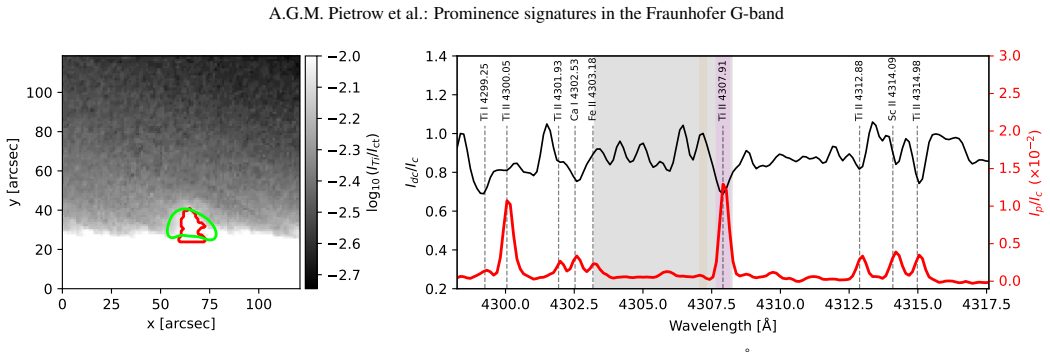
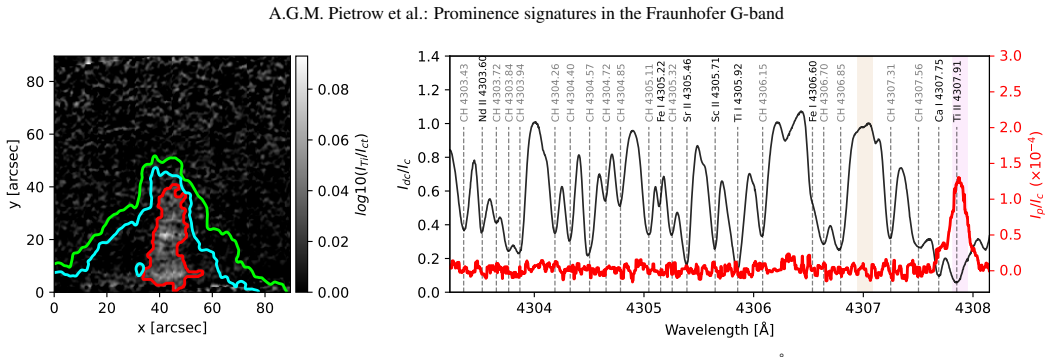
Prominence emission in the G-band comes from metal lines like Ti II and Ca I, not CH molecules, and shows no ionization memory.
A machine-rendered reading of the paper's core claim, the machinery that carries it, and where it could break.
Core claim
Clear prominence emission is present in several metal lines within the G-band, primarily from Ti II and Ca I lines, while contributions from CH molecular lines are not observed. A comparison of the simultaneously observed ionized and neutral lines reveals no clear evidence for an ionization memory effect. Since the prominence emission does not originate from CH lines, the structures are independent of the primary diagnostic in this spectral window, and the absence of a clear ionization memory effect suggests that such effects may be less pronounced for weak neutral lines.
What carries the argument
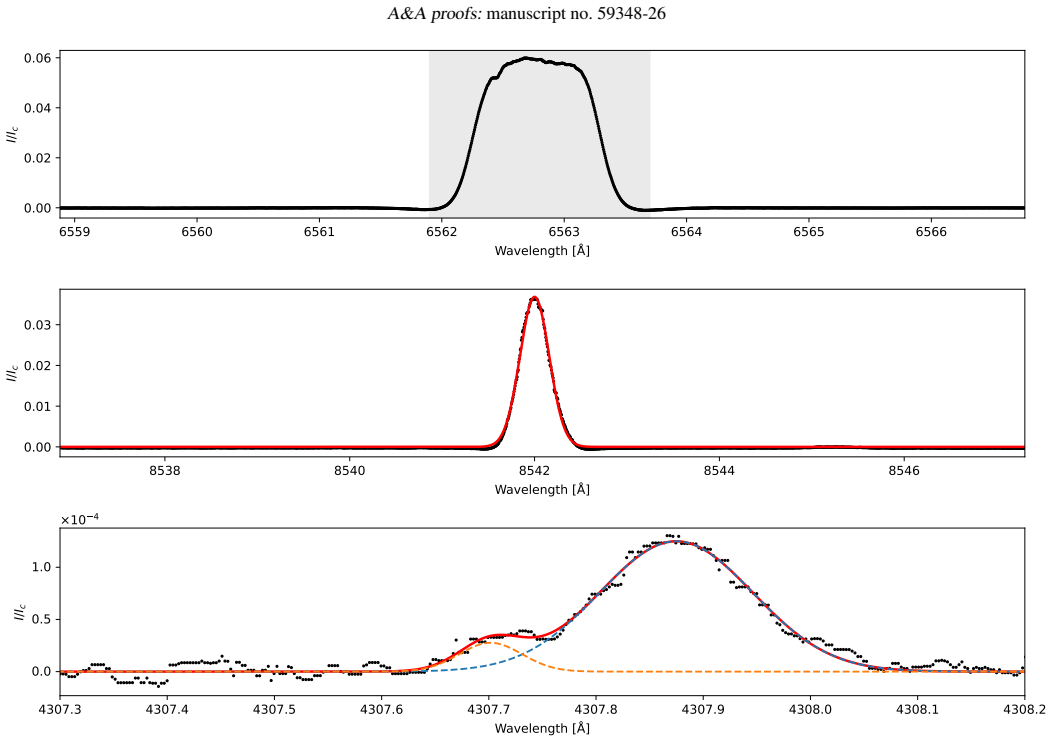
Simultaneous line-width measurements of neutral and ionized metal lines to separate thermal and non-thermal broadening components and test for ionization memory.
Load-bearing premise
The emission features are correctly identified as specific Ti II and Ca I lines without significant blending or misidentification, and line width differences accurately separate thermal from non-thermal broadening.
What would settle it
High-resolution spectra of the same prominences that show no emission peaks at the laboratory wavelengths of the identified Ti II and Ca I lines, or that display clear systematic differences in non-thermal broadening between neutral and ionized lines.
Figures

read the original abstract
The Fraunhofer G-band around 4304 {\AA} is widely used as a photospheric diagnostic and is generally not expected to show signatures of chromospheric or coronal structures. However, recent amateur observations have suggested the presence of off-limb prominence emission in this spectral region. We investigate the origin of the prominence emission in the G-band to determine if this is caused by methylene (CH) or other lines in this band. We also aim to test these lines for the presence of ionization memory effects in neutral lines. We present a case study of two prominences, one obtained with a Solar Explorer (Sol'Ex) spectroheliograph and another with the high-resolution Fast Multi-Line Universal Spectrograph (FaMuLUS) camera system at the echelle spectrograph of the German Vacuum Tower Telescope (VTT). Line widths are measured for simultaneously observed neutral and ionized metal lines, allowing a comparison of thermal and non-thermal broadening components to see if these lines exhibit any ionization memory effects. We report clear prominence emission in several metal lines within the G-band, primarily from Ti II and Ca I lines, while contributions from CH molecular lines are not observed. A comparison of the simultaneously observed ionized and neutral lines reveals no clear evidence for an ionization memory effect. Since the prominence emission does not originate from CH lines, we will not call them "G-band prominences" but rather prominences in the G-band, as they are independent of the primary diagnostic in this spectral window. In addition, the absence of a clear ionization memory effect suggests that such effects may be less pronounced for weak neutral lines.
Editorial analysis
A structured set of objections, weighed in public.
Referee Report
Summary. The manuscript reports a case study of two prominences observed with the Sol'Ex spectroheliograph and the FaMuLUS camera at the VTT echelle spectrograph. It claims that emission features in the Fraunhofer G-band (~4304 Å) originate from Ti II and Ca I metal lines rather than CH molecular lines, and that simultaneous measurements of neutral and ionized metal line widths show no clear evidence of an ionization memory effect.
Significance. If the line identifications prove robust, the result clarifies that apparent G-band prominence signatures are independent of the CH diagnostic and may indicate that ionization memory effects are weak or absent in these faint neutral lines. The use of two independent high-resolution instruments with simultaneous multi-line coverage is a methodological strength that enables direct thermal/non-thermal broadening comparisons.
major comments (2)
- [Results on line identification] Results section on line identification and CH absence: the central claim that emission arises from specific Ti II and Ca I lines with no detectable CH contribution rests on visual or qualitative profile matching in a crowded spectral region. No quantitative details are given on the line list employed, wavelength calibration precision, profile-fitting procedure, residual analysis after subtracting identified lines, or upper limits on possible CH blends; without these the origin conclusion and the subsequent memory test are not fully secured.
- [Line width analysis] Section on line-width measurements and ionization memory test: the reported absence of an ionization memory effect is based on comparing widths of neutral (Ca I) and ionized (Ti II) lines to separate thermal and non-thermal components. The manuscript does not specify how instrumental resolution is removed, what temperature is assumed for the thermal width calculation, or the statistical significance of any width differences; these omissions directly affect the reliability of the memory-effect conclusion.
minor comments (1)
- [Abstract] Abstract: quantitative error bars, typical S/N values, or measured widths would strengthen the statements of 'clear' emission and 'no clear evidence' for memory effects.
Simulated Author's Rebuttal
We thank the referee for their thorough review and constructive comments on our manuscript. We agree that the presentation of our line identifications and width analyses would benefit from additional quantitative details and clarifications. We address each major comment below and will revise the manuscript accordingly to strengthen the supporting evidence for our conclusions.
read point-by-point responses
-
Referee: Results section on line identification and CH absence: the central claim that emission arises from specific Ti II and Ca I lines with no detectable CH contribution rests on visual or qualitative profile matching in a crowded spectral region. No quantitative details are given on the line list employed, wavelength calibration precision, profile-fitting procedure, residual analysis after subtracting identified lines, or upper limits on possible CH blends; without these the origin conclusion and the subsequent memory test are not fully secured.
Authors: We acknowledge that the line identification section relies primarily on qualitative profile comparisons and would be strengthened by quantitative details. In the revised manuscript we will add: the specific line list employed (sourced from the VALD database), the wavelength calibration precision achieved with Sol'Ex (~0.01 Å) and FaMuLUS (~0.005 Å), a description of the multi-Gaussian profile-fitting procedure, residual spectra after subtracting the identified Ti II and Ca I components, and an estimated upper limit on any undetected CH contribution (less than 10% of the observed emission, derived from the absence of expected CH features and comparison with photospheric reference spectra). These additions will better secure the conclusion that the prominence emission originates from the metal lines rather than CH. revision: yes
-
Referee: Section on line-width measurements and ionization memory test: the reported absence of an ionization memory effect is based on comparing widths of neutral (Ca I) and ionized (Ti II) lines to separate thermal and non-thermal components. The manuscript does not specify how instrumental resolution is removed, what temperature is assumed for the thermal width calculation, or the statistical significance of any width differences; these omissions directly affect the reliability of the memory-effect conclusion.
Authors: We agree that these methodological details are necessary for a robust assessment of the ionization memory test. The revised manuscript will specify: instrumental broadening is removed by subtracting the measured instrumental FWHM (from calibration lamp spectra) in quadrature from the observed line widths (assuming Gaussian profiles); a fiducial temperature of 8000 K (within the 7000-10000 K range typical for quiescent prominences) is used for the thermal component, with justification from standard prominence models; and width uncertainties are obtained from the fitting covariance matrix, showing that neutral and ionized line widths agree to within 1-1.5 sigma with no statistically significant difference. These clarifications and any supporting equations will be added to the methods and results sections. revision: yes
Circularity Check
No significant circularity; purely observational comparison
full rationale
The paper reports direct spectroscopic observations of prominences in the G-band using Sol'Ex and FaMuLUS/VTT instruments. Line identifications (Ti II, Ca I) rely on standard wavelength tables external to the study, and the ionization-memory test is a side-by-side empirical comparison of measured line widths in neutral vs. ionized species. No equations, fitted parameters presented as predictions, self-referential definitions, or load-bearing self-citations appear in the derivation chain. The central claims are falsifiable observational statements that do not reduce to their own inputs by construction.
Axiom & Free-Parameter Ledger
axioms (2)
- domain assumption Line identifications in the G-band are accurate based on standard solar atlases and laboratory wavelengths
- domain assumption Line width differences between neutral and ionized species primarily reflect thermal plus non-thermal broadening without dominant blending
Reference graph
Works this paper leans on
- [1]
-
[2]
2023, Photoniques, 120, 36 Díaz Baso, C., Vissers, G., Calvo, F., et al
Buil, C., Malherbe, J.-M., & Maksimovic, M. 2023, Photoniques, 120, 36 Díaz Baso, C., Vissers, G., Calvo, F., et al. 2021, in Zenodo software package, V ol. 56, 5608441
work page 2023
-
[3]
2015, in Astrophysics and Space Science Library, V ol
Engvold, O. 2015, in Astrophysics and Space Science Library, V ol. 415, Solar Prominences, ed. J.-C. Vial & O. Engvold, 31
work page 2015
- [4]
-
[5]
Gilbert, H. R., Hansteen, V . H., & Holzer, T. E. 2002, ApJ, 577, 464
work page 2002
-
[6]
Gouttebroze, P., Heinzel, P., & Vial, J. C. 1993, A&AS, 99, 513
work page 1993
-
[7]
Harvey, J. W., Hill, F., Hubbard, R. P., et al. 1996, Science, 272, 1284
work page 1996
-
[8]
2015, in Astrophysics and Space Science Library, V ol
Heinzel, P. 2015, in Astrophysics and Space Science Library, V ol. 415, Solar Prominences, ed. J.-C. Vial & O. Engvold, 103
work page 2015
- [9]
-
[10]
Howard, R. A., Moses, J. D., V ourlidas, A., et al. 2008, Space Sci. Rev., 136, 67
work page 2008
- [11]
- [12]
-
[13]
Johnson, H. L. & Morgan, W. W. 1953, ApJ, 117, 313
work page 1953
- [14]
-
[15]
Ralchenko, Reader, J., & and NIST ASD Team
Kramida, A., Yu. Ralchenko, Reader, J., & and NIST ASD Team. 2024, NIST Atomic Spectra Database (Ver. 5.12), online: physics.nist.gov/asd, accessed: 2025 December 16, National Institute of Standards and Technology, Gaithers- burg, MD
work page 2024
-
[16]
Labrosse, N., Rodger, A. S., Radziszewski, K., et al. 2022, MNRAS, 513, L30
work page 2022
- [17]
-
[18]
Landman, D. A. 1981, ApJ, 251, 768
work page 1981
- [19]
- [20]
-
[21]
Lemen, J. R., Title, A. M., Akin, D. J., et al. 2012, Sol. Phys., 275, 17
work page 2012
- [22]
-
[23]
Moore, C. E., Minnaert, M. G. J., & Houtgast, J. 1966, The Solar Spectrum 2935 Å to 8770 Å (Wahington, DC: National Bureau of Standards)
work page 1966
- [24]
- [25]
-
[26]
Pesnell, W. D., Thompson, B. J., & Chamberlin, P. C. 2012, Sol. Phys., 275, 3
work page 2012
- [27]
-
[28]
Pietrow, A. G. M. 2026, The Open Journal of Astrophysics, 9, 58273
work page 2026
-
[29]
Pietrow, A. G. M., Liakh, V ., Osborne, C. M. J., Jenkins, J., & Keppens, R. 2024, A&A, 690, L15
work page 2024
- [30]
-
[31]
Shelyag, S., Schüssler, M., Solanki, S. K., Berdyugina, S. V ., & Vögler, A. 2004, A&A, 427, 335
work page 2004
- [32]
-
[33]
Tandberg-Hanssen, E. 1995, The nature of solar prominences (Dordrecht, The Netherlands: Springer Science+Business Media) Váradi Nagy, P. 2024, Prominences in G-band – Spectral Imaging, on- line: www.asztrofoto.hu/galeria_image/1727382235, accessed: 2025 Decem- ber 13, image posted on Asztrofotó.hu Váradi Nagy, P. 2025, Prominences in the G-band and beyond...
-
[34]
Wiehr, E., Balthasar, H., Stellmacher, G., & Bianda, M. 2025, A&A, 696, A209
work page 2025
-
[35]
Wiehr, E., Stellmacher, G., Balthasar, H., & Bianda, M. 2021, ApJ, 920, 47
work page 2021
- [36]
-
[37]
Wuelser, J.-P., Lemen, J. R., Tarbell, T. D., et al. 2004, in Proc. SPIE, V ol. 5171, Telescopes and Instrumentation for Solar Astrophysics, ed. S. Fineschi & M. A. Gummin, 111–122 Article number, page 7
work page 2004
discussion (0)
Sign in with ORCID, Apple, or X to comment. Anyone can read and Pith papers without signing in.