Recognition: unknown
HeartSway: Exploring Biodata as Poetic Traces in Public Space
Pith reviewed 2026-05-10 14:52 UTC · model grok-4.3
The pith
HeartSway turns heart rate and micro-movements into embodied traces that connect successive users in public spaces.
A machine-rendered reading of the paper's core claim, the machinery that carries it, and where it could break.
Core claim
HeartSway demonstrates that biodata can serve as evocative traces in public space by capturing and replaying heart rate and micro-movements in an interactive hammock, leading to users feeling connected to prior visitors and valuing the shared vitality of human bodies.
What carries the argument
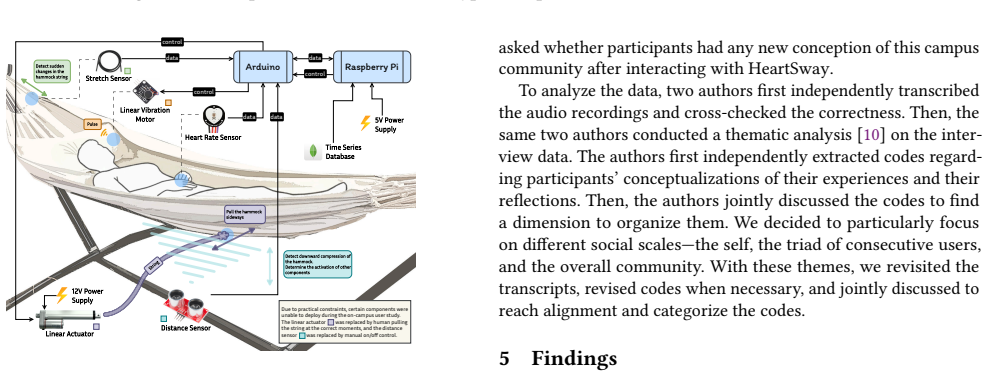
HeartSway, an interactive hammock that senses heart rate via pulse oximeter and micro-movements via accelerometers, then replays them through gentle swinging and lighting effects for subsequent users.
Load-bearing premise
That feelings of connection reported by ten participants after using the hammock in one location will hold for wider public use and reliably show biodata's effectiveness as poetic traces.
What would settle it
A larger study with diverse users in multiple public locations finding no increase in reported connection or curiosity compared to a non-biodata hammock.
Figures


read the original abstract
Human traces scattered across urban landscapes can signify our everyday lives and societal vibrancy in subtle and poetic forms. In this paper, we explore how designed technology can engage biodata as evocative traces. To this end, we present the design, implementation, and evaluation of HeartSway, an interactive hammock that captures a user's heart rate and micro-movements as traces and replays them as an embodied experience for the next visitor. Through a qualitative field study (N=10), we find that HeartSway evokes feelings of connection, curiosity about prior users, and appreciation for shared human vitality. Our work contributes to understanding anonymous archival biodata as a design material for experiential urban traces. We offer design considerations for intimate asynchronous encounters between strangers in public spaces and for reimagining public amenities.
Editorial analysis
A structured set of objections, weighed in public.
Referee Report
Summary. The paper presents HeartSway, an interactive hammock that captures a user's heart rate and micro-movements as biodata traces and replays them as an embodied experience for the next visitor. Through a qualitative field study (N=10), it reports that the system evokes feelings of connection, curiosity about prior users, and appreciation for shared human vitality. The work contributes design considerations for anonymous archival biodata as a material for experiential urban traces and for intimate asynchronous encounters between strangers in public spaces.
Significance. If the reported participant experiences hold under improved methodological transparency, the paper offers a meaningful contribution to HCI by treating biodata as a poetic design material for public installations. The real-world field deployment and focus on anonymous, asynchronous stranger interactions provide grounded insights that extend beyond lab studies. The work is strengthened by its emphasis on design considerations derived from observed encounters rather than unsubstantiated efficacy claims.
major comments (2)
- [Evaluation / Field Study] Evaluation section: the qualitative field study description provides no details on participant recruitment, the specific analysis method (e.g., thematic analysis steps or coding process), or explicit limitations of the N=10 sample. This omission is load-bearing because the central claim rests on the reported feelings of connection and curiosity, making it difficult to assess robustness or transferability.
- [Discussion] Discussion section: the mapping from specific participant observations to the proposed design considerations for biodata traces and public amenities is not explicitly articulated, weakening the link between findings and contributions.
minor comments (2)
- [Abstract] Abstract: the mention of 'implementation' lacks any high-level technical description of sensor placement, data replay mechanism, or privacy handling, which would help readers understand the artifact before the evaluation.
- [Figures] Figure captions throughout: several could be expanded to describe the embodied interaction sequence more clearly, aiding readers who cannot view the images.
Simulated Author's Rebuttal
We thank the referee for the constructive and detailed review. The comments highlight important opportunities to strengthen the paper's methodological transparency and the explicit linkage between empirical observations and design contributions. We will revise the manuscript to address both points fully.
read point-by-point responses
-
Referee: [Evaluation / Field Study] Evaluation section: the qualitative field study description provides no details on participant recruitment, the specific analysis method (e.g., thematic analysis steps or coding process), or explicit limitations of the N=10 sample. This omission is load-bearing because the central claim rests on the reported feelings of connection and curiosity, making it difficult to assess robustness or transferability.
Authors: We agree that the Evaluation section requires greater detail to support assessment of the findings. In the revised manuscript, we will expand this section to describe: participant recruitment (public-space approach, consent process, and any available demographics); the thematic analysis procedure (including data familiarization, initial coding, theme generation, review, and refinement steps); and explicit limitations of the N=10 sample (self-selection bias, context-specificity, and constraints on generalizability). These additions will directly address the robustness and transferability concerns. revision: yes
-
Referee: [Discussion] Discussion section: the mapping from specific participant observations to the proposed design considerations for biodata traces and public amenities is not explicitly articulated, weakening the link between findings and contributions.
Authors: We acknowledge that the connections between observations and design considerations could be stated more explicitly. In the revision, we will add a dedicated subsection in the Discussion that systematically maps specific participant quotes and observed behaviors (e.g., expressions of curiosity about prior users' vitality) to each design consideration. This will make the derivation of contributions from the field-study data transparent and strengthen the overall argument. revision: yes
Circularity Check
No significant circularity
full rationale
This is a design exploration and qualitative HCI paper whose central claims rest on direct reporting of participant experiences from a scoped field study (N=10). There are no equations, models, fitted parameters, predictions, or derivation chains that reduce to self-defined inputs or self-citations. The findings are presented as observations from the study rather than generalized efficacy claims, making the argument self-contained and non-circular by construction.
Axiom & Free-Parameter Ledger
Reference graph
Works this paper leans on
-
[1]
Syed Ishtiaque Ahmed, Md. Romael Haque, Shion Guha, Md. Rashidujjaman Rifat, and Nicola Dell. 2017. Privacy, Security, and Surveillance in the Global South: A Study of Biometric Mobile SIM Registration in Bangladesh. InProceedings of the 2017 CHI Conference on Human Factors in Computing Systems (CHI ’17). Association for Computing Machinery, New York, NY,...
-
[2]
Miquel Alfaras, Vasiliki Tsaknaki, Pedro Sanches, Charles Windlin, Muhammad Umair, Corina Sas, and Kristina Höök. 2020. From Biodata to Somadata. In Proceedings of the 2020 CHI Conference on Human Factors in Computing Systems (CHI ’20). Association for Computing Machinery, New York, NY, USA, 1–14. doi:10.1145/3313831.3376684
-
[3]
Andreas Almqvist, Anders Hedman, Adrian K Clear, and Rob Comber. 2023. Different Together: Design for Radical Placemaking. InProceedings of the 2023 CHI Conference on Human Factors in Computing Systems (CHI ’23). Association for Computing Machinery, New York, NY, USA, 1–16. doi:10.1145/3544548.3581080
-
[4]
Karen Anne Cochrane, Kristina Mah, Anna Ståhl, Claudia Núñez-Pacheco, Made- line Balaam, Naseem Ahmadpour, and Lian Loke. 2022. Body Maps: A Generative Tool for Soma-based Design. InProceedings of the Sixteenth International Confer- ence on Tangible, Embedded, and Embodied Interaction (TEI ’22). Association for Computing Machinery, New York, NY, USA, 1–14...
-
[5]
Ilhan Aslan, Andreas Seiderer, Chi Tai Dang, Simon Rädler, and Elisabeth André
-
[6]
InProceedings of the 2020 International Conference on Multimodal Interaction (ICMI ’20)
PiHearts: Resonating Experiences of Self and Others Enabled by a Tangi- ble Somaesthetic Design. InProceedings of the 2020 International Conference on Multimodal Interaction (ICMI ’20). Association for Computing Machinery, New York, NY, USA, 433–441. doi:10.1145/3382507.3418848
-
[7]
Mara Balestrini, Paul Marshall, Raymundo Cornejo, Monica Tentori, Jon Bird, and Yvonne Rogers. 2016. Jokebox: Coordinating Shared Encounters in Public Spaces. InProceedings of the 19th ACM Conference on Computer-Supported Cooperative Work & Social Computing (CSCW ’16). Association for Computing Machinery, New York, NY, USA, 38–49. doi:10.1145/2818048.2835203
-
[8]
Kirsten Boehner, Rogério DePaula, Paul Dourish, and Phoebe Sengers. 2005. Af- fect: From Information to Interaction. InProceedings of the 4th Decennial Confer- ence on Critical Computing: Between Sense and Sensibility (CC ’05). Association for Computing Machinery, New York, NY, USA, 59–68. doi:10.1145/1094562.1094570
-
[9]
Haena Cho, Yoonji Lee, Woohun Lee, and Chang Hee Lee. 2024. Thermo-Play: Exploring the Playful Qualities of Thermochromic Materials. InProceedings of the Eighteenth International Conference on Tangible, Embedded, and Embodied Interaction (TEI ’24). Association for Computing Machinery, New York, NY, USA, 1–16. doi:10.1145/3623509.3633376
-
[10]
Marika Cifor. 2016. Affecting Relations: Introducing Affect Theory to Archival Discourse.Archival Science16, 1 (March 2016), 7–31. doi:10.1007/s10502-015- 9261-5
-
[11]
Victoria Clarke and Virginia Braun. 2014. Thematic Analysis. InEncyclopedia of Critical Psychology. Springer, New York, NY, 1947–1952. doi:10.1007/978-1-4614- 5583-7_311
-
[12]
Claudia Daudén Roquet and Corina Sas. 2021. Interoceptive Interaction: An Embodied Metaphor Inspired Approach to Designing for Meditation. InPro- ceedings of the 2021 CHI Conference on Human Factors in Computing Systems (CHI ’21). Association for Computing Machinery, New York, NY, USA, 1–17. doi:10.1145/3411764.3445137 HeartSway DIS ’26, June 13–17, 2026,...
-
[13]
Michiel de Lange and Martijn de Waal. 2013. Owning the City: New Media and Citizen Engagement in Urban Design.First Monday(Nov. 2013). doi:10.5210/fm. v18i11.4954
work page doi:10.5210/fm 2013
-
[14]
Arindam Dey, Hao Chen, Chang Zhuang, Mark Billinghurst, and Robert W. Lindeman. 2018. Effects of Sharing Real-Time Multi-Sensory Heart Rate Feed- back in Different Immersive Collaborative Virtual Environments. In2018 IEEE International Symposium on Mixed and Augmented Reality (ISMAR). 165–173. doi:10.1109/ISMAR.2018.00052
-
[15]
Tamar Dublin, Talia Sofia Ezer, and Oren Zuckerman. 2024. A Journey Inward: The Somaesthetic Experience of a Heated Walking Carpet. InExtended Abstracts of the CHI Conference on Human Factors in Computing Systems (CHI EA ’24). Association for Computing Machinery, New York, NY, USA, 1–7. doi:10.1145/3613905.3650915
-
[16]
Yuan-Ling Feng, Mingyue Gao, Chih-Heng Li, Zhihao Yao, and Haipeng Mi. 2024. ExBreath: Explore the Expressive Breath System as Nonverbal Signs towards Semi-unintentional Expression. InExtended Abstracts of the 2024 CHI Conference on Human Factors in Computing Systems (CHI EA ’24). Association for Computing Machinery, New York, NY, USA, 1–7. doi:10.1145/36...
-
[17]
Fischer, Stuart Reeves, and Sarah Sharples
Jérémy Frey, May Grabli, Ronit Slyper, and Jessica R. Cauchard. 2018. Breeze: Sharing Biofeedback through Wearable Technologies. InProceedings of the 2018 CHI Conference on Human Factors in Computing Systems (CHI ’18). Association for Computing Machinery, New York, NY, USA, 1–12. doi:10.1145/3173574.3174219
-
[18]
Magnus Frisk, Mads Vejrup, Frederik Kjaer Soerensen, and Michael Wessely
-
[19]
ChromaNails: Re-Programmable Multi-Colored High-Resolution On-Body Interfaces Using Photochromic Nail Polish. InAdjunct Proceedings of the 36th Annual ACM Symposium on User Interface Software and Technology (UIST ’23 Adjunct). Association for Computing Machinery, New York, NY, USA, 1–5. doi:10. 1145/3586182.3615824
-
[20]
Gaver, Jacob Beaver, and Steve Benford
William W. Gaver, Jacob Beaver, and Steve Benford. 2003. Ambiguity as a Re- source for Design. InProceedings of the SIGCHI Conference on Human Factors in Computing Systems (CHI ’03). Association for Computing Machinery, New York, NY, USA, 233–240. doi:10.1145/642611.642653
-
[21]
Schieck, Vassilis Kostakos, and Alan Penn
Ava Fatah gen. Schieck, Vassilis Kostakos, and Alan Penn. 2010. Exploring Digital Encounters in the Public Arena. InShared Encounters, Katharine S. Willis, George Roussos, Konstantinos Chorianopoulos, and Mirjam Struppek (Eds.). Springer, London, 179–195. doi:10.1007/978-1-84882-727-1_9
-
[22]
Rebecca Gulotta, William Odom, Jodi Forlizzi, and Haakon Faste. 2013. Dig- ital Artifacts as Legacy: Exploring the Lifespan and Value of Digital Data. In Proceedings of the SIGCHI Conference on Human Factors in Computing Systems (CHI ’13). Association for Computing Machinery, New York, NY, USA, 1813–1822. doi:10.1145/2470654.2466240
-
[23]
PER Gustafson. 2001. MEANINGS OF PLACE: EVERYDAY EXPERIENCE AND THEORETICAL CONCEPTUALIZATIONS.Journal of Environmental Psychology 21, 1 (March 2001), 5–16. doi:10.1006/jevp.2000.0185
-
[24]
Marc Hassenzahl, Stephanie Heidecker, Kai Eckoldt, Sarah Diefenbach, and Uwe Hillmann. 2012. All You Need Is Love: Current Strategies of Mediating Intimate Relationships through Technology.ACM Trans. Comput.-Hum. Interact.19, 4 (Dec. 2012), 30:1–30:19. doi:10.1145/2395131.2395137
-
[25]
Mariam Hassib, Daniel Buschek, Paweł W. Wozniak, and Florian Alt. 2017. HeartChat: Heart Rate Augmented Mobile Chat to Support Empathy and Aware- ness. InProceedings of the 2017 CHI Conference on Human Factors in Computing Systems (CHI ’17). Association for Computing Machinery, New York, NY, USA, 2239–2251. doi:10.1145/3025453.3025758
- [26]
-
[27]
Alice C Haynes, Christopher Kent, and Jonathan Rossiter. 2024. Just a Breath Away: Investigating Interactions with and Perceptions of Mediated Breath via a Haptic Cushion. InProceedings of the Eighteenth International Conference on Tan- gible, Embedded, and Embodied Interaction (TEI ’24). Association for Computing Machinery, New York, NY, USA, 1–19. doi:1...
-
[28]
Linda Hirsch. 2020. Unobtrusive Interfaces for Historical and Culturally Sensitive Places. InCompanion Publication of the 2020 ACM Designing Interactive Systems Conference (DIS’ 20 Companion). Association for Computing Machinery, New York, NY, USA, 521–525. doi:10.1145/3393914.3395825
-
[29]
Stefan Hirschauer. 2005. On Doing Being a Stranger: The Practical Constitution of Civil Inattention.Journal for the Theory of Social Behaviour35, 1 (2005), 41–67. doi:10.1111/j.0021-8308.2005.00263.x
-
[30]
2018.Designing with the Body: Somaesthetic Interaction Design
Kristina Höök. 2018.Designing with the Body: Somaesthetic Interaction Design. The MIT Press. doi:10.7551/mitpress/11481.001.0001
-
[31]
Eva Hornecker, Trevor Hogan, Uta Hinrichs, and Rosa Van Koningsbruggen
-
[32]
A Design Vocabulary for Data Physicalization.ACM Trans. Comput.-Hum. Interact.31, 1 (Nov. 2023), 2:1–2:62. doi:10.1145/3617366
-
[33]
Noura Howell, John Chuang, Abigail De Kosnik, Greg Niemeyer, and Kimiko Ryokai. 2018. Emotional Biosensing: Exploring Critical Alternatives.Proc. ACM Hum.-Comput. Interact.2, CSCW (Nov. 2018), 69:1–69:25. doi:10.1145/3274338
-
[34]
Noura Howell, Laura Devendorf, Tomás Alfonso Vega Gálvez, Rundong Tian, and Kimiko Ryokai. 2018. Tensions of Data-Driven Reflection: A Case Study of Real-Time Emotional Biosensing. InProceedings of the 2018 CHI Conference on Human Factors in Computing Systems (CHI ’18). Association for Computing Machinery, New York, NY, USA, 1–13. doi:10.1145/3173574.3174005
-
[35]
Noura Howell, Greg Niemeyer, and Kimiko Ryokai. 2019. Life-Affirming Biosens- ing in Public: Sounding Heartbeats on a Red Bench. InProceedings of the 2019 CHI Conference on Human Factors in Computing Systems (CHI ’19). Association for Computing Machinery, New York, NY, USA, 1–16. doi:10.1145/3290605.3300910
-
[36]
Zeyu Huang, Xinyi Cao, Yuanhao Zhang, and Xiaojuan Ma. 2024. Sharing Frissons among Online Video Viewers: Exploring the Design of Affective Communication for Aesthetic Chills. InProceedings of the CHI Conference on Human Factors in Computing Systems (CHI ’24). Association for Computing Machinery, New York, NY, USA, 1–19. doi:10.1145/3613904.3642818
-
[37]
Hiroshi Ishii and Brygg Ullmer. 1997. Tangible Bits: Towards Seamless Interfaces between People, Bits and Atoms. InProceedings of the ACM SIGCHI Conference on Human Factors in Computing Systems (CHI ’97). Association for Computing Machinery, New York, NY, USA, 234–241. doi:10.1145/258549.258715
-
[38]
Sylvia Janicki, Nassim Parvin, and Noura Howell. 2024. Crip Reflections on Designing with Plants: Intersecting Disability Theory, Chronic Illness, and More- than-Human Design. InProceedings of the 2024 ACM Designing Interactive Systems Conference (DIS ’24). Association for Computing Machinery, New York, NY, USA, 1044–1058. doi:10.1145/3643834.3661509
-
[39]
Joris H. Janssen, Jeremy N. Bailenson, Wijnand A. IJsselsteijn, and Joyce H.D.M. Westerink. 2010. Intimate Heartbeats: Opportunities for Affective Communica- tion Technology.IEEE Transactions on Affective Computing1, 2 (July 2010), 72–80. doi:10.1109/T-AFFC.2010.13
-
[40]
Yuhua Jin, Isabel Qamar, Michael Wessely, Aradhana Adhikari, Katarina Bulovic, Parinya Punpongsanon, and Stefanie Mueller. 2019. Photo-Chromeleon: Re- Programmable Multi-Color Textures Using Photochromic Dyes. InProceedings of the 32nd Annual ACM Symposium on User Interface Software and Technology (UIST ’19). Association for Computing Machinery, New York,...
-
[41]
Lee Jones, Greta Grip, Erin Kennedy, and Sara Nabil. 2024. A Year of Interac- tion Around Town: Gathering Traces with an Interactive Knitting Machine and Community Stitch Markers. InProceedings of the 2024 ACM Designing Interactive Systems Conference (DIS ’24). Association for Computing Machinery, New York, NY, USA, 1116–1133. doi:10.1145/3643834.3660736
-
[42]
Lee Jones, Greta Grip, and Sara Nabil. 2023. Wear Your Heart on Your Sleeve: Using Digital Knitting Machines to Craft Wearable Biodata Portraits. InProceedings of the 2023 ACM Designing Interactive Systems Conference (DIS ’23). Association for Computing Machinery, New York, NY, USA, 547–563. doi:10.1145/3563657. 3596007
-
[43]
Martin Jonsson, Anna Ståhl, Johanna Mercurio, Anna Karlsson, Naveen Ramani, and Kristina Höök. 2016. The Aesthetics of Heat: Guiding Awareness with Thermal Stimuli. InProceedings of the TEI ’16: Tenth International Conference on Tangible, Embedded, and Embodied Interaction (TEI ’16). Association for Comput- ing Machinery, New York, NY, USA, 109–117. doi:1...
-
[44]
Kaiser and Urs Fuhrer
Florian G. Kaiser and Urs Fuhrer. 1996. Dwelling: Speaking of an Unnoticed Universal Language.New Ideas in Psychology14, 3 (Nov. 1996), 225–236. doi:10. 1016/S0732-118X(96)00017-7
1996
-
[45]
Pavel Karpashevich, Pedro Sanches, Rachael Garrett, Yoav Luft, Kelsey Cotton, Vasiliki Tsaknaki, and Kristina Höök. 2022. Touching Our Breathing through Shape-Change: Monster, Organic Other, or Twisted Mirror.ACM Trans. Comput.- Hum. Interact.29, 3 (Feb. 2022), 22:1–22:40. doi:10.1145/3490498
-
[46]
J. F. Kelley. 1983. An Empirical Methodology for Writing User-Friendly Natural Language Computer Applications. InProceedings of the SIGCHI Conference on Human Factors in Computing Systems (CHI ’83). Association for Computing Machinery, New York, NY, USA, 193–196. doi:10.1145/800045.801609
-
[47]
Jina Kim, Young-Woo Park, and Tek-Jin Nam. 2015. BreathingFrame: An Inflatable Frame for Remote Breath Signal Sharing. InProceedings of the Ninth International Conference on Tangible, Embedded, and Embodied Interaction (TEI ’15). Association for Computing Machinery, New York, NY, USA, 109–112. doi:10.1145/2677199. 2680606
-
[48]
Cheryl Akner Koler, Mischa Billing, and Annika Göran Rodell. 2020. Sharing Haptic Attributes between the Proximity Senses
2020
-
[49]
Susan Kozel. 2012. AffeXity: Performing Affect with Augmented Reality.The Fibreculture Journal(Jan. 2012), 72–97
2012
-
[50]
Smith, and Rajan Vaish
Joanne Leong, Yuanyang Teng, Xingyu "Bruce" Liu, Hanseul Jun, Sven Kratz, Yu Jiang Tham, Andrés Monroy-Hernández, Brian A. Smith, and Rajan Vaish
-
[51]
Social Wormholes: Exploring Preferences and Opportunities for Distributed and Physically-Grounded Social Connections.Proc. ACM Hum.-Comput. Interact. 7, CSCW2 (Oct. 2023), 359:1–359:29. doi:10.1145/3610208
-
[52]
Zisu Li, Li Feng, Chen Liang, Yuru Huang, and Mingming Fan. 2023. Exploring the Opportunities of AR for Enriching Storytelling with Family Photos between Grandparents and Grandchildren.Proceedings of the ACM on Interactive, Mobile, Wearable and Ubiquitous Technologies7, 3 (Sept. 2023), 108:1–108:26. doi:10.1145/ 3610903
2023
-
[53]
Can Liu, Ben Bengler, Danilo Di Cuia, Katie Seaborn, Giovanna Nunes Vilaza, Sarah Gallacher, Licia Capra, and Yvonne Rogers. 2018. Pinsight: A Novel Way of DIS ’26, June 13–17, 2026, Singapore Huang et al. Creating and Sharing Digital Content through ’Things’ in the Wild. InProceedings of the 2018 Designing Interactive Systems Conference (DIS ’18). Associ...
-
[54]
Fannie Liu, Mario Esparza, Maria Pavlovskaia, Geoff Kaufman, Laura Dabbish, and Andrés Monroy-Hernández. 2019. Animo: Sharing Biosignals on a Smartwatch for Lightweight Social Connection.Proceedings of the ACM on Interactive, Mobile, Wearable and Ubiquitous Technologies3, 1 (March 2019), 18:1–18:19. doi:10.1145/ 3314405
2019
-
[55]
2002.Phenomenology of Perception: An Introduction
Maurice Merleau-Ponty. 2002.Phenomenology of Perception: An Introduction. Routledge, London
2002
-
[56]
Clara Moge, Katherine Wang, and Youngjun Cho. 2022. Shared User Interfaces of Physiological Data: Systematic Review of Social Biofeedback Systems and Contexts in HCI. InProceedings of the 2022 CHI Conference on Human Factors in Computing Systems (CHI ’22). Association for Computing Machinery, New York, NY, USA, 1–16. doi:10.1145/3491102.3517495
-
[57]
Beatrice Monastero and David K. McGookin. 2018. Traces: Studying a Public Reactive Floor-Projection of Walking Trajectories to Support Social Awareness. InProceedings of the 2018 CHI Conference on Human Factors in Computing Systems (CHI ’18). Association for Computing Machinery, New York, NY, USA, 1–13. doi:10.1145/3173574.3174061
-
[58]
Ann Morrison, Cristina Manresa-Yee, and Hendrik Knoche. 2018. Vibrotactile and Vibroacoustic Interventions into Health and Well-Being.Universal Access in the Information Society17, 1 (March 2018), 5–20. doi:10.1007/s10209-016-0516-6
-
[59]
Melissa Anna Murphy. 2017. Dwelling Together: Observable Traces and Controls in Residential Urban Spaces.Space and Culture20, 1 (Feb. 2017), 4–23. doi:10. 1177/1206331216643782
2017
-
[60]
Truong, Caty Telfair, Loe Feijs, Edwin Dertien, and Vanessa Evers
Kristin Neidlinger, Khiet P. Truong, Caty Telfair, Loe Feijs, Edwin Dertien, and Vanessa Evers. 2017. AWElectric: That Gave Me Goosebumps, Did You Feel It Too?. InProceedings of the Eleventh International Conference on Tangible, Embedded, and Embodied Interaction (TEI ’17). Association for Computing Machinery, New York, NY, USA, 315–324. doi:10.1145/30249...
-
[61]
Eleuda Nunez, Masakazu Hirokawa, Monica Perusquia-Hernandez, and Kenji Suzuki. 2019. Effect on Social Connectedness and Stress Levels by Using a Hug- gable Interface in Remote Communication. In2019 8th International Conference on Affective Computing and Intelligent Interaction (ACII). 1–7. doi:10.1109/ACII. 2019.8925457
-
[62]
Netta Ofer and Mirela Alistar. 2024. Tracing as a Strategy for Orienting to Nonhuman Perspectives. InProceedings of the 2024 ACM Designing Interactive Systems Conference (DIS ’24). Association for Computing Machinery, New York, NY, USA, 1087–1100. doi:10.1145/3643834.3661621
-
[63]
Beste Ozcan, Valerio Sperati, Flora Giocondo, Massimiliano Schembri, and Gi- anluca Baldassarre. 2023. Multi-Sensory Wearable Bio-feedback Pillow to En- hance Genuine Feeling of Intimate Connection. InProceedings of the Seven- teenth International Conference on Tangible, Embedded, and Embodied Interac- tion (TEI ’23). Association for Computing Machinery, ...
-
[64]
Rakesh Patibanda, Nathalie Overdevest, Shreyas Nisal, Aryan Saini, Don Samitha Elvitigala, Jarrod Knibbe, Elise Van Den Hoven, and Florian ’Floyd’ Mueller
-
[65]
InProceedings of the 2024 ACM Designing Interactive Systems Conference (DIS ’24)
Shared Bodily Fusion: Leveraging Inter-Body Electrical Muscle Stimulation for Social Play. InProceedings of the 2024 ACM Designing Interactive Systems Conference (DIS ’24). Association for Computing Machinery, New York, NY, USA, 2088–2106. doi:10.1145/3643834.3660723
-
[66]
Eric Paulos and Elizabeth Goodman. 2004. The Familiar Stranger: Anxiety, Comfort, and Play in Public Places. InProceedings of the SIGCHI Conference on Human Factors in Computing Systems (CHI ’04). Association for Computing Machinery, New York, NY, USA, 223–230. doi:10.1145/985692.985721
-
[67]
Peter Peltonen, Esko Kurvinen, Antti Salovaara, Giulio Jacucci, Tommi Ilmonen, John Evans, Antti Oulasvirta, and Petri Saarikko. 2008. It’s Mine, Don’t Touch! Interactions at a Large Multi-Touch Display in a City Centre. InProceedings of the SIGCHI Conference on Human Factors in Computing Systems (CHI ’08). Association for Computing Machinery, New York, N...
-
[68]
Mediacities
Achilleas Psyllidis and Nimish Biloria. 2013. Urban Media Geographies: Interfac- ing Ubiquitous Computing with the Physicality of Urban Space. InProceedings Media City 4" Mediacities": International Conference, Workshops and Exhibition
2013
-
[69]
Alexandra Teixeira Riggs, Sylvia Janicki, Noura Howell, and Anne Sullivan
-
[70]
InProceedings of the 2024 CHI Conference on Human Factors in Computing Systems (CHI ’24)
Designing an Archive of Feelings: Queering Tangible Interaction with Button Portraits. InProceedings of the 2024 CHI Conference on Human Factors in Computing Systems (CHI ’24). Association for Computing Machinery, New York, NY, USA, 1–17. doi:10.1145/3613904.3642312
-
[71]
Karin Ryding, Vasiliki Tsaknaki, Stina Marie Hasse Jørgensen, and Jonas Fritsch
-
[72]
LYDSPOR: AN URBAN SOUND EXPERIENCE WEAVING TOGETHER PAST AND PRESENT THROUGH VIBRATING BODIES. InProceedings of the 2023 CHI Conference on Human Factors in Computing Systems (CHI ’23). Association for Computing Machinery, New York, NY, USA, 1–16. doi:10.1145/3544548.3581523
-
[73]
Phoebe Sengers, Kirsten Boehner, Shay David, and Joseph ’Jofish’ Kaye. 2005. Reflective Design. InProceedings of the 4th Decennial Conference on Critical Computing: Between Sense and Sensibility (CC ’05). Association for Computing Machinery, New York, NY, USA, 49–58. doi:10.1145/1094562.1094569
- [74]
-
[75]
Yoshinari Shirai, Kumiyo Nakakoji, and Yasuhiro Yamamoto. 2007. Interacting with Interaction Histories in a History-Enriched Environment. InUbiquitous Computing: Design, Implementation and Usability, Yin-Leng Theng and Henry B. L. Duh (Eds.). IGI Global, 72–86. doi:10.4018/978-1-59904-693-8.ch005
-
[76]
Georg Simmel. 1950. The Metropolis and Mental Life. InThe Sociology of Georg Simmel. Simon and Schuster, New York, NY, USA, 409–424
1950
-
[77]
Patricia Simões Aelbrecht. 2016. ‘Fourth Places’: The Contemporary Public Settings for Informal Social Interaction among Strangers.Journal of Urban Design21, 1 (Jan. 2016), 124–152. doi:10.1080/13574809.2015.1106920
-
[78]
Marie Louise Juul Søndergaard and Nadia Campo Woytuk. 2023. Feminist Posthumanist Design of Menstrual Care for More-than-Human Bodies. InPro- ceedings of the 2023 CHI Conference on Human Factors in Computing Systems (CHI ’23). Association for Computing Machinery, New York, NY, USA, 1–18. doi:10.1145/3544548.3581083
-
[79]
Shenando Stals, Michael Smyth, and Oli Mival. 2017. Exploring People’s Emo- tional Bond with Places in the City: A Pilot Study. InProceedings of the 2017 ACM Conference Companion Publication on Designing Interactive Systems (DIS ’17 Companion). Association for Computing Machinery, New York, NY, USA, 207–212. doi:10.1145/3064857.3079147
-
[80]
Wang, Chinmay Kulkarni, Lauren Wilcox, Michael Terry, and Michael Madaio
Lydia Stamato, Hasan Mahmud Prottoy, Erin Higgins, Lisa Z. Scheifele, and Foad Hamidi. 2024. Message in a Bottle: Investigating Bioart Installations as a Transdisciplinary Means of Community Engagement. InProceedings of the 2024 CHI Conference on Human Factors in Computing Systems (CHI ’24). Association for Computing Machinery, New York, NY, USA, 1–17. do...
discussion (0)
Sign in with ORCID, Apple, or X to comment. Anyone can read and Pith papers without signing in.