Recognition: unknown
A Distributed Bilevel Framework for the Macroscopic Optimization of Multi-Agent Systems
Pith reviewed 2026-05-10 14:55 UTC · model grok-4.3
The pith
Distributed bilevel optimization steers multi-agent systems toward desired macroscopic behaviors via local updates and estimates.
A machine-rendered reading of the paper's core claim, the machinery that carries it, and where it could break.
Core claim
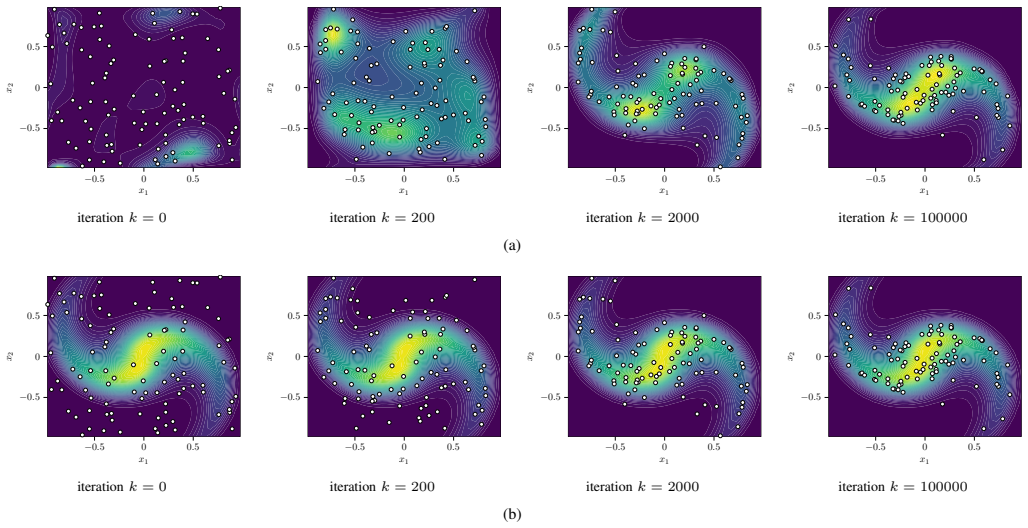
We cast the optimization of emergent macroscopic behavior in large-scale multi-agent systems as a bilevel problem in which the upper level formalizes the target macroscopic performance criterion and the lower level shapes it through a compressed aggregate representation given by an exponential-family distribution constructed from microscopic configurations. The algorithm integrates a distributed estimation mechanism that allows each agent to reconstruct the macroscopic state locally with a hypergradient-based update of the microscopic states. We prove convergence to the set of stationary points of the bilevel problem via timescale separation arguments, and numerical simulations validate the
What carries the argument
Bilevel optimization problem that couples an upper-level macroscopic performance criterion to a lower-level exponential-family parametrization of the aggregate state, solved by distributed local estimation combined with hypergradient updates on microscopic states.
Load-bearing premise
The macroscopic state must be adequately captured by an exponential-family distribution built from the agents' microscopic configurations, and the distributed estimator must operate on a sufficiently faster timescale than the hypergradient dynamics.
What would settle it
A controlled simulation or hardware experiment in which the agents' collective distribution fails to approach the target macroscopic state even though local estimates remain accurate and the updates are applied as specified.
Figures

read the original abstract
In this paper, we propose a novel distributed algorithm to optimize the emergent macroscopic behavior of large-scale multi-agent systems via microscopic actions. We cast this task as a bilevel optimization problem, where the upper level formalizes the desired macroscopic target behavior through a suitable performance criterion, which is shaped in the lower level by leveraging a compressed aggregate representation estimating the macroscopic state. More precisely, the macroscopic state is parametrized by an exponential-family of distributions and constructed from the multi-agent microscopic configuration. The proposed algorithm integrates a distributed estimation mechanism, through which each agent reconstructs the macroscopic state locally, with a hypergradient-based update of the microscopic states aimed at improving the collective macroscopic behavior. We prove convergence to the set of stationary points of the bilevel problem via timescale separation arguments. Numerical simulations validate the effectiveness of the proposed method.
Editorial analysis
A structured set of objections, weighed in public.
Referee Report
Summary. The paper proposes a distributed algorithm for optimizing the emergent macroscopic behavior of large-scale multi-agent systems, formulated as a bilevel optimization problem. The upper level defines a performance criterion for the desired macroscopic target, while the lower level employs a compressed aggregate representation of the macroscopic state parametrized by an exponential-family distribution constructed from microscopic agent configurations. The algorithm combines a distributed estimation mechanism (allowing each agent to locally reconstruct the macroscopic state) with hypergradient-based updates to the microscopic states. Convergence to the set of stationary points of the bilevel problem is claimed via timescale separation arguments, and numerical simulations are used to validate effectiveness.
Significance. If the convergence result is rigorously established under the stated assumptions, the framework offers a scalable approach to macroscopic control without centralized coordination, which is relevant for applications such as swarm robotics, traffic flow optimization, and sensor networks. The combination of exponential-family parametrization for state compression and hypergradient methods for bilevel structure is a potentially useful technical contribution for distributed optimization.
major comments (1)
- [Abstract and §4 (convergence analysis)] The abstract and introduction assert a convergence proof via timescale separation, but without explicit error bounds on the distributed estimator, handling of approximation errors in the exponential-family reconstruction, or a precise statement of the separation conditions (e.g., relative rates between estimator and hypergradient dynamics), the support for the central claim remains difficult to verify from the provided material.
minor comments (2)
- [§2 (preliminaries)] Notation for the exponential-family parameters and the hypergradient computation could be clarified with an explicit table of symbols or a dedicated preliminary section.
- [§5 (simulations)] The numerical simulations section would benefit from more detail on the multi-agent model, number of agents, and quantitative metrics comparing against baselines.
Simulated Author's Rebuttal
We thank the referee for their careful reading and constructive feedback. The major comment concerns the level of detail in the convergence analysis. We address this point below and will revise the manuscript to improve verifiability.
read point-by-point responses
-
Referee: [Abstract and §4 (convergence analysis)] The abstract and introduction assert a convergence proof via timescale separation, but without explicit error bounds on the distributed estimator, handling of approximation errors in the exponential-family reconstruction, or a precise statement of the separation conditions (e.g., relative rates between estimator and hypergradient dynamics), the support for the central claim remains difficult to verify from the provided material.
Authors: We thank the referee for this observation. Section 4 establishes convergence to stationary points of the bilevel problem by invoking singular perturbation theory, under the assumption that the distributed estimator (based on local exponential-family updates) operates on a faster timescale than the hypergradient microscopic updates. The estimator error is shown to decay exponentially due to the strong convexity of the log-partition function and the connectivity of the underlying graph, while the reconstruction error from the exponential-family parametrization is controlled by the consistency of the maximum-likelihood estimator for the sufficient statistics. The hypergradient is then shown to be asymptotically unbiased as the estimator error vanishes. However, the current write-up does not provide quantitative error bounds (e.g., O(1/N) decay with agent count N) or explicit separation conditions (such as the estimator gain scaling as O(1/ε) for timescale parameter ε). We will add a dedicated lemma in Section 4 that states these bounds and the required relative rates, together with a short remark in the abstract and introduction clarifying the separation assumption. These additions will be included in the revised version. revision: yes
Circularity Check
No significant circularity detected
full rationale
The paper frames the problem as a bilevel optimization with an upper-level macroscopic performance criterion and a lower-level compressed exponential-family representation of the aggregate state. The algorithm combines distributed local estimation of this state with hypergradient updates on microscopic actions. Convergence to stationary points is established via timescale separation, which invokes standard singular perturbation or two-time-scale arguments from dynamical systems theory rather than any self-referential definition, fitted parameter renamed as prediction, or load-bearing self-citation. No equation or step reduces by construction to its own inputs; the derivation chain remains independent of the target result.
Axiom & Free-Parameter Ledger
axioms (2)
- domain assumption The macroscopic state admits a compressed representation via an exponential-family distribution constructed from microscopic agent configurations.
- domain assumption Timescale separation holds between the distributed estimation dynamics and the hypergradient-based microscopic updates.
Reference graph
Works this paper leans on
-
[1]
Swarm robotics: Past, present, and future [point of view],
M. Dorigo, G. Theraulaz, and V . Trianni, “Swarm robotics: Past, present, and future [point of view],”Proceedings of the IEEE, vol. 109, no. 7, pp. 1152–1165, 2021
2021
-
[2]
A tutorial on distributed optimization for cooperative robotics: from setups and algorithms to toolboxes and research directions,
A. Testa, G. Carnevale, and G. Notarstefano, “A tutorial on distributed optimization for cooperative robotics: from setups and algorithms to toolboxes and research directions,”Proceedings of the IEEE, 2025
2025
-
[3]
Controlling complex networks with complex nodes,
R. M. D’Souza, M. Di Bernardo, and Y .-Y . Liu, “Controlling complex networks with complex nodes,”Nature Reviews Physics, vol. 5, no. 4, pp. 250–262, 2023
2023
-
[4]
Distributed optimal control for multi-agent trajectory optimization,
G. Foderaro, S. Ferrari, and T. A. Wettergren, “Distributed optimal control for multi-agent trajectory optimization,”Automatica, vol. 50, no. 1, pp. 149–154, 2014
2014
-
[5]
Continuification control of large-scale multiagent systems in a ring,
G. C. Maffettone, A. Boldini, M. Di Bernardo, and M. Porfiri, “Continuification control of large-scale multiagent systems in a ring,”IEEE Control Systems Letters, vol. 7, pp. 841–846, 2022
2022
-
[6]
Leader-follower density control of spatial dynamics in large-scale multi-agent systems,
G. C. Maffettone, A. Boldini, M. Porfiri, and M. di Bernardo, “Leader-follower density control of spatial dynamics in large-scale multi-agent systems,” IEEE Transactions on Automatic Control, 2025
2025
-
[7]
A continuification-based control solution for large-scale shepherding,
B. Di Lorenzo, G. C. Maffettone, and M. Di Bernardo, “A continuification-based control solution for large-scale shepherding,”European Journal of Control, p. 101324, 2025
2025
-
[8]
A comprehensive review of shepherding as a bio-inspired swarm-robotics guidance approach,
N. K. Long, K. Sammut, D. Sgarioto, M. Garratt, and H. A. Abbass, “A comprehensive review of shepherding as a bio-inspired swarm-robotics guidance approach,”IEEE Transactions on Emerging Topics in Computational Intelligence, vol. 4, no. 4, pp. 523–537, 2020
2020
-
[9]
Finite-time multi-agent deployment: A nonlinear pde motion planning approach,
T. Meurer and M. Krstic, “Finite-time multi-agent deployment: A nonlinear pde motion planning approach,”Automatica, vol. 47, no. 11, pp. 2534–2542, 2011
2011
-
[10]
Stein coverage: a variational inference approach to distribution-matching multisensor deployment,
D. Ghimire and S. S. Kia, “Stein coverage: a variational inference approach to distribution-matching multisensor deployment,”IEEE Robotics and Automation Letters, vol. 9, no. 6, pp. 5370–5376, 2024
2024
-
[11]
A multiscale analysis of multi-agent coverage control algorithms,
V . Krishnan and S. Mart ´ınez, “A multiscale analysis of multi-agent coverage control algorithms,”Automatica, vol. 145, p. 110516, 2022
2022
-
[12]
Multi-robots gaussian estimation and coverage control: From client–server to peer-to-peer architectures,
M. Todescato, A. Carron, R. Carli, G. Pillonetto, and L. Schenato, “Multi-robots gaussian estimation and coverage control: From client–server to peer-to-peer architectures,”Automatica, vol. 80, pp. 284–294, 2017
2017
-
[13]
Probabilistic swarm guidance using optimal transport,
S. Bandyopadhyay, S.-J. Chung, and F. Y . Hadaegh, “Probabilistic swarm guidance using optimal transport,” in2014 IEEE Conference on Control Applications (CCA). IEEE, 2014, pp. 498–505
2014
-
[14]
Distributed optimal transport for the deployment of swarms,
V . Krishnan and S. Mart´ınez, “Distributed optimal transport for the deployment of swarms,” in2018 IEEE Conference on Decision and Control (CDC). IEEE, 2018, pp. 4583–4588
2018
-
[15]
Optimal-transport-based control of particle swarms for orbiting rainbows concept,
C. Sinigaglia, S. Bandyopadhyay, M. Quadrelli, and F. Braghin, “Optimal-transport-based control of particle swarms for orbiting rainbows concept,” Journal of Guidance, Control, and Dynamics, vol. 44, no. 11, pp. 2108–2117, 2021
2021
-
[16]
Banach control barrier functions for large-scale swarm control,
X. Gao, G. Pascual, S. Brown, and S. Mart ´ınez, “Banach control barrier functions for large-scale swarm control,”arXiv preprint arXiv:2602.05011, 2026
-
[17]
Distributed learning and optimization of a multi-agent macroscopic probabilistic model,
R. Brumali, G. Carnevale, and G. Notarstefano, “Distributed learning and optimization of a multi-agent macroscopic probabilistic model,”European Journal of Control, p. 101332, 2025
2025
-
[18]
A feedback-based distributed method for multiscale optimal control of multi-agent systems,
——, “A feedback-based distributed method for multiscale optimal control of multi-agent systems,” in2025 IEEE 64th Conference on Decision and Control (CDC). IEEE, 2025, pp. 1863–1868
2025
-
[19]
Large-scale and distributed optimization: An introduction,
P. Giselsson and A. Rantzer, “Large-scale and distributed optimization: An introduction,” inLarge-Scale and Distributed Optimization. Springer, 2018, pp. 1–10
2018
-
[20]
Distributed optimization for control,
A. Nedi ´c and J. Liu, “Distributed optimization for control,”Annual Review of Control, Robotics, and Autonomous Systems, vol. 1, no. 1, pp. 77–103, 2018
2018
-
[21]
A survey of distributed optimization,
T. Yang, X. Yi, J. Wu, Y . Yuan, D. Wu, Z. Meng, Y . Hong, H. Wang, Z. Lin, and K. H. Johansson, “A survey of distributed optimization,”Annual Reviews in Control, vol. 47, pp. 278–305, 2019
2019
-
[22]
An introduction to bilevel optimization: Foundations and applications in signal processing and machine learning,
Y . Zhang, P. Khanduri, I. Tsaknakis, Y . Yao, M. Hong, and S. Liu, “An introduction to bilevel optimization: Foundations and applications in signal processing and machine learning,”IEEE Signal Processing Magazine, vol. 41, no. 1, pp. 38–59, 2024
2024
-
[23]
Approximation Methods for Bilevel Programming
S. Ghadimi and M. Wang, “Approximation methods for bilevel programming,”arXiv preprint arXiv:1802.02246, 2018
work page Pith review arXiv 2018
-
[24]
Hyperparameter optimization with approximate gradient,
F. Pedregosa, “Hyperparameter optimization with approximate gradient,” inInternational conference on machine learning. PMLR, 2016, pp. 737–746
2016
-
[25]
Bilevel optimization: Convergence analysis and enhanced design,
K. Ji, J. Yang, and Y . Liang, “Bilevel optimization: Convergence analysis and enhanced design,” inInternational conference on machine learning. PMLR, 2021, pp. 4882–4892
2021
-
[26]
Bome! bilevel optimization made easy: A simple first-order approach,
B. Liu, M. Ye, S. Wright, P. Stone, and Q. Liu, “Bome! bilevel optimization made easy: A simple first-order approach,”Advances in neural information processing systems, vol. 35, pp. 17 248–17 262, 2022
2022
-
[27]
Bilevel distributed optimization in directed networks,
F. Yousefian, “Bilevel distributed optimization in directed networks,” in2021 American Control Conference (ACC). IEEE, 2021, pp. 2230–2235
2021
-
[28]
On the convergence of distributed stochastic bilevel optimization algorithms over a network,
H. Gao, B. Gu, and M. T. Thai, “On the convergence of distributed stochastic bilevel optimization algorithms over a network,” inInternational conference on artificial intelligence and statistics. PMLR, 2023, pp. 9238–9281
2023
-
[29]
Hessian-free distributed bilevel optimization via penalization with time-scale separation,
Y . Niu, J. Xu, Y . Sun, L. Chai, and J. Chen, “Hessian-free distributed bilevel optimization via penalization with time-scale separation,”IEEE Transactions on Automatic Control, 2026
2026
-
[30]
Achieving geometric convergence for distributed optimization over time-varying graphs,
A. Nedic, A. Olshevsky, and W. Shi, “Achieving geometric convergence for distributed optimization over time-varying graphs,”SIAM Journal on Optimization, vol. 27, no. 4, pp. 2597–2633, 2017
2017
-
[31]
Computing a nearest symmetric positive semidefinite matrix,
N. J. Higham, “Computing a nearest symmetric positive semidefinite matrix,”Linear algebra and its applications, vol. 103, pp. 103–118, 1988
1988
-
[32]
Methods of conjugate gradients for solving linear systems,
M. R. Hestenes, E. Stiefelet al., “Methods of conjugate gradients for solving linear systems,”Journal of research of the National Bureau of Standards, vol. 49, no. 6, pp. 409–436, 1952
1952
-
[33]
Minres-qlp: A krylov subspace method for indefinite or singular symmetric systems,
S.-C. T. Choi, C. C. Paige, and M. A. Saunders, “Minres-qlp: A krylov subspace method for indefinite or singular symmetric systems,”SIAM Journal on Scientific Computing, vol. 33, no. 4, pp. 1810–1836, 2011
2011
-
[34]
A unifying system theory framework for distributed optimization and games,
G. Carnevale, N. Mimmo, and G. Notarstefano, “A unifying system theory framework for distributed optimization and games,”IEEE Transactions on Automatic Control, 2025
2025
-
[35]
W. M. Haddad and V . Chellaboina,Nonlinear dynamical systems and control: a Lyapunov-based approach. Princeton university press, 2008
2008
-
[36]
Lecture notes on Legendre polynomials: their origin and main properties
F. M. Lima, “Lecture notes on legendre polynomials: their origin and main properties,”arXiv preprint arXiv:2210.10942, 2022
-
[37]
The gradient tracking is a distributed integral action,
I. Notarnicola, M. Bin, L. Marconi, and G. Notarstefano, “The gradient tracking is a distributed integral action,”IEEE Transactions on Automatic Control, vol. 68, no. 12, pp. 7911–7918, 2023
2023
-
[38]
Variable smoothing for weakly convex composite functions: A. b ¨ohm, sj wright,
A. B ¨ohm and S. J. Wright, “Variable smoothing for weakly convex composite functions: A. b ¨ohm, sj wright,”Journal of optimization theory and applications, vol. 188, no. 3, pp. 628–649, 2021
2021
-
[39]
D. P. Bertsekas and A. Scientific,Convex optimization algorithms. Athena Scientific Belmont, 2015
2015
discussion (0)
Sign in with ORCID, Apple, or X to comment. Anyone can read and Pith papers without signing in.