Recognition: unknown
The nature of tilted supercritical accretion discs
Pith reviewed 2026-05-10 16:34 UTC · model grok-4.3
The pith
Tilted supercritical accretion discs around spinning black holes can exceed the Eddington limit by up to a factor of ten due to standing shocks.
A machine-rendered reading of the paper's core claim, the machinery that carries it, and where it could break.
Core claim
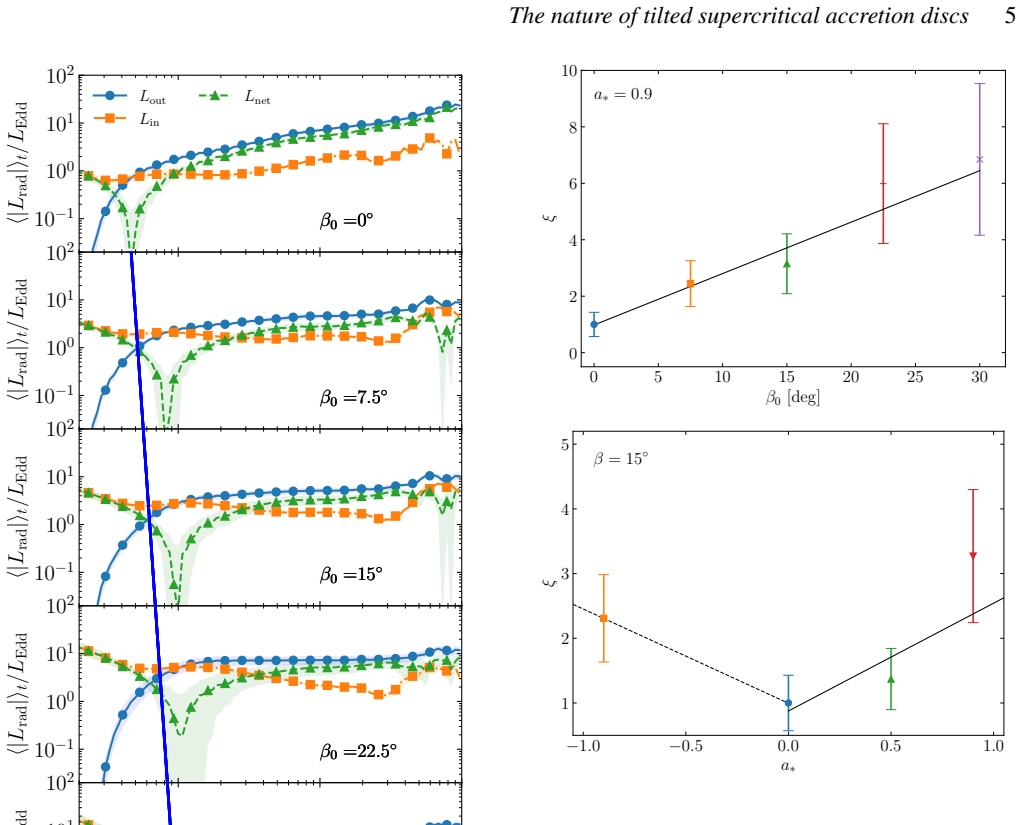
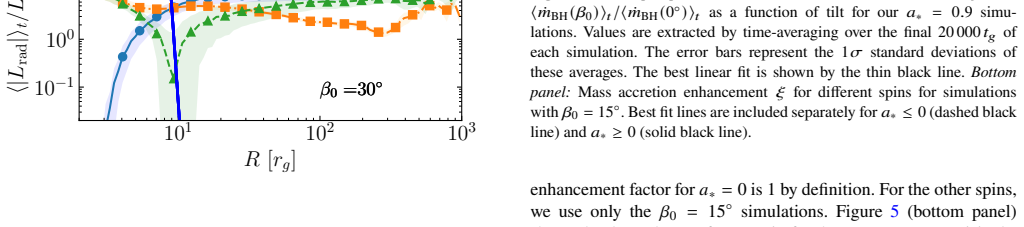
The central claim is that tilted supercritical accretion discs allow black holes to accrete at rates up to ten times the Eddington limit, with the rate scaling linearly with tilt angle and proportionally with spin magnitude. This occurs because standing shocks form in the inner accretion flow, a feature absent in untilted discs. The same shocks make the discs more advective overall. All reported differences in accretion behavior are attributed to these shocks.
What carries the argument
Standing shocks that form uniquely in the inner regions of tilted accretion flows and drive enhanced mass inflow and advection.
If this is right
- Mass accretion rates onto the black hole increase linearly with the initial tilt angle.
- For a fixed tilt the enhancement grows with the magnitude of the black hole spin.
- Tilted discs are more advective than untilted counterparts and carry more energy inward.
- The Eddington limit can be exceeded in tilted supercritical flows.
- The mechanism offers one route to explaining rapid growth of the first supermassive black holes.
Where Pith is reading between the lines
- If the linear scaling with tilt persists in nature, even modest misalignments could substantially speed up black hole growth at high redshifts.
- Distinct variability or spectral features tied to the inner shocks might appear in observations of X-ray binaries or active nuclei with known disc-spin misalignments.
- Running the same setup with alternate radiation transport schemes would test whether the shock-driven boost remains stable under different physical assumptions.
Load-bearing premise
The simulations accurately capture the standing shocks and their impact on accretion without being dominated by numerical artifacts from resolution, boundary conditions, or the radiation transport scheme.
What would settle it
A higher-resolution simulation or one using a different radiation transport method in which the standing shocks vanish and the accretion rate falls back to or below the Eddington limit would falsify the central claim.
Figures




read the original abstract
In this paper, we report on the first 3D general relativistic radiation magnetohydrodynamic simulations of large supercritical accretion discs that are tilted with respect to the black hole spin axis. We explore a range of black hole spin parameters (from $a_* = -0.9$ to 0.9), initial tilts (in the range from $\beta_0 = 0^\circ$ to $30^\circ$), and target mass accretion rates. We first confirm that, for all the untilted simulations, the Eddington accretion limit is obeyed ($\dot{M}_\mathrm{BH} \lesssim \dot{M}_\mathrm{Edd}$), consistent with our previous findings. However, for tilted discs we find that the mass accretion rate can be enhanced by up to a factor of ten and that factor depends linearly on tilt $\dot{M}_\mathrm{BH} \propto \beta_0 \ge \dot{M}_\mathrm{Edd}$. This could be an important aspect in solving the puzzle of the growth of the first supermassive black holes. We also find that for a given tilt, the mass accretion rate enhancement is proportional to the magnitude of the spin. Additionally, we find that tilted supercritical accretion discs are more advective than their untilted counterparts. We attribute all of these differences to the presence of standing shocks in the inner regions of the accretion flow, a feature unique to tilted discs.
Editorial analysis
A structured set of objections, weighed in public.
Referee Report
Summary. The manuscript reports the first 3D general relativistic radiation magnetohydrodynamic (GRRMHD) simulations of large supercritical accretion discs tilted relative to the black hole spin axis. Across a parameter scan of black hole spins (a_* from -0.9 to 0.9), initial tilt angles (β₀ from 0° to 30°), and target accretion rates, the authors find that untilted discs respect the Eddington limit (Ṁ_BH ≲ Ṁ_Edd), while tilted discs exhibit accretion rates enhanced by up to a factor of ten. This enhancement scales linearly with tilt (Ṁ_BH ∝ β₀) and with the magnitude of the black hole spin; tilted discs are also more advective. All differences are attributed to standing shocks present only in the inner regions of tilted flows.
Significance. If the results are robust, the work provides a plausible mechanism for sustained super-Eddington accretion that could help resolve the puzzle of rapid supermassive black hole growth at high redshift. The direct 3D GRRMHD treatment with radiation transport is a clear strength, enabling self-consistent capture of shock heating and radiative effects in the optically thick regime without ad-hoc assumptions.
major comments (3)
- [Numerical Methods] Numerical Methods section: the manuscript provides no resolution convergence tests for the identification, location, or strength of the standing shocks. Because the central quantitative claims (factor-of-ten enhancement and linear scaling with β₀) are attributed entirely to these shocks, it is essential to demonstrate that shock properties and the resulting torque balance are insensitive to grid scale in the radiation-pressure-dominated inner flow.
- [Results] Results on accretion-rate measurements: the reported linear dependence Ṁ_BH ∝ β₀ and the factor-of-ten boost are presented without quantitative error bars, details on time-averaging intervals, or the radial location at which Ṁ_BH is evaluated. In the absence of such analysis, the statistical significance of the trend across the parameter scans cannot be assessed.
- [Radiation Transport Implementation] Radiation transport and shock physics: no tests are described that vary the radiation closure (e.g., M1 versus flux-limited diffusion) or that quantify radiative diffusion across the shocks. In the supercritical regime the inner flow is optically thick; any numerical broadening or weakening of the shocks by the transport scheme would directly affect the claimed accretion enhancement.
minor comments (2)
- [Abstract] Abstract: the notation 'Ṁ_BH ∝ β₀ ≥ Ṁ_Edd' is syntactically unclear and should be rewritten for precision.
- [Figures] Figure captions and axis labels: several panels comparing tilted and untilted runs would benefit from explicit annotation of the shock locations to aid the reader in connecting the visuals to the text claims.
Simulated Author's Rebuttal
We thank the referee for their constructive feedback and for recognizing the potential importance of our findings for understanding super-Eddington accretion. We address each major comment below.
read point-by-point responses
-
Referee: [Numerical Methods] Numerical Methods section: the manuscript provides no resolution convergence tests for the identification, location, or strength of the standing shocks. Because the central quantitative claims (factor-of-ten enhancement and linear scaling with β₀) are attributed entirely to these shocks, it is essential to demonstrate that shock properties and the resulting torque balance are insensitive to grid scale in the radiation-pressure-dominated inner flow.
Authors: We agree that explicit resolution convergence tests for the standing shocks would strengthen the robustness of our central claims. While our chosen grid resolution follows standard practice for 3D GRRMHD simulations of this type and the shocks are captured across multiple cells, we will add a dedicated subsection with new convergence tests (lower and higher resolution runs for representative tilted cases) in the revised manuscript to demonstrate that shock location, strength, and the resulting accretion enhancement are insensitive to grid scale. revision: yes
-
Referee: [Results] Results on accretion-rate measurements: the reported linear dependence Ṁ_BH ∝ β₀ and the factor-of-ten boost are presented without quantitative error bars, details on time-averaging intervals, or the radial location at which Ṁ_BH is evaluated. In the absence of such analysis, the statistical significance of the trend across the parameter scans cannot be assessed.
Authors: We acknowledge the omission of these quantitative details. We will revise the Results section to explicitly state the radial location at which Ṁ_BH is evaluated, the time-averaging intervals used after the flow reaches quasi-steady state, and the method for computing error bars (e.g., standard deviation over the averaging window). This will enable readers to assess the statistical significance of the reported linear trend with β₀. revision: yes
-
Referee: [Radiation Transport Implementation] Radiation transport and shock physics: no tests are described that vary the radiation closure (e.g., M1 versus flux-limited diffusion) or that quantify radiative diffusion across the shocks. In the supercritical regime the inner flow is optically thick; any numerical broadening or weakening of the shocks by the transport scheme would directly affect the claimed accretion enhancement.
Authors: We used the M1 closure, which is well-suited to the optically thick inner regions. No direct comparisons with alternative closures were performed owing to the substantial computational expense of these large 3D runs. In the revised manuscript we will expand the Methods section to justify the choice of M1, reference prior validation studies on untilted discs, and discuss the expected impact of numerical diffusion on the shocks. We note that the shocks are primarily a hydrodynamic feature whose existence and torque balance are robust across different radiation treatments in the literature; a full closure-variation study lies beyond the scope of the present work. revision: partial
Circularity Check
No circularity: results are direct outputs of numerical simulations
full rationale
The paper reports outcomes from 3D GRRMHD simulations of tilted supercritical accretion discs. Key claims (enhanced Ṁ_BH up to 10× Eddington with linear dependence on β₀, greater advection, standing shocks) are simulation outputs, not analytic derivations or fitted parameters that reduce to inputs by construction. The untilted confirmation is noted as consistent with prior work, but this is not load-bearing for the tilted results and introduces no self-definitional or self-citation circularity. No equations, ansatzes, or uniqueness theorems are invoked that collapse the reported enhancements to the simulation inputs themselves.
Axiom & Free-Parameter Ledger
free parameters (3)
- initial tilt angle beta_0
- black hole spin a_*
- target mass accretion rate
axioms (2)
- standard math General relativistic radiation magnetohydrodynamics equations govern the flow
- domain assumption Standing shocks form only in tilted configurations and drive the accretion enhancement
Reference graph
Works this paper leans on
-
[1]
Anninos P., Fragile P. C., Salmonson J. D., 2005, @doi [ ] 10.1086/497294 , https://ui.adsabs.harvard.edu/abs/2005ApJ...635..723A 635, 723
-
[2]
Asahina Y., Ohsuga K., 2022, @doi [ ] 10.3847/1538-4357/ac5d37 , https://ui.adsabs.harvard.edu/abs/2022ApJ...929...93A 929, 93
-
[3]
Asahina Y., Ohsuga K., 2024, @doi [ ] 10.3847/1538-4357/ad6cd9 , https://ui.adsabs.harvard.edu/abs/2024ApJ...973...45A 973, 45
-
[4]
Ba \ n ados E., et al., 2018, @doi [ ] 10.1038/nature25180 , https://ui.adsabs.harvard.edu/abs/2018Natur.553..473B 553, 473
-
[5]
Bardeen J. M., Petterson J. A., 1975, @doi [ ] 10.1086/181711 , https://ui.adsabs.harvard.edu/abs/1975ApJ...195L..65B 195, L65
-
[6]
Begelman M. C., Volonteri M., Rees M. J., 2006, @doi [ ] 10.1111/j.1365-2966.2006.10467.x , https://ui.adsabs.harvard.edu/abs/2006MNRAS.370..289B 370, 289
-
[7]
Boggs S. E., et al., 2015, @doi [Science] 10.1126/science.aaa2259 , https://ui.adsabs.harvard.edu/abs/2015Sci...348..670B 348, 670
-
[8]
C., Roth N., Ramirez-Ruiz E., Miller M
Dai L., McKinney J. C., Roth N., Ramirez-Ruiz E., Miller M. C., 2018, @doi [ ] 10.3847/2041-8213/aab429 , https://ui.adsabs.harvard.edu/abs/2018ApJ...859L..20D 859, L20
-
[9]
Dexter J., Fragile P. C., 2011, @doi [ ] 10.1088/0004-637X/730/1/36 , https://ui.adsabs.harvard.edu/abs/2011ApJ...730...36D 730, 36
-
[10]
Dijkstra M., Haiman Z., Mesinger A., Wyithe J. S. B., 2008, @doi [ ] 10.1111/j.1365-2966.2008.14031.x , https://ui.adsabs.harvard.edu/abs/2008MNRAS.391.1961D 391, 1961
-
[11]
Fragile P. C., Anninos P., 2005, @doi [ ] 10.1086/428433 , https://ui.adsabs.harvard.edu/abs/2005ApJ...623..347F 623, 347
-
[12]
Fragile P. C., Blaes O. M., 2008, @doi [ ] 10.1086/591936 , https://ui.adsabs.harvard.edu/abs/2008ApJ...687..757F 687, 757
-
[13]
Fragile P. C., Liska M., 2025, in Bambi C., Mizuno Y., Shashank S., Yuan F., eds, , New Frontiers in GRMHD Simulations. pp 361--387, @doi 10.1007/978-981-97-8522-3_11
-
[14]
Fragile P. C., Blaes O. M., Anninos P., Salmonson J. D., 2007, @doi [ ] 10.1086/521092 , https://ui.adsabs.harvard.edu/abs/2007ApJ...668..417F 668, 417
-
[15]
Fragile P. C., Olejar A., Anninos P., 2014, @doi [ ] 10.1088/0004-637X/796/1/22 , https://ui.adsabs.harvard.edu/abs/2014ApJ...796...22F 796, 22
-
[16]
2025, MNRAS, 540, 2820, doi: 10.1093/mnras/staf890
Fragile P. C., Middleton M. J., Bollimpalli D. A., Smith Z., 2025, @doi [ ] 10.1093/mnras/staf890 , https://ui.adsabs.harvard.edu/abs/2025MNRAS.540.2820F 540, 2820
-
[17]
Fragos T., Tremmel M., Rantsiou E., Belczynski K., 2010, @doi [ ] 10.1088/2041-8205/719/1/L79 , https://ui.adsabs.harvard.edu/abs/2010ApJ...719L..79F 719, L79
-
[18]
Fukue J., 2004, @doi [ ] 10.1093/pasj/56.3.569 , https://ui.adsabs.harvard.edu/abs/2004PASJ...56..569F 56, 569
-
[19]
Generozov A., Blaes O., Fragile P. C., Henisey K. B., 2014, @doi [ ] 10.1088/0004-637X/780/1/81 , https://ui.adsabs.harvard.edu/abs/2014ApJ...780...81G 780, 81
-
[20]
Grefenstette B. W., et al., 2014, @doi [ ] 10.1038/nature12997 , https://ui.adsabs.harvard.edu/abs/2014Natur.506..339G 506, 339
-
[21]
Jiang Y.-F., Stone J. M., Davis S. W., 2014, @doi [ ] 10.1088/0004-637X/796/2/106 , https://ui.adsabs.harvard.edu/abs/2014ApJ...796..106J 796, 106
-
[22]
Kaaret P., Feng H., Roberts T. P., 2017, @doi [ ] 10.1146/annurev-astro-091916-055259 , https://ui.adsabs.harvard.edu/abs/2017ARA&A..55..303K 55, 303
-
[23]
Kaaz N., Liska M. T. P., Jacquemin-Ide J., Andalman Z. L., Musoke G., Tchekhovskoy A., Porth O., 2023, @doi [ ] 10.3847/1538-4357/ace051 , https://ui.adsabs.harvard.edu/abs/2023ApJ...955...72K 955, 72
-
[24]
King A., 2024, @doi [ ] 10.1093/mnras/stae1171 , https://ui.adsabs.harvard.edu/abs/2024MNRAS.531..550K 531, 550
-
[25]
King A., Nixon C., 2016, @doi [ ] 10.1093/mnras/stw1598 , https://ui.adsabs.harvard.edu/abs/2016MNRAS.462..464K 462, 464
-
[26]
King A. R., Pringle J. E., 2006, @doi [ ] 10.1111/j.1745-3933.2006.00249.x , https://ui.adsabs.harvard.edu/abs/2006MNRAS.373L..90K 373, L90
-
[27]
King A. R., Davies M. B., Ward M. J., Fabbiano G., Elvis M., 2001, @doi [ ] 10.1086/320343 , https://ui.adsabs.harvard.edu/abs/2001ApJ...552L.109K 552, L109
-
[28]
King A. R., Pringle J. E., Hofmann J. A., 2008, @doi [ ] 10.1111/j.1365-2966.2008.12943.x , https://ui.adsabs.harvard.edu/abs/2008MNRAS.385.1621K 385, 1621
-
[29]
King A., Lasota J.-P., Middleton M., 2023, @doi [ ] 10.1016/j.newar.2022.101672 , https://ui.adsabs.harvard.edu/abs/2023NewAR..9601672K 96, 101672
-
[30]
Kinney A. L., Schmitt H. R., Clarke C. J., Pringle J. E., Ulvestad J. S., Antonucci R. R. J., 2000, @doi [ ] 10.1086/309016 , https://ui.adsabs.harvard.edu/abs/2000ApJ...537..152K 537, 152
-
[31]
Liska M., Hesp C., Tchekhovskoy A., Ingram A., van der Klis M., Markoff S., 2018, @doi [ ] 10.1093/mnrasl/slx174 , https://ui.adsabs.harvard.edu/abs/2018MNRAS.474L..81L 474, L81
-
[32]
Liska M. T. P., Kaaz N., Musoke G., Tchekhovskoy A., Porth O., 2023, @doi [ ] 10.3847/2041-8213/acb6f4 , https://ui.adsabs.harvard.edu/abs/2023ApJ...944L..48L 944, L48
-
[33]
Mayer L., Kazantzidis S., Escala A., Callegari S., 2010, @doi [ ] 10.1038/nature09294 , https://ui.adsabs.harvard.edu/abs/2010Natur.466.1082M 466, 1082
-
[34]
Middleton M. J., Parker M. L., Reynolds C. S., Fabian A. C., Lohfink A. M., 2016, @doi [ ] 10.1093/mnras/stw035 , https://ui.adsabs.harvard.edu/abs/2016MNRAS.457.1568M 457, 1568
-
[35]
Middleton M. J., et al., 2018, @doi [ ] 10.1093/mnras/stx2986 , https://ui.adsabs.harvard.edu/abs/2018MNRAS.475..154M 475, 154
-
[36]
Middleton M. J., Fragile P. C., Ingram A., Roberts T. P., 2019, @doi [ ] 10.1093/mnras/stz2005 , https://ui.adsabs.harvard.edu/abs/2019MNRAS.489..282M 489, 282
-
[37]
Morales Teixeira D., Fragile P. C., Zhuravlev V. V., Ivanov P. B., 2014, @doi [ ] 10.1088/0004-637X/796/2/103 , https://ui.adsabs.harvard.edu/abs/2014ApJ...796..103M 796, 103
-
[38]
D., Thorne K
Novikov I. D., Thorne K. S., 1973, in Dewitt C., Dewitt B. S., eds, Black Holes (Les Astres Occlus). pp 343--450
1973
-
[39]
Ohsuga K., Mori M., Nakamoto T., Mineshige S., 2005, @doi [ ] 10.1086/430728 , https://ui.adsabs.harvard.edu/abs/2005ApJ...628..368O 628, 368
-
[40]
F., Baumgardt H., Hut P., Makino J., McMillan S
Portegies Zwart S. F., Baumgardt H., Hut P., Makino J., McMillan S. L. W., 2004, @doi [ ] 10.1038/nature02448 , https://ui.adsabs.harvard.edu/abs/2004Natur.428..724P 428, 724
-
[41]
Poutanen J., Lipunova G., Fabrika S., Butkevich A. G., Abolmasov P., 2007, @doi [ ] 10.1111/j.1365-2966.2007.11668.x , https://ui.adsabs.harvard.edu/abs/2007MNRAS.377.1187P 377, 1187
-
[42]
J., 1978, @doi [ ] 10.1038/275516a0 , https://ui.adsabs.harvard.edu/abs/1978Natur.275..516R 275, 516
Rees M. J., 1978, @doi [ ] 10.1038/275516a0 , https://ui.adsabs.harvard.edu/abs/1978Natur.275..516R 275, 516
-
[43]
Scheuer P. A. G., Feiler R., 1996, @doi [ ] 10.1093/mnras/282.1.291 , https://ui.adsabs.harvard.edu/abs/1996MNRAS.282..291S 282, 291
-
[44]
Schneider R., Valiante R., Trinca A., Graziani L., Volonteri M., Maiolino R., 2023, @doi [ ] 10.1093/mnras/stad2503 , https://ui.adsabs.harvard.edu/abs/2023MNRAS.526.3250S 526, 3250
-
[45]
I., Sunyaev R
Shakura N. I., Sunyaev R. A., 1973, , https://ui.adsabs.harvard.edu/abs/1973A&A....24..337S 24, 337
1973
-
[46]
Sironi L., Tran A., 2024, @doi [ ] 10.3847/1538-4357/ad4607 , https://ui.adsabs.harvard.edu/abs/2024ApJ...968..102S 968, 102
-
[47]
S a dowski A., Narayan R., 2016, @doi [ ] 10.1093/mnras/stv2941 , https://ui.adsabs.harvard.edu/abs/2016MNRAS.456.3929S 456, 3929
-
[48]
Smith A., Bromm V., 2019, @doi [Contemporary Physics] 10.1080/00107514.2019.1615715 , https://ui.adsabs.harvard.edu/abs/2019ConPh..60..111S 60, 111
-
[49]
Takahashi H. R., Mineshige S., Ohsuga K., 2018, @doi [ ] 10.3847/1538-4357/aaa082 , https://ui.adsabs.harvard.edu/abs/2018ApJ...853...45T 853, 45
-
[50]
Taylor A. J., et al., 2025, @doi [ ] 10.3847/2041-8213/ade789 , https://ui.adsabs.harvard.edu/abs/2025ApJ...989L...7T 989, L7
-
[51]
Utsumi A., Ohsuga K., Takahashi H. R., Asahina Y., 2022, @doi [ ] 10.3847/1538-4357/ac7eb8 , https://ui.adsabs.harvard.edu/abs/2022ApJ...935...26U 935, 26
-
[52]
J., 2005, @doi [ ] 10.1086/466521 , https://ui.adsabs.harvard.edu/abs/2005ApJ...633..624V 633, 624
Volonteri M., Rees M. J., 2005, @doi [ ] 10.1086/466521 , https://ui.adsabs.harvard.edu/abs/2005ApJ...633..624V 633, 624
-
[53]
White C. J., Quataert E., Blaes O., 2019, @doi [ ] 10.3847/1538-4357/ab089e , https://ui.adsabs.harvard.edu/abs/2019ApJ...878...51W 878, 51
-
[54]
Wu S., Coughlin E. R., Nixon C., 2018, @doi [ ] 10.1093/mnras/sty971 , https://ui.adsabs.harvard.edu/abs/2018MNRAS.478.3016W 478, 3016
-
[55]
Yang J., et al., 2021, @doi [ ] 10.3847/1538-4357/ac2b32 , https://ui.adsabs.harvard.edu/abs/2021ApJ...923..262Y 923, 262
-
[56]
Yoshioka S., Mineshige S., Ohsuga K., Kawashima T., Kitaki T., 2022, @doi [ ] 10.1093/pasj/psac076 , https://ui.adsabs.harvard.edu/abs/2022PASJ...74.1378Y 74, 1378
-
[57]
Zhang L., Stone J. M., Mullen P. D., Davis S. W., Jiang Y.-F., White C. J., 2025, @doi [ ] 10.3847/1538-4357/ae0f91 , https://ui.adsabs.harvard.edu/abs/2025ApJ...995...26Z 995, 26
discussion (0)
Sign in with ORCID, Apple, or X to comment. Anyone can read and Pith papers without signing in.