Recognition: unknown
Patterns in Individual Blood Count Trajectories in the UK Biobank Characterise Disease-Specific Signatures and Anticipate Pan-Cancer Risk
Pith reviewed 2026-05-10 15:33 UTC · model grok-4.3
The pith
Longitudinal blood count trajectories form disease-specific signatures that anticipate cancer risk before symptoms.
A machine-rendered reading of the paper's core claim, the machinery that carries it, and where it could break.
Core claim
Using normalised temporal profiles of blood analytes and machine learning applied to UK Biobank longitudinal data, the analysis demonstrates that analyte-group patterns in common blood tests are both disease-sensitive and disease-specific, with CBC markers providing the majority of the predictive signal for early detection of cancer and other conditions before any symptoms appear.
What carries the argument
Normalised temporal profiles of Complete Blood Count markers fed into machine learning models that classify disease signatures.
If this is right
- CBC markers alone carry the dominant predictive signal across multiple diseases.
- Routine longitudinal monitoring of standard blood counts can surface disease patterns years ahead of symptoms.
- Biochemistry panels add only modest, disease-targeted information beyond the CBC baseline.
- Existing, scalable blood tests combined with computation can support population-level predictive medicine.
Where Pith is reading between the lines
- The same trajectory signatures could be used to adjust individual screening intervals according to personal risk curves.
- Extending the approach to progression speed rather than binary presence would require only additional outcome labels.
- Integration into electronic health records could generate automated early-warning flags during routine care.
- Validation on cohorts with different demographics would test whether the signatures generalise beyond the original dataset.
Load-bearing premise
The longitudinal patterns observed in the cohort reflect genuine disease biology rather than selection biases, participation effects or post-diagnosis treatments.
What would settle it
Apply the same trained models without retraining to an independent longitudinal blood-marker dataset from a separate population and measure whether cancer and disease prediction accuracy remains comparable.
Figures



read the original abstract
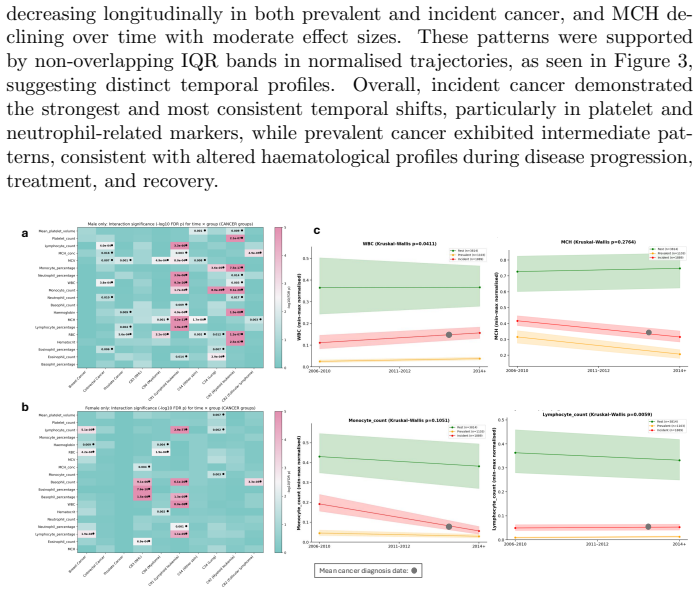
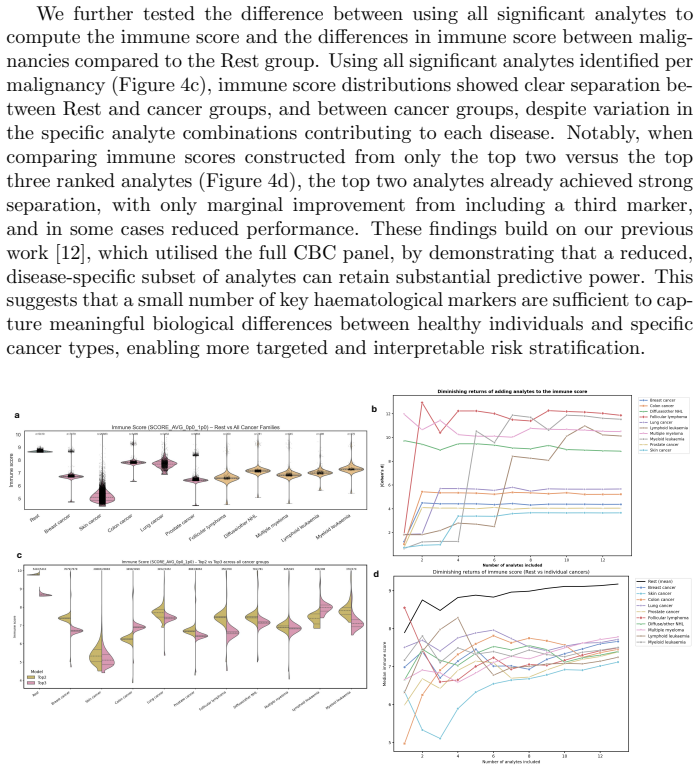
We investigate the longitudinal behaviour of blood markers from common haematological tests as a marker of disease and as a function of disease progression in a variety of conditions including cancer, cardiovascular disease, and infections. We study confounding and non-confounding factors to allow for the earlier detection of disease and conditions based on their longitudinal signatures from biomarker patterns commonly measured in popular and scalable common blood tests across routine clinical tests, in particular the Complete Blood Count (CBC or FBC). Our analysis with normalised temporal profiles and machine learning techniques even before any symptoms appear demonstrates that analyte-group patterns found in blood testing are disease sensitive and disease specific. We demonstrate that CBC markers contribute to the majority of the predictive signal, while biochemistry and other blood panels provide only a modest additional gain mostly associated to very the individual disease for which the test was designed (e.g. CRP, liver enzymes, blood sugar). Our results demonstrate how regular monitoring, computational intelligence, and machine learning applied to longitudinal CBC data can converge to uncover disease patterns, advancing the potential for precision healthcare and predictive medicine on a mass scale leveraging an existing and pervasive blood test.
Editorial analysis
A structured set of objections, weighed in public.
Referee Report
Summary. The manuscript analyzes longitudinal trajectories of blood markers (focusing on Complete Blood Count/CBC and other panels) in the UK Biobank cohort across cancer, cardiovascular disease, and infections. It claims that normalized temporal profiles combined with machine learning reveal disease-sensitive and disease-specific analyte patterns that can anticipate pan-cancer risk even before symptoms, with CBC markers supplying the majority of predictive signal while biochemistry panels add only modest, disease-specific gains.
Significance. If the central claims survive rigorous validation, the work would be significant for precision medicine: it leverages an existing, scalable routine test (CBC) for early detection at population scale. The use of a large linked cohort is a strength, but the absence of external validation, explicit pre-diagnostic filtering, and reproducible modeling details currently limits the result to an exploratory observation rather than a deployable signature.
major comments (3)
- [Methods] Methods (data selection and temporal filtering): No explicit lead-time cutoff is described for pre-diagnosis measurements (e.g., restricting to samples >2 years before registry diagnosis date). Without this, trajectories can incorporate near-diagnostic testing, surveillance, or early treatment effects that alter CBC counts, directly undermining the claim that signatures are anticipatory and pre-symptomatic.
- [Methods and Results] Methods and Results (model validation): The predictive models are trained and evaluated on the same UK Biobank longitudinal dataset used to discover the patterns, with no held-out external cohorts, temporal cross-validation details, or baseline comparisons reported. This renders the reported AUCs and CBC dominance in-sample fits rather than generalizable predictions.
- [Methods] Methods (trajectory construction): No details are given on handling of missing data, temporal alignment of irregular sampling intervals, or normalization procedure across individuals. These choices are load-bearing for the normalized temporal profiles that underpin both the pattern discovery and the ML claims.
minor comments (2)
- [Abstract] Abstract: Typo in phrase 'mostly associated to very the individual disease' (likely intended 'the very individual disease' or rephrasing needed).
- [Figures] Figures: Example individual trajectories or group-level normalized profiles should be shown to illustrate the claimed disease-specific patterns before the aggregate ML results.
Simulated Author's Rebuttal
Thank you for the thorough review. We have carefully considered each comment and provide point-by-point responses below. Where appropriate, we will revise the manuscript to address the concerns.
read point-by-point responses
-
Referee: [Methods] Methods (data selection and temporal filtering): No explicit lead-time cutoff is described for pre-diagnosis measurements (e.g., restricting to samples >2 years before registry diagnosis date). Without this, trajectories can incorporate near-diagnostic testing, surveillance, or early treatment effects that alter CBC counts, directly undermining the claim that signatures are anticipatory and pre-symptomatic.
Authors: We thank the referee for highlighting this important point. Upon review, our current analysis includes all pre-diagnosis CBC measurements available in the UK Biobank without an explicit lead-time restriction. This may indeed include measurements taken close to diagnosis that could reflect early symptoms or diagnostic workup. To address this, we will implement and report a sensitivity analysis using a 2-year lead-time cutoff, restricting the trajectories to measurements at least 2 years prior to the recorded diagnosis date. This will be added to the Methods and Results sections, along with a discussion of how the signatures hold under stricter pre-symptomatic criteria. revision: yes
-
Referee: [Methods and Results] Methods and Results (model validation): The predictive models are trained and evaluated on the same UK Biobank longitudinal dataset used to discover the patterns, with no held-out external cohorts, temporal cross-validation details, or baseline comparisons reported. This renders the reported AUCs and CBC dominance in-sample fits rather than generalizable predictions.
Authors: We agree that external validation is ideal for establishing generalizability. Our models were evaluated using internal cross-validation within the UK Biobank cohort, but the specific details of the validation strategy (such as the number of folds and stratification) were not fully elaborated. We will add a dedicated subsection in Methods describing the cross-validation procedure and include comparisons to baseline models, such as random forests on static features or simple logistic regression. Regarding external cohorts, this is a limitation of the current study given the unique linkage in UK Biobank; we will explicitly discuss this in the revised manuscript and suggest future directions for validation in other biobanks. revision: partial
-
Referee: [Methods] Methods (trajectory construction): No details are given on handling of missing data, temporal alignment of irregular sampling intervals, or normalization procedure across individuals. These choices are load-bearing for the normalized temporal profiles that underpin both the pattern discovery and the ML claims.
Authors: We apologize for the omission of these methodological details in the main text. The normalization involves per-individual z-scoring of each analyte's time series to focus on relative changes. Missing data were handled by excluding individuals with insufficient measurements and using interpolation for irregular intervals where necessary. Temporal alignment was performed by centering time at the diagnosis date for cases and at a matched time for controls. We will expand the Methods section to provide a full description of these procedures, including any code or pseudocode, to ensure reproducibility. revision: yes
Circularity Check
No significant circularity; empirical ML study on public dataset
full rationale
The paper performs an observational analysis of longitudinal CBC and blood marker trajectories in UK Biobank participants, applying normalization and standard machine-learning classifiers to identify disease-associated patterns. No mathematical derivations, first-principles claims, or equations are presented that reduce to their own inputs by construction. No self-citations are invoked to establish uniqueness theorems or to smuggle ansatzes. The reported predictive performance is obtained by fitting models to the same cohort used for pattern discovery, which is the normal supervised-learning workflow rather than a tautological renaming or self-definitional loop. The central claim therefore remains an empirical demonstration on a fixed dataset and does not collapse into its own fitted quantities by logical necessity.
Axiom & Free-Parameter Ledger
free parameters (1)
- Machine learning hyperparameters and feature selection thresholds
axioms (1)
- domain assumption UK Biobank participants are representative of broader populations and longitudinal blood data contain no major unmeasured confounding
Reference graph
Works this paper leans on
-
[1]
A prospective cohort examination of haematological parameters in relation to cancer death and incidence: the busselton health study.BMC cancer, 18(1):863, 2018
Niwansa Adris, Anita Chai Geik Chua, Matthew William Knuiman, Mark Laurence Divitini, Debbie Trinder, and John Kevin Olynyk. A prospective cohort examination of haematological parameters in relation to cancer death and incidence: the busselton health study.BMC cancer, 18(1):863, 2018
2018
-
[2]
N. Aziz, R. Detels, J.J. Quint, et al. Biological variation of immunological blood biomarkers in healthy individuals and quality goals for biomarker tests.BMC Immunology, 20:33, 2019. doi: 10.1186/s12865-019-0313-0
-
[3]
Orli G. Bahcall. Uk biobank — a new era in genomic medicine.Nature Reviews Genetics, 19(12):737, 2018. doi: 10.1038/s41576-018-0065-3
-
[4]
U Chinedu-Madu Jane, A Onyenze Chimdiya, and C Aloy-Amadi Oluchi. Assessment of red blood cell count and red cell indices in patients diagnosed with breast cancer at federal teaching hospital, owerri nigeria.International Journal of clinical and Medical Case Reports, 4(3), 2025
2025
-
[5]
Yasemin Benderli Cihan, Alaettin Arslan, and Mehmet Ali Ergul. Sub- types of white blood cells in patients with prostate cancer or benign pro- static hyperplasia and healthy individuals.Asian Pacific Journal of Cancer Prevention, 14(8):4779–4783, 2013. 18
2013
-
[6]
The prognos- tic roles of red blood cell-associated indicators in patients with resectable gastric cancers.Translational Cancer Research, 9(4):2300, 2020
Meng-Ting Cui, Zhan-Wen Liang, Yi-Zhang Sun, Jing Wu, Hong Lu, Wen- Jie Wang, Meng-Dan Xu, Min Jiang, Wei Li, Jun Qian, et al. The prognos- tic roles of red blood cell-associated indicators in patients with resectable gastric cancers.Translational Cancer Research, 9(4):2300, 2020
2020
-
[7]
Sustained lymphocyte decreases after treatment for early breast cancer.npj Breast Cancer, 10(1):94, 2024
Julia Dixon-Douglas, Balaji Virassamy, Kylie Clarke, Michael Hun, Stephen J Luen, Peter Savas, Courtney T van Geelen, Steven David, Pru- dence A Francis, Roberto Salgado, et al. Sustained lymphocyte decreases after treatment for early breast cancer.npj Breast Cancer, 10(1):94, 2024
2024
-
[8]
Peripheral blood monocyte count is a dynamic prognostic biomarker in multiple myeloma.Blood Advances, 7(4):482–490, 2023
Camille V Edwards, Hamza Hassan, Cenk Yildirim, Grace Ferri, Karina P Verma, Mara E Murray Horwitz, Nathanael R Fillmore, and Nikhil C Mun- shi. Peripheral blood monocyte count is a dynamic prognostic biomarker in multiple myeloma.Blood Advances, 7(4):482–490, 2023
2023
-
[9]
Pre- dicting progression events in multiple myeloma from routine blood work
Maximilian Ferle, Nora Grieb, Markus Kreuz, Uwe Platzbecker, Thomas Neumuth, Kristin Reiche, Alexander Oeser, and Maximilian Merz. Pre- dicting progression events in multiple myeloma from routine blood work. Blood, 144:7476, 2024. doi: 10.1182/blood-2024-192951
-
[10]
B.H. Foy, R. Petherbridge, M.T. Roth, et al. Haematological setpoints are a stable and patient-specific deep phenotype.Nature, 637:430–438, 2025. doi: 10.1038/s41586-024-08264-5
-
[11]
Impact of sample size and its estimation in medical research
Wenqi Gan. Impact of sample size and its estimation in medical research. AJPM Focus, page 100451, 2025
2025
-
[12]
Santiago Hern´ andez-Orozco, Abicumaran Uthamacumaran, Fran- cisco Hern´ andez Quiroz, Kourosh Saeb-Parsy, and Hector Zenil. Integrative adaptive indexes from noisy routine haematological markers can predict and discriminate health status and biological age.Computers in Biology and Medicine, 208:111628, 2026
2026
-
[13]
Zoltan Herold, Magdolna Herold, Julia Lohinszky, Attila Marcell Szasz, Magdolna Dank, and Aniko Somogyi. Longitudinal changes in personal- ized platelet count metrics are good indicators of initial 3-year outcome in colorectal cancer.World Journal of Clinical Cases, 10(20):6825, 2022. doi: 10.12998/wjcc.v10.i20.6825
-
[14]
A Ali Heydari, Naghmeh Rezaei, Javier L Prieto, Shwetak N Patel, and Ahmed A Metwally. Lifestyle-informed personalized blood biomarker pre- diction via novel representation learning.arXiv preprint arXiv:2407.07277,
-
[15]
doi: 10.48550/arXiv.2407.07277
-
[16]
Lo Kai Shun John, Riya Nagar, Abicumaran Uthamacumaran, and Hec- tor Zenil. Xgboost-powered digital twins leverage routine blood tests for early detection of cancer and cardiovascular disease.arXiv preprint arXiv:2511.14816, 2025. 19
-
[17]
Differences in the count of blood cells pre-and post-chemotherapy in patients with cancer: a retrospective study (2022).Frontiers in Medicine, 12:1485676, 2025
Tadele Derbew Kassie, Bayu Wondimneh Yimenu, Gelagey Baye Temesgen, Rahel Asres Shimelash, and Aysheshim Asnake Abneh. Differences in the count of blood cells pre-and post-chemotherapy in patients with cancer: a retrospective study (2022).Frontiers in Medicine, 12:1485676, 2025
2022
-
[18]
Elizabeth Gathoni Kibaru, Ruth Nduati, Dalton Wamalwa, and Nyambura Kariuki. Impact of highly active antiretroviral therapy on hematological indices among hiv-1 infected children at kenyatta national hospital-kenya: retrospective study.AIDS research and therapy, 12(1):26, 2015
2015
-
[19]
Prediagnostic immune cell profiles and breast cancer.JAMA Network Open, 3(1):e1919536–e1919536, 2020
Jacob K Kresovich, Katie M O’Brien, Zongli Xu, Clarice R Weinberg, Dale P Sandler, and Jack A Taylor. Prediagnostic immune cell profiles and breast cancer.JAMA Network Open, 3(1):e1919536–e1919536, 2020
2020
- [20]
-
[21]
Nonlinear relationship of red blood cell indices (mch, mchc, and mcv) with all-cause and cardiovascular mortality: A cohort study in us adults.Plos one, 19(8):e0307609, 2024
Dan Li, Aiting Wang, Yeting Li, Zhishen Ruan, Hengyi Zhao, Jing Li, Qing Zhang, and Bo Wu. Nonlinear relationship of red blood cell indices (mch, mchc, and mcv) with all-cause and cardiovascular mortality: A cohort study in us adults.Plos one, 19(8):e0307609, 2024
2024
-
[22]
Lymphocyte depletion during treatment with intensive chemotherapy for cancer.Blood, 84(7), 1994
Crystal L Mackall, Thomas A Fleisher, Margaret R Brown, Ian T Magrath, Aziza T Shad, Marc E Horowitz, Leonard H Wexler, Melissa A Adde, Linda L McClure, and Ronald E Gress. Lymphocyte depletion during treatment with intensive chemotherapy for cancer.Blood, 84(7), 1994
1994
-
[23]
StatPearls [Internet]
Daniel Matienzo and Bruno Bordoni.Anatomy, Blood Flow. StatPearls [Internet]. Treasure Island (FL): StatPearls Publishing, 2025
2025
-
[24]
Altered monocyte phenotype in hiv-1 infection tends to normalize with integrase-inhibitor-based antiretroviral therapy
Marie R McCausland, Steven M Juchnowski, David A Zidar, Daniel R Kuritzkes, Adriana Andrade, Scott F Sieg, Michael M Lederman, and Nicholas T Funderburg. Altered monocyte phenotype in hiv-1 infection tends to normalize with integrase-inhibitor-based antiretroviral therapy. PLoS One, 10(10):e0139474, 2015
2015
-
[25]
Edwin Mwilitsa, Evans Raballah, and Sammy Kimoloi. Hematological changes in newly diagnosed pulmonary tuberculosis patients on standard anti-tb treatment regimen and their influence on smear conversion.African Journal of Empirical Research, 5(4):975–986, 2024
2024
-
[26]
Sys- temic inflammation markers and cancer incidence in the uk biobank.Eu- ropean journal of epidemiology, 36(8):841–848, 2021
Therese Haugdahl Nøst, Karine Alcala, Ilona Urbarova, Karl Smith Byrne, Florence Guida, Torkjel Manning Sandanger, and Mattias Johansson. Sys- temic inflammation markers and cancer incidence in the uk biobank.Eu- ropean journal of epidemiology, 36(8):841–848, 2021. 20
2021
-
[27]
Revolutionizing breast cancer monitoring: emerging hematocrit-based metrics–a narrative review.Annals of Medicine and Surgery, 87(6):3327–3338, 2025
Emmanuel Ifeanyi Obeagu and Getrude Uzoma Obeagu. Revolutionizing breast cancer monitoring: emerging hematocrit-based metrics–a narrative review.Annals of Medicine and Surgery, 87(6):3327–3338, 2025
2025
-
[28]
Chizoba O Okeke, Grace I Amilo, Martin O Ifeanyichukwu, and Ejeat- uluchukwu O Obi. Longitudinal assessment of the impact of tuberculo- sis infection and treatment on monocyte–lymphocyte ratio, neutrophil– lymphocyte ratio, and other white blood cell parameters.The Egyptian Journal of Haematology, 45(2):97–104, 2020
2020
-
[29]
Red blood cells protein profile is modified in breast cancer patients.Molecular & Cellular Proteomics, 21 (12):100435, 2022
Thais Pereira-Veiga, Susana Bravo, Antonio G´ omez-Tato, Celso Y´ a˜ nez- G´ omez, Carmen Abu´ ın, Vanesa Varela, Juan Cueva, Patricia Palacios, Ana B D´ avila-Ib´ a˜ nez, Roberto Pi˜ neiro, et al. Red blood cells protein profile is modified in breast cancer patients.Molecular & Cellular Proteomics, 21 (12):100435, 2022
2022
-
[30]
Anna C Phillips, Douglas Carroll, Catharine R Gale, Mark Drayson, and G David Batty. Lymphocyte cell counts in middle age are positively asso- ciated with subsequent all-cause and cardiovascular mortality.QJM: An International Journal of Medicine, 104(4):319–324, 2011
2011
-
[31]
Longitudinal analysis of blood markers reveals progressive loss of resilience and predicts human lifespan limit.Nature communications, 12(1):2765, 2021
Timothy V Pyrkov, Konstantin Avchaciov, Andrei E Tarkhov, Leonid I Menshikov, Andrei V Gudkov, and Peter O Fedichev. Longitudinal analysis of blood markers reveals progressive loss of resilience and predicts human lifespan limit.Nature communications, 12(1):2765, 2021. doi: 10.1038/ s41467-021-23014-1
2021
-
[32]
Lon- gitudinal analysis of complete blood count parameters in advanced-stage lung cancer patients.Thoracic cancer, 11(11):3193–3204, 2020
Livia Rojko, Zsolt Megyesfalvi, Eszter Czibula, Lilla Reiniger, Vanda Te- glasi, Zsolt Szegedi, Zoltan Szallasi, Balazs Dome, and Judit Moldvay. Lon- gitudinal analysis of complete blood count parameters in advanced-stage lung cancer patients.Thoracic cancer, 11(11):3193–3204, 2020
2020
-
[33]
Monocyte number associated with incident cancer and mortality in middle-aged and elderly community- dwelling danes.European Journal of cancer, 47(13):2015–2022, 2011
Ahmad Sajadieh, Mette R Mouridsen, Christian Selmer, Theodoros Intzi- lakis, Olav W Nielsen, and Steen B Haugaard. Monocyte number associated with incident cancer and mortality in middle-aged and elderly community- dwelling danes.European Journal of cancer, 47(13):2015–2022, 2011
2015
-
[34]
In-Ho Seo and Yong-Jae Lee. Usefulness of complete blood count (cbc) to assess cardiovascular and metabolic diseases in clinical settings: a comprehensive literature review.Biomedicines, 10(11):2697, 2022. doi: 10.3390/biomedicines10112697
-
[35]
Hemoglobin levels in red blood cells and risk of colorectal cancer: A causal investigation based on mendelian randomization.Medicine, 103(48):e40562, 2024
Jin Shen, Xiuyuan Qin, Xiang Zeng, Hanyu Xiao, and Suhe Lai. Hemoglobin levels in red blood cells and risk of colorectal cancer: A causal investigation based on mendelian randomization.Medicine, 103(48):e40562, 2024. 21
2024
-
[36]
Yusuke Shima, Takahiro Masuda, Nanako Miwa, Yoko Kida, Rikiya Koketsu, Hiroshi Kamiryo, Toshiyasu Sakurai, and Kimihide Tada. Mono- cytes predict prognosis and successful treatment in older patients with mil- iary tuberculosis.Journal of Clinical Tuberculosis and Other Mycobacterial Diseases, 35:100437, 2024
2024
-
[37]
Uk biobank: an open access resource for identifying the causes of a wide range of complex diseases of middle and old age.PLoS medicine, 12 (3):e1001779, 2015
Cathie Sudlow, John Gallacher, Naomi Allen, Valerie Beral, Paul Burton, John Danesh, Paul Downey, Paul Elliott, Jane Green, Martin Landray, et al. Uk biobank: an open access resource for identifying the causes of a wide range of complex diseases of middle and old age.PLoS medicine, 12 (3):e1001779, 2015
2015
-
[38]
Nathan E Timbrell. The role and limitations of the reference interval within clinical chemistry and its reliability for disease detection.British Journal of Biomedical Science, 81:12339, 2024. doi: 10.3389/bjbs.2024.12339
-
[39]
Uthamacumaran and H
A. Uthamacumaran and H. Zenil. A review of mathematical and compu- tational methods in cancer dynamics.Frontiers in Oncology, 12:850731,
-
[40]
doi: 10.3389/fonc.2022.850731
-
[41]
Pradeep S Virdee, Kiana K Collins, Claire Friedemann Smith, Xin Yang, Sufen Zhu, Sophie E Roberts, Nia Roberts, Jason L Oke, Clare Bankhead, Rafael Perera, et al. The association between blood test trends and undi- agnosed cancer: A systematic review and critical appraisal.Cancers, 16 (9):1692, 2024. doi: 10.3390/cancers16091692
-
[42]
Hematologic markers and prostate cancer risk: a prospective analysis in uk biobank.Cancer Epidemiology, Biomarkers & Prevention, 29(8):1615–1626, 2020
Eleanor L Watts, Aurora Perez-Cornago, Jaimal Kothari, Naomi E Allen, Ruth C Travis, and Timothy J Key. Hematologic markers and prostate cancer risk: a prospective analysis in uk biobank.Cancer Epidemiology, Biomarkers & Prevention, 29(8):1615–1626, 2020
2020
-
[43]
Uk biobank opens its data vaults to researchers.BMJ, 344: e2459, 2012
Geoff Watts. Uk biobank opens its data vaults to researchers.BMJ, 344: e2459, 2012. ISSN 1756-1833. doi: 10.1136/bmj.e2459
-
[44]
Kunlin Wu, Abicumaran Uthamacumaran, and Hector Zenil. Global simi- larity analysis of blood count reference intervals across populations reveals no reproducible ethnic or geography- linked structure and supports per- sonalised reference standards.arXiv preprint arXiv:2511.09584, 2025. doi: 10.48550/arXiv.2511.09584
work page internal anchor Pith review Pith/arXiv arXiv doi:10.48550/arxiv.2511.09584 2025
-
[45]
Kunlin Wu, Abicumaran Uthamacumaran, and Hector Zenil. Sim- ilarity analysis of complete blood count (cbc) reference interval dis- tributions across ethnic and geographic populations.arXiv preprint arXiv:2511.09584, 2025
work page internal anchor Pith review Pith/arXiv arXiv 2025
-
[46]
Roles of the hepcidin– ferroportin axis and iron in cancer.European journal of cancer prevention, 23(2):122–133, 2014
Xian-Ning Wu, Dan Su, Li Wang, and Feng-Lei Yu. Roles of the hepcidin– ferroportin axis and iron in cancer.European journal of cancer prevention, 23(2):122–133, 2014. 22
2014
-
[47]
Zhanyi Zhang, Shanshan Gao, Mengya Dong, Jian Luo, Chenbo Xu, Wen Wen, Yuzhi Huang, Yue Wu, Juan Zhou, and Zuyi Yuan. Relationship between red blood cell indices (mcv, mch, and mchc) and major adverse cardiovascular events in anemic and nonanemic patients with acute coro- nary syndrome.Disease markers, 2022(1):2193343, 2022
2022
-
[48]
Prognostic role of pretreatment blood lymphocyte count in patients with solid tumors: a systematic review and meta-analysis.Cancer cell international, 20(1):15, 2020
Jiawen Zhao, Weijia Huang, Yongxian Wu, Yihuan Luo, Bo Wu, Jiwen Cheng, Junqiang Chen, Deyun Liu, and Chengyang Li. Prognostic role of pretreatment blood lymphocyte count in patients with solid tumors: a systematic review and meta-analysis.Cancer cell international, 20(1):15, 2020. 23 5 Acknowledgements This research has been conducted using the UK Bioban...
2020
discussion (0)
Sign in with ORCID, Apple, or X to comment. Anyone can read and Pith papers without signing in.