Recognition: 2 theorem links
· Lean TheoremDBGL: Decay-aware Bipartite Graph Learning for Irregular Medical Time Series Classification
Pith reviewed 2026-05-10 15:29 UTC · model grok-4.3
The pith
A patient-variable bipartite graph with node-specific decay encoding models irregular medical time series without artificial alignment.
A machine-rendered reading of the paper's core claim, the machinery that carries it, and where it could break.
Core claim
DBGL constructs a patient-variable bipartite graph that captures irregular sampling patterns without artificial alignment while adaptively modeling variable relationships to handle temporal sampling irregularity. It adds a node-specific temporal decay encoding mechanism that computes decay rates for each variable from its sampling intervals, producing representations that more accurately reflect variable decay irregularity. Evaluation on four public datasets shows DBGL outperforming all baselines in classification performance.
What carries the argument
Patient-variable bipartite graph paired with node-specific temporal decay encoding, which jointly represents patient-variable connections and per-variable decay from irregular intervals.
If this is right
- Temporal sampling irregularity is preserved rather than distorted by alignment steps.
- Variable decay irregularity receives explicit modeling tied to each variable's own observation history.
- Representation learning improves for asynchronous and heterogeneous sampling common in clinical records.
- Classification accuracy increases across multiple public medical time series benchmarks.
Where Pith is reading between the lines
- The same bipartite construction could apply to other irregularly sampled domains such as environmental sensor networks or financial tick data.
- Node-specific decay terms might offer built-in interpretability for clinicians tracking which variables influence predictions most after long gaps.
- Extending the graph to include explicit edge features for gap lengths could further reduce reliance on post-hoc tuning.
Load-bearing premise
The bipartite graph and decay encoding together faithfully represent the underlying irregular dynamics and variable relationships without introducing new distortions that affect the reported performance gains.
What would settle it
On a held-out irregular medical time series dataset, if DBGL shows no accuracy improvement over standard alignment-based or imputation baselines after identical hyperparameter search, the superiority claim would not hold.
Figures



read the original abstract
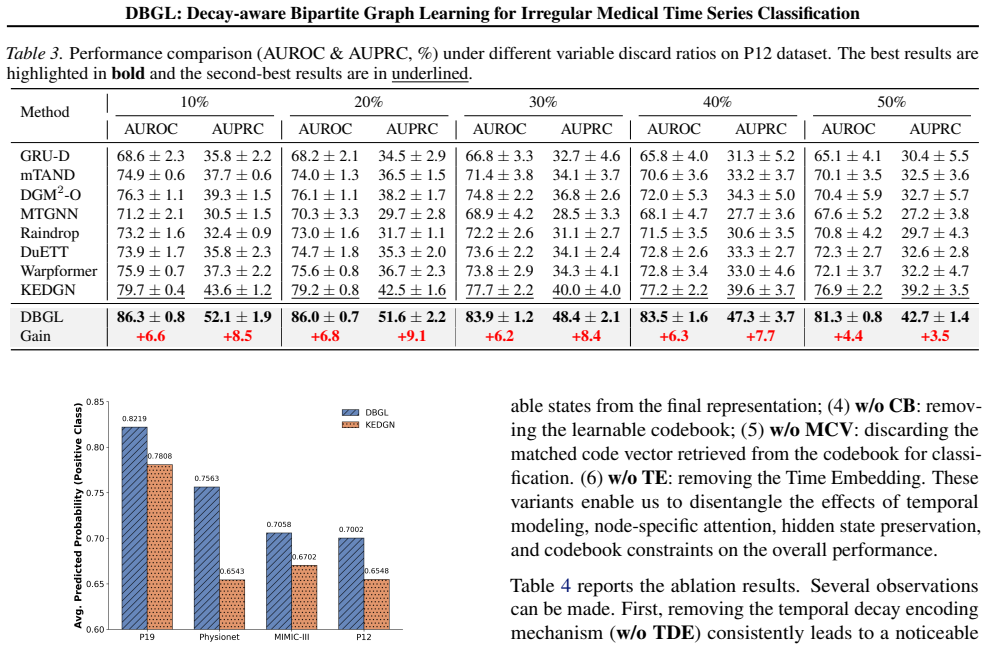
Irregular Medical Time Series play a critical role in the clinical domain to better understand the patient's condition. However, inherent irregularity arising from heterogeneous sampling rates, asynchronous observations, and variable gaps poses key challenges for reliable modeling. Existing methods often distort temporal sampling irregularity and missingness patterns while failing to capture variable decay irregularity, resulting in suboptimal representations. To address these limitations, we introduce DBGL, Decay-Aware Bipartite Graph Learning for Irregular Medical Time Series. DBGL first introduces a patient-variable bipartite graph that simultaneously captures irregular sampling patterns without artificial alignment and adaptively models variable relationships for temporal sampling irregularity modeling, enhancing representation learning. To model variable decay irregularity, DBGL designs a novel node-specific temporal decay encoding mechanism that captures each variable's decay rates based on sampling interval, yielding a more accurate and faithful representation of irregular temporal dynamics. We evaluate the performance of DBGL on four publicly available datasets, and the results show that DBGL outperforms all baselines.
Editorial analysis
A structured set of objections, weighed in public.
Referee Report
Summary. The paper introduces DBGL, a decay-aware bipartite graph learning method for irregular medical time series classification. It constructs a patient-variable bipartite graph to capture irregular sampling patterns without artificial alignment while adaptively modeling variable relationships, and proposes a node-specific temporal decay encoding mechanism that captures each variable's decay rates based on sampling intervals. The method is evaluated on four public datasets and reported to outperform all baselines.
Significance. If the empirical results hold with proper validation, DBGL offers a meaningful contribution by preserving natural irregularity in medical time series through bipartite graph modeling and explicit decay encoding, avoiding common distortions from imputation or alignment. This could improve representation learning for asynchronous clinical data and provide a template for graph-based approaches in healthcare ML.
major comments (1)
- Abstract and Experiments section: The central claim of outperformance on four public datasets is asserted without any quantitative results, baseline descriptions, metrics, statistical tests, or ablation studies visible in the provided text. This is load-bearing for the empirical superiority argument and must be addressed with concrete numbers, controls, and significance testing to allow verification.
minor comments (1)
- The abstract is overly high-level and could benefit from one or two key quantitative highlights to summarize the gains.
Simulated Author's Rebuttal
We thank the referee for the positive overall assessment of DBGL's approach to preserving irregularity in medical time series and for the constructive feedback. We address the single major comment below and will incorporate the requested changes in the revised manuscript.
read point-by-point responses
-
Referee: Abstract and Experiments section: The central claim of outperformance on four public datasets is asserted without any quantitative results, baseline descriptions, metrics, statistical tests, or ablation studies visible in the provided text. This is load-bearing for the empirical superiority argument and must be addressed with concrete numbers, controls, and significance testing to allow verification.
Authors: We agree that the abstract, being a concise summary, does not contain specific quantitative results, which limits immediate verifiability of the outperformance claim. The full manuscript's Experiments section reports results on the four public datasets with comparisons against baselines, using standard classification metrics, and includes ablation studies on the bipartite graph construction and node-specific decay encoding. To strengthen the presentation and directly address the concern, we will revise the abstract to include key quantitative highlights (e.g., relative improvements on primary metrics), name the core baselines and metrics, and explicitly reference the statistical significance testing and ablation results already present in the Experiments section. These updates will be made in the next version. revision: yes
Circularity Check
No significant circularity; empirical model proposal with no load-bearing derivation
full rationale
The paper introduces DBGL as a new architecture (patient-variable bipartite graph plus node-specific decay encoding) and reports empirical outperformance on four public datasets. No mathematical derivation, first-principles prediction, or parameter-fitting step is described that could reduce to its own inputs by construction. The abstract and description contain no equations, self-citations used as uniqueness theorems, or ansatzes smuggled via prior work. The central claims rest on standard experimental comparison rather than any self-referential chain, making the derivation self-contained.
Axiom & Free-Parameter Ledger
Lean theorems connected to this paper
-
IndisputableMonolith/Cost/FunctionalEquation.leanJcost definition and uniqueness unclear?
unclearRelation between the paper passage and the cited Recognition theorem.
DBGL designs a novel node-specific temporal decay encoding mechanism that captures each variable's decay rates based on sampling interval... γt p,n = e −λt p,n ·∆t ... ht p,n = (1−r t p,n)· ˆht−1 p,n +r t p,n ·e t p,n
-
IndisputableMonolith/Foundation/ArithmeticFromLogic.leanLogicNat orbit and embedding unclear?
unclearRelation between the paper passage and the cited Recognition theorem.
we represent medical time series as a sequence of patient-variable bipartite graphs... EdgeSAGE network to propagate and aggregate information
What do these tags mean?
- matches
- The paper's claim is directly supported by a theorem in the formal canon.
- supports
- The theorem supports part of the paper's argument, but the paper may add assumptions or extra steps.
- extends
- The paper goes beyond the formal theorem; the theorem is a base layer rather than the whole result.
- uses
- The paper appears to rely on the theorem as machinery.
- contradicts
- The paper's claim conflicts with a theorem or certificate in the canon.
- unclear
- Pith found a possible connection, but the passage is too broad, indirect, or ambiguous to say the theorem truly supports the claim.
Reference graph
Works this paper leans on
- [1]
-
[2]
Towards multi-resolution spatiotemporal graph learning for medical time series classification
Fan, W., Fei, J., Guo, D., Yi, K., Song, X., Xiang, H., Ye, H., and Li, M. Towards multi-resolution spatiotemporal graph learning for medical time series classification. In Proceedings of the ACM on Web Conference 2025, pp. 5054–5064,
2025
-
[3]
Time2Vec: Learning a Vector Representation of Time
Kazemi, S. M., Goel, R., Eghbali, S., Ramanan, J., Sa- hota, J., Thakur, S., Wu, S., Smyth, C., Poupart, P., and Brubaker, M. Time2vec: Learning a vector representation of time.arXiv preprint arXiv:1907.05321,
work page Pith review arXiv 1907
-
[4]
Kingma, D. P. Adam: A method for stochastic optimization. arXiv preprint arXiv:1412.6980,
work page internal anchor Pith review Pith/arXiv arXiv
-
[5]
Peri- ormer: Periodic transformer for seasonal and irregularly sampled time series
Ren, X., Zhao, K., Taˇskova, K., Riddle, P., and Li, L. Peri- ormer: Periodic transformer for seasonal and irregularly sampled time series. InProceedings of the 33rd ACM International Conference on Information and Knowledge Management, pp. 1973–1982,
1973
-
[6]
A., Josef, C
Reyna, M. A., Josef, C. S., Jeter, R., Shashikumar, S. P., Westover, M. B., Nemati, S., Clifford, G. D., and Sharma, A. Early prediction of sepsis from clinical data: the phys- ionet/computing in cardiology challenge 2019.Critical care medicine, 48(2):210–217,
2019
- [7]
- [8]
-
[9]
Shukla, S. N. and Marlin, B. M. Multi-time attention net- works for irregularly sampled time series.arXiv preprint arXiv:2101.10318, 2021b. Silva, I., Moody, G., Scott, D. J., Celi, L. A., and Mark, R. G. Predicting in-hospital mortality of icu patients: The physionet/computing in cardiology challenge
-
[10]
In 2012 computing in cardiology, pp. 245–248. IEEE,
2012
-
[11]
Sun, C., Hong, S., Song, M., and Li, H. A review of deep learning methods for irregularly sampled medical time series data.arXiv preprint arXiv:2010.12493,
-
[12]
Zhang, X., Zeman, M., Tsiligkaridis, T., and Zitnik, M. Graph-guided network for irregularly sampled multivari- ate time series.arXiv preprint arXiv:2110.05357,
-
[13]
Originating from the PhysioNet 2019 Sepsis Early Prediction Challenge (Reyna et al., 2020), this dataset comprises medical records of 38,803 patients
Table 6.Dataset statistics Datasets # Samples # Variables # Max Length Missing Ratio Task P19 38803 34 60 94.9% Sepsis Prediction P12 11988 36 215 88.4% Stay Predcition MIMIC-III 21107 16 292 65.5% Mortality Prediction Physionet 3997 36 215 84.9% Mortality Prediction P19 Dataset. Originating from the PhysioNet 2019 Sepsis Early Prediction Challenge (Reyna...
2019
-
[14]
The binary labels are determined based on the length of ICU stay: a negative label indicates a short stay ( ≤ 3 days), and a positive label indicates a long stay ( > 3 days)
contains 11,988 valid patient records. The binary labels are determined based on the length of ICU stay: a negative label indicates a short stay ( ≤ 3 days), and a positive label indicates a long stay ( > 3 days). Each patient’s record includes multivariate time series collected from 36 types of sensors (excluding weight measurements) during the first 48 ...
2012
-
[15]
is a widely used public medical database containing de-identified electronic health records of ICU patients at the Beth Israel Deaconess Medical Center between 2001 and
2001
-
[16]
variable decay irregularity
contains monitoring data from the first 48 hours of ICU patient admissions. This study primarily uses the in-hospital mortality prediction task. Following the same preprocessing pipeline as applied to the P12 dataset, 3,997 annotated samples were obtained. The data can be found at: https://physionet.org/content/challenge-2012/. This dataset performs patie...
2012
-
[17]
Higherλindicates faster-changing
17:returnˆy p 13 DBGL: Decay-aware Bipartite Graph Learning for Irregular Medical Time Series Classification Table 8.Variable-specific decay rates (λ) on the P19 dataset. Higherλindicates faster-changing. Variable λ Variable λ Variable λ Variable λ Heart rate 0.0759 Temp 0.1131 BaseExcess 14.0 SpO2 0.0822 SBP 0.0813 HCO3 0.0900 MAP 0.0820 DBP 0.0798 FiO2 ...
-
[18]
Table 12.Training time and memory consumption per epoch of different models. Model Time (min/epoch) Space (MiB) AUPRC (%) ODE-RNN 5.06 2582 33.7±4.1 GRU-D 1.32 796 42.7±7.2 SeFT 0.07 684 29.4±0.9 mTAND 0.05 4658 52.5±1.3 DGM2-O 0.06 684 50.4±3.2 Raindrop 0.17 4864 41.2±3.6 Warpformer 0.33 11084 43.5±2.3 KEDGN 0.44 1798 57.5±2.5 DBGL 0.52 2674 60.8±2.2 As ...
2048
-
[19]
Beyond 2 layers, gains plateau or fluctuate slightly, suggesting diminishing returns and potential over-smoothing
Increasing the depth from 1 to 2 consistently improves AUPRC across all datasets (e.g., P19: 65.0% → 66.3%), indicating that capturing higher-order patient-variable dependencies benefits positive-sample discrimination. Beyond 2 layers, gains plateau or fluctuate slightly, suggesting diminishing returns and potential over-smoothing. Based on these results,...
2048
-
[20]
Similar trends are observed on P12 and MIMIC-III, while Physionet shows a slight drop beyond 2048, suggesting diminishing returns with overly large codebooks. These results indicate a trade-off between expressiveness and overfitting: a larger codebook enables finer-grained representation of input features, improving predictive power, but excessively large...
2048
discussion (0)
Sign in with ORCID, Apple, or X to comment. Anyone can read and Pith papers without signing in.