Recognition: 2 theorem links
· Lean TheoremGravitational lensing around a Kerr-Sen black hole in plasma background
Pith reviewed 2026-05-10 16:12 UTC · model grok-4.3
The pith
Light deflection angles and circular photon orbits around a Kerr-Sen black hole change when the black hole is immersed in plasma.
A machine-rendered reading of the paper's core claim, the machinery that carries it, and where it could break.
Core claim
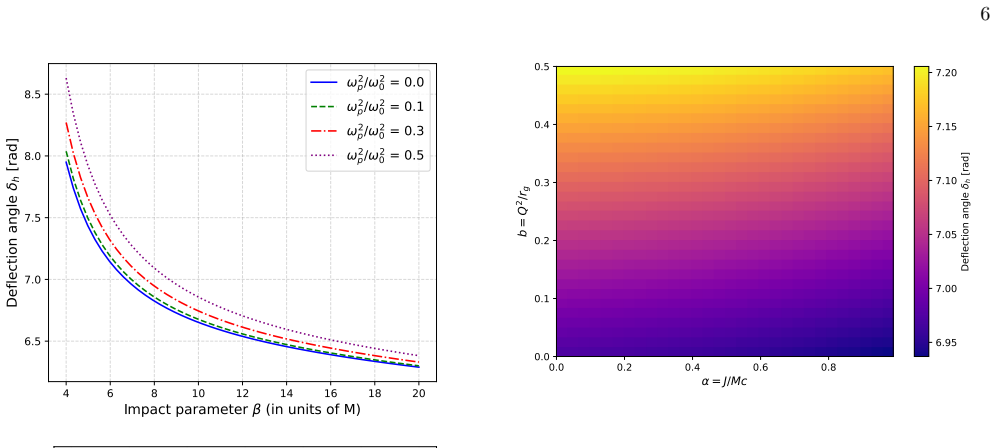
The light deflection angle is computed for massless particles around a Kerr-Sen black hole in both homogeneous and inhomogeneous plasma, with the effects of rotation and charge on bending analyzed in detail and the conditions for circular photon orbits examined, showing explicit differences from the vacuum case.
What carries the argument
The deflection angle and photon orbit conditions derived from null geodesics in the Kerr-Sen metric modified by the plasma frequency term that acts as an effective refractive index.
If this is right
- Deflection angles vary with plasma frequency, black hole spin, and charge in ways absent from the vacuum calculation.
- Stable circular photon orbits exist only for restricted ranges of the rotation and charge parameters that shift when plasma is present.
- Inhomogeneous plasma produces different bending behavior than uniform plasma for the same black hole parameters.
- The vacuum results are recovered exactly when the plasma frequency is set to zero.
Where Pith is reading between the lines
- The same plasma-modified geodesic approach could be applied to other rotating charged black hole solutions to compare lensing signatures.
- Telescopic measurements of strong lensing near candidate Kerr-Sen-like objects could constrain both the plasma environment and the black hole parameters simultaneously.
- The results connect to models of light propagation through accretion flows, where density gradients would further alter the computed deflection.
Load-bearing premise
The plasma is assumed to be magnetized, cold, and pressureless with specific chosen homogeneous and inhomogeneous density distributions.
What would settle it
A direct observation of light deflection angles around a spinning charged black hole whose dependence on plasma density and black hole parameters deviates from the calculated curves would contradict the model's predictions.
Figures


read the original abstract
We investigate the gravitational lensing of massless particles around a Kerr-Sen black hole immersed in a magnetized, cold, pressureless plasma medium. Both homogeneous and inhomogeneous plasma distributions are considered in this study to mimic realistic astrophysical environments. The light deflection angle is computed, and the effects of the black hole's rotation and charge on light bending are analyzed in detail. The conditions for the circular photon orbits are also examined in both plasma configurations. A comparison with the vacuum case (i.e. zero plasma frequency) highlights the role of plasma in modifying the light propagation, and the results obtained provide a deeper insight into plasma effects which improve our understanding of observational signatures of rotating charged black holes.
Editorial analysis
A structured set of objections, weighed in public.
Referee Report
Summary. The paper investigates gravitational lensing of massless particles around a Kerr-Sen black hole immersed in a magnetized, cold, pressureless plasma. It considers both homogeneous and inhomogeneous plasma distributions, derives expressions for the light deflection angle, examines the effects of the black hole's rotation and charge parameters on bending, determines conditions for circular photon orbits in each plasma configuration, and compares all results to the vacuum (zero plasma frequency) case.
Significance. If the derivations hold, the work provides concrete analytic and numerical insights into how a refractive plasma medium modifies null geodesics and photon orbits relative to vacuum in the Kerr-Sen spacetime. Such results are potentially useful for modeling lensing or shadow observations near charged, rotating compact objects in astrophysical environments containing plasma.
major comments (3)
- [§3.1, Eq. (18)] §3.1 and Eq. (18): the refractive index is inserted as n = sqrt(1 - ω_p²/ω²) directly into the Hamilton-Jacobi equation without an explicit derivation of the dispersion relation from the magnetized cold-plasma Maxwell equations; this step is load-bearing for all subsequent deflection integrals and orbit conditions.
- [§3.2] §3.2: the inhomogeneous plasma profile ω_p(r,θ) is introduced as an ad-hoc radial function without reference to MHD equilibrium, observational constraints, or a robustness test against alternative profiles (e.g., exponential or power-law); because this function enters the effective potential and the deflection integral (Eq. 32), the claimed plasma-induced modifications cannot be assessed for generality.
- [§5] §5: the circular-orbit conditions are obtained by setting the derivative of the effective potential to zero, but no stability analysis (second-derivative test or Lyapunov exponent) or comparison with the known vacuum Kerr-Sen photon sphere is provided; this omission weakens the claim that plasma alters orbit existence in a physically meaningful way.
minor comments (3)
- [Abstract] The abstract states that 'massless particles' are studied, yet the entire analysis concerns photons; a brief clarification of the null geodesic limit would avoid confusion.
- [Figures] Several figures (e.g., Fig. 4) plot deflection angle versus impact parameter but omit error bars or convergence checks for the numerical integration of the deflection integral.
- [§3.2] Notation for the plasma frequency ω_p is used interchangeably with ω_0 in §3.2; consistent symbols would improve readability.
Simulated Author's Rebuttal
We thank the referee for the thorough review and insightful comments on our manuscript. We have addressed each of the major comments below and will make the necessary revisions to improve the clarity and completeness of the paper.
read point-by-point responses
-
Referee: [§3.1, Eq. (18)] §3.1 and Eq. (18): the refractive index is inserted as n = sqrt(1 - ω_p²/ω²) directly into the Hamilton-Jacobi equation without an explicit derivation of the dispersion relation from the magnetized cold-plasma Maxwell equations; this step is load-bearing for all subsequent deflection integrals and orbit conditions.
Authors: The refractive index formula n = sqrt(1 - ω_p²/ω²) is the standard result for the dispersion relation in a cold plasma, obtained from the linearized Maxwell equations with the plasma frequency ω_p. Although the plasma is described as magnetized in the paper, for the high-frequency limit relevant to gravitational lensing, this approximation holds for the ordinary mode. We will add an explicit reference to the derivation from the plasma dispersion relation and clarify the assumptions in the revised manuscript. revision: yes
-
Referee: [§3.2] §3.2: the inhomogeneous plasma profile ω_p(r,θ) is introduced as an ad-hoc radial function without reference to MHD equilibrium, observational constraints, or a robustness test against alternative profiles (e.g., exponential or power-law); because this function enters the effective potential and the deflection integral (Eq. 32), the claimed plasma-induced modifications cannot be assessed for generality.
Authors: The chosen inhomogeneous plasma profile is a common choice in the literature for studying variable plasma density effects around black holes, allowing for analytic expressions. It is not derived from MHD equilibrium as the focus is on the optical properties in the Kerr-Sen metric rather than self-consistent plasma dynamics. We will expand the discussion in §3.2 to include references to similar profiles used in other works and add a note on its phenomenological nature, along with a brief robustness check using an alternative profile if feasible. revision: partial
-
Referee: [§5] §5: the circular-orbit conditions are obtained by setting the derivative of the effective potential to zero, but no stability analysis (second-derivative test or Lyapunov exponent) or comparison with the known vacuum Kerr-Sen photon sphere is provided; this omission weakens the claim that plasma alters orbit existence in a physically meaningful way.
Authors: We concur that including a stability analysis would enhance the section. In the revision, we will compute the second derivative of the effective potential at the critical points to assess stability and provide explicit comparisons of the circular orbit radii and conditions between the plasma cases and the vacuum Kerr-Sen spacetime, thereby strengthening the physical interpretation of the plasma effects. revision: yes
Circularity Check
No significant circularity; derivation proceeds from metric plus standard plasma dispersion without reduction to inputs.
full rationale
The paper starts from the established Kerr-Sen metric, inserts the standard cold-plasma refractive index n = sqrt(1 - ω_p²/ω²) with chosen ω_p(r,θ) profiles as modeling assumptions, and computes deflection angles and photon-orbit conditions via the modified Hamilton-Jacobi or geodesic equations. These steps yield explicit integrals and conditions that are not equivalent to the input profiles by construction; the vacuum limit is recovered directly by setting ω_p = 0. No load-bearing self-citations, uniqueness theorems, or fitted parameters renamed as predictions appear in the derivation chain. The results remain falsifiable against alternative plasma models or observations, satisfying the criteria for a self-contained calculation.
Axiom & Free-Parameter Ledger
Lean theorems connected to this paper
-
IndisputableMonolith/Cost/FunctionalEquation.leanwashburn_uniqueness_aczel unclear?
unclearRelation between the paper passage and the cited Recognition theorem.
The propagation condition ω(r)>ω_p(r) ... refractive index n²(r,ω)=1−ω_p²(r)/ω²(r) ... Hamiltonian H=½[g_μν p^μ p^ν + ω_p²(r)]=0
-
IndisputableMonolith/Foundation/DimensionForcing.leanreality_from_one_distinction unclear?
unclearRelation between the paper passage and the cited Recognition theorem.
deflection angle δ_h + π = 2 ∫ ... H_h²(r) ... photon sphere dH²/dr=0
What do these tags mean?
- matches
- The paper's claim is directly supported by a theorem in the formal canon.
- supports
- The theorem supports part of the paper's argument, but the paper may add assumptions or extra steps.
- extends
- The paper goes beyond the formal theorem; the theorem is a base layer rather than the whole result.
- uses
- The paper appears to rely on the theorem as machinery.
- contradicts
- The paper's claim conflicts with a theorem or certificate in the canon.
- unclear
- Pith found a possible connection, but the passage is too broad, indirect, or ambiguous to say the theorem truly supports the claim.
Forward citations
Cited by 1 Pith paper
-
Light Deflection and Greybody Bound Around a BTZ-ModMax Black Hole in Plasma Medium
Modified deflection angle and greybody bounds for BTZ-ModMax black holes in plasma reveal distinct effects from nonlinear electrodynamics and plasma dispersion compared to vacuum and charged cases.
Reference graph
Works this paper leans on
-
[1]
K. Akiyama, et al., First M87 Event Horizon Telescope Results. I. The Shadow of the Supermassive Black Hole, Astrophys. J. Lett.875, L1 (2019). doi:10.3847/2041- 8213/ab0ec7
-
[2]
A. Einstein, The foundation of the general the- ory of relativity., Annalen Phys.49(7), 769 (1916). doi:10.1002/andp.19163540702
-
[3]
Schwarzschild, ¨Uber das gravitationsfeld eines massenpunktes nach der einsteinschen theorie, Sitzungs- berichte der k¨ oniglich preussischen Akademie der Wis- senschaften pp
K. Schwarzschild, ¨Uber das gravitationsfeld eines massenpunktes nach der einsteinschen theorie, Sitzungs- berichte der k¨ oniglich preussischen Akademie der Wis- senschaften pp. 189–196 (1916)
1916
-
[4]
Palatini, On the bending of light from the Newtonian point of view, Mem
A. Palatini, On the bending of light from the Newtonian point of view, Mem. Soc. Ast. It.2, 371 (1923)
1923
-
[5]
Ohanian, The black hole as a gravitational “lens”, American Journal of Physics55(5), 428 (1987)
H.C. Ohanian, The black hole as a gravitational “lens”, American Journal of Physics55(5), 428 (1987)
1987
-
[6]
Schneider, J
P. Schneider, J. Ehlers, E. Falco, Gravitational lenses 11 springer-verlag, Berlin Inc., New York (1992)
1992
-
[7]
J.D. Bekenstein, R.H. Sanders, Gravitational lenses and unconventional gravity theories, Astrophys. J.429, 480 (1994). doi:10.1086/174337
-
[8]
S. Kopeikin, V. Makarov, Gravitational bending of light by planetary multipoles and its measurement with mi- croarcsecond astronomical interferometers, Phys. Rev. D 75, 062002 (2007). doi:10.1103/PhysRevD.75.062002
-
[9]
F.W. Dyson, A.S. Eddington, C. Davidson, A Determina- tion of the Deflection of Light by the Sun’s Gravitational Field, from Observations Made at the Total Eclipse of May 29, 1919, Phil. Trans. Roy. Soc. Lond. A220, 291 (1920). doi:10.1098/rsta.1920.0009
-
[10]
Darwin, The gravity field of a particle, Proceedings of the Royal Society of London
C.G. Darwin, The gravity field of a particle, Proceedings of the Royal Society of London. Series A. Mathematical and Physical Sciences249(1257), 180 (1959)
1959
-
[11]
Refsdal, The gravitational lens effect, Mon
S. Refsdal, The gravitational lens effect, Mon. Not. Roy. Astron. Soc.128, 295 (1964)
1964
-
[12]
S.V. Iyer, A.O. Petters, Light’s bending angle due to black holes: From the photon sphere to infinity, Gen. Rel. Grav.39, 1563 (2007). doi:10.1007/s10714-007-0481-8
-
[13]
Virbhadra, G.F
K.S. Virbhadra, G.F. Ellis, Schwarzschild black hole lens- ing, Physical Review D62(8), 084003 (2000)
2000
-
[14]
Virbhadra, Relativistic images of Schwarzschild black hole lensing, Phys
K.S. Virbhadra, Relativistic images of Schwarzschild black hole lensing, Phys. Rev. D79, 083004 (2009). doi:10.1103/PhysRevD.79.083004
-
[15]
V. Bozza, S. Capozziello, G. Iovane, G. Scarpetta, Strong field limit of black hole gravitational lensing, Gen. Rel. Grav.33, 1535 (2001). doi:10.1023/A:1012292927358
-
[16]
Bozza, Gravitational lensing in the strong field limit, Phys
V. Bozza, Gravitational lensing in the strong field limit, Phys. Rev. D66, 103001 (2002). doi:10.1103/PhysRevD.66.103001
-
[17]
S.V. Iyer, E.C. Hansen, Light’s Bending Angle in the Equatorial Plane of a Kerr Black Hole, Phys. Rev. D80, 124023 (2009). doi:10.1103/PhysRevD.80.124023
-
[19]
T. Ono, A. Ishihara, H. Asada, Deflection angle of light for an observer and source at finite distance from a ro- tating wormhole, Phys. Rev. D98(4), 044047 (2018). doi:10.1103/PhysRevD.98.044047
-
[20]
Sturm–Liouville and Carroll: at the heart of the memory effect,
H. Arakida, Light deflection and Gauss–Bonnet theorem: definition of total deflection angle and its applications, Gen. Rel. Grav.50(5), 48 (2018). doi:10.1007/s10714- 018-2368-2
-
[21]
Y. Huang, Z. Cao, Z. Lu, Generalized Gibbons-Werner method for stationary spacetimes, JCAP01, 013 (2024). doi:10.1088/1475-7516/2024/01/013
-
[22]
Synge, The Escape of Photons from Gravitationally Intense Stars, Mon
J.L. Synge, The Escape of Photons from Gravitationally Intense Stars, Mon. Not. Roy. Astron. Soc.131(3), 463 (1966). doi:10.1093/mnras/131.3.463
-
[23]
J. Ehlers, A.R. Prasanna, R.A. Breuer, Propagation of Gravitational Waves Through Pressureless Matter, Class. Quant. Grav.4, 253 (1987). doi:10.1088/0264- 9381/4/2/009
-
[24]
Perlick, Gravitational lensing from a spacetime per- spective, Living Rev
V. Perlick, Gravitational lensing from a spacetime per- spective, Living Rev. Rel.7, 9 (2004). doi:10.12942/lrr- 2004-9
-
[26]
G.S. Bisnovatyi-Kogan, O.Y. Tsupko, Gravitational lens- ing in a non-uniform plasma, Mon. Not. Roy. Astron. Soc. 404, 1790 (2010). doi:10.1111/j.1365-2966.2010.16290.x
-
[27]
Tsupko, G
O.Y. Tsupko, G. Bisnovatyi-Kogan, On gravitational lensing in the presence of a plasma, Gravitation and Cos- mology18(2), 117 (2012)
2012
-
[28]
O.Y. Tsupko, G.S. Bisnovatyi-Kogan, Gravitational lensing in plasma: Relativistic images at homoge- neous plasma, Phys. Rev. D.87(12), 124009 (2013). doi:10.1103/Phys. Rev. D. 87.124009
-
[29]
Morozova, B
V. Morozova, B. Ahmedov, A. Tursunov, 346. 513m. vol. 346, Astrophys. Space Sci p. 513 (2013)
2013
-
[30]
X. Er, S. Mao, Effects of plasma on gravitational lens- ing, Mon. Not. Roy. Astron. Soc.437(3), 2180 (2014). doi:10.1093/mnras/stt2043
-
[31]
Rogers, Frequency-dependent effects of gravitational lensing within plasma, Monthly Notices of the Royal As- tronomical Society451(1), 17 (2015)
A. Rogers, Frequency-dependent effects of gravitational lensing within plasma, Monthly Notices of the Royal As- tronomical Society451(1), 17 (2015)
2015
-
[32]
G. Crisnejo, E. Gallo, Weak lensing in a plasma medium and gravitational deflection of massive par- ticles using the Gauss-Bonnet theorem. A unified treatment, Phys. Rev. D97(12), 124016 (2018). doi:10.1103/PhysRevD.97.124016
-
[33]
F. Atamurotov, A. Abdujabbarov, W.B. Han, Effect of plasma on gravitational lensing by a Schwarzschild black hole immersed in perfect fluid dark matter, Phys. Rev. D104(8), 084015 (2021). doi:10.1103/PhysRevD.104.084015
-
[34]
F. Atamurotov, A. Abdujabbarov, J. Rayimbaev, Weak gravitational lensing Schwarzschild-MOG black hole in plasma, Eur. Phys. J. C81(2), 118 (2021). doi:10.1140/epjc/s10052-021-08919-x
-
[35]
W. Javed, I. Hussain, A. ¨Ovg¨ un, Weak deflection angle of Kazakov–Solodukhin black hole in plasma medium using Gauss–Bonnet theorem and its grey- body bonding, Eur. Phys. J. Plus137(1), 148 (2022). doi:10.1140/epjp/s13360-022-02374-7
-
[36]
S. Kala, H. Nandan, P. Sharma, Shadow and weak gravitational lensing of a rotating regular black hole in a non-minimally coupled Einstein-Yang-Mills theory in the presence of plasma, Eur. Phys. J. Plus137(4), 457 (2022). doi:10.1140/epjp/s13360-022-02634-6
-
[37]
Q. Li, Y. Zhang, Z.W. Lin, Q.Q. Li, Q. Sun, Weak gravi- tational lensing by an ESTGB black hole in the presence of a plasma, Mod. Phys. Lett. A38(04), 2350025 (2023). doi:10.1142/S0217732323500256
-
[38]
F. Atamurotov, O. Yunusov, A. Abdujabbarov, G. Mustafa, Gravitational weak lensing of hairy black hole in presence of plasma, New Astron.105, 102098 (2024). doi:10.1016/j.newast.2023.102098
-
[39]
S. Kala, H. Nandan, A. Abebe, S. Roy, Gravitational lensing around a dual-charged stringy black hole in plasma background, Eur. Phys. J. C84(10), 1089 (2024). doi:10.1140/epjc/s10052-024-13362-9
-
[40]
Y. Feng, A. Ditta, G. Mustafa, S.K. Maurya, A. Mahmood, F. Atamurotov, Non-commutative Schwarzschild black hole surrounded by Perfect fluid dark matter: Plasma lensing and thermodynam- ics analysis, Nucl. Phys. B1008, 116713 (2024). doi:10.1016/j.nuclphysb.2024.116713
-
[41]
Randomized Controlled Trials Evaluating Artificial Intelligence in Cardiovascular Care
B. Rahmatov, I. Egamberdiev, S. Murodov, J. Rayim- baev, I. Ibragimov, E. Davletov, S. Djumanov, Grav- 12 itational lensing by black holes surrounded by PFDM in Kalb-Ramond gravity in plasma medium, Phys. Dark Univ.50, 102152 (2025). doi:10.1016/j.dark.2025.102152
-
[42]
H. Hoshimov, S. Orzuev, F. Atamurotov, A. Abdujab- barov, Gravitational weak lensing and shadow radius of black holes in Horndeski gravity: Effects of plasma and scalar modifications, Annals Phys.482, 170209 (2025). doi:10.1016/j.aop.2025.170209
-
[43]
S. Kala, J. Singh, Gravitational lensing and shadow around a non-minimally coupled Horndeski black hole in plasma medium, Eur. Phys. J. C85(9), 1047 (2025). doi:10.1140/epjc/s10052-025-14793-8
-
[44]
Z. Turakhonov, F. Atamurotov, S.G. Ghosh, A. Abdu- jabbarov, Probing effects of plasma on shadow and weak gravitational lensing by regular black holes in asymptot- ically safe gravity, Phys. Dark Univ.48, 101880 (2025). doi:10.1016/j.dark.2025.101880
-
[45]
On consistency of the interacting (anti)holomorphic higher-spin sector
G. Mustafa, A. Alimova, F. Atamurotov, A.A. Ibraheem, P. Channuie, G. Bahaddinova, Testing regular black holes in the framework of asymptotically safe gravity using particle dynamics, QPOs, and shadow constraints, Eur. Phys. J. C85(7), 741 (2025). doi:10.1140/epjc/s10052- 025-14431-3
-
[46]
D.J. Gross, J.A. Harvey, E.J. Martinec, R. Rohm, The Heterotic String, Phys. Rev. Lett.54, 502 (1985). doi:10.1103/PhysRevLett.54.502
-
[47]
D. Garfinkle, G.T. Horowitz, A. Strominger, Charged black holes in string theory, Phys. Rev. D43, 3140 (1991). doi:10.1103/PhysRevD.43.3140. [Erratum: Phys.Rev.D 45, 3888 (1992)]
-
[48]
Anomalies and Fermion Zero Modes on Strings and Domain Walls,
A. Sen, Black hole solutions in heterotic string theory on a torus, Nucl. Phys. B440, 421 (1995). doi:10.1016/0550- 3213(95)00063-X
-
[49]
Uniyal, H
R. Uniyal, H. Nandan, P. Jetzer, Bending angle of light in equatorial plane of kerr–sen black hole, Physics Letters B782, 185 (2018)
2018
-
[50]
S. Roy, S. Kala, A. Singha, H. Nandan, A.K. Sen, Deflec- tion of light due to Kerr Sen black hole in heterotic string theory using material medium approach, Eur. Phys. J. C 85(7), 772 (2025). doi:10.1140/epjc/s10052-025-14459-5
-
[51]
P. Wang, S. Guo, L.F. Li, Z.F. Mai, B.F. Wu, W.H. Deng, Q.Q. Jiang, Optical images of the Kerr–Sen black hole and thin accretion disk, Eur. Phys. J. C85(7), 747 (2025). doi:10.1140/epjc/s10052-025-14441-1
-
[52]
K. Wang, X.X. Zeng, Hotspot images driven by mag- netic reconnection in Kerr–Sen black hole, Eur. Phys. J. C86(1), 41 (2026). doi:10.1140/epjc/s10052-025-15257-9
-
[53]
S. Kumar Sahoo, I. Banerjee, Deciphering signatures of Kerr-Sen black holes in presence of plasma from the Event Horizon Telescope data, JCAP10, 100 (2025). doi:10.1088/1475-7516/2025/10/100
-
[54]
Siahaan, Destroying kerr-sen black holes, Physical Review D93(6), 064028 (2016)
H.M. Siahaan, Destroying kerr-sen black holes, Physical Review D93(6), 064028 (2016)
2016
-
[55]
Landau, E.M
L. Landau, E.M. Lifshitz. The classical theory of fields: Volume 2 (1951)
1951
-
[56]
G.S. Bisnovatyi-Kogan, O.Y. Tsupko, Gravitational Lensing in Presence of Plasma: Strong Lens Systems, Black Hole Lensing and Shadow, Universe3(3), 57 (2017). doi:10.3390/universe3030057
-
[57]
C.A. Benavides-Gallego, A.A. Abdujabbarov, C. Bambi, Gravitational lensing for a boosted Kerr black hole in the presence of plasma, Eur. Phys. J. C78(9), 694 (2018). doi:10.1140/epjc/s10052-018-6170-9
-
[58]
B. Turimov, B. Ahmedov, A. Abdujabbarov, C. Bambi, Gravitational lensing by a magnetized compact object in the presence of plasma, Int. J. Mod. Phys. D28(16), 2040013 (2019). doi:10.1142/S0218271820400131
-
[59]
Yan, Influence of a plasma on the observational signa- ture of a high-spin Kerr black hole, Phys
H. Yan, Influence of a plasma on the observational signa- ture of a high-spin Kerr black hole, Phys. Rev. D99(8), 084050 (2019). doi:10.1103/PhysRevD.99.084050
-
[60]
D., Akiyama, K., Blackburn, L., et al
M.D. Johnson, et al., Key Science Goals for the Next- Generation Event Horizon Telescope, Galaxies11(3), 61 (2023). doi:10.3390/galaxies11030061
-
[61]
R. Genzel, F. Eisenhauer, S. Gillessen, Experi- mental studies of black holes: status and future prospects, Astron. Astrophys. Rev.32(1), 3 (2024). doi:10.1007/s00159-024-00154-z
discussion (0)
Sign in with ORCID, Apple, or X to comment. Anyone can read and Pith papers without signing in.